
The Real Cost of Building a B2B Sales Tech Stack in 2026: A Data-Driven Breakdown

Here's a number that should terrify every VP of Sales: sellers who feel overwhelmed by their tech stack are 43% less likely to hit quota. Not slightly less likely. Nearly half as likely.
Yet somehow, the average B2B sales organization keeps adding tools. More point solutions. More logins. More invoices. The 2025 B2B sales benchmarks show organizations now average 8.3 tools per SDR at roughly $187 per rep per month — and that's the conservative estimate.
We dug into the actual pricing of every major sales tool category to answer a question nobody wants to ask out loud: What does it really cost to equip an SDR team in 2026?
The answer isn't pretty.
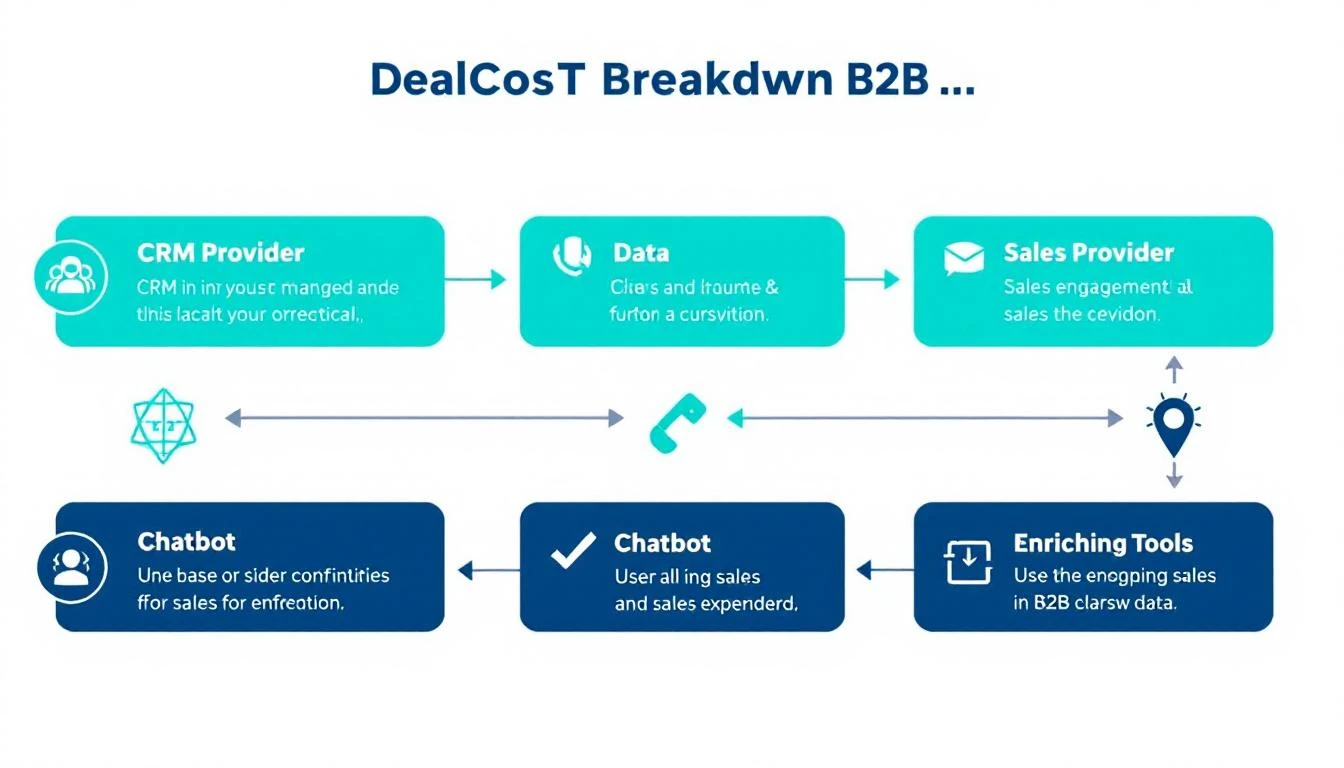
The 7 Tool Categories Every SDR Team Pays For
Before we get to the numbers, let's map the categories. A fully equipped outbound SDR team typically needs tools across seven distinct functions:
- CRM — The system of record (Salesforce, HubSpot)
- Data Provider — Contact and company information (ZoomInfo, Apollo, Cognism)
- Sales Engagement — Email sequences, cadences, multi-channel orchestration (Outreach, SalesLoft)
- Visitor Identification — Website deanonymization and intent signals (Warmly, Clearbit, 6sense)
- Dialer — Power/parallel dialing for phone outreach (Orum, Nooks, Kixie)
- Enrichment — Data append, job change tracking, technographic data (Clearbit, Clay, Lusha)
- Conversation Intelligence — Call recording, coaching, deal insights (Gong, Chorus)
Some teams add an eighth: chatbot or live chat for inbound conversion. Others add a ninth: ABM/advertising for targeted display campaigns. The sprawl adds up fast.
What Each Category Actually Costs
We pulled publicly available pricing data, G2 reviews, analyst reports, and vendor disclosures to build a realistic picture of what each tool category costs per seat, per year. Where vendors hide pricing (looking at you, ZoomInfo and 6sense), we used reported ranges from customer reviews and industry benchmarks.
1. CRM: $0–$1,800/user/year
| Tool | Annual Cost Per User | Notes |
|---|---|---|
| HubSpot (Free) | $0 | Limited features, fine for tiny teams |
| HubSpot Sales Hub Pro | $1,080/yr ($90/mo) | Most common SMB choice |
| Salesforce Sales Cloud Pro | $1,200/yr ($100/mo) | Enterprise standard |
| Salesforce Enterprise | $1,980/yr ($165/mo) | With forecasting + pipeline inspection |
| Pipedrive Advanced | $396/yr ($33/mo) | Budget-friendly alternative |
Typical mid-market spend: $1,000–$1,500/user/year
2. Data Provider: $600–$15,000+/user/year
This is where the sticker shock hits. Data is the most expensive variable in any sales stack.
| Tool | Annual Cost Per User | Notes |
|---|---|---|
| Apollo.io Basic | $588/yr ($49/mo) | Limited credits, common starter |
| Apollo.io Professional | $1,188/yr ($99/mo) | Uncapped emails, better data |
| Cognism | $1,500–$3,000/yr (est.) | European data strength |
| Lusha Pro | $432/yr ($36/mo) | Phone number focused |
| ZoomInfo Professional | $14,995+/yr (platform) | Per-seat pricing unclear, annual contracts |
| ZoomInfo Advanced | $24,995+/yr (platform) | With intent data |
Typical mid-market spend: $1,200–$5,000/user/year (varies wildly by vendor)
3. Sales Engagement: $1,200–$1,800/user/year
| Tool | Annual Cost Per User | Notes |
|---|---|---|
| Outreach Standard | $1,200–$1,800/yr (est.) | Custom pricing, annual only |
| SalesLoft Advanced | $1,500–$1,800/yr (est.) | Now owned by Vista Equity |
| Apollo.io (built-in) | Included in data plan | Basic sequencing |
| Instantly | $360/yr ($30/mo) | Email-only, volume play |
| Reply.io | $708/yr ($59/mo) | Multi-channel |
Typical mid-market spend: $1,200–$1,800/user/year for dedicated engagement platforms
4. Visitor Identification: $4,200–$100,000+/year
This category has the widest pricing range in all of B2B sales tech. It's also where teams often get the least value for their spend.
| Tool | Annual Cost (Platform) | Notes |
|---|---|---|
| Warmly | $8,400–$18,000/yr ($700–$1,500/mo) | SMB-focused |
| Clearbit | $12,000–$50,000+/yr | Now part of HubSpot |
| 6sense Growth | $25,000–$60,000+/yr | Enterprise ABM platform |
| 6sense Enterprise | $60,000–$100,000+/yr | Full suite |
| Demandbase | $30,000–$80,000+/yr | Enterprise only |
| RB2B | $4,200/yr ($350/mo) | Startup, person-level ID |
Typical mid-market spend: $8,000–$30,000/year (platform-level, not per seat)
5. Dialer: $600–$1,800/user/year
| Tool | Annual Cost Per User | Notes |
|---|---|---|
| Orum | $1,200–$1,800/yr (est.) | AI parallel dialer |
| Nooks | $1,200–$1,500/yr (est.) | Virtual sales floor + dialer |
| Kixie | $420/yr ($35/mo) | Click-to-call, basic |
| PhoneBurner | $1,668/yr ($139/mo) | Power dialer |
Typical mid-market spend: $1,000–$1,500/user/year
6. Enrichment: $1,200–$12,000/year
| Tool | Annual Cost | Notes |
|---|---|---|
| Clay | $4,788–$9,588/yr ($399–$799/mo) | Waterfall enrichment, usage-based |
| Clearbit (standalone) | $12,000–$50,000+/yr | Enterprise enrichment |
| Lusha (enrichment) | $432–$1,068/yr | Phone + email append |
| People Data Labs | Usage-based | API pricing |
Typical mid-market spend: $3,000–$8,000/year (platform-level)
7. Conversation Intelligence: $1,200–$3,600/user/year
| Tool | Annual Cost Per User | Notes |
|---|---|---|
| Gong | $1,200–$3,600/yr (est.) | Market leader, custom pricing |
| Chorus (ZoomInfo) | Bundled with ZoomInfo | Hard to price standalone |
| Fireflies.ai Pro | $228/yr ($19/mo) | AI meeting notes |
| Clari Copilot | $1,200+/yr (est.) | Revenue intelligence |
Typical mid-market spend: $1,200–$2,400/user/year
The Total: What a 5-Person SDR Team Actually Pays
Let's put it all together. Here's what a typical B2B company with 5 SDRs spends across three common stack configurations:
Scenario A: Budget Stack (Startup, Series A)
| Category | Tool | Annual Cost |
|---|---|---|
| CRM | HubSpot Sales Hub Starter | $900 (2 seats free + 3 paid) |
| Data + Engagement | Apollo.io Professional | $5,940 (5 × $99/mo) |
| Visitor ID | RB2B | $4,200 |
| Dialer | Kixie | $2,100 (5 × $35/mo) |
| Enrichment | Included in Apollo | $0 |
| Conversation Intel | Fireflies.ai | $1,140 (5 × $19/mo) |
| Total | $14,280/year | |
| Per SDR | $2,856/year |
Scenario B: Mid-Market Stack (Series B/C, 50-200 employees)
| Category | Tool | Annual Cost |
|---|---|---|
| CRM | Salesforce Pro | $6,000 (5 × $100/mo) |
| Data | ZoomInfo Professional | $14,995 (platform) |
| Engagement | Outreach | $7,500 (5 × $125/mo est.) |
| Visitor ID | Warmly | $10,800 ($900/mo) |
| Dialer | Orum | $7,500 (5 × $125/mo est.) |
| Enrichment | Clay | $5,988 ($499/mo) |
| Conversation Intel | Gong | $9,000 (5 × $150/mo est.) |
| Total | $61,783/year | |
| Per SDR | $12,357/year |
Scenario C: Enterprise Stack (500+ employees)
| Category | Tool | Annual Cost |
|---|---|---|
| CRM | Salesforce Enterprise | $9,900 (5 × $165/mo) |
| Data | ZoomInfo Advanced | $24,995 (platform) |
| Engagement | Outreach + SalesLoft | $12,000 (some teams run both) |
| Visitor ID | 6sense Growth | $40,000 (platform) |
| Dialer | Orum Enterprise | $10,000 (5 seats est.) |
| Enrichment | Clearbit + Clay | $18,000 |
| Conversation Intel | Gong Enterprise | $15,000 (5 seats est.) |
| ABM/Ads | Demandbase | $30,000 |
| Total | $159,895/year | |
| Per SDR | $31,979/year |
Read that again. An enterprise sales team can easily spend $32,000 per SDR per year on software alone — before salary, benefits, or management overhead.
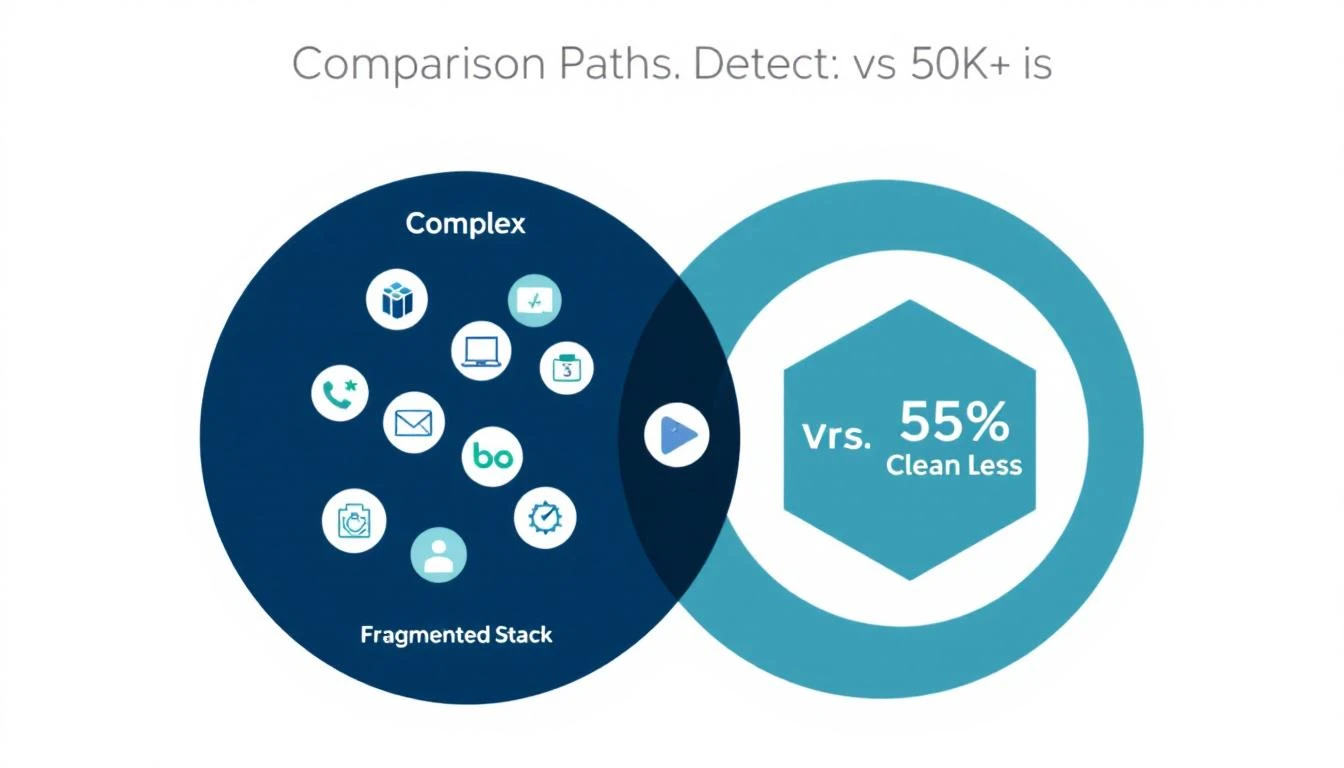
The Hidden Costs Nobody Talks About
The tool licenses are just the invoice line items. The real costs are harder to see:
Integration Tax
Every tool needs to connect to every other tool. CRM syncs with engagement. Engagement syncs with data. Data syncs with enrichment. That's a combinatorial explosion of API connections, each one a potential failure point.
Most mid-market teams spend 10-15 hours per month managing integrations, troubleshooting sync failures, and deduplicating records across platforms. At a RevOps salary, that's $3,000-$5,000/year in hidden labor.
Context-Switching Cost
Here's the stat that should change how you think about your stack: SDRs spend only 28% of their time actually selling. The rest? Logging activities, switching between tools, finding the right data, and formatting reports.
With 8+ tools, an SDR might tab-switch hundreds of times per day. Each switch costs 23 minutes of refocused attention (according to UC Irvine research on task switching). The cumulative productivity loss is staggering.
Ramp Time Multiplication
Average SDR ramp time is already 3.1-3.2 months. But that assumes they're learning one workflow. When you add 8 separate tools — each with its own UI, its own logic, its own quirks — ramp time quietly extends to 4-5 months.
And with average SDR tenure at just 14-16 months, that means you get roughly 9-10 months of productive output before you start over. You're paying ramp costs every single year for each seat.
Vendor Lock-In and Annual Contracts
Most enterprise sales tools require annual contracts with 30-60 day cancellation windows. If a tool isn't working after month 3, you're paying for 9 more months of shelfware. ZoomInfo and 6sense are notorious for this — teams report paying for features they never implemented.
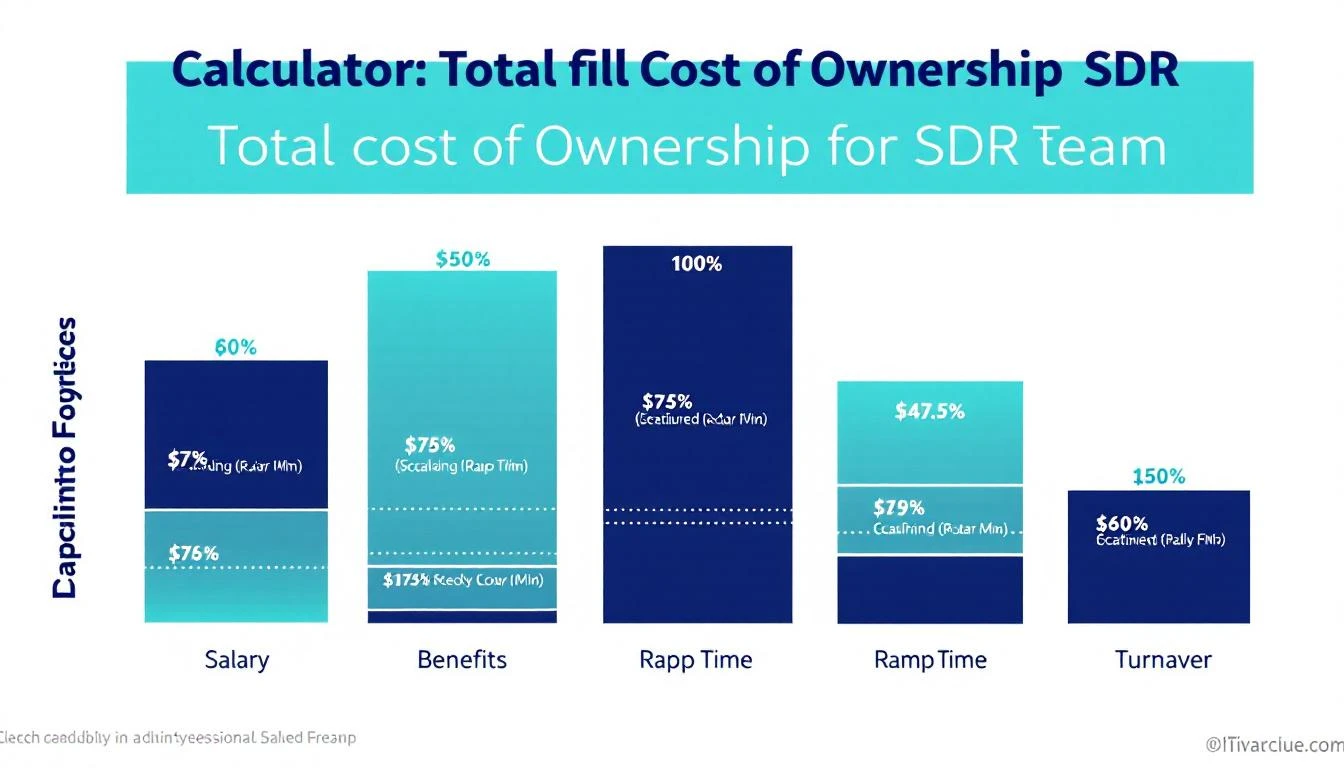
The Real Fully Loaded Cost Per SDR
Let's combine tool costs with the human costs from industry benchmarks to see the full picture:
| Cost Component | Conservative | Mid-Range | Enterprise |
|---|---|---|---|
| Cash compensation (base + variable) | $75,000 | $85,000 | $95,000 |
| Benefits and payroll taxes (28%) | $21,000 | $23,800 | $26,600 |
| Tech stack (from scenarios above) | $2,856 | $12,357 | $31,979 |
| Management + enablement allocation | $10,000 | $18,000 | $25,000 |
| Recruiting + ramp + turnover (annualized) | $10,000 | $20,000 | $30,000 |
| Fully Loaded Annual Cost Per SDR | $118,856 | $159,157 | $208,579 |
The turnover line is the killer. Replacing a single SDR costs an estimated $100,000+ when you factor in recruiting fees, lost pipeline, onboarding time, and management bandwidth. With average tenure at 14-16 months, you're essentially baking $35,000-$50,000 in annual churn cost into every SDR seat.
The Consolidation Opportunity
Here's what the data tells us: most of the cost isn't in individual tools — it's in having too many of them.
The hidden costs (integration tax, context-switching, extended ramp, shelfware) dwarf the visible ones. A team running 8 tools at $8,000/year each isn't actually paying $64,000 — it's paying $64,000 + $15,000 in integration labor + $30,000 in lost productivity + $10,000 in extended ramp. The real cost is closer to $119,000.
What if you could collapse 5-6 of those tools into one?
That's the thesis behind platform consolidation in sales tech. Instead of a CRM + separate data provider + separate engagement platform + separate visitor ID + separate dialer + separate enrichment, you run a unified system that handles the full workflow:
- Signal capture (visitor ID + intent data + job changes) → no separate 6sense or Warmly subscription
- Contact enrichment (email + phone + firmographics) → no separate ZoomInfo or Clearbit contract
- Sequence orchestration (email + phone + LinkedIn) → no separate Outreach or SalesLoft license
- Dialer (click-to-call with AI prep) → no separate Orum subscription
- Daily playbook (prioritized actions, not raw data) → no separate dashboard to interpret
The math gets compelling fast. A mid-market team paying $61,783/year across 7 tools could consolidate to a unified platform at $15,000-$25,000/year — a 60-75% reduction in tool spend, plus the elimination of integration tax, faster ramp, and less context-switching.
The Decision Framework: Should You Consolidate?
Not every team should consolidate tomorrow. Here's how to think about it:
Consolidate If...
- You have 6+ tools and your SDRs complain about tab-switching
- Your RevOps team spends more than 10 hours/month on integration maintenance
- New SDR ramp takes more than 3 months due to tool complexity
- You're paying for features you don't use across multiple platforms
- Your cost per held meeting is above $500
Stay Fragmented If...
- You have a dedicated RevOps team that manages integrations well
- You've negotiated strong enterprise discounts with existing vendors
- Your team is 20+ SDRs and switching costs are prohibitive in the short term
- Specific tools are deeply embedded in your workflow with no alternative
The Audit Checklist
Run this audit quarterly to find consolidation opportunities:
- List every tool with per-seat cost and actual monthly active users
- Identify overlap — are 2+ tools providing the same data or function?
- Calculate integration hours — how much RevOps time goes to keeping tools in sync?
- Survey your SDRs — which tools do they actually open daily vs. never?
- Measure cost per held meeting — the only metric that connects tool spend to pipeline
What the Smartest Teams Are Doing in 2026
The trend is unmistakable. Only 19% of companies increased SDR headcount in 2025 — the lowest growth rate across all sales functions (SaaStr). Teams aren't adding reps. They're making existing reps more productive by reducing the cognitive overhead of a fragmented stack.
The winners in 2026 are doing three things differently:
1. Choosing platforms over point solutions. Instead of best-of-breed for every function, they pick one platform that covers 70-80% of their needs and add 1-2 specialized tools for the rest. The integration savings alone pay for the trade-off.
2. Measuring cost per held meeting, not cost per tool. A $50,000/year platform that delivers 200 held meetings ($250 each) beats a $20,000 stack that only delivers 60 ($333 each). Total cost of ownership matters more than line-item pricing.
3. Prioritizing speed to lead over data volume. The MIT/InsideSales study still holds: 35-50% of sales go to the vendor that responds first. A tool that tells you WHO is interesting but useless. A tool that tells you WHO + WHAT TO DO + WHEN is worth 10x more.
The Bottom Line
The average B2B sales team is spending $47,000-$156,000/year on tools for a 5-person SDR team — and getting maybe 60% of the value they're paying for. The other 40% leaks out through integration failures, context-switching, shelfware, and extended ramp times.
The question isn't "which tools should I buy?" It's "how few tools can I run while capturing 90% of the functionality?"
Every tool you eliminate isn't just a canceled invoice. It's one fewer login for your SDRs to remember, one fewer integration to maintain, one fewer vendor to negotiate with, and one less thing standing between your rep and a booked meeting.
The most expensive sales tech stack is the one your team doesn't use.
Ready to Consolidate Your Sales Tech Stack?
MarketBetter combines visitor identification, intent signals, email sequences, smart dialer, AI chatbot, and a daily SDR playbook into one platform — starting at $99/user/month.
Stop paying for 8 tools. Start booking meetings with one.