
Why Your Sales Team Still Calls Leads 3 Days Late — And How to Fix It Today [2026]

A prospect visits your pricing page. Downloads your whitepaper. Fills out a demo request form. They're hot. They're interested. They're ready to talk.
Your SDR calls them back three days later.
By then? The prospect already had two demos with competitors, forgot why they filled out your form, and moved on. You lost the deal before your rep even picked up the phone.
This isn't a hypothetical. It's the reality for the majority of B2B sales teams — and the data behind it is brutal.
The Speed-to-Lead Crisis: What the Data Actually Says
Let's start with the number that should keep every VP of Sales up at night:
The average B2B lead response time is 47 hours.
That's not a typo. Nearly two full business days pass between a prospect raising their hand and a rep making contact. And it gets worse from there.
The Harvard Business Review Study
The most cited research on this topic comes from a Harvard Business Review study that analyzed 2.24 million sales leads across hundreds of companies. The findings:
- Companies that responded within 1 hour were 7x more likely to qualify the lead than those that waited even 60 minutes longer
- Companies that waited 24+ hours were 60x less likely to qualify the lead compared to first-hour responders
- The odds of qualifying a lead drop 400% when response time goes from 5 to 10 minutes
Read that last one again. Five extra minutes. Four hundred percent worse odds.
The MIT/InsideSales.com Study
A joint study from MIT and InsideSales.com went even deeper, analyzing over 15,000 leads and 100,000 call attempts:
- Leads contacted within 5 minutes are 21x more likely to qualify than those contacted after 30 minutes
- The odds of even making contact with a lead drop 100x between 5 minutes and 30 minutes
- After 20 hours, every additional dial actually hurts your ability to make contact
The conversion decay curve isn't gradual — it's a cliff. You either catch the lead in the first five minutes, or you're fighting an uphill battle that gets steeper by the minute.
The Close Rate Numbers
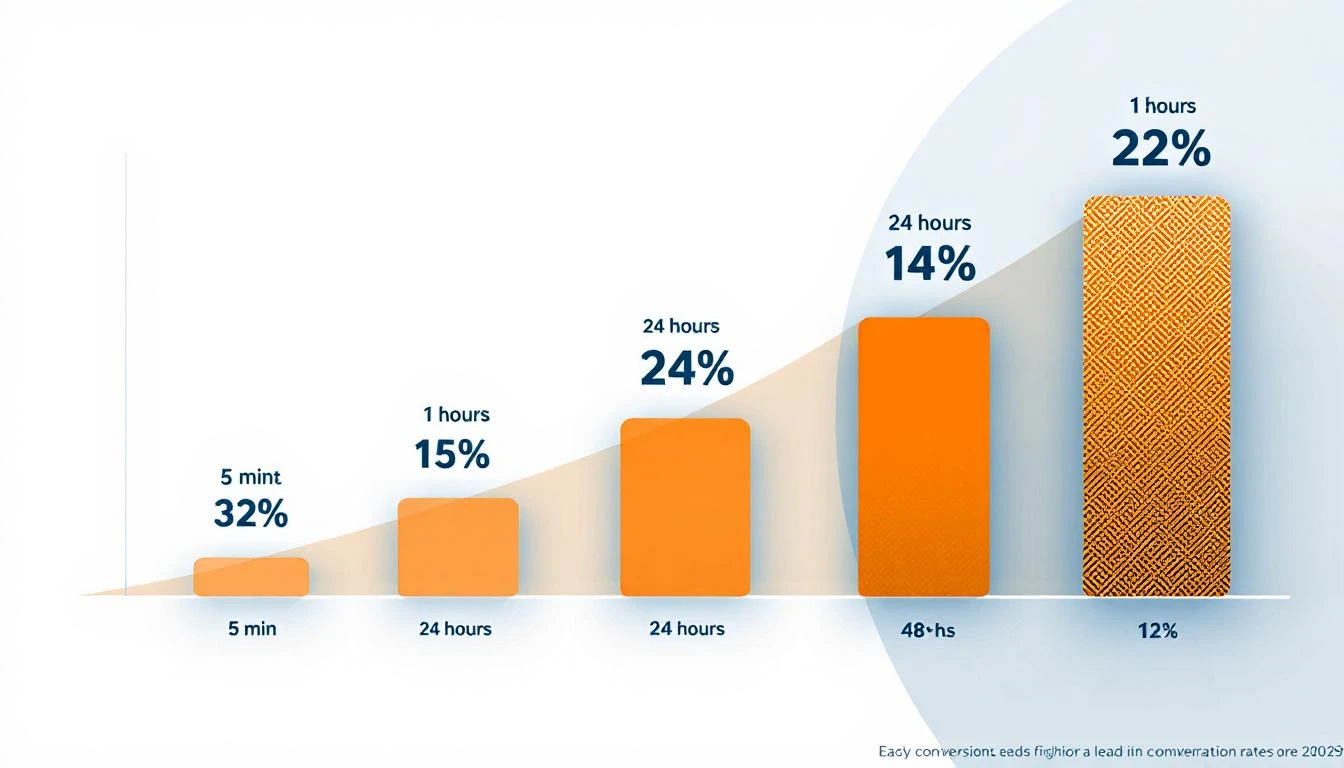
When you look at actual close rates by response time, the picture is even clearer:
| Response Time | Close Rate | Multiplier |
|---|---|---|
| Under 5 minutes | 32% | Baseline |
| Under 1 hour | 24% | 0.75x |
| Under 24 hours | 15% | 0.47x |
| Over 24 hours | 12% | 0.38x |
Responding in under 5 minutes gives you a 2.6x higher close rate than waiting a day. And most teams are waiting two days.
The Real Cost: What 47-Hour Response Times Are Costing You
Let's do some math that will make your CFO flinch.
78% of buyers purchase from the company that responds first — not the one with the best product, the lowest price, or the strongest brand. The first responder wins.
If your team generates 100 inbound leads per month and your average deal size is $25,000:
- At 5-minute response: 32% close rate = 32 deals = $800,000/month
- At 47-hour response (industry average): ~12% close rate = 12 deals = $300,000/month
That's $500,000 per month left on the table. Not because your product is wrong. Not because your pricing is off. Because your reps called three days late.
And the compounding effects go further:
- 73% of leads are never contacted at all — they fall through the cracks entirely
- 44% of salespeople give up after one follow-up, when 80% of deals require 5-12 touchpoints
- Deals that drag past 6 months have a 60% failure rate, per SiriusDecisions research — and slow initial response extends every subsequent stage
The follow-up gap isn't just a conversion problem. It's a pipeline problem, a revenue problem, and an efficiency problem rolled into one.
Why It Happens: The Anatomy of a 3-Day Delay
If the data is this clear, why do teams still respond in 47 hours? Because the problem isn't awareness — it's workflow.
Here's what actually happens when a lead comes in at most B2B companies:
Stage 1: The Signal Gets Lost (0-2 hours)
A prospect fills out a form, visits the pricing page, or replies to a cold email. The notification goes to a shared inbox, a Slack channel, or a CRM queue. Nobody owns it yet.
Meanwhile, the intent signal that triggered the action — the pricing page visit, the email open, the LinkedIn profile view — goes completely unnoticed because it's trapped in a separate tool.
Stage 2: Manual Routing Burns Time (2-12 hours)
A manager sees the lead in the morning standup. They assign it to an SDR based on territory, round-robin, or whoever seems least busy. The SDR gets a task in their CRM.
But the SDR already has 47 other tasks. They're mid-call-block. They'll get to it after lunch. Or tomorrow.
Stage 3: Research and Scripting (12-48 hours)
The SDR finally picks up the lead. Now they need to:
- Look up the company on LinkedIn
- Check the CRM for prior engagement
- Figure out what the prospect actually did (which form? which page?)
- Write a personalized email
- Find the right phone number
- Decide whether to call, email, or send a LinkedIn message
Each step requires switching between 3-5 different tools. We've written about this before — the average SDR juggles 20+ tabs just to work a single lead.
Stage 4: The Attempt (48-72 hours)
The SDR finally calls. The prospect doesn't pick up. The SDR sends a generic email. No response. They move on to the next lead.
Total elapsed time: 3 days. Total meaningful touches: 1-2. Result: Lost deal.
The problem isn't lazy reps. It's a broken workflow that forces humans to do things machines should handle — routing, research, scripting, multi-channel coordination — before any actual selling happens.
The Fix: Automated Follow-Up Workflows That Fire in Minutes, Not Days
The solution isn't "tell your SDRs to be faster." They're already buried. The solution is removing the manual steps between signal detection and follow-up action.
Here's what a modern automated follow-up workflow looks like:
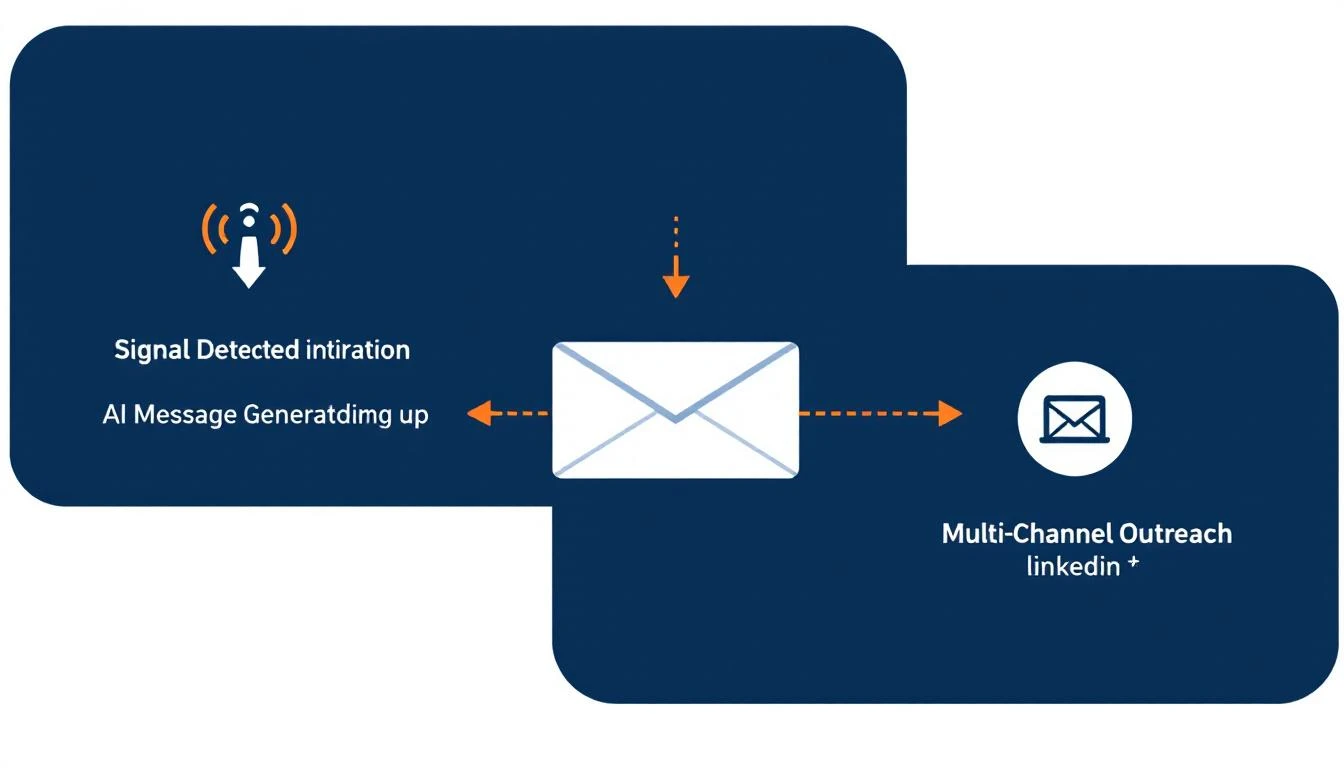
1. Detect the Signal Automatically
Instead of waiting for a human to notice a form fill, the system continuously monitors for buyer signals:
- Website visits (especially high-intent pages like pricing, case studies, integrations)
- Email opens, clicks, and replies
- LinkedIn profile views and engagement
- Form submissions and content downloads
- Return visits from previously identified accounts
The system scans for these signals on a rolling window — catching everything from a form fill five minutes ago to a pricing page visit from three days ago that nobody followed up on.
2. Generate the Right Message Instantly
This is where most "automation" tools fail. They send a canned template that screams "you're getting a robot email." Nobody responds.
Modern workflow automation uses AI to generate contextual follow-up messages based on:
- What the prospect did — "I noticed you were looking at our enterprise pricing" hits different than "Hope this email finds you well"
- Who they are — Role, company size, industry, prior engagement history
- What matters to them — Mapping their activity to relevant case studies, features, or ROI data
The result is a personalized message that reads like a human wrote it — because an AI understood the context and generated it in seconds, not the 30 minutes it takes an SDR to manually research and draft.
3. Fire Across Every Channel Simultaneously
A single-channel follow-up is a coinflip. Multi-channel follow-up is a strategy.
When a signal triggers a workflow, the best systems coordinate across:
- Email — Personalized message referencing their specific activity
- Phone — Immediate dial with an AI-generated call script tailored to the prospect's context
- LinkedIn — Connection request or InMail through integrated campaign tools
All three fire within minutes of the signal, not days. The SDR doesn't have to think about channel strategy — the workflow handles it.
4. Track Everything, Learn, Repeat
Every follow-up attempt, every response, every outcome gets logged automatically. No more "did anyone call this lead?" conversations in Slack. No more leads falling through cracks between tools.
The execution history gives managers visibility into:
- Which signals convert best
- Which message types get responses
- Where in the workflow leads stall
- Which reps need coaching vs. which workflows need tuning
This closes the feedback loop that most sales teams never build — because they're too busy manually logging activities in Salesforce.
What Changes When You Fix Speed-to-Lead
The impact isn't theoretical. Here's what the shift looks like in practice:
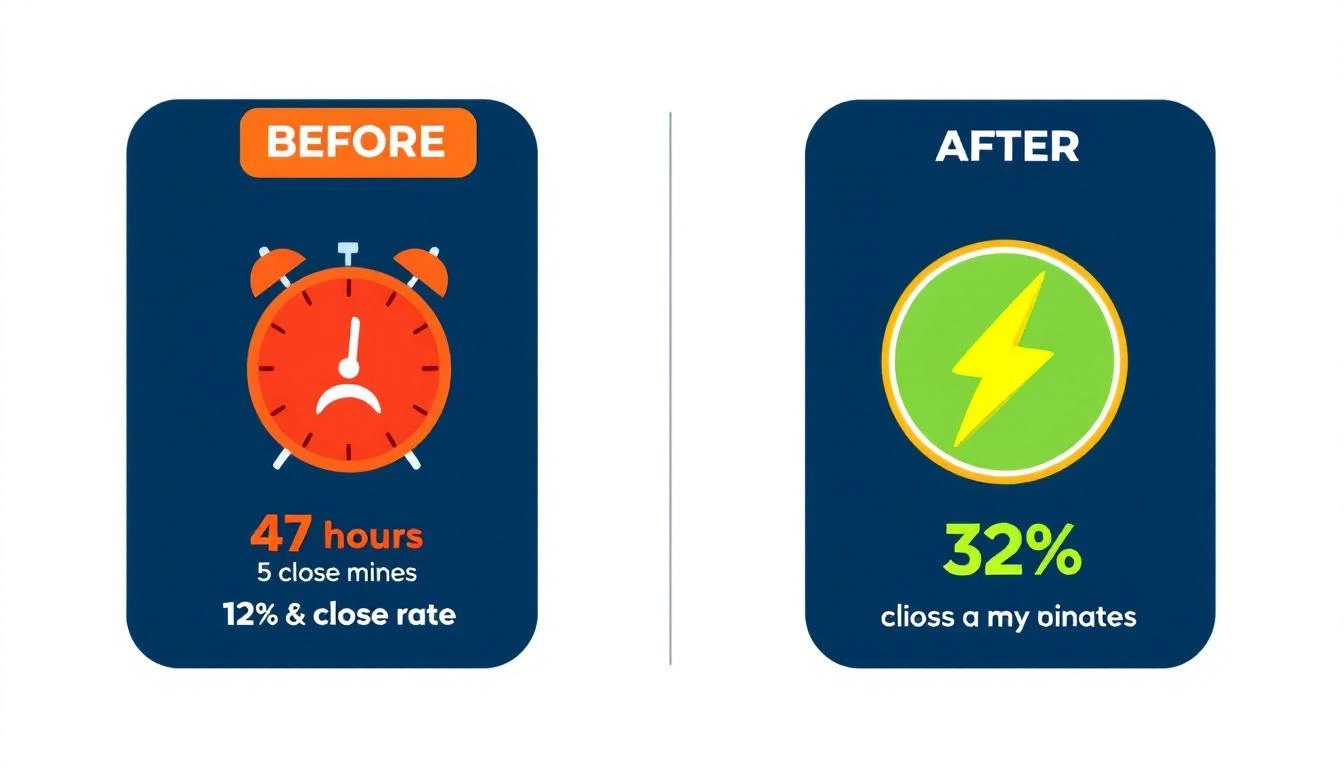
Before (manual workflow):
- Average response time: 47 hours
- Lead contact rate: 27%
- Close rate: 12%
- SDR spends 65% of time on non-selling activities
After (automated follow-up workflows):
- Average response time: Under 5 minutes
- Lead contact rate: 90%+
- Close rate: 32%
- SDR focuses on conversations, not research and routing
The math works because you're not asking humans to be faster. You're removing the bottlenecks that made them slow:
- No more manual routing — leads go to the right rep automatically
- No more research lag — AI generates context and scripts instantly
- No more channel switching — email, phone, and LinkedIn fire from one workflow
- No more forgotten leads — the system catches every signal, even ones from days ago that slipped through
The 5-Minute Window Is Non-Negotiable
Here's the bottom line: you have 5 minutes.
Not 5 hours. Not "by end of day." Not "we'll get to it in tomorrow's standup." Five minutes.
Every minute after that, your conversion rate decays. After 30 minutes, you've lost 21x your qualifying potential. After an hour, you're 7x behind the first responder. After 24 hours, you're competing against companies that already had discovery calls with your prospect.
The companies winning right now aren't winning because they have better products or bigger teams. They're winning because they built systems that turn signals into action in minutes instead of days.
Your sales cadence shouldn't start when an SDR gets around to it. It should start the moment a buyer raises their hand.
The technology exists today. The data has been clear for over a decade. The only question is whether you'll fix it before your competitors do.
Tired of watching leads go cold? MarketBetter detects buyer signals, generates personalized follow-up, and fires multi-channel outreach — all before your competitor's SDR finishes their coffee. See it in action →