Breakout (getbreakout.ai) has carved out a niche as an "inbound AI SDR" — a chatbot that engages website visitors, qualifies them, and books meetings. It's clean, fast to set up, and has solid reviews.
But at $1,500–$2,500/month starting prices with no public pricing details, Breakout isn't the right fit for every team. And if you need more than just a chatbot — outbound, dialer, email sequences, or a full SDR workflow — Breakout's focused approach leaves gaps you'll need to fill with additional tools.
Here are 7 alternatives worth evaluating, depending on what you actually need.
Best for: Teams that want a complete SDR platform, not just a chatbot
Why it's the #1 Breakout alternative:
MarketBetter doesn't just replicate what Breakout does — it replaces your entire SDR tool stack. Where Breakout handles inbound chat, MarketBetter handles chat + email + phone + LinkedIn + visitor intelligence, all orchestrated by AI into a daily SDR playbook.
Built-in smart dialer — Breakout has no calling capability. Your SDRs still need Orum, Nooks, or similar ($150+/seat/mo). MarketBetter includes a full dialer with call recording and AI coaching.
Email automation — AI-generated, hyper-personalized sequences. Not just "warm email outbound" as an add-on.
Daily SDR playbook — Every morning, your reps see exactly who to call, email, and follow up with — prioritized by AI. Breakout just shows chat conversations.
Qualified is Breakout's most direct competitor — an AI-powered conversational platform that engages website visitors and routes qualified leads to sales reps. They're more enterprise-focused, with deep Salesforce integration and account-based routing.
Best for: Current Drift customers weighing their options
Drift pioneered conversational marketing but is now being sunset by Clari + Salesloft after a series of acquisitions. It's still functional, but no longer receiving active development. Existing customers should plan their migration now.
Many teams searching for "Breakout alternatives" are also evaluating what to do about Drift. If you're currently on Drift, you should migrate — not to Breakout, but to a platform that replaces everything Drift did plus more.
Best for: Real-time visitor engagement via chat + enrichment
Warmly sits between Breakout and enterprise tools like Qualified — offering visitor identification, AI chatbot engagement, and orchestration at mid-market pricing. Their "data waterfall" approach (20+ enrichment providers) delivers strong company-level identification.
Best for: Teams needing sales + support chat in one tool
Intercom's Fin AI agent handles both customer support and sales conversations. If you already use Intercom for support, adding the sales layer is seamless. Not as sales-focused as Breakout, but the combined support + sales value is compelling.
Best for: Fast form-to-meeting conversion (not really a chatbot)
Chili Piper isn't a chatbot, but it's often compared because it solves the same core problem: converting inbound interest into booked meetings. Instead of chat, Chili Piper focuses on form submission routing — showing calendar slots immediately after a form fill.
Best for: HubSpot customers who want "good enough" chat built in
If you're already paying for HubSpot Sales Hub or Service Hub, you get a chatbot included. It's not as sophisticated as Breakout's AI, but it costs $0 extra, integrates perfectly with your CRM, and handles basic qualification and meeting booking.
Breakout (getbreakout.ai) has positioned itself as an "inbound AI SDR" — a chatbot that engages website visitors, qualifies leads, and books meetings. It's a clean product with good G2 reviews and a focused feature set.
But here's what Breakout won't tell you: a chatbot is one step in the pipeline, not the whole pipeline.
What happens when a visitor doesn't engage with chat? What about the 95%+ of traffic that bounces without clicking anything? What about outbound? What about follow-up sequences when a meeting no-shows? What about the SDR's daily workflow beyond inbound chat?
That's where the difference is. Breakout does one thing. MarketBetter does everything.
Breakout is an AI-powered inbound SDR tool built by Meaku, Inc. Their product focuses on engaging website visitors through conversational AI, qualifying leads, and routing them to sales reps.
Clean chatbot experience — Their AI SDR engages visitors with personalized demos and conversations. The "Breakout Blocks" feature turns product pages into interactive selling experiences.
Fast setup — Multiple G2 reviews mention going live in under 3 hours.
Good G2 reviews — 4.9 rating with 30+ reviews (though small sample size).
Warm outbound plays — After a visitor leaves your site, Breakout can trigger email and LinkedIn follow-ups (Growth plan only).
No smart dialer — Your SDRs still need a separate tool (Orum, Nooks, etc.) for cold calling. That's $150-200/seat/mo extra.
No daily SDR playbook — There's no prioritized task list. Your reps know about chat conversations, but what about everything else? Signal-based outreach? Follow-up cadences? Multi-channel prioritization?
No outbound workflows — Breakout is inbound-only. If a visitor doesn't engage with the chatbot, Breakout can't help. And if your GTM motion includes outbound prospecting, you need an entirely separate tool stack.
High starting price — $1,500/mo just for deanonymization and basic features. $2,500/mo before you get the AI SDR, routing, or scheduling. For a tool that does one thing (inbound chat), that's expensive.
Non-transparent pricing — "Starts at" pricing with no public details on what drives costs up. Volume-based? Seats? Conversations? You have to book a demo to find out.
No Chrome extension — Can't prospect on LinkedIn with real-time enrichment.
Limited to inbound — If you're building pipeline from outbound, events, referrals, or signals, Breakout doesn't participate.
MarketBetter is an AI-powered SDR platform that handles the entire pipeline lifecycle — from identifying anonymous visitors to booking meetings to executing multi-channel outreach sequences.
Skip the $150/seat/mo dialer add-on. MarketBetter's smart dialer includes:
Click-to-call from any contact
Call recording and transcription
AI coaching and analysis
Voicemail drop
4. Transparent Pricing
No "starts at" games. No mystery pricing tiers. No mandatory demo to learn what things cost. MarketBetter offers transparent per-user pricing with all features included.
Breakout: Clean conversational AI that engages visitors, qualifies leads, and can deliver personalized demos via "Breakout Blocks." Good at what it does, and setup is fast.
MarketBetter: AI chatbot trained on your product knowledge base. Answers complex product questions, qualifies based on ICP criteria, and books meetings. Plus, it captures visitors who don't engage with chat — through visitor identification and automated email follow-up.
Verdict: Breakout's chatbot is polished. MarketBetter's chatbot is one piece of a larger machine. If chat is your only channel, Breakout is focused. If you need chat + email + phone + LinkedIn, MarketBetter wins.
Breakout: Company and person-level identification with waterfall enrichment. Buying group identification to surface the full decision-making team.
MarketBetter: Company and person-level visitor intelligence with enrichment. Identified visitors automatically become SDR tasks — not just dashboard entries.
Verdict: Similar core capability. The difference is what happens after identification. Breakout shows you data. MarketBetter turns it into action items.
Breakout: Warm email outbound and LinkedIn follow-ups are available on the Growth plan ($2,500/mo). No phone/dialer capability.
MarketBetter: Email sequences + smart dialer + LinkedIn integration + AI chatbot — all included. SDRs execute across every channel from one interface.
Verdict: MarketBetter wins decisively. Teams using Breakout still need to buy Outreach/Salesloft ($100+/seat/mo) + a dialer ($150+/seat/mo) for full-channel coverage.
Breakout is a well-built inbound AI chatbot. If chat is your entire pipeline strategy, and you have a separate outbound stack, it works.
MarketBetter is a full SDR platform. Chat is one channel alongside email, phone, and LinkedIn — all orchestrated by AI into a daily playbook that tells your reps exactly what to do.
The key question: Do you need a chatbot, or do you need a pipeline engine?
Free Tool
Try our AI Lead Generator — find verified LinkedIn leads for any company instantly. No signup required.
Breakout (getbreakout.ai) has been gaining attention in the B2B sales tech space as an "inbound AI SDR" — a tool that engages website visitors, qualifies them through AI-powered conversations, and books meetings for your sales team.
With a 4.9 rating on G2 (30+ reviews) and endorsements from mid-market growth teams, Breakout looks impressive on paper. But is it worth $1,500–$2,500/month? And does it really replace a human SDR?
We dug into Breakout's features, pricing, user reviews, and competitive positioning to give you an honest assessment.
One differentiating feature is Breakout Blocks — interactive, personalized content experiences embedded in your website. Think of them as AI-powered microsites that adapt to each visitor, showing relevant case studies, demos, and pricing based on who's viewing.
This is genuinely interesting and something most competitors don't offer. It goes beyond a chat widget into site-wide personalization.
Multiple reviewers on G2 mention getting Breakout live in under 3 hours. One-click CRM marketplace integration and a simple GTM tag make deployment painless. Compared to enterprise tools like Qualified or 6sense (which take weeks to months), this is a genuine advantage.
The UI is described as "super crisp" by users. Breakout clearly invested in design, which matters when you're asking your sales team to use another tool daily.
Unlike rigid chatbot playbooks (Drift-style decision trees), Breakout's AI SDR can hold contextual conversations, answer product questions, and adapt based on visitor behavior. G2 reviews confirm this works well:
"It's like having a 24/7 sales rep who never sleeps. You don't lose potential leads just because someone wasn't available."
After a visitor leaves your site, Breakout can trigger multi-channel follow-ups — personalized emails and LinkedIn messages. This "warm outbound" approach bridges the gap between pure inbound chat and outbound prospecting.
Breakout doesn't just identify the individual visitor — it surfaces the buying committee at their company. This is useful for B2B deals where multiple stakeholders are involved.
This is our biggest concern. Breakout's pricing page shows "Starts at $1,500/mo" and "Starts at $2,500/mo" — but there's no detail on:
What drives the price above the "starting" number
Per-conversation costs or volume tiers
How pricing scales as your traffic grows
The actual Enterprise tier pricing
Why this matters: Budget-conscious teams can't forecast costs. CFOs can't approve without exact numbers. And renewal pricing is a black box — teams report significant price increases at renewal when vendors use opaque initial pricing.
Phone calling remains one of the highest-converting outreach channels for B2B sales. Breakout has no phone capability. Your SDRs need a separate dialer — Orum ($150/seat/mo), Nooks ($150-200/seat/mo), or similar.
This isn't a minor gap. It's a $1,500-2,000/mo additional expense for a 10-person team that Breakout's pricing doesn't surface.
When your SDR logs in each morning, what do they see?
Breakout: Chat conversations from yesterday, deanonymization alerts, maybe some warm outbound queued up.
What SDRs actually need: A prioritized list of everyone to call, email, and follow up with — across all channels — ranked by likelihood to convert.
Breakout handles the inbound chat slice of an SDR's day. It doesn't orchestrate the rest: outbound calls, email follow-ups, LinkedIn messages, signal-based outreach, or meeting prep.
A 4.9 rating is impressive, but with only 30+ reviews, the dataset is small. Early-stage products often have inflated G2 scores because initial reviewers are typically enthusiastic early adopters. For comparison:
Tool
G2 Rating
Number of Reviews
Drift
4.4
1,200+
Intercom
4.5
3,000+
Qualified
4.9
950+
Warmly
4.7
200+
Breakout
4.9
30+
As the review count grows, the score typically normalizes. We'd give more weight to Breakout's reviews once they reach 100+ verified users.
The Inbound AI SDR — Breakout's headline feature — is not included in the Starter plan ($1,500/mo). Neither is lead routing or scheduling. These are Growth plan ($2,500/mo) features. If you're drawn to Breakout for the AI chatbot, you need the more expensive tier.
Similarly, enterprise features like SSO, custom integrations, and data governance require the Enterprise plan with custom pricing.
Based on our analysis, Breakout is best suited for:
✅ Mid-market B2B companies (51-1000 employees) with significant inbound website traffic
✅ Marketing teams that want to personalize site experiences and capture more leads from existing traffic
✅ Teams with an existing outbound stack (Outreach/Salesloft + dialer) that need to add inbound chat intelligence
✅ Companies spending $5K+/mo on digital ads driving traffic to their website — Breakout helps convert that traffic
⚠️ Budget-conscious teams — $1,500-2,500/mo for a single-channel tool is steep. Consider Warmly ($700/mo), HubSpot chatbot (included), or Intercom Fin ($29/seat).
⚠️ Outbound-heavy teams — If 50%+ of your pipeline comes from outbound, Breakout doesn't participate in that motion.
⚠️ Teams wanting to consolidate tools — Breakout adds to your stack; it doesn't replace it. You still need a dialer, outbound email, and potentially a meeting scheduler.
⚠️ Teams that need pricing transparency — If your procurement process requires clear pricing before engaging sales, Breakout's "request a demo" model creates friction.
Breakout is a polished, well-executed inbound AI chatbot that genuinely works. The AI conversations are natural, setup is fast, and G2 users are happy.
But it's not what the marketing suggests. "AI SDR" implies replacing a human SDR. In reality, it replaces one thin slice of an SDR's job — inbound chat — at a premium price point that doesn't include the tools needed for the other 80% of the job.
Our recommendation: If you have budget for a $2,500/mo single-purpose chatbot AND you already have a dialer, outbound platform, and email tool, Breakout is a good add-on. If you want a single platform that handles the full SDR workflow, look at all-in-one options instead.
What We'd Score
Rating
Feature set
⭐⭐⭐⭐ (8/10) — great for inbound chat, lacking for full SDR workflow
Pricing value
⭐⭐⭐ (6/10) — expensive for a single channel, opaque pricing model
Ease of use
⭐⭐⭐⭐⭐ (9/10) — clean UI, fast setup, intuitive
AI quality
⭐⭐⭐⭐ (8/10) — genuine conversational AI, not rigid decision trees
Overall
⭐⭐⭐⭐ (7/10) — good tool, narrow scope, premium price
Free Tool
Try our AI Lead Generator — find verified LinkedIn leads for any company instantly. No signup required.
Want a Full SDR Platform Instead of Just a Chatbot?
MarketBetter includes AI chatbot + email automation + smart dialer + visitor ID + daily SDR playbook — all in one platform with transparent pricing.
Picture this: your marketing working like a powerful magnet, not a loud megaphone. That's the heart of lead generation inbound marketing. It's a philosophy centered on creating genuinely valuable content that naturally pulls interested people right to your digital doorstep. Instead of interrupting their day, you become the solution they're actively looking for.
Inbound completely flips the script on the old business-to-customer dynamic. Outbound marketing is about pushing a message out; inbound marketing is about pulling an audience in. Instead of blasting your message out to a massive, often indifferent audience, you build a hub of resources that people actually want to find. It’s about becoming the answer they’re looking for when they type a question into Google.
The whole strategy is built on a simple, powerful idea: earn attention, don't buy it.
When you consistently put out helpful blog posts, deep-dive guides, or useful tools, you're not just creating content—you're building credibility. People find you on their own terms, start to see you as an expert, and become far more willing to trade their contact info for something you've offered. It feels helpful, not pushy.
The clearest way to really get what lead generation inbound marketing is all about is to see it side-by-side with its old-school counterpart, outbound marketing. They're two completely different ways of thinking and operating. This comparison makes the distinction crystal clear.
Inbound Magnet vs Outbound Megaphone: A Comparison
This table breaks down the core philosophies, methods, and results you can expect from each approach. It’s less about one being "good" and the other "bad," and more about understanding the right tool for the job and when to use it.
Attribute
Inbound Marketing (The Magnet)
Outbound Marketing (The Megaphone)
Philosophy
Pull Marketing: Earns attention by providing value and solving problems.
Push Marketing: Buys attention by interrupting with promotional messages.
Communication
Two-way conversation; focuses on engagement and building relationships.
One-way broadcast; company-centric and focused on the sale.
Primary Methods
SEO, blogging, content marketing, social media engagement, and lead magnets.
Cold calls, paid ads, TV commercials, direct mail, and email blasts.
Lead Quality
Generates higher-quality, more qualified leads who have a genuine interest.
Often produces lower-quality leads who may have little to no initial interest.
Cost-Effectiveness
Tends to be more cost-effective over time, creating sustainable assets.
Can be expensive with costs directly tied to campaign reach and frequency.
As you can see, the inbound "magnet" is all about attraction and long-term value, while the outbound "megaphone" is about immediate, wide-scale broadcasting.
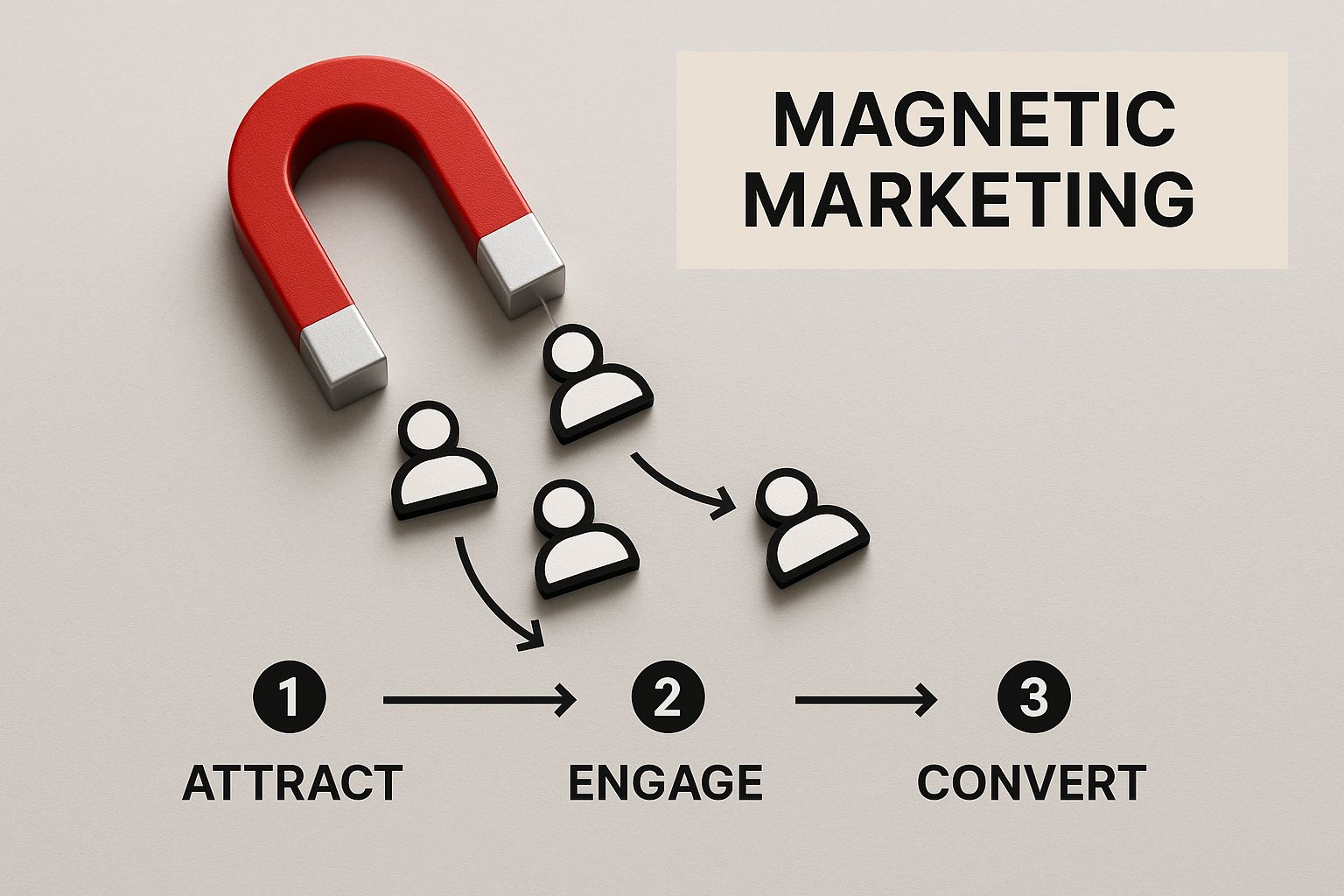
This infographic really drives home the idea of 'Magnetic Marketing,' where your content does the heavy lifting, drawing your ideal customers in.
The image reinforces how inbound strategies create an attractive force, pulling prospects toward your brand rather than you having to chase them down.
The inbound process isn't random; it's a structured journey designed to turn a complete stranger into a raving fan of your brand. It’s built around three core stages.
"The inbound methodology isn't just a funnel; it's a flywheel. By delighting customers, you create advocates who help attract new prospects, creating a self-sustaining growth engine."
Here’s an actionable breakdown of each stage:
Attract: First, you have to draw in the right people with content that positions you as a trusted advisor. This is where your blog posts, social media presence, and SEO efforts shine, making you discoverable when it matters most. Action Step: Identify the top 5 questions your ideal customer asks before buying, and write a detailed blog post answering each one.
Engage: Once you have their attention, you need to offer them real solutions that speak directly to their goals and frustrations. This is where you convert visitors into leads with things like forms, clear calls-to-action (CTAs), and dedicated landing pages. Action Step: Create a simple checklist or template that solves one small problem for your audience and offer it as a free download in exchange for an email.
Delight: This final stage is all about delivering an incredible experience that actually helps customers succeed. When you do this right, they don’t just stay customers—they become promoters, feeding new energy back into your growth flywheel. Action Step: Send a personal follow-up email to a new customer one week after their purchase, offering help and asking for feedback.
To really nail the execution, it's worth digging deeper into specific inbound marketing lead generation tactics, as different strategies work best at each stage. When done right, this entire process builds a reliable pipeline of high-quality leads who actually want to hear from you.
Turning a complete stranger into a loyal customer doesn't just happen. It’s a deliberate journey, and the best way to visualize it is as a funnel. Each stage is designed to guide potential customers along a path, building trust and delivering value until they’re ready to become a customer.
This isn’t about forcing people through some rigid, cookie-cutter system. It’s about creating a helpful pathway that meets them exactly where they are.
The classic inbound marketing funnel has four key stages: Attract, Convert, Close, and Delight. Think of it as the roadmap for your entire lead generation effort. Each phase has a specific job, and they all work together to create a smooth, effective customer experience.
The first step in any lead generation inbound marketing strategy is to pull in the right kind of traffic. You don't want just anyone landing on your site; you want people who are actively searching for the solutions you offer. This is where your content becomes a magnet.
Here's an actionable checklist to make that happen:
SEO-Optimized Blog Posts: Write high-quality articles that directly answer the questions your ideal customers are typing into Google. Focus on solving their problems first and foremost, not just pitching your product.
Engaging Social Media Content: Share valuable insights, tips, and industry news on the platforms where your audience actually hangs out. The goal isn't just to post, but to start conversations and establish your brand as a go-to resource.
Keyword Strategy: Use a tool like Ahrefs or SEMrush to find keywords with good search volume but low competition. Target these to get found faster.
When you create content that’s genuinely tailored to their needs, the visitors who show up are already partially qualified. They found you because you had an answer, which builds your credibility from the very first click.
Okay, so you've attracted some visitors. Now what? The next goal is to turn them into actual leads. This is that critical moment when an anonymous visitor gives you their contact information, essentially giving you permission to keep the conversation going. To get them to do that, you have to offer something valuable in return.
This value exchange is powered by a few key tools:
Compelling Calls-to-Action (CTAs): These are the clear, direct prompts telling visitors what to do next. Use action-packed language like "Download Your Free Guide" or "Get Your Custom Demo" to make clicking irresistible. Pro Tip: A/B test your CTA button colors. Sometimes a simple change from blue to orange can increase clicks.
Optimized Landing Pages: A good landing page has one job and one job only: get the visitor to take a specific action. It should be clean and free of distractions, with a killer headline, benefit-driven copy, and a dead-simple form.
Frictionless Forms: Keep your forms as short as humanly possible. Only ask for the absolute essentials you need to qualify and contact the lead. Every extra field you add is another reason for someone to bounce.
The conversion process is a value exchange. You must offer something so useful—be it an ebook, a webinar, or a template—that a visitor feels it's a fair trade for their email address.
You now have a list of leads. The focus shifts to nurturing them until they’re ready to buy. Let's be real: most leads aren't ready to pull out their credit card right away. The "Close" stage is all about building that relationship and guiding them toward a decision with targeted, personalized communication.
Effective closing tactics lean heavily on automation and segmentation. This ensures you're sending the right message, to the right person, at the right time. Properly executing your customer segmentation strategies is what makes your content feel personal and relevant.
Here are the workhorses of the Close stage:
Automated Email Sequences: Set up a series of emails that deliver more helpful content related to what the lead was interested in initially. For example, if they downloaded your ebook on SEO, your follow-up emails should offer more advanced SEO tips or case studies.
CRM Workflows: Use a Customer Relationship Management (CRM) system like HubSpot or Salesforce to track every interaction a lead has with your brand. This lets you score their engagement, helping your sales team spot the hottest leads who are most likely to buy, so they can focus their energy where it really counts.
This nurturing process ensures that when a lead is finally ready to make a purchase, your brand is the first one they think of.
The funnel doesn't end when you close a deal. The final—and arguably most important—stage is Delight. This is where you transform satisfied customers into enthusiastic promoters of your brand. A delighted customer becomes your single most powerful marketing asset, generating priceless word-of-mouth leads.
Delighting your customers creates a self-perpetuating cycle of growth, often called the flywheel effect. By delivering an outstanding experience after the sale, you pour fuel back into the "Attract" stage with organic referrals and glowing reviews.
Here are a few actionable ways to delight your customers:
Exceptional Customer Service: Be fast, helpful, and proactive with your support. Action Step: Implement a simple customer satisfaction (CSAT) survey after each support interaction to gather real-time feedback.
Ongoing Value: Don't disappear after the sale. Keep sharing exclusive content, tips, or updates that help them succeed with your product or service.
Feedback and Community: Actively ask for feedback to show you value their opinion, and consider creating communities where they can connect with other users.
By focusing on all four stages, you build more than just a list of leads. You build a sustainable, scalable engine for business growth.
To build an inbound machine that consistently brings in new leads, you need to master three core strategies. These aren't just tactics you can pick and choose; they're pillars that hold each other up.
Think of it like this: content is the engine, SEO is the map that guides people to you, and social media is the highway that distributes your message.
When these three work in harmony, they create a powerful system that attracts, engages, and converts the exact people you want to talk to.
Content is the heart of any solid inbound strategy. It's the value you offer upfront that pulls people toward your brand. Instead of starting with a sales pitch, you’re offering a solution, an answer, or a fresh perspective.
This approach builds trust long before anyone thinks about buying. In fact, 76% of marketers rely on content to generate leads. Companies that publish content consistently—say, around 15 blog posts a month—can see an average of 1,200 new leads monthly. It shows how a good inbound funnel uses content to guide people from discovery to decision.
Here’s a comparison of how different content types work at different funnel stages:
Content Type
Primary Goal
Best For
Blog Posts & Articles
Attracting new visitors via search engines; establishing topical authority.
Top-of-funnel awareness and education.
Ebooks & Whitepapers
Capturing leads by offering in-depth knowledge in exchange for contact info.
Mid-funnel consideration and lead conversion.
Webinars & Demos
Engaging qualified leads with interactive, solution-focused content.
Bottom-of-funnel decision-making and closing.
Your content needs to hit on the real problems your audience is facing. If they're wrestling with project management, write the definitive guide on it. If they need to fix their sales process, host a webinar with an expert who's been there and done that.
Creating fantastic content is only half the battle. If nobody finds it, it might as well not exist. This is where Search Engine Optimization (SEO) comes in. It’s the art and science of making your content visible when potential customers are actively searching for solutions on Google.
But SEO isn't just about cramming keywords into an article anymore. It's about deeply understanding what a searcher wants and structuring your content so that search engines recognize it as the best possible answer.
SEO ensures that your valuable content doesn't just exist—it gets discovered. It connects your solutions to the people who are actively searching for them, turning passive content into an active lead-generation tool.
Here are a few actionable techniques to get started:
Keyword Research: Get inside your audience's head. What phrases and questions are they typing into Google? Zero in on long-tail keywords (like "how to generate B2B leads with inbound marketing"), which usually have less competition and signal that someone is closer to making a decision.
On-Page Optimization: Make sure your page titles, headers, and meta descriptions include your main keywords. This is like putting a clear label on your content so search engines know exactly what it's about. Action Step: Use a free tool like Yoast SEO or Rank Math to audit and improve the on-page SEO of your top 5 blog posts.
Internal Linking: Don't let your articles be dead ends. Link them together where it makes sense. This helps search engines map out your site and, more importantly, keeps visitors engaged by leading them to other helpful resources.
Ultimately, a core goal of inbound marketing is to bring more of the right people to your website. For a closer look, there are tons of practical strategies to increase website traffic you can use to capture more organic visitors.
Social Media Marketing: The Highway to Your Audience
While SEO helps you get found by people who are already looking, social media helps you get in front of audiences where they already hang out. It’s the distribution network that carries your content to new communities and sparks conversations.
Don't make the mistake of trying to be everywhere at once. The real key is to figure out where your ideal customers actually spend their time and build a genuine presence there. A B2B software company will probably get more traction on LinkedIn, while a fashion brand is better off on Instagram.
Here’s how to use social media for lead generation, not just likes:
Share Valuable Content: Don't just drop a link to your latest blog post. Pull out a surprising statistic, turn a key concept into an infographic, or shoot a quick video summary. Adapt your content to feel native to each platform.
Engage with Your Community: Social media is a two-way street. Answer comments, ask questions, and jump into relevant conversations. This shows there are real people behind your logo and builds actual relationships.
Use Targeted Calls-to-Action: Gently guide your followers back to your website. Promote your latest ebook, invite them to a webinar, or ask them to subscribe to your newsletter. Make the next step obvious and valuable. Action Step: Add a link to your latest lead magnet (like an ebook or webinar registration) to your social media bio on your most active platform.
By weaving these three pillars together—Content, SEO, and Social Media—you build a cohesive system for lead generation inbound marketing. Your content offers the value, SEO ensures it's discoverable, and social media delivers it to the right people. That’s how you create a reliable, continuous flow of qualified leads.
Getting a new lead is just the start of the conversation. The real magic in lead generation inbound marketing happens next—turning that initial spark of interest into actual revenue through smart lead nurturing.
Think of it like tending a garden. A seed (your new lead) needs consistent care—water, sunlight, and the right nutrients—to grow into a healthy plant. In the same way, leads need timely, relevant information to guide them toward a purchase decision.
This whole process is about building a relationship, not just hammering them with a sales pitch. You're the helpful guide, providing the right answers and resources at the perfect moment. That's how you build trust and stay top-of-mind.
Following up with every single lead by hand is impossible to scale. This is where automation becomes your best friend, letting you deliver personalized experiences to hundreds or even thousands of leads without burning out your team. The comparison is stark: manual follow-up is inconsistent and time-consuming, while automated workflows are reliable, scalable, and data-driven.
Automated email drip campaigns are the workhorse here. These are pre-built sequences of emails that get sent automatically based on what a lead does, like downloading an ebook or visiting your pricing page.
The goal isn't to be salesy. It's to deliver a string of helpful touchpoints that educate the prospect over time. This is a world away from those generic, one-off email blasts that everyone ignores. An automated workflow creates a logical journey.
A well-run nurturing strategy puts the right content in front of the right person at exactly the right time. It transforms a cold lead into an educated, engaged prospect who is actually ready to talk to sales.
Creating a nurturing campaign that works doesn't have to be some overly complex project. It starts with a simple question: what was the lead interested in first? From there, you just map out a logical content path that answers their next likely questions.
Here’s a simple, actionable blueprint you can use today:
Identify the Trigger: What did the lead do? Let's say they downloaded a "Beginner's Guide to SEO." This tells you they're at the top of the funnel, just starting their research.
Email #1 (Day 1): Send an immediate thank-you email with the guide. Keep it short and sweet. No sales pitch.
Email #2 (Day 3): Offer a related piece of content, like a blog post on "5 Common SEO Mistakes to Avoid." This adds more value and builds on their initial interest.
Email #3 (Day 7): Introduce something for the middle of the funnel, like a case study or a webinar invite showing how another company crushed it with their SEO strategy.
Email #4 (Day 12): Gently pivot toward your solution. This email can briefly introduce your product or service as a way to solve the problems you've been talking about, and include a soft call-to-action like, "Ready to see how it works? Schedule a quick demo."
This structured approach ensures you’re building trust before asking for the sale—a core principle of inbound marketing. As you get more advanced, you can explore how things like AI for marketing automation can create even more dynamic and personalized journeys for your leads.
Not all leads are created equal. Some are just kicking the tires, while others are ready to pull out their credit card. Lead scoring is how you tell them apart. It’s a system for assigning points to leads based on who they are and what they do.
For example, a Marketing Director (demographic info) from a target company might get +10 points. If they then visit your pricing page (a behavior), they could get another +15 points. Once a lead hits a certain score (e.g., 50 points), they get flagged as a "hot lead"—or a Sales Qualified Lead (SQL)—signaling they're ready for a chat with your sales team.
This system stops your sales team from wasting time on unready prospects and lets them focus their energy where it counts. The numbers back this up: companies that excel at lead nurturing generate 50% more sales-ready leads at a 33% lower cost. It just goes to show how targeted follow-ups can dramatically improve both the quality and efficiency of your entire process.
Great inbound marketing isn’t about shouting from every rooftop. It's about finding the few quiet corners where your ideal customers are already listening. Picking your channels strategically means you stop wasting energy and start focusing your budget where it will actually make a difference.
Trying to be a master of every platform is a fast track to burnout and mediocre results. Think of your channels like tools in a workshop. A hammer is perfect for nails, but totally useless for screws. In the same way, the channel that works wonders for a B2C fashion brand might be a complete dead end for a B2B software company.
Your entire goal is to match your channel choice to your audience's behavior and your business goals. This focused approach is what separates high-impact lead generation inbound marketing from campaigns that just add to the noise.
The first, most critical question you have to answer is whether you're talking to a business or a consumer. Their motivations, how they make decisions, and where they spend their time online are worlds apart. Get this wrong, and nothing else matters.
B2B (Business-to-Business): Decisions here are driven by logic, ROI, and efficiency. The sales process is longer, involves a committee of people, and is built on a foundation of trust and professional authority. Channels like LinkedIn and industry-specific forums are goldmines.
B2C (Business-to-Consumer): Decisions are often emotional, sparked by entertainment, a desire, or what friends are recommending. The path to purchase is much shorter, more direct, and often impulsive. Visual and community-driven platforms like Instagram, TikTok, and Facebook dominate.
This is the fork in the road. Your entire channel plan starts here.
To make this actionable, let’s break down three of the most powerful inbound channels—SEO, LinkedIn, and Email Marketing—and compare how they perform for different businesses.
Channel
Best For
Key Strength
Primary Weakness
Organic Search (SEO)
B2B & B2C
Capturing people with high intent who are actively searching for what you sell.
It's a long game. You won't see results overnight.
LinkedIn
B2B
Targeting professionals with surgical precision by job title, industry, and company.
Pretty ineffective for most B2C; requires consistent, high-value content.
Email Marketing
B2B & B2C
Nurturing the leads you already have and driving repeat business through personalization.
You have to build a list first; it can't attract people who don't know you exist.
See the difference? Each channel has a specific job. SEO is your foundation for attracting fresh eyes, LinkedIn is your scalpel for B2B targeting, and email is your engine for turning warm leads into customers.
So, how do you actually choose? Start with your customer persona and your business goals.
A B2B tech company trying to land enterprise clients should be all-in on LinkedIn and creating SEO-driven whitepapers. On the flip side, an e-commerce store selling handcrafted jewelry will get far more mileage from visual platforms and smartly targeted B2C email campaigns.
The data backs this up, especially in the B2B world. For the vast majority of marketers (91%), lead generation is the number one priority. And while companies generate an average of 1,877 leads per month, where those leads come from varies wildly. For B2B, LinkedIn is the undisputed champ—40% of marketers rate it as their most effective platform for high-quality leads. Its native Lead Gen Forms even boast a 13% conversion rate, crushing the performance of a typical landing page. For more on this, check out these insightful lead generation statistics and findings.
The best inbound channel strategy is not about adding more platforms; it's about going deeper into the few that matter most to your audience. Mastery of one or two relevant channels will always outperform a shallow presence on ten.
By choosing your channels with care, you turn your inbound marketing from a scattered mess into a focused, efficient lead generation machine.
Free Tool
Try our AI Lead Generator — find verified LinkedIn leads for any company instantly. No signup required.
As you start sketching out your own inbound strategy, the practical questions always bubble up. Getting straight answers to these common hurdles is the key to building momentum and setting expectations that don't lead to burnout.
Let's walk through the questions I hear most often from leaders just starting their inbound journey, from timelines to tactics.
This is always question number one, and for good reason. Unlike paid ads that can give you an instant (but temporary) traffic spike, inbound marketing is a long game. Think of it like planting a garden, not setting off a firework.
You might get a few early wins, but it typically takes 6 to 12 months of consistent work to see a real, significant impact. Why so long? Because that's the time it takes to:
Build a solid library of content that actually helps your audience.
Gain traction in search rankings as your SEO efforts start to compound.
Establish real authority and trust in your industry.
The beautiful part is that the results are cumulative. The article you write today can keep generating leads for years to come, turning your marketing efforts into a business asset that actually grows in value.
What's the Difference Between a Lead and a Qualified Lead?
Getting this right is critical for keeping your marketing and sales teams on the same page. If you don't, your sales reps will waste a ton of time chasing people who just aren't ready to talk. Not all leads are created equal.
A lead is basically anyone who's raised their hand and given you their contact info. A qualified lead is someone who not only raised their hand but also fits the profile of your ideal customer. They've been vetted.
Here’s a simple comparison:
Attribute
A General Lead
A Qualified Lead (MQL/SQL)
Initial Action
Showed initial interest, like downloading a top-of-funnel ebook.
Took actions that signal real interest or buying intent.
Information
You might just have a name and an email.
You have more context—job title, company size, specific needs.
Sales Readiness
Still in the research phase; not ready for a sales call.
Vetted and deemed a good fit who is likely to become a customer.
The whole point of lead nurturing is to guide those general leads through the process until they become qualified and ready for a real conversation.
Absolutely. The core idea—attracting people with valuable content instead of interrupting them—works everywhere. The execution, however, looks completely different. The "why" is the same, but the "how" changes based on the audience.
"Inbound marketing is audience-centric. Whether you're selling software to a CIO or sneakers to a teenager, the goal is to solve their problem and earn their trust. The 'how' is what changes, not the 'why'."
Here’s a quick comparison of how the strategies differ:
B2B Inbound: This is all about longer sales cycles and building professional credibility. Channels like LinkedIn and organic search are king. The content is usually deeper—think whitepapers, detailed case studies, and webinars that prove ROI.
B2C Inbound: Here, you're often dealing with shorter, more emotional buying decisions. Visual platforms like Instagram and TikTok are huge, along with building communities on places like Facebook. Content is more about engagement—blog posts, influencer collaborations, and user-generated content campaigns.
Success can't be a gut feeling. You need to track real numbers that tie back to your business goals. Focusing on the right key performance indicators (KPIs) shows you what's working, what's a waste of time, and where you need to double down.
While every business will have its own unique metrics, there are a few essentials every inbound marketer should have on their dashboard. If you want to go deep, you can explore a full list of lead generation key performance indicators that will help you prove your marketing's impact.
At a minimum, keep your eyes on these core metrics:
Website Traffic: Are more of the right people finding you?
Lead Conversion Rate: Of all your visitors, what percentage are turning into leads?
Cost Per Lead (CPL): How much are you spending to get one new lead through your inbound efforts?
Customer Acquisition Cost (CAC): What’s the total cost to turn that lead into a paying customer?
Return on Investment (ROI): The ultimate question: is the money you're making from inbound greater than the money you're spending?
By watching these numbers like a hawk, you can stop guessing and start making data-driven decisions that actually improve your results.
Ready to stop chasing leads and start attracting them with a smarter, more efficient strategy? marketbetter.ai uses an integrated AI platform to help you create high-quality content, automate nurturing workflows, and prove your marketing ROI. See how our AI-powered marketing platform can build your inbound engine by visiting https://www.marketbetter.ai.


 To build an inbound machine that consistently brings in new leads, you need to master three core strategies. These aren't just tactics you can pick and choose; they're pillars that hold each other up.