Your Campaigns Can Now Go Out in 17 Languages — and Every Draft Gets Checked

Most of our customers sell globally. IoT connectivity deals in Germany and Japan, EHS compliance deals across five European markets, logistics deals in Brazil. Their buyers read email in their own language — and reply rates show it.
Until this week, running a German campaign in MarketBetter meant writing your templates in German and trusting the AI to take the hint. It usually did. "Usually" is not a word you want anywhere near your outbound.
So we shipped the obvious thing, and then the less obvious thing that makes it actually trustworthy. In the campaign builder's Voice step — right next to tone and AI Context — there's now a Language control. Pick German, and the campaign's emails are generated in German. All of them. Every touch, every follow-up, for every contact on the list.
The pickable set today: Czech, Dutch, French, German, Greek, Hungarian, Italian, Japanese, Korean, Polish, Portuguese (Brazilian and European), Romanian, Spanish (Castilian and Latin American), Turkish, and Ukrainian. English isn't on the list because the default already handles it — more on that below.

Why "just add it to the prompt" wasn't good enough
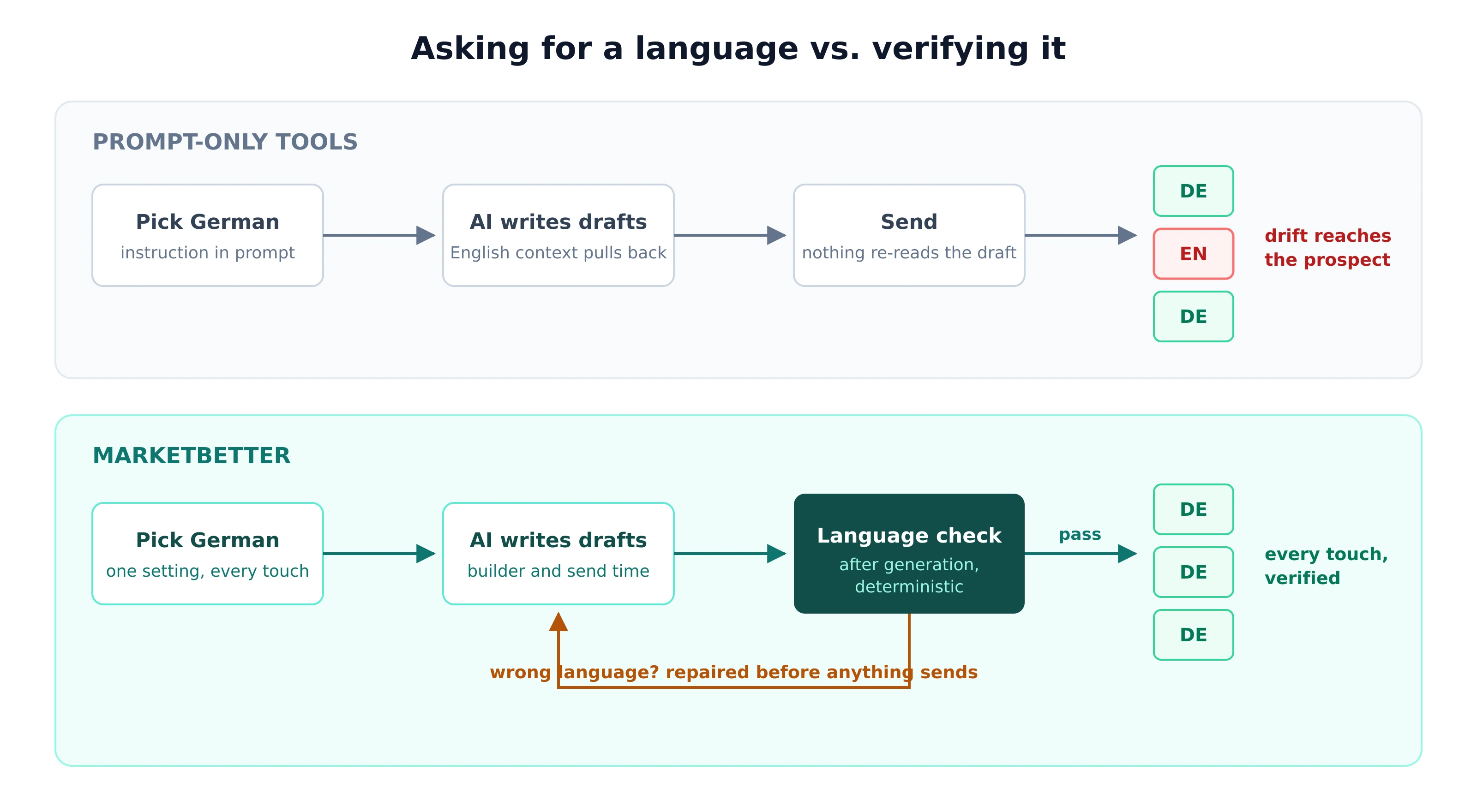
Here's the failure mode every AI writing tool has and few talk about: you ask for German, and three emails out of two hundred come out in English. Or worse — the email starts in German and drifts into English halfway through, because the product context, the merge-tag rules, and everything else surrounding the instruction are written in English, and that weight quietly pulls the model back.
To the person who picked German, that's not a quirk. That's a bug. "I picked German and a prospect in Munich got English" is indistinguishable from the product being broken — because for that prospect, it was.
There's a second, sneakier version of the same failure. In MarketBetter, the first touch you review in the builder and the follow-up touches that go out days later are generated at different times. If the language choice only lived in the builder, touch one would arrive in German and touch three in English — and you'd never see it happen, because by then the campaign is running without you watching.
So the language pick is wired through both halves of the system. The drafts you review in the builder come out in your language. The touches generated at send time, days or weeks later, read the same setting and come out in the same language. One choice, carried end to end. Rebuilding the audience, editing the sequence, re-running drafts — none of it can silently drop the setting.
Verified after generation, not just requested
The part I actually care about: a picked language is checked after the draft is written, not merely asked for in the prompt.
Every generated email passes through a deterministic language check before it's allowed to proceed. If a draft comes back in the wrong language — or starts right and drifts — it gets caught and repaired before anything reaches a prospect. The prompt asks; the check verifies. A prompt cannot verify its own output, so we don't let it.
This is also the honest answer to "why only 17 languages?" The model can write in far more. But 17 is the set our verification layer can actually check today. We'd rather offer 17 languages we can verify than 60 we can only hope about. When the check learns a new language, the picker gets it — in that order, not the reverse.
If something ever goes wrong internally — a setting arrives corrupted, a value we don't recognize — the system fails closed: it falls back to the previous behavior (inferring language from your template) rather than instructing a language it can't verify. Fail closed is a theme in how we build; it's the same principle behind the publish gates on AI landing pages and the verification tiers in the chatbot's form-filler recognition.
What "Automatic" means (and why the default isn't "English")
The Language control defaults to Automatic, not English — and that's deliberate.
Automatic means what it did before this release: the generator infers the language from your template and from each contact's own fields. If your template is written in German, your drafts come out in German, no setting required. Labelling that default "English" would make a perfectly working German-template campaign look misconfigured, so we didn't.
That leaves a genuinely useful division of labor:
| You want | Use |
|---|---|
| The whole campaign in one language, guaranteed | Pick the language |
| Language to follow the template you wrote | Automatic |
| English | Automatic with an English template |
One precedence rule worth knowing: an explicit pick wins over everything, including per-contact inference. If you pick German for a list that includes contacts in France, everyone gets German. That's by design — you said German, you get German — but it means the right unit for a multilingual motion is one campaign per language market, not one campaign with a mixed list and a single picked language.
And once a language is picked, it's visible on the Voice step's summary pill without reopening anything. A non-English campaign is the most surprising thing about a campaign on a re-read; it shouldn't hide behind a click.
One more behavior that protects you from yourself: changing the language invalidates existing drafts. If you reviewed English drafts and then switch to German, those English drafts don't survive into your German campaign — you review new ones. Your sequence plan (touch counts, channels, timing) stays put, because no language changes how many touches a campaign should have.
How this fits a global territory motion
We've written before about the manual version of this problem. Our multilanguage cold outreach guide from February walks through doing it with AI tooling by hand — useful, but it's a workflow you babysit. The multi-language SDR playbook for IoT and telecom teams and our piece on scaling EHS sales across European markets both land on the same structure: segment by language market, route signals by territory, and run one motion per market.
The language control is the missing execution piece of that structure:
- Build one audience per language market. Germany/Austria/Switzerland gets one campaign, France another, Brazil a third. Signal-based targeting doesn't care what language the signal fires in — a pricing-page visit from Munich is as hot as one from Austin.
- Pick the market's language in the Voice step. Same product story, same tone, same AI Context. Different language, enforced.
- Let every touch inherit it. Follow-ups generated three weeks from now come out in the campaign's language without anyone remembering to check.
- Keep the rest of the machine identical. The cost math on omnichannel ABM doesn't change per language; neither does the human-in-the-loop review model. You're localizing the copy, not rebuilding the process.
If you're running nurture through Loops, this release doesn't change it yet — Loops reads replies and writes nurture emails on its own cycle, and we're deliberately careful about what we let it do. Campaign language is campaign-builder scope today.
The honest checklist before you run your first non-English campaign
A language check catches the wrong language. It does not catch a culturally flat email. Before you point this at your German pipeline:
- Have a native speaker read the first batch. The drafts will be in German. Whether they're in your company's German — formal vs. informal address alone can decide whether you sound credible — is a judgment call a human should make once, early. Review the drafts in the builder like you would English ones.
- Localize your evidence, not just your prose. A case study link in English behind a German email is a seam. It won't block replies, but know it's there. (This is exactly the gap account-specific landing pages are built to close — pair them by market.)
- Measure against your English baseline. The interesting number isn't the reply rate of the German campaign; it's the delta against the same ICP worked in English. That delta is the business case for doing the next five markets.
- Mind the sender. An SDR who can't read the replies shouldn't own the inbox. Route each language campaign to a rep who can hold the conversation it starts — the point of in-language outreach is the conversation, not the open.
Where this goes next
Seventeen languages is the set we can verify today, and verification is the constraint we're keeping. The list grows as the check does. Per-market campaigns are the unit for now; smarter handling of genuinely mixed territories is an open design question we'd rather get right than get first.
If you sell into markets that don't read English email, this is the release that makes MarketBetter's whole signal-to-outreach motion work there — same signals, same playbooks, same review gates, in the buyer's language.
Want to see a campaign built in your market's language, end to end? Book a demo →