AI Landing Pages in Your Own Brand — One for Every Target Account

Outbound personalization has a last-mile problem. Teams spend real money personalizing the email — the signal, the opener, the proof point — and then the click lands on the same generic homepage every other prospect sees. The one moment a buyer voluntarily gives you their attention, you hand them the brochure.
Today we're shipping personalized landing pages in MarketBetter: for every account in an audience, the platform generates a dedicated page that reads like it was written for that account and looks like it belongs on your website — your fonts, your colors, your buttons, your layout. Not a page-builder template with your logo pasted on. Your actual design, captured from a page you already published.
And because a web page is public in a way an email never is, every page passes a human review gate before it goes live. More on that below — it's the part we sweated most.
The idea: show the account you did the work
We keep coming back to the same thesis: in 2026, showing beats telling. We wrote about it when Clay demoed their inbound SDR agent live instead of describing it, and when we broke down agent-built demo videos as an outbound tactic. A cold email that claims you understand an account is noise. An artifact that proves it — a video, a working demo, a page that talks about their business in their language — is signal.
A landing page is the cheapest artifact in that family to consume. No play button, no meeting, no attachment. One click and the account is looking at a page about them. The problem was never whether 1:1 pages work — ABM teams have hand-built them for years for six-figure deals, and the economics of omnichannel ABM campaigns show why: hand-building stops scaling somewhere around the tenth account. The problem is production cost. That's what we automated.
How it works
Personalized pages live where your targeting already lives: as a column on an audience. If you can build an audience in MarketBetter, you can give every account in it a page.
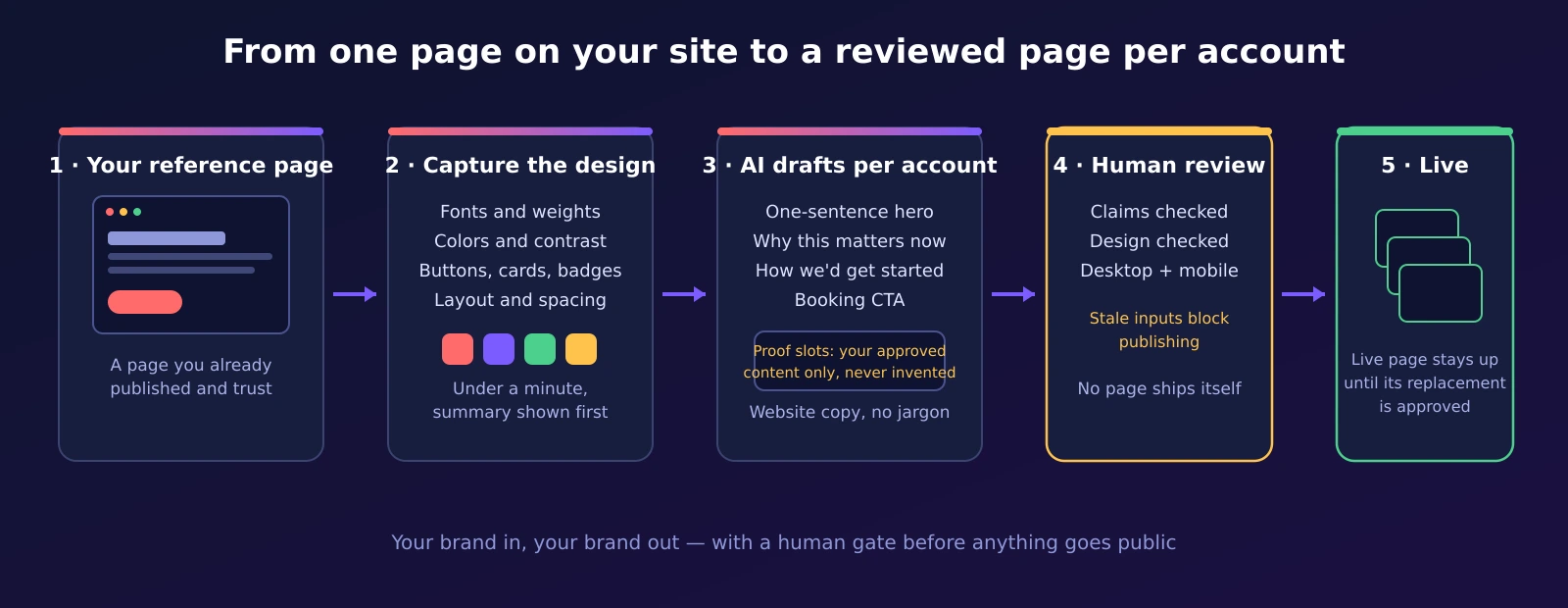
1. Point it at your own website. You start with a reference page — a solutions page, a pricing page, any page on your site whose look you want. MarketBetter loads it and captures the visible design: typography (the real font files, in the weights your site actually uses), colors, button styles, card styles, the little eyebrow badge above your headline, heading accents, spacing, layout. The capture takes under a minute and shows you a summary of what it found before anything is generated.
This is the detail we spent the most engineering time on, because "almost your brand" is worse than "obviously a template." Dark sites keep their contrast. Gradient buttons stay readable. Cards keep visible edges on dark backgrounds. Cookie banners don't end up fossilized in your captured design. If your hero headline isn't marked up the way most sites do it, capture finds it anyway. The bar is: someone from your marketing team glances at the generated page and doesn't flinch.
2. Choose who each page is for. Two modes: a page per named account, or a page per industry. Account pages are the sharp end — the hero speaks to that company specifically, built from the same research and buying signals that drive the rest of your campaign. Industry pages trade some sharpness for reach when your audience is wide.
One guardrail worth naming: an account's name on a page identifies the intended audience. The page never implies the account is a customer. That distinction is enforced, not just encouraged.
3. The AI writes the page — in website language. Each page gets a one-sentence hero headline, a short section on why this matters now for that account — three concrete, researched reasons, not boilerplate — and a how we'd get started section with three practical next steps. The copy is sized and shaped like web copy, not like a sales deck crammed into a browser. We taught the generator, with some persistence, not to leak sales-process jargon onto a public page; phrases that make sense in a pipeline review have no business in your hero section.
4. Proof is yours, never invented. The page has three optional slots — a customer testimonial, a product demo link, and a resource or case study. The AI never writes these. You supply them: either as fixed approved content, from a reusable library, or pulled per-row from another column in your audience. Testimonials require full attribution — quote, name, company, source URL, source date — and every slot requires an explicit confirmation that the content is approved for publication and its claims are sourced. An empty slot simply doesn't render. A page with no proof is honest; a page with invented proof is a liability.
5. Booking that meets the buyer where they are. Each page ends with a call to action: your sales form, the rep's calendar, or the booking link that already exists on your reference page. Links open directly — no scheduler embed required, nothing for the visitor's browser to fight.
The review gate: no page ships itself
Here's the part where we deliberately slowed our own feature down.
An email goes to one inbox. A landing page is on the open internet, in your brand, making claims about a named company. Those are different risk classes, and we built the publish flow accordingly — the same human-in-the-loop conviction that runs through everything we ship.
Before a page goes live, a human reviews the generated draft next to a screenshot of the reference page — on desktop and mobile, both required — and confirms two things separately: the account-specific claims (and the sources behind any testimonial or proof) are accurate, and the design is faithful to the brand. Only then does the publish button work.
Two more safeguards operate underneath:
- A live page never gets silently replaced. When a row regenerates — new research, updated signals — the existing published page stays up until a human approves the replacement. Your prospects never see a half-reviewed draft because a refresh happened to run overnight.
- Stale inputs block publishing. If the reference design or the source content changed after the draft was generated, the draft can't be published until it's regenerated. You can't accidentally ship a page built on last month's inputs.
If that sounds like more friction than "AI generates infinite landing pages!!" — yes. Deliberately. We've been explicit that the teams winning with AI SDRs are the ones that kept humans on the claims, and a public page in your brand is the last place to abandon that.
Where it fits in a play
A page on its own does nothing — it needs traffic from a motion that's already working. The pattern we're running internally:
- Signal-triggered outreach first. The account shows a real buying signal, the rep (or agent) sends a short, specific email.
- The link is the page. Instead of "here's our homepage" or a calendar link cold, the CTA is the account's own page. The email can be two sentences shorter because the page carries the argument.
- Proof does the mid-funnel work. Testimonial from their industry, a personalized demo or video in the demo slot if you have one.
- Nurture reuses it. When a Loop sends its one relevant update months later, the page is still there, still current — pages regenerate as research changes (reviewed, per the gate above). What we learned in Loops' first month applies here too: the artifact only earns attention when the reason for sending it is real.
What to measure. Keep it simple: click-through to the page versus your previous destination link, page-to-booking rate, and meetings per hundred pages published. If the page doesn't beat your homepage on booking rate inside a quarter, something upstream — targeting, signal quality, the offer — is the real problem, and the page is just making that visible.
What it doesn't do
In the spirit of our field reports: the honest edges.
- It personalizes from your design, for your targets. It's not a general-purpose site builder, and it won't invent a brand for you — if the reference page is weak, the generated pages inherit that.
- Account-level pages are only as good as the research behind the account. Garbage targeting in, eloquent garbage out.
- The review gate means a human spends real seconds per page. For a 50-account tier-one list that's trivial; for a 5,000-account blast it's the point — maybe don't give 5,000 accounts a 1:1 page.
- Proof slots stay empty until you bring approved content. The AI writing fake testimonials is a feature we will never ship.
Try it on your own accounts
Personalized landing pages are rolling out to MarketBetter workspaces now. If you want to see your own website's design captured and turned into account pages live — bring a URL from your site and a target account list, and we'll generate the first pages during the call.