
Congrats on the New Role… You Took in 2018. Champion Alerts Now Fire Only on Fresh Moves

A champion changing jobs is the warmest signal in B2B sales. Someone who already bought from you just landed somewhere new, with new problems and new budget. Every champion-tracking vendor — us included — has been telling you some version of that story for two years.
Here's the part of the story nobody leads with: most of the "job changes" these systems detect aren't new. They're old news your CRM was too stale to notice.
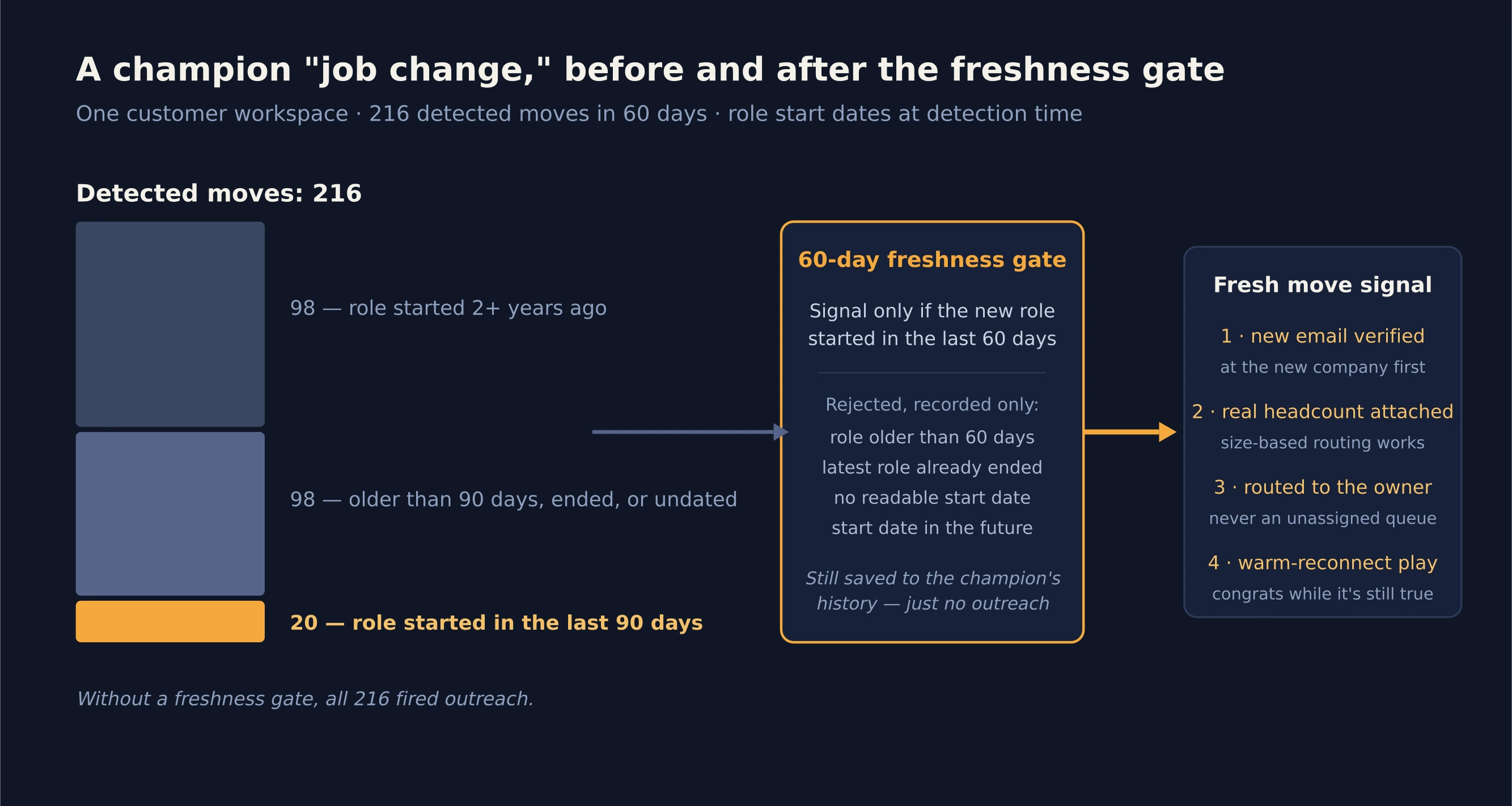
We pulled the numbers on one customer's workspace this fall. Of 216 champion job-change signals detected over a 60-day stretch, only 20 involved a role the person had started within the previous 90 days. 98 of them — nearly half — were moves into roles the person had started more than two years earlier. Reps enrolled them in outreach anyway, and real prospects got "congratulations on the new role" emails for jobs they took in 2018.
That's not a warm signal. That's a cold email with a timestamp problem, sent to the exact person whose goodwill you could least afford to burn.
So we changed how the whole pipeline works. As of November 3, a detected champion move becomes a signal — with outreach, owner routing, and email lookup — only when the new role started within the last 60 days. Everything older is still recorded on the champion's history, but nobody gets congratulated for ancient history again.
Why trackers "detect" job changes that happened years ago
The mechanics are unglamorous. Champion tracking works by comparing where a person's professional profile says they work against where your CRM says they work. When the two disagree, that's a detected move.
The problem is the second half of that comparison. CRM records go stale fast — people leave, nobody updates the contact, and the record quietly rots for years. So when a tracker first syncs a customer's CRM, or re-checks a long-untouched contact, it finds thousands of mismatches. Each one is technically a "job change." Almost none of them are news.
The person who left in 2018 shows up in the same detection queue as the person who started three weeks ago. Without a freshness gate, both generate the same alert, the same enrichment spend, and the same "saw you just made a move!" email. One of those emails builds pipeline. The other one teaches your best champion that your company doesn't actually know them at all.
We wrote last year about why champion tracking alone isn't enough — this is the sharpest example we've found of the gap between detecting something and that something being actionable.
What changed: a 60-day freshness window on every signal
We didn't go straight to 60. In early October we added the first gate: a detected move only became a signal if the new role had started within 180 days. That killed the 2018-vintage congratulations immediately.
Then we watched a month of production data and tightened it. 180 days still let through moves where the person had been in seat for five months — past their onboarding, past their honeymoon-period tool evaluations, deep into committed budgets. The "I heard you just moved" framing reads false by then, because it is false.
Since November 3, the window is 60 days, for every customer. A detected move becomes a signal only when the new role started within the last 60 days. The gate also filters out three other kinds of junk the comparison method throws off:
| What we detect | What happens now |
|---|---|
| New role started in the last 60 days | Signal fires: email lookup, owner routing, outreach play |
| New role started more than 60 days ago | Recorded on the champion, no signal, no outreach |
| Latest role already has an end date | No signal — they've already left that company too |
| No readable start date on the new role | No signal — we won't congratulate on a guess |
| Start date in the future | No signal until it's real |
Two honest footnotes on the mechanics. Professional profiles report dates at month precision, so we measure a role's age from the first of its start month — a "60-day" window can be a few days generous at the edges. And a stale move isn't deleted: the champion's record still updates with the new company and title, so your account history stays accurate. The move is remembered. It just doesn't pretend to be breaking news.
Why 60 days is the right window
The entire value of a job-change signal is the window where reaching out feels natural. In the first two months, "congrats on the new role — curious what you're building there" is a normal thing to say. The person is still forming their stack opinions, still auditing what their new team bought, still spending like someone who gets to make first-90-days decisions.
At month five, that same email is an awkward lie. At year two, it's disqualifying.
This matches what we've seen on conversion all along — the win in turning job changes into closed deals is overwhelmingly a speed win, and the teams that move within days of a real alert take the meeting before anyone else knows the person moved. A freshness gate is just that logic applied in reverse: if we can't be early, we shouldn't pretend to be.
Fewer signals, each one real, beats a dashboard full of mismatches. It's the same position we took on job-change alerts versus intent signals: a signal is only worth what you can act on without embarrassing yourself.
The second fix: signals now arrive knowing how big the new company is
The 60-day window fixes which moves become signals. The same week, we fixed where those signals land.
Many of our customers route leads by company size — one team owns sub-200-employee accounts, another owns enterprise. Those routing rules need a real employee count to work. And champion moves had a blind spot: the profile a move is detected from tells us the new company's name and domain, but not its size. So on size-routed workspaces, job-change signals — the warmest signals in the system — were landing unassigned, waiting for a human to notice and place them.
Now, before a job-change signal is admitted, we look the new company up by its domain and attach its actual employee count — the same field every other signal type carries. The lookup is deliberately strict:
- Only a match on the same domain (or a subdomain of it) is trusted.
- Only an exact, positive employee count is used. Ranges and AI-generated estimates are treated as unknown — a routing rule that fires on a guessed headcount is worse than one that doesn't fire.
- If there's no domain, no match, or the lookup fails, the signal goes through exactly as before — unassigned, flagged for a human. It fails closed. It never invents a number.
This is the same design position as our chatbot's form-filler recognition and the language verification in multilingual campaigns: when the system isn't sure, it says so, instead of acting confident and being wrong in front of your prospect — or your routing rules.
What a signal looks like now, end to end
When a champion's move clears the 60-day gate, here's the sequence:
- Email first. We find and verify the champion's address at the new company before the signal reaches anyone. Reps never see — or worse, mail — the dead address from the old company.
- Size attached. The new company's employee count rides along, so size-based routing places the signal with the right owner instead of dropping it in an unassigned queue.
- Context preserved. The signal carries the relationship: this person championed your product at their previous company. The outreach that gets drafted knows it's a warm reconnect, not a cold intro.
- A play, not just an alert. The owner gets the move as an action with suggested next steps — and a champion who lands at an account you're already nurturing can flow into a running nurture loop instead of a one-off blast.
That last distinction is the one we keep coming back to: most tools in this category stop at the alert. The hidden cost of champion-tracking tools is everything you have to build after the alert — and an alert that's two years late makes all of it worthless.
Check your own job-change stack
If you're running champion tracking anywhere — with us, with Champify, with a UserGems-style tool, or a homegrown sheet — run this audit this week:
- Pull your last 50 job-change alerts.
- For each, find when the person actually started the new role — not when the alert fired.
- Count how many started more than 90 days before the alert.
If that number is above a quarter, your reps are congratulating people on old jobs under your brand name. Either your vendor has a freshness gate you need to turn on, or it doesn't have one and you're the gate. The fix isn't more alerts — it's refusing to act on stale ones. The dormant-pipeline play still works (we wrote the playbook for it) — but it's a re-engagement play, with re-engagement framing. It's not "congrats on the new role."
Want job-change signals your reps can act on without checking the date first? MarketBetter tracks your champions, fires only on fresh moves, finds the new email before you see the alert, and routes it to the right owner by real company size. Book a demo →