2 posts tagged with "lead generation ai"

View All Tags

AI for Sales Prospecting That Actually Works

· 24 min read

AI in sales prospecting is about one thing: turning data into deals. It's the technology that automates tedious research, pinpoints leads who are actually ready to talk, and helps you personalize your outreach so it doesn't sound like a robot wrote it. This lets your reps get out of the weeds and into high-value conversations.

Moving Beyond Manual Prospecting

For too long, sales prospecting has been a grind. Picture your top reps, the ones who should be closing, buried in spreadsheets and endlessly scrolling through LinkedIn. They're spending hours hunting for breadcrumbs instead of actually connecting with people. This old way of doing things isn't just slow—it's a massive drain on your team's energy and morale.

This manual-first approach is where productivity goes to die. Time is the ultimate sales killer, and reps only spend 28% of their week actually selling. The rest gets eaten by admin work and chasing leads that go nowhere.

AI gives you those hours back. It’s already happening—54% of sales teams now use AI to customize outbound emails, and 45% use it for account research. The impact is undeniable.

The impact here is real. Teams using AI are cutting their lead follow-up time by as much as 60% and boosting conversions by 30%. Prospecting stops being a guessing game and starts becoming a precise, data-driven engine for growth.

The Shift from Guesswork to Guidance

Before we get into the nuts and bolts, let's be clear: the foundational sales prospecting best practices still matter. You still need to understand your buyer and deliver real value. That never changes.

What has changed is how we execute. Old-school prospecting was built on gut feelings and a whole lot of manual effort. AI flips the script, automatically capturing buying signals and turning them into clear, actionable tasks right inside your CRM.

This is the difference between:

  • Manual Research vs. Automated Insights: Instead of a rep burning an hour researching one account, AI can surface critical intel—like a fresh funding round or a new executive hire—in seconds.
  • Generic Outreach vs. Scaled Personalization: AI helps draft timely, relevant emails and call scripts that reference specific company events, finally killing the "Hi [First Name]" template.
  • Reactive Follow-up vs. Proactive Engagement: AI spots intent signals, like a prospect hitting your pricing page for the third time, and immediately flags it as a high-priority task for a rep to jump on.

At the end of the day, AI for sales prospecting isn't about replacing reps. It’s about making them smarter and faster, freeing them from the low-value tasks so they can focus on what they do best: building relationships and closing deals.

The Core Functions of AI Prospecting Platforms

To see how AI for sales prospecting really changes the game, you have to look past the hype and see what the tech actually does. Don't think of it as a magic button. It’s more like a combination of four distinct, interconnected functions working together.

Each one takes a chunk of the old-school sales workflow and makes it smarter, faster, and less reliant on guesswork. The whole point is to free up your reps to focus on what they do best: having great conversations.

1. Intelligent Lead Scoring

Traditional lead scoring is broken. It’s usually a rigid, rules-based system that gets stale the minute you set it up. Someone visits the pricing page? +10 points. Downloads an ebook? +5 points. These rules are simple, but they miss the bigger picture entirely.

AI-powered lead scoring is a different beast altogether. It digs into thousands of data points in real time—things like the software a company uses (technographic), its size and industry (firmographic), and even whether they’re hiring for roles your product supports. It then stacks all that information against your past wins and losses to build a predictive model.

Basically, it learns what your best customers look like and finds more of them right now. For a deeper dive on this, check out our guide on lead scoring best practices.

This is the difference between a static checklist and a living, breathing system. Instead of a rep staring at a list of 100 "warm" leads, the AI tells them, "These 5 accounts are your top priority today. They match the profile of your last 10 closed-won deals and just posted a relevant job opening." That’s an instruction you can actually act on.

2. Automated Account Research

Before any good SDR makes a call, they do their homework. That usually means spending 15 to 30 minutes per prospect digging through news articles, LinkedIn profiles, and earnings reports, trying to find a relevant hook. It's a time-suck.

AI completely automates this discovery phase. It acts like a tireless research assistant, constantly scanning the web for critical buying signals and account intel.

  • Company News: It flags recent funding rounds, new product launches, or big press mentions.
  • Personnel Changes: It spots when a key executive joins or leaves a target company.
  • Strategic Talking Points: It pulls out juicy quotes from an earnings call or a CEO's recent interview.

Instead of the rep piecing this puzzle together, the AI drops a concise brief right into their CRM. This instantly gives them the context they need to have a sharp, informed conversation from the very first hello.

This isn't just about saving time; it's about elevating the quality of every single interaction. An AI-surfaced insight turns a generic cold call into a timely, strategic conversation.

3. AI-Assisted Outreach

Let's be honest: generic, one-size-fits-all email templates are dead. Buyers can spot them a mile away. But personalizing every single message by hand is a recipe for burnout. This is where AI-assisted outreach finds the perfect middle ground.

Modern AI doesn't just plug in [First Name] and [Company Name]. It uses all the intel it gathered during the research phase to draft emails and call scripts that are genuinely context-aware.

Actionable Comparison: Manual vs. AI-Assisted Email

Manual TemplateAI-Assisted Draft
"Hi John, I saw you work at Acme Corp and thought our tool could help your team improve efficiency.""Hi John, saw the news about Acme Corp's new logistics hub in Texas. As you scale operations, our platform can help streamline your supply chain workflows."

The AI draft gets you 80% of the way there. It gives the rep a high-quality, relevant starting point, so all they have to do is add their personal touch and hit send.

4. Streamlined Workflow Execution

All the scoring, research, and drafting in the world is useless if it doesn't lead to action. This is the final, and most critical, piece of the puzzle. The best AI prospecting tools don't just find opportunities—they help you act on them.

They do this by plugging directly into a rep's existing workflow, usually inside a CRM like Salesforce or HubSpot.

When the AI flags a high-intent signal, it doesn't just send a Slack alert and call it a day. It creates a prioritized task in the CRM—like "Call Jane Doe about their new product launch"—and attaches all the research and a suggested script. The rep can execute the task with a single click, and the AI automatically logs the outcome. No more manual data entry. It keeps the CRM clean without adding another chore to the rep's plate.

Comparing AI Prospecting Tools and Workflows

Picking the right AI for sales prospecting isn't just about features and price tags. It's a fork-in-the-road decision. One path speeds your team up, the other bogs them down in a mess of tabs and logins.

The choice really boils down to two philosophies. You can either stitch together a handful of separate 'Point Solutions' or you can adopt a single, 'Integrated Task Engine' that lives and breathes inside your CRM.

The difference is everything. The point solution route might mean using a slick AI email writer, a separate data provider, and a standalone dialer. Each tool might be best-in-class at its one job, but stringing them together creates a ton of invisible friction. Every click, every copy-paste, every tab switch is a tiny drain on a rep's momentum.

An integrated engine is different. It's built from the ground up to be a native part of your CRM. It connects the dots from an intent signal straight through to the outreach, creating one fluid motion where research, outreach, and logging all happen in the same place.

This decision tree shows the key jobs an AI prospecting system has to handle, from figuring out who to call first to executing the actual outreach.
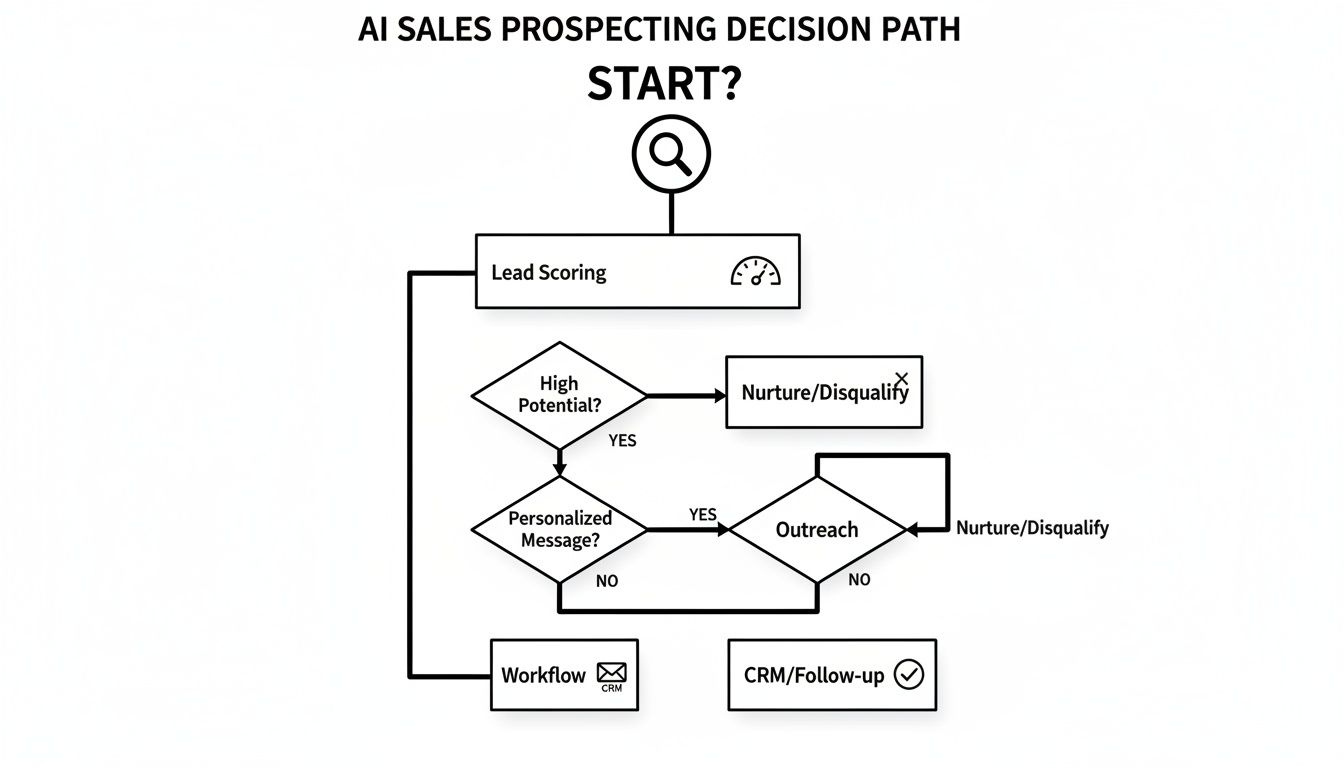
Flowchart illustrating an AI sales prospecting decision path with lead scoring and outreach steps.

The real insight here? These aren't separate tasks. A system that actually works connects them all into a single, cohesive process. And that's where integrated engines usually win.

Integrated Engines vs. Point Solutions

The hidden tax you pay with separate tools is context switching. Every time a rep has to copy-paste a personalized line from an AI writer into their email client, momentum dies. Every time they have to manually log a call from their dialer into the CRM, you risk losing data. These little interruptions seem small, but they add up to a massive drag on your team's day.

Think about it. The old world of prospecting is a rep staring at a giant list, wasting hours just figuring out who's worth a call. That old-school manual grind still eats up 40% of a sales rep's week—that's 16 hours out of a 40-hour week just gone. By contrast, teams that move to AI-driven platforms are cutting their lead follow-up time by a staggering 60%. This shift is real, and you can dig into more findings about AI's impact on sales prospecting to see just how big it is.

To make this crystal clear, let's break down the practical differences between these two approaches. The table below shows how an integrated engine and a collection of point solutions stack up in the real world.

AI Prospecting Tools: Integrated Engines vs. Point Solutions

FeatureIntegrated Task Engine (e.g., MarketBetter.ai)Standalone Point Solutions (e.g., separate AI writer + dialer)
Workflow EfficiencyHigh. Reps stay in the CRM, knocking out AI-generated tasks with a single click. No wasted motion.Low. Constant tabbing between the CRM, AI writer, and dialer creates friction and kills productivity.
CRM IntegrationDeep and Native. Every call, email, and task is logged to the right record automatically. Your data stays pristine.Shallow or API-based. Relies on reps to manually log data or uses clunky connectors that often break, creating data gaps.
Data AccuracyVery High. With everything logged automatically, the CRM becomes a reliable source of truth for your pipeline.Inconsistent. Manual logging is a recipe for human error, missed activities, and reports you just can't trust.
User AdoptionHigh. The tool lives where your reps live—the CRM. It becomes a natural part of their daily flow.Low to Moderate. Reps hate adding "yet another tool" to their stack, especially one that makes their job harder.

As you can see, the debate isn't just about features. It's about workflow, data integrity, and whether your reps will actually use the tool you give them.

Why a Unified System Wins

The killer advantage of an integrated engine is that it creates a closed-loop system. An intent signal is picked up, a prioritized task pops up in the CRM, the rep hits "go" using the built-in tools, and the result is logged instantly. This creates a powerful feedback loop that doesn't just make reps faster—it makes the AI smarter over time.

For RevOps and sales leaders, this is the whole game. A unified system doesn't just boost rep productivity; it gives you the clean, reliable activity data you need to actually forecast, coach, and make smart strategic bets.

At the end of the day, you bring in AI for sales prospecting to remove friction, not create more of it. Point solutions might seem like a quick fix for a single problem, but their true cost is paid in the thousands of hours your team loses switching between windows. An integrated engine treats prospecting as one fluid motion, giving your team the speed and focus they need to build a pipeline that actually closes.

Your Step-By-Step AI Implementation Plan

Putting AI for sales prospecting into motion isn't about flipping a switch. It’s about a thoughtful rollout that empowers your team, not overwhelms them. A good launch moves from a clear strategy to measurable results, making sure the tech actually fits into your reps' daily lives instead of blowing them up.
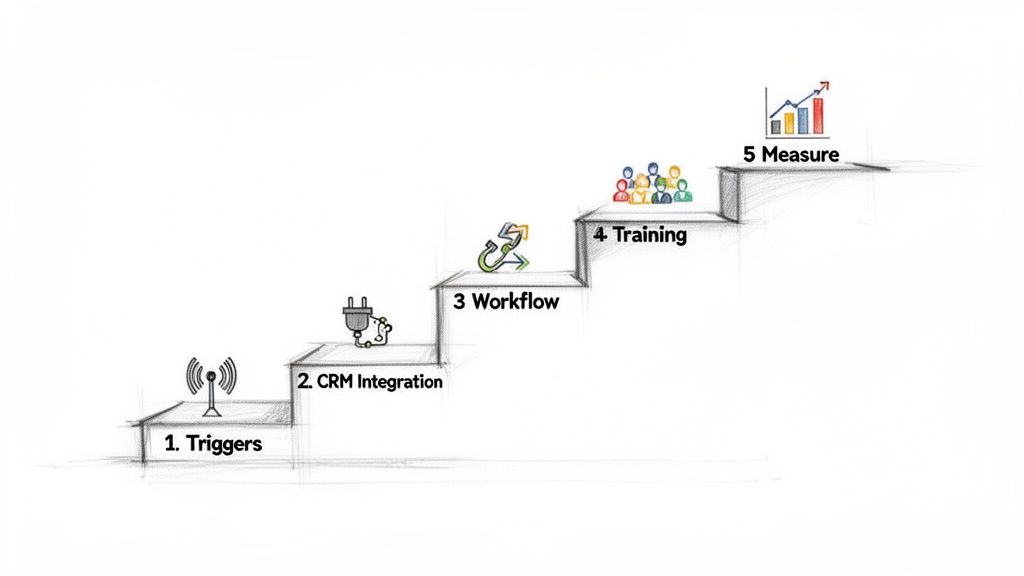
A 5-step process diagram depicted as a staircase, illustrating stages: Triggers, CRM Integration, Workflow, Training, and Measure.

This five-step framework is your roadmap. It’s built to get you from setup to proven ROI by chasing small wins and getting a little better every day.

Step 1: Define Your Prospecting Triggers

Before you touch any software, you have to decide what a "good opportunity" actually looks like. What specific events tell you an account is ready for outreach? This is the bedrock of your entire AI prospecting engine.

Generic signals get you generic outreach. Don't do that. Instead, zero in on triggers that are hyper-relevant to the problem you solve. This clarity is what separates a noisy, distracting AI from one that serves up genuinely prioritized tasks.

Actionable Step: Gather your top three sales reps and a marketing lead. Brainstorm and list the top 10 events that preceded your last five biggest deals. Circle the top three most reliable triggers—these are your starting point.

Your best triggers might look like this:

  • Competitor Shake-Ups: A key rival announces a big price hike or a service outage.
  • Hiring and Growth: A target account posts jobs for roles that scream for your solution (like a "Director of Supply Chain").
  • Tech Stack Changes: An account rips out a competing software from its tech stack.

Step 2: Ensure Deep CRM Integration

Your AI tool cannot be an island. If you want your team to actually use it, it has to live inside the system they already use all day, every day—your CRM. A shallow connection that requires manual data syncing is a recipe for failure.

Deep integration means AI-generated tasks, contact info, and activity logs show up and get updated right inside Salesforce or HubSpot. This isn't just a nice-to-have; it's critical for keeping a single source of truth and killing the friction of jumping between tabs.

The core difference here is workflow disruption vs. workflow acceleration. A non-native tool makes reps juggle tabs, copy-paste info, and manually log calls. A deeply integrated engine makes acting on an insight a one-click action inside the CRM.

Step 3: Configure Your First Automated Workflow

Don't try to boil the ocean. Start with one, high-impact workflow to prove the concept and build some momentum. Pick one of the triggers you defined in Step 1 and build a dead-simple, automated process around it.

For instance, your first workflow could be:

  1. Trigger: The AI flags a target account that just hired a new VP of Sales (your perfect champion).
  2. Action: The system automatically creates a "High Priority: New Champion" task in your CRM.
  3. Execution: That task lands with the account owner, complete with all the context, an AI-drafted email, and a click-to-call button.

This approach delivers an immediate, tangible win. Reps see the value right away, which is the secret to getting the whole team on board. If you're ready to get your hands dirty, guides on how to build a real estate AI agent with N8n and ChatGPT can offer a practical blueprint for creating your own automation.

Step 4: Empower Your Sales Team with Training

The point of training isn't just showing reps which buttons to click. It's about building their confidence by framing the AI as a powerful assistant that makes them better, not a replacement that threatens their job.

Actionable Step: Create a one-page "AI Quick-Start Guide" for your reps. Include: 1) What the AI does (automates research), 2) What it doesn't do (close deals for you), and 3) The top 3 ways it will help them hit their quota faster. Frame it as a tool for winning.

Good training has to focus on the "why" behind the "what." Explain how the AI surfaces better opportunities so they can have smarter conversations and crush their quota faster. Make it clear the AI handles the robotic research, freeing them up to do what humans do best: build relationships, tell good stories, and close deals.

Step 5: Measure What Matters

Finally, you have to track the right numbers to prove this AI investment is actually paying off. Vague goals like "improved efficiency" won't cut it. You need concrete KPIs that tie directly to pipeline and revenue.

Actionable Step: Before launch, establish a baseline for your key metrics. Then, track them weekly for the first 90 days. Present the "Before vs. After" results to your team to build momentum and prove ROI to leadership.

Track these key metrics before and after you go live:

  • Activity Volume: How many calls and emails is each rep sending per day?
  • Connection Rate: What percentage of calls actually turn into a conversation?
  • Pipeline Generated: What's the dollar value of new opportunities coming from AI-surfaced tasks?
  • CRM Data Hygiene: Are you seeing fewer manual logging errors and more accurately tracked activities?

Following this plan turns the big idea of AI for sales prospecting into a practical, results-driven reality for your team.

Crafting AI-Powered Outreach That Connects

This is where the rubber meets the road. All the lead scoring and intent signals in the world don't mean a thing if your outreach falls flat. This is the moment AI stops being a research tool and starts driving actual conversations. The real goal is to use it not just to find the right people, but to say the right thing at the right time.

Personalization used to be a pipe dream for outbound sales—it was just too time-intensive to do at scale. Not anymore. A staggering 58% of sales teams now use AI to help write their outreach, and 57% use it for prospect research. That lines up perfectly with the 57% of businesses that ramped up their AI investments in prospecting over the past year. They see it for what it is: a high-return activity. You can get a deeper look at these stats and discover insights on AI in sales and marketing.

This isn't about finding a new template. It's about shifting from generic blasts to context-aware conversations, with AI as the engine that finally makes it possible to do this for every single prospect.

From Robotic to Relevant: AI-Powered Emails

Let's be real: nobody wants an email that sounds like a robot wrote it. The fear of AI-generated messages coming across as cold and impersonal is totally valid, but it’s based on yesterday's tech. Modern AI doesn't just fill in blanks in a template; it synthesizes information to create a compelling, human-sounding starting point for your reps.

The secret sauce is context. A smart AI email tool plugs into the research it’s already done—like a recent funding announcement, a new product launch, or a key executive hire—and weaves that intel directly into the message.

Here’s what that looks like in the real world:

The Generic, Manual Email:

"Hi Sarah, I saw you’re the VP of Operations at Innovate Inc. and wanted to introduce our logistics platform. We help companies like yours streamline their supply chain. Are you free to connect next week?"

It’s polite, sure. But it’s also instantly forgettable. It’s all about the sender and has zero to do with Sarah or what's happening at Innovate Inc. right now.

The Context-Aware, AI-Assisted Email:

"Hi Sarah, I saw the news about Innovate Inc.'s expansion into the EU market—congratulations on the big move. As you navigate the complexities of cross-border logistics, our platform can help automate customs compliance, which is often a major hurdle. Is that a challenge on your radar?"

See the difference? This version is sharp, timely, and focused entirely on the prospect's world. The AI surfaced the "EU expansion" trigger and used it to frame a relevant problem. A rep can take this draft, add a touch of their own personality, and hit send on a message that has a real shot at getting a reply. You can see how this applies to broader campaigns in our guide on using email marketing to generate leads.

AI-Assisted Cold Calls That Actually Build Confidence

The same idea applies to cold calls. A great call isn't about rigidly reading a script; it’s about having a flexible, informed conversation. This is where AI gives reps a massive boost in both confidence and effectiveness.

Instead of a rep scrambling to find talking points a few seconds before dialing, an AI tool can generate a concise "call prep" brief right inside their CRM.

For RevOps leaders, this is a game-changer for consistency. AI ensures every rep—from the seasoned pro to the new hire—is armed with the same high-quality intelligence before every single dial.

This AI-generated brief can include things like:

  • Key Talking Points: A few bullets connecting your solution to the prospect’s recent company news.
  • Common Objection Handling: Smart suggestions for handling pushback, based on what's worked in similar calls.
  • Relevant Questions: Open-ended questions designed to uncover pain points related to the buying signals you've detected.

Think of it like an expert sales coach whispering in your rep’s ear. It doesn't tell them exactly what to say word-for-word. It gives them the strategic ammo they need to navigate the conversation with authority. This level of preparation turns a dreaded cold call into a strategic discussion, proving that AI doesn't make interactions less human—it makes reps more prepared, and therefore, more human.

Measuring Success and Avoiding Common Pitfalls

An AI platform is just another shiny object if it doesn't deliver results. When you bring AI for sales prospecting into your stack, you need a dead-simple way to measure its ROI and get ahead of the usual roadblocks. Vague goals won't cut it. You have to track the business-critical numbers that prove the tech is actually driving growth.
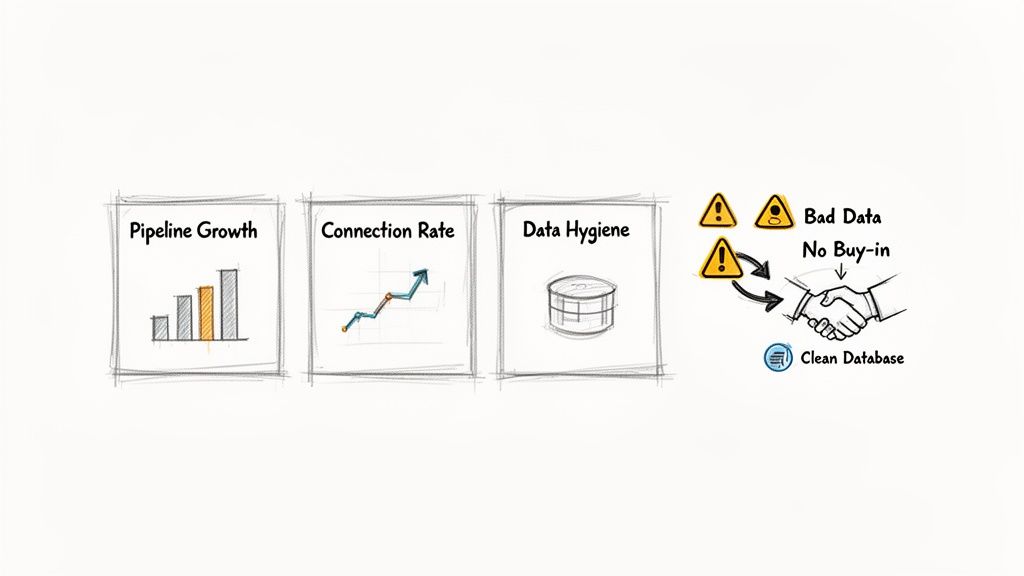
Sketched charts illustrate pipeline growth, connection rate, data hygiene, and the importance of a clean database over bad data.

This means shifting your focus from vanity metrics to the numbers that directly feed your pipeline. Instead of just celebrating a higher email volume, successful teams track the outcomes that really matter.

  • SDR Activity vs. Burnout: Is your team making more quality calls and sending smarter emails without burning the midnight oil on manual prep?
  • Connection and Conversion Rates: Are more conversations turning into booked meetings because reps have better, AI-surfaced insights at their fingertips?
  • CRM Data Hygiene: Is activity logging finally happening automatically and without errors, giving you a pipeline view you can actually trust?

These metrics give you a clear before-and-after picture, showing exactly how AI is moving the needle on both efficiency and effectiveness.

But here's the reality check: even the slickest tool will fail if the rollout is botched. There are a few classic pitfalls that can kill your AI initiative before it even gets off the ground. Knowing what they are—and having a plan—is the key to making this work long-term.

The biggest hurdle, hands down, is poor data hygiene. An AI is only as smart as the data it eats. If your CRM is a graveyard of duplicate records, old contacts, and half-filled fields, your AI's recommendations will be useless. That just leads to wasted effort and seriously frustrated reps.

The rule is simple: garbage in, garbage out. The teams that crush it with AI are the ones who commit to disciplined data management first. This isn't a one-time cleanup; it's a constant habit.

To sidestep these issues, you need a proactive game plan. The table below breaks down the common problems and the practical solutions.

Common PitfallActionable Solution
Lack of Team Buy-InDon't position AI as a replacement; frame it as an assistant that kills grunt work. Run a pilot with a small crew of champions to build early success stories and prove its value to the rest of the team.
Poor CRM IntegrationPick a tool with deep, native integration into your CRM, whether it's Salesforce or HubSpot. The goal is a seamless workflow where reps never have to leave their home base to act on AI-driven tasks.
Ignoring Data QualityGet regular data audits and automated deduplication processes on the calendar. Set up clear data governance policies so every new piece of information that enters the CRM is clean and consistent from day one.

By measuring the right things and tackling these roadblocks head-on, you can make sure your investment in AI for sales prospecting delivers a powerful, lasting impact on your revenue engine.

Got Questions About AI Prospecting?

Lots of sales leaders are kicking the tires on AI for sales prospecting, but they’ve got real, practical questions about how this stuff works on the ground. Let's cut through the noise and get straight to the answers.

Is AI Going to Replace My Sales Reps?

Nope. Think of AI as a world-class research assistant, not a replacement. The real win here is automating the soul-crushing grunt work that eats up to 40% of a rep’s day—endless digging, manual data entry, you know the drill.

This frees up your team to do what humans do best. AI preps the brief; your rep closes the deal. They get to focus on building actual relationships, navigating tricky objections, and solving customer problems in ways a machine never could.

How Does This Actually Plug into Our CRM?

This is a big one. The best AI prospecting tools don’t just sit next to your CRM; they live inside it. We’re talking deep, native integrations with platforms like Salesforce and HubSpot. Forget clunky tools that force your team to toggle between a dozen tabs and manually sync data. That’s a recipe for failure.

A native integration means AI-powered tasks and insights show up right where your team already works. No more copy-pasting. It keeps your CRM the clean, single source of truth for everything sales-related.

Can AI-Written Emails Actually Sound Human?

Early AI-generated text was painfully robotic, we’ve all seen it. But modern tools are in a different league because they’re driven by context, not just templates. They analyze company data, buyer personas, and recent trigger events to draft emails that are relevant and timely.

The goal isn't to hit "send" on a fully automated email. It’s about acceleration. The AI gives your rep a solid, 80% complete draft to work with. They add their own unique voice and personality, then send a highly personalized message in a fraction of the time.


Ready to see how a native AI task engine can light up your team's pipeline? marketbetter.ai embeds AI-powered emails and a one-click dialer directly into your Salesforce or HubSpot workflow, turning buyer signals into immediate, actionable tasks. See how it works at https://www.marketbetter.ai.


Lead Generation AI: A Practical Guide to Smarter Growth

· 24 min read

Lead generation AI is the strategic use of intelligent technology to find, qualify, and connect with potential customers. It transforms the traditional, manual playbook into a data-driven, predictive system that works smarter, not harder. The actionable result? Radically improved efficiency and a significant increase in closed deals.

The End of Guesswork in Lead Generation

A modern dashboard showing business analytics and charts, symbolizing AI-driven precision in marketing.

Imagine the difference between dragging a massive fishing net hoping to catch something and using a high-tech sonar that pinpoints exactly where the prize fish are swimming. That’s the leap from old-school lead gen to an AI-powered strategy. The best businesses are ditching the high-effort, low-return grind for the sharp precision of lead generation AI.

This isn't just about making things faster; it's a complete shift away from wishful thinking and toward predictable results. The old way was a messy affair of casting a wide net with generic campaigns, dialing down cold-call lists, and manually sifting through piles of unqualified names. It was a time-suck that left sales teams chasing dead ends.

From Manual Labor to Intelligent Strategy

Traditional methods are all about elbow grease and gut feelings. A marketing team might spend weeks cooking up a campaign based on loose demographic data, crossing their fingers that it lands. A sales rep could burn 80% of their day on tasks that don’t generate revenue, like digging for contact info and trying to qualify prospects.

Contrast that with an AI-driven approach. It automates the grunt work but does so with an intelligence a human can't match at scale. AI can analyze thousands of data points in a split second, flagging prospects who not only fit your ideal customer profile but are also actively showing signs they're ready to buy right now.

The real difference is simple. Old methods ask, "Who could we possibly sell to?" AI answers, "Who is most likely to buy, and what do we need to say to them?" This frees your team up to do what they do best: build relationships with people who actually want to talk.

The Old Way vs. The New Way: A Practical Comparison

When you put the two approaches side-by-side, the contrast is stark. This isn't just theory; it's a fundamental change in daily workflow and results.

TaskTraditional Lead Generation (The Old Way)Lead Generation AI (The New Way)Actionable Advantage
Lead SourcingManual list building, trade shows, generic ads.Predictive analytics identifies high-intent accounts.Focus your budget on accounts that are already showing buying signals.
QualificationManual BANT questions, subjective scoring.Automated lead scoring based on behavior & data.Your sales team only spends time on leads vetted by data, not guesswork.
PersonalizationUses basic fields like First_Name and Company.Hyper-personalization based on real-time behavior.Craft outreach that references a prospect's recent activity for higher reply rates.
EfficiencyHigh manual effort, slow response times.Automated workflows, 24/7 engagement via chatbots.Engage leads instantly, even outside business hours, preventing them from going to a competitor.

This isn't just a "nice to have" upgrade. The way people buy has fundamentally changed. Enterprise deals now involve more decision-makers and take longer to close, and every one of those people expects a relevant, personalized conversation. The tactics that were "good enough" a few years ago just don't cut it anymore. By adopting lead generation AI, you empower your team to stop chasing ghosts and start closing deals with your most valuable prospects.

How AI Learns to Find Your Best Leads

You don't need a computer science degree to understand how AI finds great leads. The easiest way to think about it is hiring a team of virtual specialists, each with a specific superpower. These specialists aren't magical—they're just core technologies that get incredibly good at learning from data to pinpoint your next best customer.

It all starts and ends with data. The more high-quality info you feed the system—everything from website visits and email opens to past sales wins and losses—the smarter it gets. This is the big difference-maker: an AI strategy is always learning and adapting, while old-school, rules-based systems just sit there.

Machine Learning: The Virtual Sales Expert

At the very heart of AI lead generation is Machine Learning (ML). Picture a seasoned sales director who’s personally reviewed every single deal your company has ever closed. They have a gut feeling for the subtle signs that separate a future champion from a dead-end prospect. ML does the exact same thing, just at a scale and speed no human ever could.

It digs through your historical sales data to find the hidden patterns and common traits of your best customers. An ML model learns which combination of factors—like company size, industry, tech stack, and online behavior—are most likely to lead to a signed contract. This lets it assign a predictive score to every new lead, bumping the most promising ones right to the top of your sales team's list.

Here’s a quick look at how the old way stacks up against the ML-powered approach:

Lead Scoring AspectTraditional Method (Manual)Machine Learning Method (AI)Actionable Advantage
CriteriaRelies on simple demographics like job title or company size.Analyzes hundreds of behavioral and firmographic data points.Your scores reflect actual buying intent, not just a static profile.
AdaptabilityUses static rules that have to be updated by hand.Dynamically learns and adjusts scores as new data flows in.The system gets smarter over time without manual intervention.
AccuracyProne to human bias and subjective guesswork.Objectively prioritizes leads based on the statistical chance of conversion.Sales trusts the leads because they're backed by data, leading to higher follow-through.
OutcomeSales reps waste time chasing poorly qualified leads.Sales focuses its energy on high-potential leads, making everyone more efficient.Increased conversion rates and a shorter sales cycle.

Natural Language Processing: The 24/7 Receptionist

Next in the lineup is Natural Language Processing (NLP). This is the tech that fuels intelligent chatbots and understands text-based conversations. Think of an NLP-powered chatbot as a tireless, incredibly smart receptionist working on your website around the clock.

When a visitor asks a detailed question like, "Do your integration features work with our existing sales software, and what is the pricing for an enterprise team?" the bot doesn't just scan for keywords. NLP lets it understand the intent and context behind the words. It can answer the question directly, ask smart follow-up questions to qualify the visitor, and even book a demo with the right sales rep—all without a human lifting a finger.

Actionable Tip: Deploy an NLP chatbot on your pricing page. This is where visitors with high buying intent go. The bot can answer last-minute questions, offer a demo, and capture the lead before they navigate away.

Predictive Analytics: The Business Fortune Teller

Finally, there's Predictive Analytics, which acts like your company’s own fortune teller. While ML is busy scoring individual leads, predictive analytics is looking at the bigger picture. It crunches your historical data and current market trends to forecast future outcomes and spot opportunities you might otherwise miss.

For instance, it can identify which market segments are poised for growth or which types of accounts deliver the highest lifetime value. This allows you to proactively target entire companies or industries that fit the profile of your best customers, long before they even know you exist. The results speak for themselves; companies using AI have reported up to a 50% increase in lead generation and a 47% improvement in conversion rates. That kind of jump comes directly from shifting from a reactive to a predictive strategy, as detailed in the latest lead generation software market report.

When you understand how these systems use data to forecast behavior, you can put your marketing dollars and sales efforts exactly where they'll have the biggest impact. To go a bit deeper on this, check out our guide on how predictive analytics reshapes modern marketing.

Putting AI to Work in Your Sales Funnel

A visual representation of a sales funnel with AI icons at each stage, indicating how technology enhances the process.

It's one thing to talk about AI for lead gen in theory. It's another thing entirely to plug it into your sales funnel and see what it can actually do. The good news is, you don't have to rip and replace your entire process overnight.

Think of it as adding boosters at critical stages of the journey. AI’s job is to amplify what your team is already great at. It automates the soul-crushing repetitive work, spots the insights you might miss, and frees up your people to focus on closing deals. This is how you turn a leaky funnel into a high-pressure revenue engine.

Automating Lead Scoring and Prioritization

One of the quickest wins you can get with AI is in lead scoring. For years, this was a manual, rules-based guessing game. Sales teams would assign points based on static data like job title or company size, often chasing leads that looked good on paper but had zero intent to buy.

AI flips that script completely. Instead of relying on gut feelings, it analyzes hundreds of real-time behavioral signals—like someone binging three blog posts, revisiting the pricing page, and opening every email. It connects those dots to find the prospects who are actually ready for a conversation. This guarantees your team is always calling the hottest lead first.

The real shift is moving from a system that asks, "Who fits our ideal customer profile?" to one that answers, "Who is most likely to buy right now?" It's a small change in wording with a massive impact on your sales velocity.

To get this set up, check out our playbook on building an effective AI lead scoring system.

Engaging Prospects with Intelligent Chatbots

Your website is your digital storefront. But for most companies, it’s a passive experience where prospects have to fill out a "Contact Us" form and wait. An intelligent chatbot turns that passive site into a 24/7 lead qualification machine.

And I'm not talking about those clunky, rules-based bots that can't understand a typo. AI-powered chatbots use Natural Language Processing (NLP) to actually understand what your visitors are asking. They can answer tough questions, qualify leads on the spot, and even book a demo right into a sales rep's calendar.

Here's how that plays out:

  • Before AI: A hot prospect hits your pricing page at 10 PM. They have a question but have to submit a form. By the time your rep follows up the next morning, the prospect has already moved on.
  • After AI: That same prospect gets their question answered instantly by the chatbot. The bot sees they're from a target account, qualifies them, and books a meeting for the next day. The deal is already in motion.

This kind of immediate, helpful engagement is a game-changer for reducing drop-off. If you want to put this into practice, here's a great guide on building a chatbot specifically for lead generation that actually gets results.

Crafting Personalized Outreach at Scale

Everyone knows personalization works, but nobody has time to manually research every single prospect for a 1,000-person campaign. This is where AI really shines—it makes true one-to-one personalization possible at scale.

AI tools can scan a prospect's LinkedIn profile, company news, and recent online activity to find the perfect hook for an email. It’s way beyond just dropping in a {First_Name} token.

Actionable Tip: Use an AI writing assistant to generate three different opening lines for your next cold email sequence. Test them on a small batch of leads and see which one gets the highest reply rate. This simple A/B test can significantly lift campaign performance.

Imagine an AI crafting an email that mentions a recent funding round, a new product launch, or even a blog post your prospect just shared. That's the kind of message that cuts through the noise and gets a reply. It’s how you build real rapport from the very first touchpoint, without your team spending all day on research.

Choosing the Right AI Lead Generation Tools

Stepping into the world of AI lead generation tools can feel like walking into a massive electronics store. You know you need something, but the sheer number of options is dizzying. The key isn't to find the "best" tool, but the best tool for your specific needs, your tech stack, and your business goals.

The market isn't a monolith; it's a collection of specialized solutions. Getting a handle on the main categories is the first step to making a smart decision that actually delivers a return.

Understanding the Main Tool Categories

Not all AI tools are built to solve the same problem. Some are massive, comprehensive platforms designed to handle everything, while others are specialists that do one thing exceptionally well. Your choice comes down to the biggest gaps in your current process.

Here’s a breakdown of the four primary types of AI lead generation tools you’ll run into:

  • All-in-One CRM Platforms: Think of these as the Swiss Army knives of sales and marketing. Platforms like HubSpot and Salesforce have baked AI features directly into their core CRM, offering things like predictive lead scoring, automated workflows, and content personalization all under one roof. They’re perfect for teams that want a single source of truth and can't stand juggling disconnected systems.

  • Dedicated Lead Scoring Tools: These are the sharpshooters. Tools like MadKudu focus on one thing and do it better than anyone: analyzing your data to predict which leads are most likely to buy. They’re a great fit for companies that already have a good CRM but need a more powerful, data-science-driven engine to prioritize where sales should spend their time.

  • Conversational AI Chatbots: Platforms like Drift are built to engage your website visitors the second they land on your site. They act as your 24/7 digital sales reps, qualifying leads, answering basic questions, and booking meetings instantly. This category is a game-changer for businesses that get solid website traffic and want to convert more of those anonymous visitors into actual conversations.

  • Data Enrichment Platforms: Tools such as ZoomInfo use AI to find, verify, and flesh out contact and company data. Their whole job is to make sure your sales team has the most accurate and complete information possible before they ever pick up the phone. They are absolutely critical for teams running outbound prospecting and account-based marketing plays.

How to Select the Right Fit for Your Business

Choosing the right tool requires a clear-eyed look at your own organization. What works for a massive enterprise won't be the right fit for a nimble startup. Start by asking yourself a few fundamental questions about your biggest bottlenecks.

The image below from HubSpot shows how an all-in-one platform presents its AI features, often bundled into a cohesive suite.

This approach is all about having a unified system where AI enhances the workflows you already use, all within a familiar environment.

The most common mistake is buying a powerful tool to solve a problem you don't actually have. Before you even look at a feature list, map out your current sales process and pinpoint the exact stage where you're losing the most momentum.

Comparison of Lead Generation AI Tool Categories

To make this even clearer, let's put these tools side-by-side. This table breaks down the different categories to help you map your specific challenges to the right type of solution.

Tool CategoryPrimary FunctionIdeal ForExample ToolsKey Consideration
All-in-One CRM PlatformsUnify sales & marketing data with built-in AITeams wanting a single, integrated systemHubSpot AI, Salesforce EinsteinBest value if you use the entire platform, can be overkill otherwise.
Dedicated Lead ScoringPredict lead conversion likelihood with high accuracyCompanies with high lead volume needing prioritizationMadKudu, InferRequires clean, historical data to be effective. Focuses on "who," not "how."
Conversational AI ChatbotsEngage & qualify website visitors in real timeBusinesses with strong website trafficDrift, IntercomExcellent for inbound conversion, less so for outbound prospecting.
Data Enrichment PlatformsFind, verify, and complete contact & company dataOutbound-heavy sales teams & ABM strategiesZoomInfo, ClearbitSolves data accuracy but doesn't manage the outreach workflow itself.

This table should give you a solid framework for starting your search. The goal is to find a tool that slots directly into your biggest area of need, not one that forces you to change your entire process.

When you're evaluating your options, it's always a good idea to look at direct comparisons and check out alternatives to AI-powered lead generation platforms like Seamless.AI to get a feel for the market. This ensures you invest in tech that truly aligns with your team’s workflow and budget.

By starting with your problem, not the product, you make sure your investment actually drives growth.

Your Step-By-Step AI Implementation Plan

Bringing new tech into the mix can feel like a monster project, but if you break it down into a clear, actionable plan, it's totally manageable. Getting started with lead generation AI isn't about flipping a switch and hoping for the best. It's a methodical rollout—one that builds momentum and proves its worth every step of the way. This roadmap is designed to get you from planning to adoption, all based on a simple philosophy: start small, then scale.

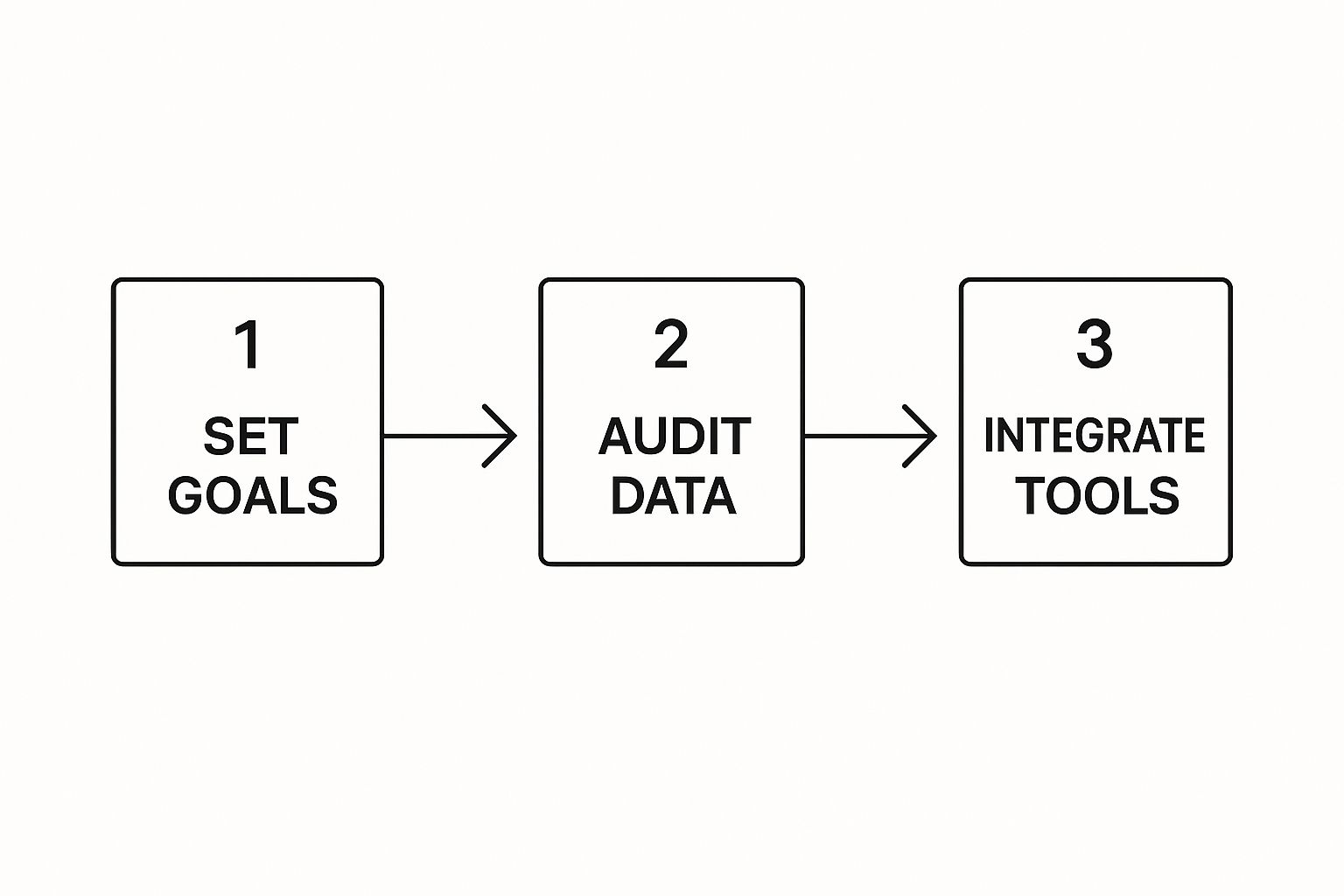
Step 1: Set Clear and Measurable Goals

Before you even glance at a single tool, you need to define what a "win" actually looks like. Your goals are the anchor for your entire strategy. Without them, you risk buying a powerful platform that solves a problem you don't even have. Ditch the vague objectives like "improve lead generation" and get specific.

For instance, a solid goal is: "Reduce our average lead response time by 50% within the next quarter." It's specific, you can measure it, and it has a deadline. Another good one? "Increase the marketing qualified lead (MQL) to sales qualified lead (SQL) conversion rate by 15% in six months." Setting these kinds of benchmarks from the jump gives you a clear way to measure ROI down the road.

Step 2: Audit and Prepare Your Data

Here’s the hard truth: your AI is only as smart as the data you feed it. Think of it like a world-class chef—they can't whip up a gourmet meal with rotten ingredients. Before you do anything else, you have to conduct a serious audit of the data living in your CRM and other systems.

Start by asking the tough questions:

  • Is our data clean and standardized? Hunt down duplicates, incomplete records, and weird formatting.
  • Is our historical data accurate? The AI will be digging through past wins and losses to find patterns, so that information has to be trustworthy.
  • Do we have enough data? A machine learning model needs a decent volume of past lead and customer data to actually learn anything useful.

Data hygiene isn't a one-and-done task. It's an ongoing discipline. Getting standardized data entry protocols in place is non-negotiable for long-term AI success.

The most common reason AI initiatives fail isn't the technology itself—it's poor data quality. A clean dataset is the foundation upon which every successful AI strategy is built.

Step 3: Select and Integrate the Right Tools

Okay, goals are set and your data is in order. Now you can confidently start looking for a tool that lines up with your needs. As we’ve covered, the market is full of options, from all-in-one CRMs to specialized predictive scoring tools. Your choice should directly solve the main bottleneck you identified back in Step 1.

This visual lays out a simple path from planning to getting your tools integrated.

Infographic about lead generation ai

As you can see, setting goals and prepping your data are the essential first moves before you ever think about software.

Once you’ve picked your platform, integration is the next hurdle. A tool that doesn't talk to your existing CRM or marketing automation software is just going to create headaches. Prioritize solutions with solid, well-documented APIs and native integrations to make sure information flows smoothly across your entire tech stack.

Step 4: Train Your Team for High Adoption

A brilliant tool is completely useless if your team doesn't know how—or why—to use it. Good training isn't just about showing them which buttons to click. It’s about proving how this new lead generation AI will make their jobs easier and more successful.

Frame the training around their specific pain points. Show your sales reps how predictive lead scoring means fewer dead-end cold calls and more conversations with people who are actually ready to buy. For your marketers, demonstrate how AI-powered personalization can seriously boost campaign engagement. When your team sees how it directly benefits their own workflow (and their commission checks), adoption will follow.

Step 5: Start Small, Then Scale Your Strategy

Finally, fight the urge to roll out every single AI feature to the entire company at once. That's a recipe for disaster. Instead, kick things off with a single, high-impact pilot program. For example, implement an AI lead scoring model for just one sales team. Or launch an intelligent chatbot on one specific high-traffic page of your website.

This approach lets you iron out the kinks on a smaller scale, rack up some early wins, and build a powerful internal case study. Once you've proven the value and shown a clear ROI, you can use that success story to get broader buy-in and strategically scale your AI implementation to other teams and use cases.

How to Measure Your AI Lead Generation ROI

A digital dashboard with charts and graphs showing a positive return on investment, symbolizing successful AI implementation.

Throwing money at a new lead generation AI feels good, but justifying the spend requires hard numbers, not just a gut feeling. To get buy-in for next year's budget, you have to prove its worth. That means moving past vanity metrics and focusing on the KPIs that tie AI's work directly to revenue.

This is how you build an undeniable business case. Tracking the right numbers shows exactly how AI is making your entire sales process leaner, faster, and more profitable. It’s all about comparing the "before" and "after" to show a clear, positive hit to your bottom line.

Core KPIs for AI Impact

You don't need a hundred different charts. Start with a few critical metrics that tell a powerful story about how AI is improving lead quality and sales velocity.

  • Lead Conversion Rate: This is the big one—the percentage of leads that actually become customers. AI is supposed to find the needles in the haystack, so your sales team should be talking to more people who are ready to buy. A rising conversion rate is the clearest sign that it’s working.

  • Customer Acquisition Cost (CAC): How much does it cost to land a new customer? By automating grunt work and sharpening your targeting, AI cuts down on wasted time and ad spend. A lower CAC means every new customer is more profitable from day one.

  • Lead-to-Opportunity Ratio: This tracks how many leads are good enough to become a qualified sales opportunity. When AI handles the initial scoring and filtering, this number should climb. It’s proof that marketing is handing off better, more vetted prospects to the sales team.

Calculating Your Return

Now, let's tie it all together with a simple formula. The investment in this space is massive for a reason. The global AI market is already valued at around $391 billion as of 2025, with AI marketing alone on track to blow past $107 billion by 2028. You can get a better sense of the scale from these powerful AI market statistics.

The simplest ROI formula is: (Gain from Investment - Cost of Investment) / Cost of Investment. A positive result means your AI is officially paying for itself.

To make it real, think about the specific gains. Let's say your AI tool costs $20,000 a year but helps your team close an extra $100,000 in revenue because the lead scoring is so sharp. That's a huge win.

For a deeper dive into these numbers, our guide on how to calculate marketing ROI breaks down the entire framework. By keeping a close eye on these KPIs, you can prove that your lead generation AI isn't just another line item—it's a revenue engine.

Got Questions About AI in Lead Generation? We’ve Got Answers.

Jumping into an AI-driven strategy always sparks a few questions. It's a big shift. Let's tackle the most common ones head-on with some straight answers.

How Is This Really Different from What We Do Now?

AI takes the guesswork out of lead generation and replaces it with data-backed precision. Think about your traditional tactics—they often rely on static lists and broad-strokes campaigns. It's slow, a bit clunky, and you burn a lot of energy chasing leads that go nowhere.

AI flips that script. It’s always on, analyzing real-time buying signals to pinpoint leads who are actually showing intent. This means your sales team stops wasting time on cold trails and starts focusing their efforts on prospects who are genuinely ready to talk.

The real difference comes down to speed and intelligence. A traditional approach might take weeks to manually qualify a list of 1,000 leads. An AI system can score and prioritize that same list in minutes, collapsing your sales cycle.

Do I Need to Be a Tech Whiz to Use These Tools?

Absolutely not. Modern lead generation AI platforms are built for marketers and salespeople, not data scientists. Forget command lines and complex code—the best tools today are all about intuitive dashboards and guided workflows.

If you can use a CRM, you can use these tools. Most of the time, you’re just a few clicks away from setting up a sophisticated lead scoring model or launching a highly personalized campaign. All the heavy lifting—the hardcore data analysis and predictive modeling—is handled for you, humming away in the background.

Is This Actually Cost-Effective?

Yes, and the ROI becomes clearer the longer you use it. While there’s an initial investment, the real value shows up in a few key places:

  • Less Manual Grind: AI automates the repetitive, time-sucking tasks that bog down your team, freeing them up for high-value work.
  • Smarter Effort: By focusing your team only on the best-fit leads, conversion rates naturally go up. You start generating more revenue from the same pool of prospects.
  • Lower Acquisition Costs: When you stop spraying and praying with your ad spend and outreach, your Customer Acquisition Cost (CAC) drops significantly.

Ultimately, AI lets you scale your growth without having to scale your headcount at the same rate. That makes it one of the smartest long-term investments you can make for your pipeline.


Ready to see how an integrated AI platform can transform your entire marketing and sales funnel? marketbetter.ai unifies content creation, campaign optimization, and customer engagement to deliver measurable results. Get a demo today and discover your path to smarter growth.