
The Modern B2B Inbound Lead Gen Playbook
Inbound lead gen isn't about shouting into the void with cold outreach. It’s the art of attracting customers to your business with genuinely valuable content and experiences. Think of it as a magnetic approach that pulls interested prospects toward you, creating warmer, more qualified leads who are already looking for the exact solution you provide.
This shift—from pushing messages out to pulling an audience in—is the entire game for sustainable B2B growth.
Why Inbound Lead Gen Is Crushing It in B2B Today
Let's be real: B2B buyers are smarter and more self-sufficient than ever. They’re deep into their research online—reading blogs, comparing solutions, watching demos—long before they ever want to talk to a salesperson. This is precisely where inbound marketing shines. It meets buyers exactly where they are with helpful information, not an unsolicited pitch.
The philosophy is simple: earn attention, don't buy it.
An outbound strategy, like a mass cold email blast, is a pure interruption. You're fighting for a sliver of a prospect's time they never planned on giving you. Inbound, on the other hand, builds a lasting asset. When a potential customer stumbles upon your definitive guide that solves one of their biggest headaches, you're not just another vendor. You're a trusted authority.
Inbound vs. Outbound: The Core Difference
This difference in approach creates a massive difference in results. Sure, outbound can sometimes generate a quick spark of interest (often low-quality), but inbound builds a predictable engine for growth that runs for you. Let's compare the two head-to-head.
| Feature | Inbound Lead Gen (Magnetic) | Outbound Lead Gen (Megaphone) |
|---|---|---|
| Approach | Attract prospects with valuable content (SEO, blogs, social). | Interrupt prospects with direct outreach (cold calls, email blasts). |
| Lead Quality | Higher quality; leads are actively researching a solution. | Lower quality; leads are often unqualified and not in-market. |
| Cost | Lower cost-per-lead over time as content assets compound. | Higher cost-per-lead; requires constant manual effort and ad spend. |
| Scalability | Highly scalable; a single blog post can generate leads for years. | Difficult to scale; requires hiring more reps to make more calls. |
Inbound marketing is about creating a system where your ideal customers find you, trust you, and actually want to do business with you. It transforms your marketing from a line item expense into a revenue-generating asset that appreciates over time.
The Real-World Impact on Your Pipeline
This isn't just a philosophical debate; the numbers don't lie.
Recent studies show inbound tactics generate 54% more leads than outbound marketing, all while slashing the cost per lead by a whopping 62%. The advantage gets even starker when you look at closing rates. SEO-driven leads, for instance, have a lead-to-close rate that is seven times higher than outbound leads.
To really make this work, you need to build an automated lead generation system that consistently pulls in, nurtures, and converts your ideal customers. That strategic foundation is what separates a few lucky wins from sustainable, cost-effective growth.
Defining Your Audience and Setting Clear Goals
Every great inbound lead gen program starts with a moment of intense clarity, not a flurry of content creation. Before you touch a keyboard to write a blog post or design a landing page, you have to be crystal clear on two things: who you're talking to and what you're trying to accomplish.
Without that foundation, you're just making noise.
Trying to market to everyone is the fastest way to resonate with no one. The real first step is nailing down a detailed Ideal Customer Profile (ICP). This goes way beyond surface-level details like company size or industry. A truly useful ICP defines the specific DNA of the companies that get the most value from what you sell—and, in turn, are the most profitable for you.

Crafting a B2B Ideal Customer Profile
A weak ICP sounds like, "We sell to mid-market tech companies." That's not a profile; it's a guess.
A strong, actionable ICP gets surgically precise: "We target Series B to D SaaS companies with 200-1,000 employees, a dedicated marketing team of at least 10 people, and a clear need to improve content creation velocity."
See the difference? That level of detail is what allows you to actually target your marketing. Once you have that company-level foundation, you can start building out personas for the key people inside those accounts. You have to remember that in B2B, you're never selling to just one person.
The buying committee is a real thing, and each member has their own agenda.
- The Champion (e.g., Content Marketing Manager): They're in the trenches, worrying about content quality and workflow headaches.
- The Decision-Maker (e.g., CMO/VP Marketing): They live and die by ROI, campaign performance, and hitting board-level targets.
- The Influencer (e.g., Marketing Ops): Their world is about smooth tech integrations and making sure the process doesn't break.
When you understand these distinct roles, you can stop creating generic content and start speaking directly to each person’s problems. A deep-dive guide on customer segmentation strategies in our guide, for example, is tailor-made for that marketing director trying to get their team to focus on the right accounts.
From Personas to Actionable SMART Goals
Okay, so you know exactly who you're talking to. Now what? You need to set goals that actually mean something. "Get more leads" isn't a goal; it's a wish. It’s useless for guiding a team.
This is where the SMART framework—Specific, Measurable, Achievable, Relevant, and Time-bound—comes in. It’s a classic for a reason. It forces you to turn vague ambitions into concrete targets that create real accountability.
The difference is night and day.
| Vague Goal | SMART Goal |
|---|---|
| Increase website conversions. | Increase the conversion rate on our main demo request landing page from 2.5% to 4% by the end of Q3. |
| Generate more MQLs. | Generate 150 new Marketing Qualified Leads (MQLs) from organic blog traffic in Q2. |
| Lower acquisition costs. | Reduce our Customer Acquisition Cost (CAC) for inbound leads from $550 to $475 within the next six months. |
These are goals you can build a plan around. They give your team a finish line to run toward, transforming your inbound strategy from a collection of random activities into a focused, data-driven growth engine.
The connection between a well-defined audience and sharp, measurable goals is the most critical link in any inbound lead gen strategy. One without the other is a recipe for wasted resources and disappointing results.
By anchoring your entire plan in who you're talking to and what success looks like, you create a powerful filter for every decision you make. Suddenly, every blog post, every ad campaign, and every dollar spent has a clear purpose: driving your business toward its most important objectives.
Creating Content That Attracts and Converts
Alright, you’ve defined your goals and you know exactly who you’re talking to. Now comes the fun part: building the engine for your entire inbound lead gen machine. I’m talking about content.
But let's be clear. This isn't about tossing random blog posts into the void and hoping someone bites. It's a calculated process. We're going to map specific content formats to each stage of the buyer's journey to attract, engage, and ultimately, get them to raise their hand.
Think of it like this: every piece of content you create has a job to do. It’s supposed to guide a prospect from one room to the next, building trust and momentum along the way. Your goal is a content calendar where every single asset—from a short video to a deep-dive whitepaper—is pulling its weight.
Mapping Content to the Buyer's Journey
The content that grabs the attention of someone just realizing they have a problem is worlds away from what a buyer needs when they're comparing you against two competitors. This is one of the most common places I see strategies fall apart. You can't offer a demo to someone who doesn't even have a name for their pain point yet.
Let's break down how to get this right:
- Awareness Stage: Your ideal customer is feeling the pain, but they can't quite diagnose it. Your job here is to educate, not to sell. Think helpful blog posts like "5 Signs Your Manual Reporting is Costing You Money," easy-to-digest infographics, or short, sharp educational videos.
- Consideration Stage: They've put a name to their problem and are now actively hunting for solutions. This is where you can start to introduce your brand as a credible answer. Webinars that go deep, detailed case studies, and comprehensive guides that compare different approaches are gold here.
- Decision Stage: The prospect has a shortlist, and you're on it. Now, your content needs to scream, "Here's why you should choose us." This is the time to roll out the big guns: product demos, free trials, one-on-one consultations, and crystal-clear pricing pages.
The best inbound programs don’t just create content; they create a content experience. Each piece should feel like the natural next step, guiding a prospect from a vague problem to a clear solution—with your brand as the trusted expert.
From Brainstorming to a Repeatable Framework
So, how do you stop guessing what to write about and start creating things your audience is actually searching for? You need a system.
Start by talking to your sales and customer success teams. Seriously, book the time. They are on the front lines every single day, hearing the raw, unfiltered challenges your customers face. Their insights are your topic goldmine.
Once you have a list of ideas, fire up a keyword research tool to validate them. You're looking for phrases with decent search volume and an intent that perfectly matches your ICP's problems. This two-step dance—internal interviews plus external data—is the key to making sure your content is both relevant and discoverable. To really nail this down, check out this complete content marketing strategy guide.
B2B Content Funnel Mapping
To help you visualize this, here's a table that breaks down which content formats work best at each stage of the funnel. Think of it as your cheat sheet for matching the right asset to the right audience at the right time.
| Funnel Stage | Primary Goal | Effective Content Formats | Key Metrics |
|---|---|---|---|
| Top of Funnel (Awareness) | Attract & Educate | Blog Posts, Infographics, Social Media, Short Videos, Checklists | Website Traffic, Social Engagement, Keyword Rankings, Video Views |
| Middle of Funnel (Consideration) | Build Trust & Provide Solutions | Case Studies, Webinars, Whitepapers, Ebooks, Comparison Guides | Lead Magnet Downloads, Webinar Registrations, Time on Page |
| Bottom of Funnel (Decision) | Convert & Close | Demos, Free Trials, Consultations, Pricing Pages, Testimonials | Demo Requests, Trial Sign-ups, Conversion Rate, Sales Inquiries |
Using a map like this takes the guesswork out of your content calendar. You're no longer just creating "stuff"—you're strategically deploying assets designed to move people forward.
Comparing Content Distribution Tactics
Creating a brilliant piece of content is only half the job. A game-changing whitepaper that nobody ever sees is just a fancy PDF sitting on your server. Your distribution strategy is what turns that asset into a lead-generating powerhouse.
You've got a few key levers to pull, and a balanced approach usually wins.
| Channel | Primary Goal & Use Case | Key Advantage |
|---|---|---|
| SEO | Long-term organic discovery. This is for grabbing people who are actively searching for answers to their problems. | Builds a compounding asset that generates leads around the clock without you having to constantly feed it ad dollars. |
| Precise audience targeting. Perfect for pushing content to specific job titles, industries, and company sizes. | There is simply no better platform for B2B targeting. You can put your content right on the screen of your ICP. | |
| Email Newsletters | Nurturing existing contacts. Ideal for re-engaging your list and guiding them deeper into the funnel. | You own this channel. It's a direct, reliable line to your warmest audience—people who have already said yes. |
Ultimately, the right mix depends on your immediate goals. For sustainable, long-term growth, SEO is your bedrock. For hyper-targeted ABM plays, LinkedIn is your scalpel. And to get the most value from the audience you've already earned, email is your most trusted tool.
Building Your Lead Capture and Scoring Machine
Getting traffic to your site is a great start, but it's really just the first half of the inbound lead gen playbook. The real work begins when you have to turn that hard-won traffic into actual, actionable leads your sales team can run with. This is where you build the machine that separates anonymous visitors from qualified prospects.
It all starts with optimizing every single conversion point, from your landing pages and forms to the very first conversation a prospect has with your brand. A huge piece of this puzzle is using smart tools like lead generation chatbots to engage and qualify visitors 24/7. These bots can handle the initial questions and gather key info without any friction, keeping the momentum going even when your team is offline.
Think about the path a buyer takes—it's not a straight line. They move from being vaguely aware of a problem to actively considering solutions, and finally, making a decision.
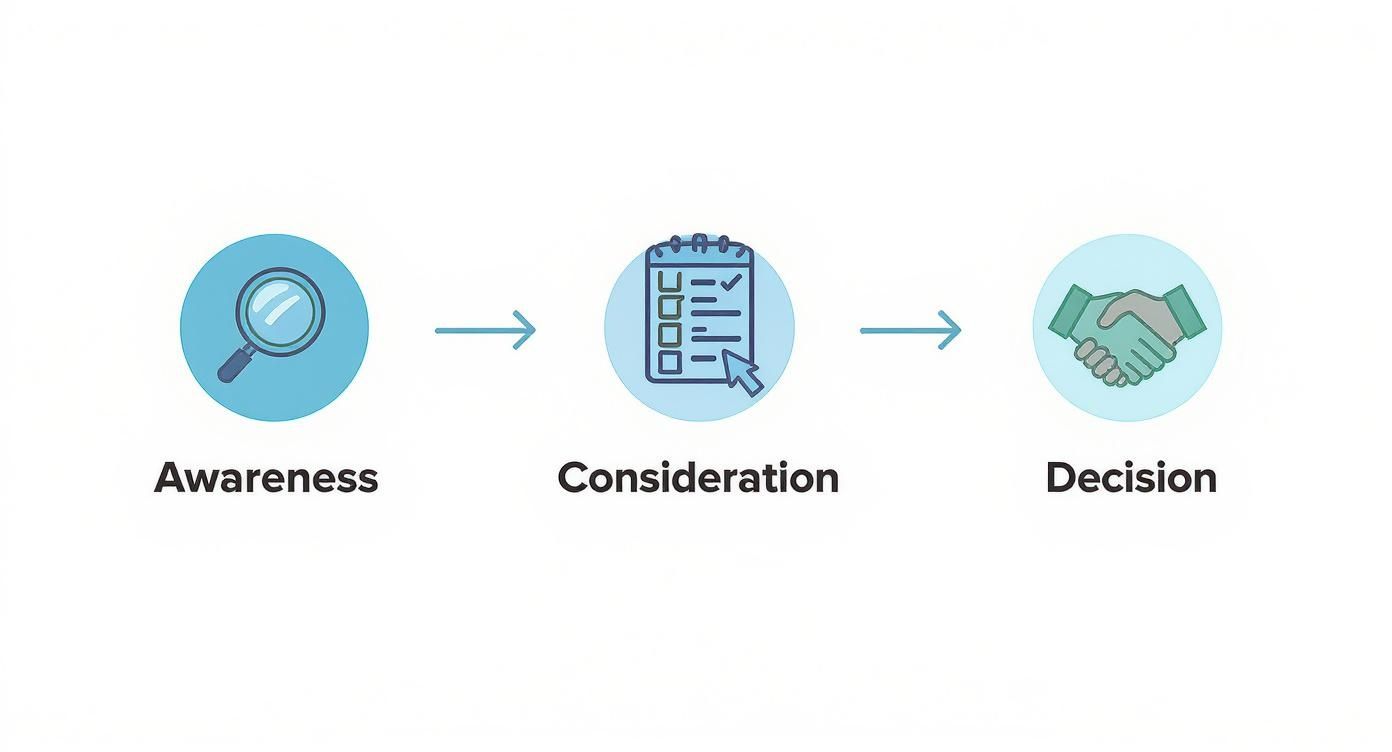
This journey underscores a critical point: your capture strategy needs to meet buyers where they are, offering the right thing at the right moment.
Designing Intelligent Forms and Landing Pages
Let's be honest, not all forms are created equal. Slapping the wrong one on a landing page is a surefire way to tank your conversion rates. The guiding principle is simple: the value of what you're offering must feel greater than the "cost" of filling out the form.
For a top-of-funnel asset—say, a quick checklist or an infographic—keep the barrier to entry almost nonexistent. Name and email. That's it. If you start asking for their phone number, company size, and job title right away, you’re creating friction for someone who's just kicking the tires.
This is where progressive profiling is a game-changer. When that same person comes back for a more substantial, middle-of-funnel piece like a detailed whitepaper or a case study, you can ask for a little more. Smart forms will recognize them and swap out the fields they've already filled in for new ones, letting you build a richer profile over time without being intrusive.
| Form Type | Best For | Typical Fields | Key Benefit |
|---|---|---|---|
| Short-Stack Form | Top-of-funnel assets (checklists, infographics) | First Name, Email | Maximizes conversion volume by reducing friction. |
| Progressive Profiling | Mid-funnel assets (webinars, case studies) | Job Title, Company Size (on 2nd visit) | Gathers deeper qualifying data without overwhelming new leads. |
| Long-Form / Demo | Bottom-of-funnel requests (demo, consultation) | All relevant fields, including custom questions | Captures high-intent leads with all necessary info for sales. |
Setting Up a Practical Lead Scoring System
Okay, so the leads are coming in. Now what? You need a system to sift through them and separate the curious browsers from the people who are actually ready to talk to sales. That’s exactly what lead scoring is for. It's a method of assigning points to leads based on who they are and how they're interacting with you.
A solid scoring model ensures your sales team doesn't waste a single minute on unqualified leads and can pour all their energy into the opportunities most likely to close. It’s the critical bridge between marketing activity and sales results.
You can start by defining criteria that fall into two main buckets.
1. Firmographic and Demographic Data (Who They Are) This is all about how well a lead fits your Ideal Customer Profile (ICP). You assign points based on the explicit data they give you.
- Job Title: A "VP of Marketing" might get +15 points, while a "Student" gets -10.
- Company Size: If you target enterprise, a company with 1,000+ employees could be worth +20 points.
- Industry: A lead from a target industry like "B2B SaaS" might get +10 points.
2. Behavioral Data (What They Do) This is where you track engagement to gauge their interest and intent. These actions signal they're actively researching a solution like yours.
- High-Value Page Visits: Someone checking out your pricing page? That’s a strong signal. Give them +15 points.
- Content Downloads: Downloading a "Decision Stage" case study is a big deal. That could be worth +20 points.
- Email Engagement: If they’re consistently opening and clicking your emails, add +5 points for each action to reflect that interest.
Your lead scoring threshold—the magic number that turns a lead into a Marketing Qualified Lead (MQL) ready for sales—shouldn't be set in a vacuum. It needs to be a collaborative decision, the handshake agreement that gets marketing and sales perfectly aligned on what a "good" lead really looks like.
Building a model from scratch can feel complicated, but it's an essential part of an efficient inbound engine. If you're ready to go deeper, our playbook on AI-powered lead scoring offers a complete framework for building a predictive and highly effective system. When you combine firmographic fit with behavioral intent, you create a powerful machine that doesn’t just capture leads—it intelligently qualifies them to drive real revenue.
Turning Interest into Pipeline with Smart Nurture Sequences
Alright, so you’ve got a new lead in the system. Your content worked. But let’s be real for a second: 96% of the people who land on your website aren't ready to buy anything. Not even close.
This is the moment where your inbound lead gen machine shifts gears—from simply capturing a name and email to actually building a relationship. And smart automation is how you do this at scale without drowning your team in manual follow-ups.
The goal here isn't to blast them with sales pitches. It's about guiding them, giving them value, and building trust so that when they are ready to talk, they think of you first.

Different Leads Need Different Conversations
A generic, one-size-fits-all nurture sequence is a massive missed opportunity. The smartest thing you can do is match the follow-up to the action that triggered it. This simple shift is what makes your automation feel helpful instead of robotic.
Let’s look at two of the most common nurture campaigns you’ll build.
| Campaign Type | Welcome Sequence | Topic-Specific Drip |
|---|---|---|
| Trigger | Someone subscribes to your newsletter. | Someone downloads a specific whitepaper (e.g., "AI in Marketing"). |
| Goal | Introduce your brand, set expectations, build a foundation. | Reinforce your expertise on that one topic and guide them deeper. |
| Content Focus | Your "greatest hits" content, company story, what makes you unique. | More on the original topic: case studies, related blogs, webinar invites. |
| Example Email #1 | "Welcome! Here’s What to Expect..." | "Your AI Whitepaper + 3 More Resources to Check Out" |
See the difference? One is a handshake; the other is a direct follow-up to a conversation they already started.
How to Write Emails That Don't Get Ignored
Here’s the golden rule for nurturing: educate, don't sell. Your job in these early emails is to become a trusted advisor. If every message screams "Book a demo!", you're just training people to hit the delete button.
A few tips I’ve learned for writing emails that people actually open and read:
- One Goal Per Email: Don't throw the kitchen sink at them. Don't cram five links and three CTAs into one email. Each message should have a single, clear purpose. Is it to share a case study? Invite them to a webinar? Stick to one thing.
- Go Beyond
[First Name]: Personalization is more than just a name merge. Use dynamic content in your marketing automation platform to reference the exact thing they downloaded or the industry they're in. It shows you're paying attention. - Write Like a Person: Ditch the corporate-speak. Use a conversational tone, ask questions, and make it feel like it came from a human, not an automation bot.
Your nurture emails should feel less like a marketing blast and more like a helpful colleague forwarding an article they know you'll find useful. That’s how you earn the right to eventually ask for their time.
A 5-Email Nurture Flow You Can Steal
Let’s make this real. Imagine someone just downloaded your "Ultimate Guide to B2B SEO." Here’s a simple, effective nurture sequence you can build out.
-
Email 1 (Immediately): Deliver the Goods.
- Subject: Here's your SEO Guide!
- Content: Keep it simple. A quick thank you and a clear, can't-miss-it link to the guide. Nothing else. Just deliver on your promise, instantly.
-
Email 2 (Day 2): Offer a Quick Win.
- Subject: One quick SEO tip from the guide
- Content: Pull out one super actionable tip from the guide and spell it out in the email. This adds value right away and encourages them to actually open that PDF.
-
Email 3 (Day 4): Show, Don't Tell.
- Subject: How [Client Name] grew organic leads by 45%
- Content: A relevant case study is pure gold. It takes the ideas from the guide and makes them feel real and achievable for a company just like theirs.
-
Email 4 (Day 7): Zoom Out a Little.
- Subject: Is your content strategy ready for SEO?
- Content: Connect their initial interest (SEO) to a related, bigger-picture challenge (content strategy). This starts to position you as a broader strategic partner. Link to a relevant blog post or webinar on the topic.
-
Email 5 (Day 10): The Gentle Pivot (Soft CTA).
- Subject: A simpler way to manage your SEO & content
- Content: Now you can start to introduce your solution. Briefly explain how your product or service helps solve the challenges you've been talking about. Instead of a hard "Book a call" push, offer something lower commitment, like a short video demo or a free tool.
This isn't rocket science. It's a strategic flow that builds trust and qualifies interest over time, turning a cold download into a warm, sales-ready conversation. This is the engine that drives your whole inbound strategy.
Measuring and Optimizing Your Inbound Engine
An inbound strategy isn't a "set it and forget it" machine. The moment you stop measuring, you start losing ground. This is where you graduate from just doing marketing activities to running a predictable, data-driven system that proves its value to the business. It’s how a good strategy becomes a great one.
Your starting point has to be a dedicated marketing dashboard. This is your single source of truth, the place your entire team looks to understand what's working. We're not talking about tracking every vanity metric under the sun; we're focused on the handful of KPIs that draw a straight line from your marketing spend to actual revenue.
Core Funnel Conversion Metrics
To really get a feel for the health of your inbound engine, you have to watch how leads move through each stage. These three conversion rates are non-negotiable. They tell a powerful story about where your process is humming along and where it's breaking down.
- Visitor-to-Lead Rate: How good are you at turning anonymous website traffic into actual contacts? A low number here is a red flag. It usually points to a mismatch between your content and your audience, or weak, uninspired calls-to-action.
- Lead-to-MQL Rate: This tells you if you're attracting the right people. If this rate is tanking, your lead magnets might be great at pulling in a crowd, but it's the wrong crowd—one that doesn't fit your ideal customer profile.
- MQL-to-SQL Rate: This is the ultimate test of your alignment with the sales team. A low conversion rate here screams that there's a disconnect. What marketing calls "qualified" and what sales considers "ready to talk" are two different things.
The numbers don’t lie. If your MQL-to-SQL rate is consistently below your target, it's time to pull a sales leader into a room and recalibrate your lead scoring model together. That alignment is the bedrock of an efficient pipeline.
Attribution and the Power of A/B Testing
Beyond just tracking the flow, you need to know which channels and content are actually pulling their weight. That's the whole point of marketing attribution. Is the company blog driving more qualified demos than your LinkedIn ad campaigns? Attribution models give you the data to answer these questions, so you can double down on what works and cut the dead weight.
This data-first mindset is absolutely critical, especially when you realize that more than 50% of marketers see lead generation as a top priority. With businesses pouring over 40% of their digital marketing budgets into this function, you have to be able to prove your ROI. You can explore more lead generation statistics and trends to see just how high the stakes are.
Once you have your baseline metrics locked in, the real fun begins: optimizing for incremental gains with A/B testing. This is all about making small, controlled changes to see what moves the needle. Don't try to test five things at once; you'll never know what actually worked. Focus on one variable at a time for clean, actionable results.
| Element to Test | Example A (Control) | Example B (Variation) | Potential Impact |
|---|---|---|---|
| Landing Page Headline | "Our Industry-Leading Software" | "Cut Your Reporting Time by 50%" | Conversion Rate |
| CTA Button Copy | "Submit" | "Get Your Free Guide" | Click-Through Rate |
| Email Subject Line | "Company Newsletter - June" | "A quick question about your goals?" | Open Rate |
This constant cycle—measure, analyze, test, repeat—is what separates stagnant programs from high-growth inbound engines. Every test, win or lose, gives you a new insight that helps you build a smarter, more effective lead generation machine over time.
Try our AI Lead Generator — find verified LinkedIn leads for any company instantly. No signup required.
Got Questions About B2B Inbound? We've Got Answers.
Even if you’ve been running B2B marketing for years, inbound can feel like its own beast. Let's tackle a few of the questions I hear all the time from teams trying to get their inbound engine humming.
How Long Does This Inbound Thing Actually Take?
Look, if you need leads tomorrow, paid ads are your friend. But if you want a sustainable, compounding asset, you need to play the long game.
Expect it to take a solid six to nine months to see real, repeatable momentum from inbound. The first few months are all about laying the foundation—creating content, building topical authority, getting your SEO legs under you. Unlike outbound's sugar rush, inbound is about building trust and an audience that comes to you. It’s an investment that works for you 24/7 once it’s up and running.
MQL vs. SQL: Why the Jargon Matters
This one trips up a lot of teams and is a classic source of friction between sales and marketing. Getting it right is non-negotiable.
- Marketing Qualified Lead (MQL): This is someone who fits your Ideal Customer Profile (ICP) and has shown interest. They downloaded your case study or signed up for a webinar. They’re a good fit, but they aren't ready for a sales call just yet.
- Sales Qualified Lead (SQL): This is an MQL that the sales team has looked at, accepted, and agrees is ready for a direct conversation. They've crossed a threshold—defined by your lead scoring—that signals real buying intent.
The handoff from MQL to SQL isn't just a status change in your CRM; it's the most critical moment in your entire funnel.
"But Does Inbound Work for Our Super Niche Industry?"
Yes. In fact, it often works better.
When you're in a highly specialized B2B space, your goal isn’t to attract thousands of leads. It's to attract the right few dozen. Blasting a huge outbound list is a waste of time and money here.
Inbound lets you create incredibly specific content that speaks directly to the unique pains of that tiny, high-value market. You’re not shouting into a void; you’re whispering the exact right thing to the only people who need to hear it. This is how you become the go-to expert and pull in the deals that truly matter.
Ready to build an inbound engine that consistently delivers qualified leads? The marketbetter.ai platform gives you the tools to create high-performing content, automate nurture sequences, and measure your ROI with precision. See how it works at https://www.marketbetter.ai.