2 posts tagged with "dynamic content"

View All Tags

What Is Dynamic Content? A Practical Guide to Personalization

· 23 min read

So, what exactly is dynamic content? At its core, it’s digital material that changes on the fly based on who's looking at it—their behavior, their preferences, their location. Instead of blasting everyone with the same generic message, it creates a personalized experience by adapting what someone sees on a website, in an email, or inside an app.

Understanding Dynamic Content in Simple Terms

Picture walking into your favorite coffee shop. The barista greets you by name and asks, "The usual today?" That small, personal touch feels good. It builds a connection and makes you want to come back.

Dynamic content brings that exact feeling to the digital world. It transforms a website from a static billboard into a living, responsive conversation.

It works by using data—like your location, browsing history, or past purchases—to show you things you'll actually care about. If you want to go a bit deeper on the mechanics, this is a great explainer on What Is Dynamic Content?. The goal is simple: make every interaction more relevant and ditch the one-size-fits-all approach for good.

Static vs Dynamic Content

The easiest way to really get what dynamic content is all about is to put it side-by-side with its opposite: static content. A static website is like a printed brochure. Every single person who picks it up sees the exact same information, images, and offers. It's fixed. Unchanging.

Dynamic content, on the other hand, is like a personal shopper. It quickly figures out who you are and what you might be looking for, then presents you with the perfect options. This isn't just a gimmick; it's a cornerstone of modern marketing.

The fundamental difference is simple: Static content speaks at an audience, while dynamic content speaks to an individual. It’s the shift from broadcasting a single message to having millions of personalized conversations at once.

Static Content vs Dynamic Content at a Glance

Let’s lay out the key differences in a table to make it crystal clear. Think of static content as that billboard on the highway everyone sees, while dynamic content is the personal shopper who knows your style.

FeatureStatic Content (The Billboard)Dynamic Content (The Personal Shopper)
User ExperienceUniform, one-size-fits-all. Everyone sees the same thing.Unique journey tailored to each visitor’s interests and needs.
PersonalizationImpossible. The message is fixed.Built around personalization, showing relevant offers or messages.
PerformanceCan load quickly but often has lower engagement.Drives higher engagement, conversions, and long-term loyalty.
Use CasesBasic info pages, blogs, company "About Us" sections.E-commerce recommendations, targeted ads, personalized emails.

This side-by-side view really highlights why the shift toward dynamic experiences is so critical for any brand that wants to connect with its customers, not just talk at them.

Here are the practical takeaways:

  • User Experience: Static is predictable and impersonal. Dynamic creates a unique journey for every single person based on their interests.

  • Personalization: With static content, you can't personalize anything. Dynamic content is built for it, using data to show relevant products or messages. To see how this plays out in the real world, check out our guide on effective marketing personalization strategies.

  • Performance: A static page might have a slight edge on initial load speed, but dynamic content absolutely crushes it in the metrics that matter—engagement, conversion rates, and customer loyalty.

This distinction isn't just academic. It directly shapes how customers see your brand and whether they decide you're worth their time and money.

The Engine Behind Personalized Experiences

Ever wonder how a retailer's website knows to show you a winter coat in January while a visitor in Florida sees swimsuits? It’s not magic. It’s a well-oiled machine humming just beneath the surface. To really get what dynamic content is, you need to peek under the hood at the three core parts that make it all happen.

Think of it like a simple conversation: listening, thinking, and then speaking. First, the system "listens" by gathering clues about the user. Next, it "thinks" by applying a set of rules to that information. Finally, it "speaks" by delivering the perfect piece of content.

This diagram breaks down that simple but powerful flow—from raw user data to a perfectly timed, personalized message.
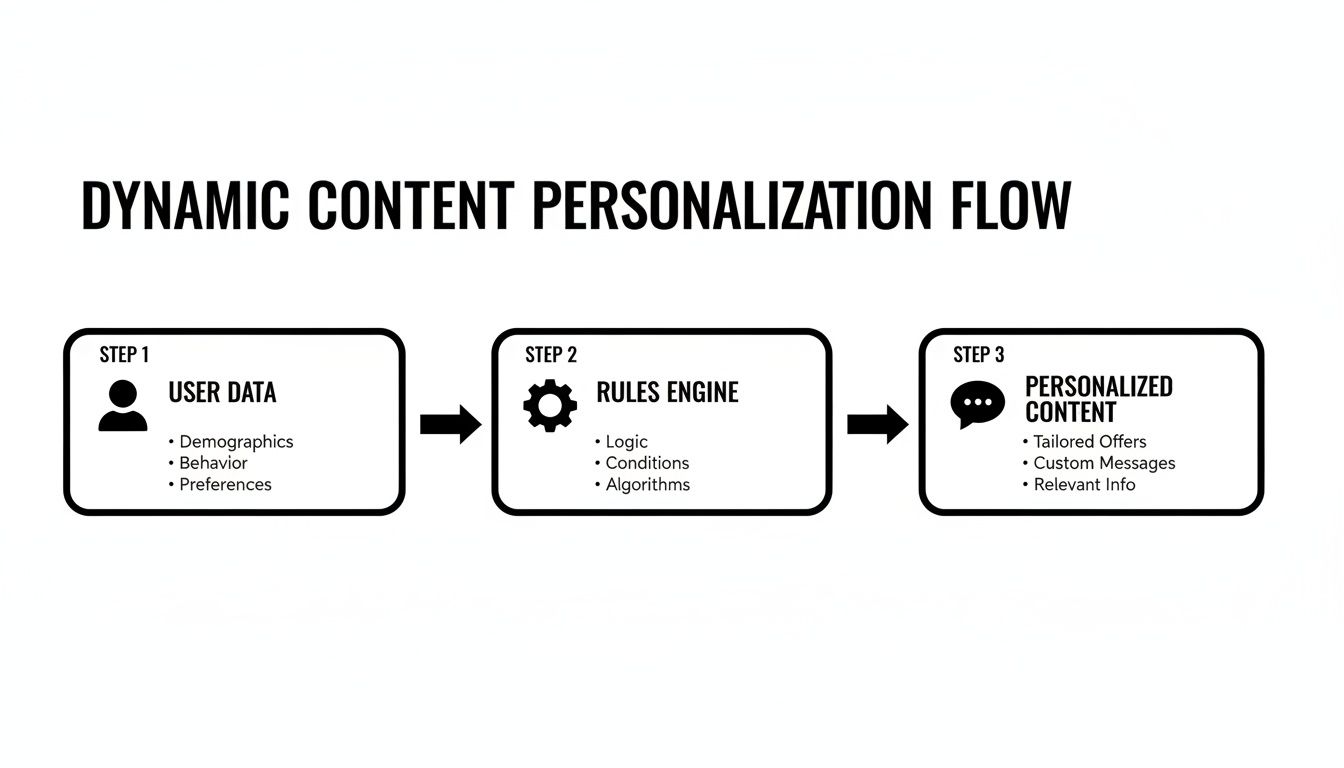
Diagram illustrating the dynamic content personalization flow from user data through a rules engine to personalized content.

As you can see, the process is all about turning anonymous data points into a relevant, one-to-one experience by filtering them through a decision-making engine.

Step 1: Data Collection — The Listening Phase

Every dynamic interaction starts with data. This is the "listening" phase, where your website or app is quietly collecting clues about who the visitor is and what they're looking for. This information can stream in from all over the place.

Some of the most valuable data points include:

  • Behavioral Data: Which pages did they visit? What products did they click on? Did they ditch a full shopping cart?
  • Contextual Data: What’s their geographic location? Are they browsing on a phone or a desktop? What time of day is it?
  • Demographic Data: For known users, this could be their age, industry, or job title, often pulled straight from your CRM.

To get even sharper, marketers often look at external signals, like intent data, to understand what topics a user is actively researching across the wider web. It adds another layer of insight.

Step 2: Rules Engine — The Thinking Brain

Once the data is in, it’s fed into the "thinking" brain of the operation: the rules engine. This is where the logic lives. A rules engine runs on simple "if-then" statements that you get to define.

For example, a rule might be as basic as:

  • IF a visitor is from Canada, THEN show them the winter collection banner.
  • IF a visitor is a returning customer, THEN greet them with a "Welcome Back" message and personalized recommendations.

These rules can be straightforward or incredibly complex, layering multiple conditions to create hyper-targeted audience segments. The engine’s job is to instantly check a user’s data against these rules and decide which content variation to serve up.

The rules engine is the critical bridge between raw data and a relevant experience. It’s where abstract information like location or click history is translated into a concrete, actionable decision about what content to display.

This is where you can start getting sophisticated. A basic engine just follows the commands you set. But more advanced systems use AI and machine learning to analyze data and make predictive decisions on their own, without you having to write an "if-then" rule for every possible scenario.

Step 3: Content Delivery — The Speaking Part

The final piece is content delivery—the "speaking" part. After the rules engine makes its split-second decision, the system serves the right content to the user in real time. The generic homepage banner gets swapped for the personalized version, and the user is none the wiser.

This whole process happens in the blink of an eye. The visitor never sees the logic whirring in the background; they just get a webpage that feels like it was made just for them. It’s this seamless execution that makes dynamic content so powerful. To pull this off effectively, you need a solid handle on your data, which is where a strong customer data platform integration becomes essential.

Bringing Dynamic Content to Life in Your Marketing

Knowing the theory is great, but seeing dynamic content actually drive results? That's the real win. It's time to move from concepts to concrete plays and look at how these strategies transform generic marketing messages into powerful, personalized experiences that actually work.

Every single use of dynamic content should tie back to a real business goal—whether that's more conversions, better engagement, or just earning some long-term loyalty. The trick is to start with a clear "why" and then figure out the "how."
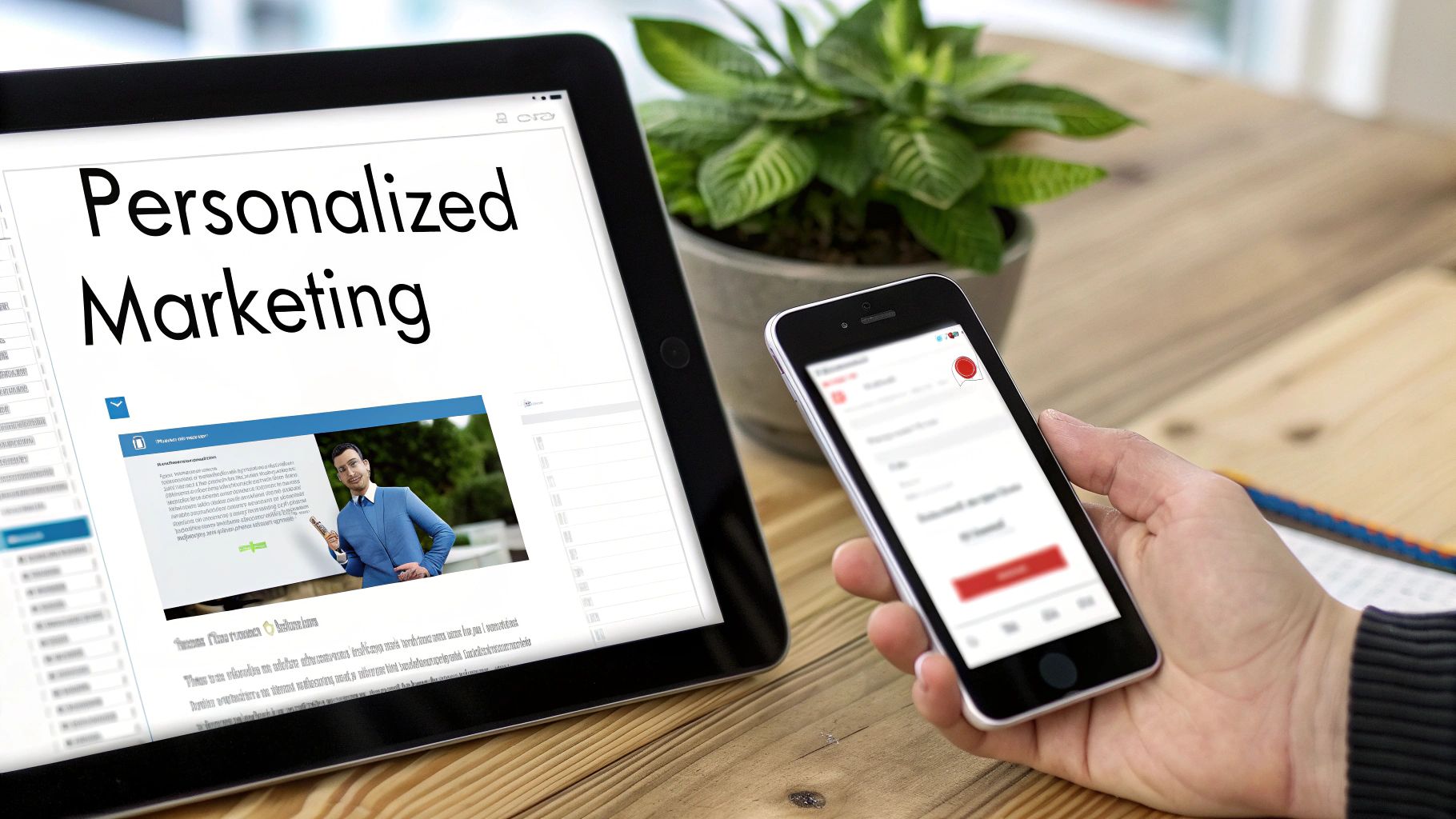
A person holding a smartphone next to a tablet displaying 'Personalized Marketing' on a wooden desk.

This isn't about one-off tricks. Effective personalization is a sequence of targeted touchpoints, each designed to guide a user through their own unique journey with your brand.

Dynamic Website Personalization

Your website is your digital storefront. It's often the first real impression someone gets. Instead of laying out a generic welcome mat for everyone, you can create a tailored experience from the moment they land. And this goes way beyond just plugging in their first name.

Think about these practical examples:

  • Smarter Hero Banners: A B2B software company could show a hero image that speaks directly to a visitor's industry. Someone from a healthcare company sees a hospital case study, while a visitor from the finance world sees a testimonial from a bank. Same page, completely different feel.
  • Location-Based Offers: A retail brand can instantly show a promotion for the nearest physical store or highlight products that are trending in the visitor's city. It makes the offer feel immediate and far more relevant.
  • Custom CTA Buttons: The call-to-action can change based on where someone is in their journey. A brand-new visitor might see a "Learn More" button, but a returning lead who has already downloaded a guide sees "Request a Demo." It’s a simple, smooth way to guide them down the funnel.

When you swap static elements for dynamic ones, your website stops being a passive brochure and becomes an active participant in the sales conversation. It starts anticipating what users need instead of just waiting for them to find it.

Hyper-Personalized Email Campaigns

Email is where dynamic content really flexes its muscles. It's the difference between a generic email blast that gets instantly archived and a one-to-one conversation that people actually open and click.

Here’s a quick breakdown of a static vs. dynamic email:

Email ElementStatic Approach (Everyone gets this)Dynamic Approach (Personalized for you)
Subject Line"Our Weekly Newsletter Is Here!""John, Here Are 3 Products You'll Love"
Product SectionShows the same 5 best-sellers to all subscribers.Displays products the user previously viewed but didn't buy.
OfferA generic 10% off coupon for everyone.A special offer on an item left in the user's abandoned cart.

The difference is night and day. The dynamic approach speaks directly to what you know about the user, making the content impossible to ignore. It’s not just a hunch; dynamic strategies can generate three times more leads per dollar than paid ads and boost email open rates by a whopping 26%.

Dynamic In-App and Ad Content

This thinking shouldn't be confined to your website or inbox. You can (and should) extend this personalized strategy to your in-app messages and digital ads to create a single, seamless experience everywhere your brand shows up.

Here’s how to put it into action:

  1. Custom In-App Notifications: If a user hasn't tried a key feature in your app, you can send a push notification with a quick tutorial. It’s a smart way to re-engage them based on their actual behavior inside the product.
  2. Smarter Retargeting Ads: Go beyond showing a generic ad to everyone who visited your site. Instead, serve up a dynamic ad that features the exact product someone looked at. It’s a powerful reminder that brings their interest right back to the forefront.
  3. Lifecycle-Aware Banners: Inside a SaaS app, a brand-new user might see a banner with links to onboarding guides. A seasoned power user, on the other hand, could see an invitation to a webinar on advanced features.

Many of these complex, data-driven campaigns are now managed through advanced platforms. If you're curious about the tech making this possible, you can learn more about how AI is used for marketing automation in our detailed guide.

When you start implementing these strategies, you stop broadcasting and start communicating. Every dynamic element you add works to build a stronger, more relevant connection with your audience—and that has a direct impact on engagement and your bottom line.

Measuring the Real-World Impact of Your Strategy

A great strategy is only as good as the results it delivers. Rolling out dynamic content just feels right, but to get budget and keep stakeholders happy, you need to back up that gut feeling with cold, hard data. It’s time to move past assumptions and connect your personalization efforts to actual business outcomes.

The goal here is simple: translate fuzzy benefits like "better engagement" into specific, measurable wins. Instead of just hoping for the best, you need a clear way to track the key performance indicators (KPIs) that prove your strategy is actually working.

Key Metrics That Prove Your Success

When you swap a static, one-size-fits-all experience for a dynamic one, you’re fundamentally changing how people interact with your brand. The right metrics will tell that story for you, showing exactly where personalization is paying off.

Focus on tracking these core performance indicators:

  • Engagement Metrics: Are people sticking around? Look for a lower bounce rate and a higher time on page. These are the clearest signs that your content is relevant enough to hold attention.
  • Conversion Metrics: This is where the money is. Keep a close eye on your click-through rate (CTR) for personalized calls-to-action and, most importantly, the overall conversion rate for your main goals, whether that's a sign-up or a sale.
  • Loyalty and Revenue Metrics: For the long game, track Customer Lifetime Value (CLV). A truly personalized journey encourages repeat business and builds loyalty, directly boosting how much each customer is worth to you over time.

Comparing Dynamic vs Static with A/B Testing

To build an undeniable business case, you have to put your new dynamic approach head-to-head with the old static version. This is where A/B testing becomes your secret weapon. It’s the cleanest way to isolate the impact of personalization and show a direct return on your investment.

Here’s a simple framework to get your tests running:

  1. Isolate One Variable: Don't try to boil the ocean. Start small by testing a single dynamic element, like a personalized hero banner or a targeted call-to-action.
  2. Define Your Audience Split: Serve the static version (Control Group A) to 50% of your audience and the new dynamic version (Test Group B) to the other 50%.
  3. Set a Clear Goal: Decide what success looks like before you start. Is it a higher CTR on the banner? More form submissions?
  4. Run the Test and Analyze: Let it run long enough to get statistically significant results, then compare the performance of Group A versus Group B. The numbers won't lie.

A well-structured A/B test kills all the guesswork. It gives you clear, quantitative proof that showing the right message to the right person drives a better outcome than a generic blast.

There’s a reason the content analytics market is projected to grow at an 18.9% CAGR. Companies that use these insights to deliver truly personalized experiences are seeing a 20% uplift in engagement. You can discover more insights about content analytics on Grand View Research. By measuring what matters, you can confidently prove the real-world impact of your dynamic content strategy.

Building Your First Dynamic Content Campaign

Alright, let's move from theory to action. Getting your first dynamic content campaign off the ground can feel like a huge lift, but it’s really about breaking the process down into manageable chunks. This is your roadmap for getting started.

Success here doesn’t start with cool tech. It starts with strategy—knowing exactly what you want to accomplish and who you're talking to.

Step 1: Define Your Goals and Audience Segments

Before you touch a line of code or design a single graphic, you have to nail two questions: What business result are we chasing? And who, specifically, are we trying to influence? Without sharp answers, you're just making noise.

Your goals need to be concrete. "Increase engagement" is a wish. "Reduce bounce rate by 15% on our pricing page for enterprise visitors" is a goal. It's specific, measurable, and gives you a clear target.

Once you have that goal, think about the distinct groups of people who will see different versions of your content. These are your segments.

For example, a B2B software company might slice its audience like this:

  • By Industry: Show a healthcare-focused case study to visitors clicking in from a hospital network.
  • By Company Size: Display an enterprise pricing plan to someone whose IP address traces back to a Fortune 500 company.
  • By Behavior: Offer a product demo popup to a user who has visited the pricing page three times this week.

Step 2: Organize Your Data and Pick Your Tools

With your goals and segments clear, it's time to check the fuel tank: your data. What information are you actually collecting on your customers, and is it organized in a way that’s usable? This data is what your system will use to decide which content to show to whom.

This is also the perfect time to look at your tech stack. It doesn’t need to be some complicated, multi-headed beast, but it must be able to execute the rules you plan on setting.

Here’s a quick way to think about your options:

Tool CategoryBest ForKey Function
Email Service Provider (ESP)Basic email personalization (e.g., first name, city).Segmenting lists and inserting simple dynamic fields.
All-in-One Marketing PlatformWebsite and email personalization based on known data (like a lead's lifecycle stage).Connecting website behavior to your CRM for a single view of the customer.
Dedicated Personalization EngineAdvanced, real-time personalization for anonymous and known visitors.Using AI and complex rule sets to deliver hyper-relevant experiences on the fly.

The right tool depends entirely on your ambition. A simple name-merge in an email? Your ESP is fine. Real-time website changes based on browsing behavior? You’ll need a dedicated engine.

Step 3: Create and Launch Your Content Variations

Now for the fun part. You get to create the different versions of content—the headlines, images, and calls-to-action—that each of your segments will see. The magic is in making each variation speak directly to that specific group's pain points or context.

Let’s say you’re personalizing the hero section of your homepage for different industries. You’d create:

  • A headline, image, and CTA for the Finance segment.
  • A different headline, image, and CTA for the Healthcare segment.
  • And a default version for anyone who doesn't fit a defined segment.

Always, always have a default version of your content. This is your safety net. It ensures any visitor who doesn't match a specific rule still gets a coherent, functional experience, preventing any weird gaps or broken pages.

Once your variations are built and the rules are plugged into your platform, you're ready to go live. But this isn't the end. It's the beginning.

Step 4: Test and Optimize Continuously

Launching the campaign isn't the finish line; it’s the starting gun. The best dynamic content strategies are built on a relentless cycle of testing and optimization. You have to measure everything.

Run A/B tests to get clean, data-backed answers. Is your personalized CTA actually getting more clicks than the generic one? Did that industry-specific banner really lower the bounce rate? Let the numbers guide your next move. This process of launching, measuring, and refining is how you turn a good campaign into a great one.

Inspiring Examples of Dynamic Content in Action

Theory is one thing, but seeing how the pros do it is where the real lightbulbs go off. Let's look at how some of the biggest brands use dynamic content to build real connections with their customers. These aren't just clever tricks; they're proven strategies that turn generic broadcasts into personal handshakes.

Think of this as a playbook you can borrow from for your own marketing.
Three large digital display screens on a tiled wall in a modern public space.

We'll break down how these companies use data to create experiences that feel like they were made just for you, stacking them up against the old-school static approach to really show the difference.

Amazon: The Recommendation Powerhouse

It's impossible to talk about this stuff without mentioning Amazon. Their product recommendation engine is the gold standard—it’s like having a personal shopper who knows what you want before you do.

  • The Old Way (Static): An e-commerce site shows every single visitor the same "Top Sellers" or "New Arrivals" list. It’s a one-size-fits-all approach that completely ignores individual tastes.
  • The Amazon Way (Dynamic): Amazon is always watching. It tracks your browsing history, past purchases, and even the items you hover over but don't buy. With that data, it populates your homepage with sections like "Inspired by your shopping trends" and "Frequently bought together," making the entire store feel like it was curated for you and you alone.

The Takeaway: Amazon’s strategy isn’t just about showing you more stuff; it’s about anticipating your needs. They use behavioral data to create a discovery loop that keeps you clicking, drives up the average order value, and makes you want to come back.

Netflix: The Art of the Personalized Thumbnail

Netflix has figured out that the image you see can be the deciding factor in whether you click "play." They’ve turned thumbnail selection into a data-driven art form, using dynamic content to grab your attention in a sea of options.

So how do they pick the perfect image for you? It all comes down to your viewing history.

If You Watch...You Might See a Thumbnail Featuring...
Lots of action moviesAn explosion or a high-speed car chase.
Dramas with strong female leadsA powerful close-up of the main actress.
Stand-up and sitcomsA shot of the cast in a laugh-out-loud moment.

This isn't just guesswork. Netflix runs thousands of A/B tests to see which thumbnail gets the most clicks from different audience segments. It's why you and a friend can look at the exact same movie title and see completely different artwork, each one optimized to match your viewing habits.

Skyscanner: The Localized Travel Companion

Travel sites like Skyscanner have perfected the art of using contextual data to make life easier for their users. Their whole game is about removing friction and getting you the right information, faster.

Here’s what that looks like in practice:

  • The Clunky Way (Static): You land on the homepage and have to manually type in your departure city every single time. It’s a small hassle, but it adds up and feels repetitive.
  • The Smart Way (Dynamic): Skyscanner uses your IP address to guess your location. It then automatically pre-fills the "From" field with your nearest major airport, saving you a step and making the whole process feel way more intuitive.

This simple use of location data shows a deep respect for the user's time. By anticipating a basic need, Skyscanner builds a little bit of trust and smooths the path to booking a flight. When people ask what is dynamic content at its best, it's this—a tool for creating smarter, more helpful, and ultimately more profitable customer experiences.

Questions We Hear All the Time

So, you're sold on the idea, but the practical side of things is still a bit fuzzy. That’s perfectly normal. Let's tackle the most common questions marketers have when they're getting ready to make the switch from static to dynamic.

Do I Need a Ton of Data to Get Started?

Honestly, you can get going with a lot less than you'd think. Forget massive data warehouses for a minute. The best first steps use simple, powerful data points you probably already have.

  • User Location: Easy win. Show different store hours or offers based on a visitor's city or country.
  • Visitor Status: Is this their first visit? Greet them with an intro offer. Are they a returning customer? Welcome them back by name.
  • Device Type: Optimize the layout and buttons for someone tapping on a phone versus clicking on a desktop.

The trick is to start small and focused. Pick one audience segment, set a clear goal, and prove the concept works with the data you have. Once you see the lift, you’ll have the business case to scale up.

Is This Going to Wreck My SEO?

This is a big one, but the short answer is no—when done right, it actually helps. Modern personalization platforms are smart enough to show a stable, default version of your page to search engine crawlers like Googlebot. This means your core content always gets indexed without a hitch.

But here's the real magic: dynamic content sends positive signals that search engines absolutely love.

When you give people a more relevant experience, they stick around longer. Your bounce rates drop and time-on-page goes up. Those are powerful signals that tell Google your site is high-quality, which can give your rankings a nice boost over time.

Wait, Isn't This Just A/B Testing?

I get this question all the time. It's a common mix-up, but they serve two completely different—and complementary—purposes. Think of it like this: A/B testing is about finding the best message, while dynamic content is about delivering it to the right person.

A/B testing is a hunt for the single best "winner." You show random groups of people different versions of a page to see which one performs best overall. The goal is to find one universally superior option for everyone.

Dynamic content isn't looking for one winner. Its whole job is to serve up different, highly relevant experiences to different people at the same time. Visitor A sees one version, Visitor B sees another, and both are "correct" because they're personalized.

Simply put: A/B testing finds the best generic message. Dynamic content delivers the right message to the right individual.


Ready to stop broadcasting one message and start having millions of personalized conversations? marketbetter.ai is the integrated AI platform that makes creating, managing, and scaling dynamic content straightforward. Explore how marketbetter.ai can elevate your marketing strategy today.

10 Actionable Marketing Personalization Strategies for 2025

· 29 min read

In a hyper-competitive market, generic messaging no longer cuts it. Customers don't just appreciate personalized interactions; they expect brands to understand their unique needs, preferences, and immediate context. The days of simply inserting a first name into an email template are over. True connection is built on a foundation of sophisticated, data-driven engagement, which is where effective marketing personalization strategies become indispensable.

This article moves beyond the basics to provide a comprehensive roundup of ten powerful and actionable tactics that create genuinely unique customer experiences. We will dissect each strategy, comparing its strengths and ideal use cases to help you build a more effective marketing engine. For those seeking a foundational understanding before diving into advanced tactics, you can read more about what is personalization in marketing to get up to speed.

From harnessing real-time behavioral data to leveraging predictive analytics, you will learn how to implement these approaches with practical, step-by-step guidance. Each item in this list includes actionable implementation tips and real-world examples to illustrate how to turn theory into practice. By mastering these diverse strategies, you can forge deeper customer relationships, significantly boost loyalty, and drive measurable ROI. We will explore everything from dynamic content optimization and purchase history-based recommendations to advanced AI-driven personalization, equipping you with the tools needed to deliver the right message to the right person at the perfect moment. Let’s explore how to build a personalization framework that not only meets customer expectations but consistently exceeds them.

1. Behavioral Personalization

Behavioral personalization is one of the most powerful marketing personalization strategies, focusing on what users do rather than just who they are. This approach leverages real-time and historical user behavior data, such as browsing history, purchase patterns, time spent on pages, and click-through rates, to customize marketing messages and website experiences. Instead of relying on static demographic profiles, it dynamically adapts to a user's journey, predicting their needs and delivering relevant content at the precise moment it matters most.

Behavioral Personalization

This method stands in contrast to demographic personalization, which groups users by attributes like age or location. While demographics provide a good starting point, behavioral data reveals intent. For example, knowing a user is a 35-year-old male is less useful than knowing he has viewed three different hiking boots in the last hour. Giants like Amazon pioneered this with its "Customers who bought this also bought" recommendations, while Netflix's content suggestions are a masterclass in using viewing history to keep users engaged.

Actionable Implementation Tips

To effectively implement this strategy, start with foundational data points and build from there. Focus on high-intent actions first to maximize your initial impact and ROI.

  • Start with Core Behaviors: Begin by tracking fundamental interactions like specific page views, items added to a cart, and past purchases. Use this data to trigger simple yet effective campaigns, such as abandoned cart emails or product recommendations based on a recently viewed category.
  • Implement Behavioral Triggers: Set up automated workflows based on specific actions. For instance, if a user downloads a whitepaper on a particular topic, trigger an email sequence offering a related webinar or case study. Actionable Step: Create a "Top 3" list of your highest-value behaviors (e.g., viewing the pricing page, watching a demo video, adding an item to cart) and build your first automated trigger for the most common one.
  • Combine with Other Data: Enhance behavioral insights by layering them with demographic or contextual data. Knowing a user repeatedly views winter coats and that their local weather forecast predicts a cold snap allows you to send a highly timely and relevant promotion.

Key Insight: The goal of behavioral personalization is to create a fluid, responsive experience that feels less like marketing and more like a helpful conversation. It’s about anticipating the next step in the customer's journey and proactively guiding them.

To execute this effectively, you must have a clear understanding of your audience segments and the data signals that define them. This often requires sophisticated tools capable of person-level identification and data analysis to connect actions across different sessions and devices.

2. Demographic Segmentation

Demographic segmentation is one of the most foundational marketing personalization strategies, involving the division of a market into segments based on variables like age, gender, income, location, education, and occupation. This approach operates on the principle that consumers with shared demographic traits are likely to have similar purchasing habits and preferences. It provides a clear, data-driven framework for creating messages that resonate with specific groups, making it an essential starting point for any personalization effort.

This method contrasts with psychographic segmentation, which focuses on lifestyle and personality traits. While demographics tell you who the customer is, psychographics explain why they buy. For example, a campaign for a luxury car might target high-income individuals (demographic), but it succeeds by appealing to their desire for status or performance (psychographic). Demographics are simpler to implement but offer less nuance. Companies like Nike master this by offering age-specific product lines for kids, teens, and adults, while L'Oréal tailors its beauty campaigns to different age groups' distinct skincare needs.

Actionable Implementation Tips

To move beyond basic demographic targeting, you must enrich this data with other insights. Use demographics as a scaffold, not a silo, to build a more nuanced understanding of your audience.

  • Combine with Other Data Types: Enhance demographic profiles by layering them with behavioral or transactional data. Knowing a customer is a 25-year-old female living in a city is useful, but knowing she recently purchased running shoes and browses for marathon gear allows for hyper-relevant product recommendations.
  • Regularly Update and Validate: Demographics are not static; people’s incomes change, they move, and their family structures evolve. Use surveys, preference centers, and third-party data enrichment tools to keep your audience information current and avoid marketing based on outdated assumptions. Actionable Step: Add a "Update Your Profile" link to your email footer that leads to a simple preference center where users can self-select interests or update their job title.
  • Test Assumptions Across Segments: Do not assume that all individuals within a demographic segment behave identically. Use A/B testing to validate your hypotheses. For instance, test different messaging or offers on a "30-35 year old, high-income" segment to discover which approach truly drives conversions.

Key Insight: Demographic data provides the fundamental "who" but is most powerful when used to answer "what next?" It is the essential first layer upon which more sophisticated personalization, such as behavioral or contextual strategies, can be built for maximum impact.

Executing this well means treating demographic segmentation not as the final goal, but as a critical first step in developing more advanced marketing personalization strategies. It offers a scalable and efficient way to create initial relevance before diving into more granular, individualized tactics.

3. Dynamic Content Optimization

Dynamic content optimization is a sophisticated marketing personalization strategy where website elements, emails, and ads automatically change in real-time based on user data. This approach moves beyond static messaging by tailoring specific components like headlines, images, offers, and calls-to-action for each individual visitor. The goal is to create a uniquely relevant experience that maximizes engagement and conversion by presenting the most compelling content at any given moment.

Dynamic Content Optimization

Unlike A/B testing, which tests variations on a broad audience to find a single "winner," dynamic content delivers the best-performing variation to specific audience segments simultaneously. The key difference is automation and scale: A/B testing is a manual experiment, while dynamic content is an ongoing, automated process. For instance, HubSpot’s "Smart Content" allows marketers to show different website banners to first-time visitors versus qualified leads. Similarly, Booking.com uses this to display personalized travel deals based on a user's search history and location, creating a sense of urgency and relevance that drives immediate action. For real-world applications of personalization in action, explore these effective personalized landing page examples.

Actionable Implementation Tips

To succeed with dynamic content, start small and scale your efforts as you gather more data and insights. A phased approach prevents complexity and ensures each change is impactful.

  • Start with High-Impact Elements: Begin by customizing simple yet powerful components like website headlines or hero images. For example, change the headline to reflect the user's industry or the call-to-action to align with their lifecycle stage (e.g., "Request a Demo" for a lead versus "Contact Support" for a customer).
  • Create a Comprehensive Content Library: Develop a repository of content variations (images, copy, offers) for each key audience segment. This ensures your system has a rich set of options to choose from, preventing repetitive experiences and enabling more granular personalization. Actionable Step: For your homepage hero image, create three variations: one for new visitors, one for leads from the finance industry, and one for existing customers. Implement a rule to show the right one based on visitor data.
  • Use Machine Learning to Optimize: Leverage AI-powered tools like Adobe Target or Optimizely to automate the selection process. These platforms can analyze user behavior in real-time to predict which content combination is most likely to convert, continuously improving performance without manual oversight.

Key Insight: Dynamic content optimization transforms a one-size-fits-all digital property into a collection of millions of potential versions, each one fine-tuned to resonate with a specific user's context, behavior, and needs.

This strategy requires a robust technology stack and a clear understanding of your audience segments. When implemented correctly, it serves as a powerful engine for improving relevance and driving significant lifts in key marketing KPIs.

4. Purchase History-Based Recommendations

Purchase history-based recommendations are a cornerstone of effective marketing personalization strategies, using past buying behavior to forecast future needs. This approach analyzes what customers have previously bought to suggest relevant products, driving repeat business and enhancing loyalty. Unlike behavioral personalization which often includes browsing actions, this method is rooted in completed transactions—a much stronger signal of a customer's preferences and budget. It leverages data to create a curated shopping experience that feels uniquely tailored to each individual.

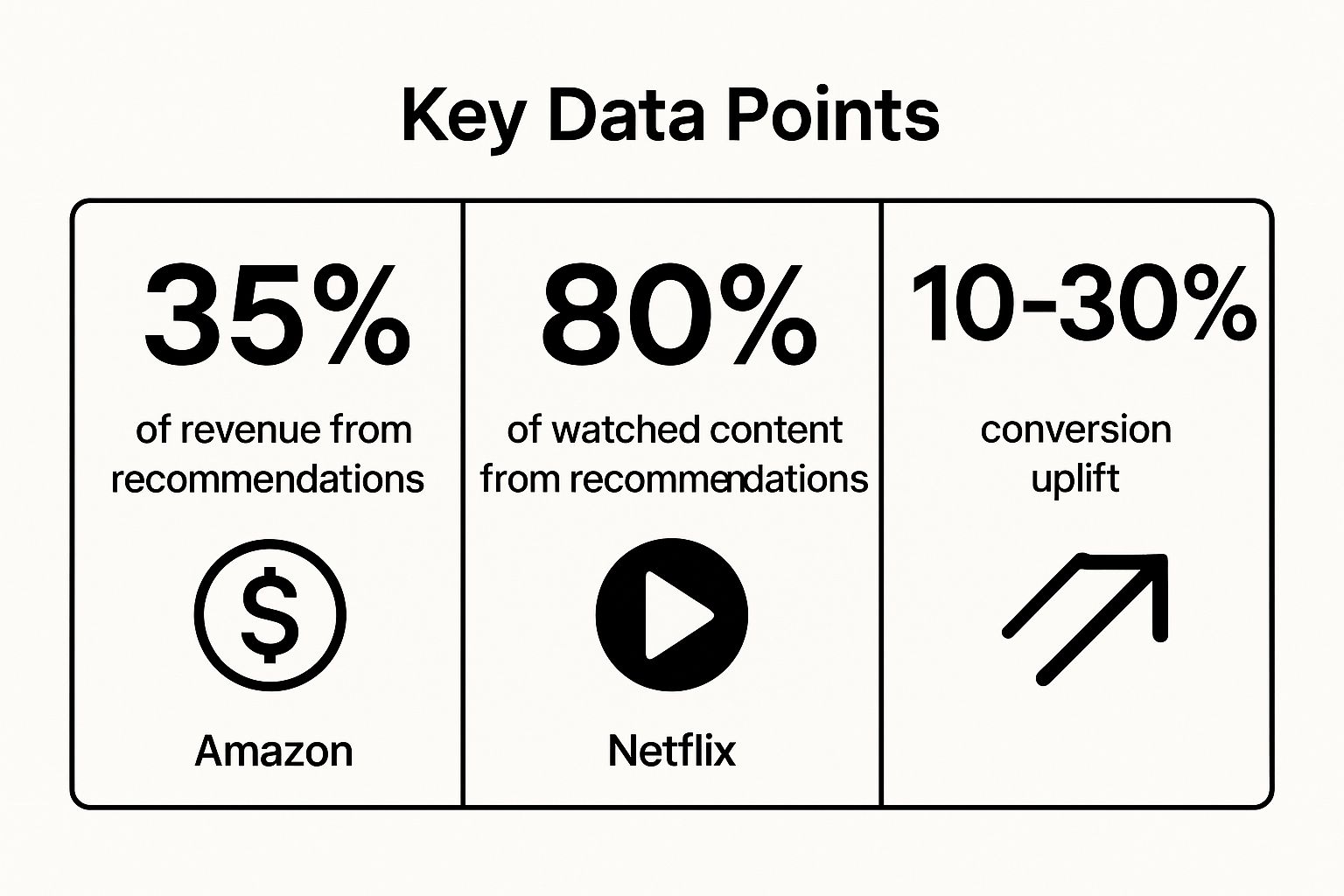
This strategy was famously pioneered and perfected by companies like Amazon, whose recommendation engine is responsible for an estimated 35% of its revenue. It's also the engine behind Sephora’s Beauty Insider suggestions and Starbucks' personalized mobile app offers. By analyzing purchase data, brands can move beyond generic promotions and offer items that customers are highly likely to value, significantly boosting cross-sell and upsell opportunities.

The following infographic highlights the immense impact of recommendation engines on revenue and engagement.

Infographic showing key data about Purchase History-Based Recommendations

These figures demonstrate that recommendations are not just a minor feature but a central driver of business growth, directly influencing conversion rates and customer retention.

Actionable Implementation Tips

To effectively leverage purchase history, focus on combining data streams and refining the timing and logic of your recommendations for maximum impact.

  • Combine with Browsing Behavior: Enhance accuracy by integrating purchase history with recent browsing data. A customer who bought hiking boots last year and is now browsing for tents is a prime candidate for a "Complete Your Camping Gear" campaign. This hybrid approach provides a more complete view of their current intent.
  • Use Purchase Frequency to Time Offers: Analyze how often customers re-purchase certain items. If a customer buys a 30-day supply of coffee every month, send a reminder or a subscription offer around day 25. This proactive timing makes the message helpful rather than intrusive. Actionable Step: Identify your top 5 consumable products. Calculate the average re-purchase cycle for each and set up an automated email reminder that triggers 7 days before the cycle ends.
  • A/B Test Recommendation Algorithms: Don't rely on a single recommendation model. Test different approaches, such as "customers who bought this also bought" (collaborative filtering) versus "products similar to this one" (content-based filtering), to see which one performs best for different product categories and customer segments.

Key Insight: This strategy transforms a simple transaction record into a predictive tool. The goal is to make customers feel understood by showing them you remember their past choices and can help them discover their next favorite product.

5. Email Personalization and Automation

Email personalization and automation are cornerstones of modern marketing personalization strategies, moving far beyond simply inserting a subscriber's first name. This approach tailors email campaigns to individual user data, behavior, and lifecycle stage. It leverages automation to deliver highly relevant content, such as personalized product recommendations, dynamic content blocks, and behavior-triggered messages, creating a one-to-one dialogue at scale.

Email Personalization and Automation

This strategy differs from generic email blasts by treating the inbox as a personal space for conversation. A key comparison is with social media personalization: email is a direct, permission-based channel, allowing for deeper, more sequential storytelling, whereas social is better for discovery and broad interest targeting. Grammarly excels at this with its weekly writing insight reports, while Airbnb sends location-based travel suggestions that feel curated for the individual. The goal is to make every email feel anticipated, relevant, and valuable.

Actionable Implementation Tips

To implement this effectively, focus on segmenting your audience and automating workflows based on meaningful triggers. Start small and build complexity as you gather more data.

  • Segment Beyond Demographics: Group subscribers based on engagement levels (active, inactive), purchase history, and stated preferences. Create tailored campaigns for each segment, such as a re-engagement series for dormant users or exclusive offers for VIP customers.
  • Implement Trigger-Based Workflows: Set up automated email sequences for key actions like welcome series for new subscribers, abandoned cart reminders, and post-purchase follow-ups. Actionable Step: Build a 3-part abandoned cart sequence. Email 1 (1 hour later): "Did you forget something?" Email 2 (24 hours later): "Your items are selling fast." Email 3 (48 hours later): "Here's a 10% discount to complete your order."
  • Personalize Content Dynamically: Use dynamic content blocks within your email templates to show different offers, articles, or products based on a subscriber's data. For example, an e-commerce store can display items related to a user's last viewed category, making the content highly specific to their interests.

Key Insight: Effective email personalization isn't about mastering one tactic; it’s about creating an integrated system where subscriber data continuously refines automated communication. The result is an email experience that builds loyalty and drives action because it consistently provides value.

Executing this requires a platform capable of deep segmentation and robust automation. By leveraging advanced tools, you can explore new features for email personalization to unlock a deeper level of customer connection and engagement.

6. Geographic and Location-Based Targeting

Geographic and location-based targeting is one of the most contextually relevant marketing personalization strategies, leveraging a user's physical location to deliver timely and specific messages. This approach uses data from IP addresses, GPS signals from mobile devices, or user-provided information to tailor content, promotions, and experiences. By understanding where a customer is, you can serve them information that is immediately useful, from promoting local store events to adjusting offers based on regional weather.

This method moves beyond broad national campaigns to create a sense of local presence and relevance. While demographic targeting might tell you a customer's city, location-based targeting can tell you if they are currently walking past your store. This real-time component makes it more dynamic and actionable than static demographic data. For example, Starbucks uses its app to show users the nearest store and push local promotions, while REI sends emails recommending rain gear to customers in areas where a storm is forecast.

Actionable Implementation Tips

To implement this strategy successfully, focus on transparency and delivering genuine value in exchange for location data. Start with broad geo-targeting and then refine your approach with more granular, real-time tactics.

  • Create Location-Specific Landing Pages: Instead of a generic homepage, direct traffic from different regions to landing pages featuring local testimonials, store information, or region-specific offers. This simple step can significantly improve conversion rates by making the content more relatable.
  • Use Local Events and Culture in Messaging: Incorporate local holidays, sporting events, or cultural nuances into your campaigns. For example, a restaurant chain could run a special promotion in a specific city when the local sports team has a home game, connecting with the community on a personal level.
  • Implement Geo-fencing and Geo-conquesting: Set up virtual perimeters around specific locations (geo-fencing), like your own stores, to trigger push notifications with offers when a user enters. Actionable Step: To try geo-conquesting, set up a geo-fence around your top competitor's location and run a mobile ad campaign offering a 15% discount to users within that zone.

Key Insight: Geographic personalization is most powerful when it bridges the digital and physical worlds. The goal is to make your brand a convenient and relevant part of the customer's immediate environment, providing utility at the exact moment of need.

Executing this requires a platform capable of processing real-time location signals and integrating them with your marketing automation tools. Always be transparent about requesting location access and clearly state the benefit to the user, as trust is paramount for this highly personal data.

7. Predictive Analytics and AI-Driven Personalization

Predictive analytics and AI-driven personalization represent the frontier of marketing personalization strategies, using machine learning to forecast future customer behavior. This advanced approach moves beyond reacting to past actions and instead anticipates future needs, preferences, and potential churn. By analyzing vast datasets, AI algorithms identify subtle patterns and correlations that are impossible for humans to detect, enabling businesses to proactively deliver hyper-relevant experiences.

This method is a significant evolution from rules-based personalization, which relies on predefined "if-then" logic (e.g., "if user views page X, then show offer Y"). While effective, rules-based systems are static and can't adapt without manual intervention. AI, in contrast, learns and optimizes automatically, making it infinitely more scalable and precise. Netflix's recommendation engine doesn't just show you movies similar to what you've watched; it predicts what you'll be in the mood for next. Similarly, Salesforce Einstein can predict which sales leads are most likely to convert.

Actionable Implementation Tips

Adopting AI requires a strategic approach that balances technological power with practical business goals. Start with manageable projects that deliver clear value before scaling to more complex applications.

  • Start with Pre-Built AI Tools: Before investing in custom-built models, leverage the predictive capabilities within your existing marketing automation or CRM platforms. Tools like Salesforce Einstein or HubSpot's predictive lead scoring offer a lower barrier to entry and can provide immediate insights.
  • Ensure Data Quality and Consistency: AI models are only as good as the data they are trained on. Prioritize cleaning and unifying your customer data across all touchpoints. Actionable Step: Perform a data audit. Identify your top 3 sources of customer data (e.g., CRM, website analytics, purchase history) and create a plan to merge them into a single, consistent customer profile.
  • Implement Gradual Rollouts: Test your predictive models on smaller segments of your audience first. Monitor performance closely, comparing the AI-driven segment against a control group to measure uplift in engagement, conversion, and retention before a full-scale deployment.

Key Insight: The true power of predictive personalization lies in its ability to move from reactive marketing to proactive relationship-building. It allows you to solve a customer's next problem, often before they've even articulated it.

Successfully executing this strategy requires a commitment to data hygiene and a willingness to trust algorithmic insights. While maintaining human oversight is crucial, embracing AI allows marketing teams to automate complex decisions and scale personalization to a level that was previously unimaginable.

8. Lifecycle Stage Personalization

Lifecycle stage personalization is a strategic approach that tailors marketing based on a customer's evolving relationship with your brand. This method moves beyond single interactions to consider the entire customer journey, from a visitor's first touchpoint to their transformation into a loyal advocate. It acknowledges that a new prospect needs different information and messaging than a long-time, high-value customer. By aligning communication with their current stage, you create a more logical and supportive experience.

Unlike behavioral personalization, which often focuses on micro-actions (e.g., clicks, page views), lifecycle marketing looks at the macro-level journey. This makes it more strategic and relationship-focused. While a behavioral trigger might send an email about a specific abandoned cart, lifecycle personalization would identify the user as being in the "consideration" stage and nurture them with case studies, comparison guides, and trial offers. Platforms like HubSpot and Salesforce have popularized this by building powerful automation tools that allow marketers to guide leads from awareness to purchase and beyond.

Actionable Implementation Tips

To implement this strategy effectively, you must first define what each stage means for your business and then create targeted content that facilitates progression to the next.

  • Map Your Customer Journey: Clearly define the stages in your customer lifecycle (e.g., Subscriber, Lead, Marketing Qualified Lead, Customer, Advocate). Establish specific criteria and data points that automatically move a contact from one stage to the next.
  • Create Stage-Specific Content: Develop a library of content tailored to the needs of each stage. A "Lead" might receive an educational ebook, while a "Customer" gets an advanced user guide or an invitation to a loyalty program. Actionable Step: Create one high-value content asset for each defined stage. For 'Leads,' an industry report. For 'MQLs,' a detailed case study. For 'Customers,' a VIP webinar.
  • Monitor Stage Progression Rates: Analyze how quickly contacts move between stages and identify bottlenecks. If many leads are stuck in the "Marketing Qualified Lead" stage, you may need to adjust your sales handoff process or provide more bottom-of-funnel content to encourage conversion.

Key Insight: This strategy’s power lies in its long-term vision. It transforms marketing from a series of disjointed campaigns into a single, cohesive journey that builds trust and maximizes customer lifetime value.

Implementing lifecycle stage personalization requires a robust CRM or marketing automation platform capable of tracking user progression. By understanding and catering to the specific needs of each stage, you can orchestrate more meaningful and profitable customer relationships.

9. Social Media and Interest-Based Personalization

Social media and interest-based personalization is a powerful strategy that taps into the rich data users willingly share on social platforms. This approach focuses on a user's expressed interests, such as the accounts they follow, the content they engage with, and the topics they discuss, to build a detailed profile of their preferences. By leveraging this data, marketers can deliver highly relevant ads, content, and product suggestions directly within social feeds and across other channels.

This method moves beyond simple demographics by capturing an individual's passions and affinities. Compared to purchase history, which reflects past needs, social data often reveals aspirational wants and community identity. Knowing a user follows several rock-climbing brands and influencers on Instagram is far more predictive for future gear sales than knowing their age and location. Platforms like Facebook and TikTok have built their entire advertising models on this principle, using sophisticated algorithms to match content with users most likely to find it engaging.

Actionable Implementation Tips

To implement this strategy effectively, you must connect social insights with your broader marketing efforts. The goal is to create a seamless experience that reflects a user's known interests.

  • Use Social Listening Tools: Deploy tools to monitor conversations, hashtags, and trends related to your industry. This helps you identify emerging interests and create customer segments based on real-time discussions, allowing for more agile and relevant campaigns.
  • Create Interest-Based Segments: Go beyond platform-level targeting. Use data from social logins or user-provided profiles to build segments in your CRM or marketing automation platform. Actionable Step: Run a poll on Instagram Stories asking followers to vote on their favorite product feature. Use the results to create two new ad audiences: one targeting users who voted for Feature A, and another for Feature B, each with tailored messaging.
  • Engage Authentically, Don't Just Advertise: Personalization here isn't just about showing a targeted ad. It's about participating in the conversation. Engage with users who mention relevant interests, share user-generated content, and create content that genuinely adds value to their passions.

Key Insight: The power of social media personalization lies in its ability to target based on passion and identity, not just need. It allows brands to connect with customers on a cultural and emotional level, fostering loyalty that transcends transactional relationships.

Executing this requires a unified view of the customer, combining social data with other signals like email engagement. For example, you can enhance your outreach by incorporating personalized videos into your email sequences, which is particularly effective for audiences cultivated through visual platforms. You can explore a variety of engagement tactics by reviewing different approaches to video and email automation.

10. Real-Time Personalization and Contextual Marketing

Real-Time Personalization and Contextual Marketing represents one of the most advanced and responsive marketing personalization strategies. It focuses on adapting the customer experience in the moment based on immediate context, including current behavior, time of day, location, device, and even environmental factors like the weather. This approach goes beyond historical data to leverage what a user is doing right now, enabling brands to deliver hyper-relevant messages with millisecond precision.

While behavioral personalization uses past actions to predict future intent, contextual marketing reacts to the present. It's the difference between a planned conversation and a spontaneous, perfectly timed interjection. For example, knowing a user has previously bought running shoes is behavioral; noticing they are browsing for rain-proof running gear on their mobile phone while it's raining in their city is contextual. Tech giants like Amazon use this for dynamic pricing, while Spotify suggests playlists based on the time of day or a user's current activity.

Actionable Implementation Tips

Implementing real-time personalization requires a sophisticated tech stack and a clear focus on high-impact scenarios. Start small and scale your efforts as you prove the ROI.

  • Start with High-Value Touchpoints: Don't try to personalize everything at once. Focus on critical moments in the customer journey, such as the homepage for a first-time visitor, the checkout process for a returning customer, or a pricing page for a user showing high purchase intent.
  • Focus on Contexts That Matter: Identify contextual signals that genuinely add value. A travel site could use a visitor's location to highlight nearby getaways, or a food delivery app could promote warm soups and indoor dining options during a cold, rainy day. Actionable Step: Implement a simple real-time rule on your website. If a user visits from a mobile device between 12 PM and 2 PM local time, display a banner that says "Quick Lunchtime Read? Check Out Our Latest Guide."
  • Implement Robust Fallback Systems: Real-time systems can be complex. Ensure you have default experiences or non-personalized fallbacks ready to go if the technology fails or data is unavailable. This prevents a broken user experience and protects your brand reputation.

Key Insight: The power of real-time personalization lies in its ability to make marketing invisible and seamlessly integrated into the user's immediate reality. When done right, it feels less like a promotion and more like a genuinely helpful, intuitive service.

Executing this strategy effectively requires technology capable of processing vast amounts of data instantly. Platforms like Salesforce Interaction Studio and Adobe's Real-Time CDP are designed for this, enabling brands to listen to and react to customer signals as they happen.

Marketing Personalization Strategies Comparison

Personalization StrategyImplementation Complexity 🔄Resource Requirements ⚡Expected Outcomes 📊Ideal Use Cases 💡Key Advantages ⭐
Behavioral PersonalizationHigh - requires real-time tracking and analysisAdvanced tracking infrastructure, data scientists10-30% conversion uplift, real-time optimizationBehavioral targeting, cross-channel personalizationAccurate, scalable, real-time optimization
Demographic SegmentationLow - straightforward segment definitionsReadily available demographic dataBroad market segmentation, initial profilingInitial market segmentation, traditional media planningEasy, cost-effective, broad applicability
Dynamic Content OptimizationHigh - needs robust CMS, A/B testing toolsContent libraries, CMS integration, analyticsImproved engagement, reduced content costsWebsites, emails, ads with dynamic contentAutomated content, continuous optimization
Purchase History-Based RecommendationsMedium - moderate complexity with filteringPurchase data, recommendation algorithms10-30% conversion uplift, increased order valueRepeat purchase, upsell/cross-sell campaignsHigh ROI, loyalty building, decision support
Email Personalization and AutomationMedium to High - requires automation setupClean segmented lists, automation platforms6x higher transactions, 14%+ open ratesLifecycle-based email campaigns, lead nurturingScalable, cost-effective, automated nurturing
Geographic and Location-Based TargetingMedium - requires location tech & content creationGPS/IP data, geo-fencing, localized contentIncreased foot traffic, local marketing impactMobile marketing, local promotionsHighly relevant for mobile, local targeting
Predictive Analytics & AI-DrivenVery High - needs ML expertise and infrastructureAI/ML platforms, data scientists, large datasetsProactive personalization, improved accuracyAdvanced customer behavior prediction, churn preventionScalable, reveals hidden insights
Lifecycle Stage PersonalizationHigh - requires detailed journey mappingTracking systems, automation workflowsImproved conversion & retention by stageCustomer journey marketing, nurture sequencesPersonalized stage-based messaging
Social Media and Interest-BasedMedium - depends on platform integrationsSocial APIs, social listening toolsHigh social engagement, viral content potentialSocial campaigns, interest targetingRich data, real-time insights, engagement
Real-Time Personalization & ContextualVery High - complex, real-time data and techReal-time processing, in-memory DBs, ML enginesHighest relevance & conversion, superior CXInstant context-based marketing, dynamic pricingMaximum timeliness, competitive edge

Your Next Move: From Personalization Strategy to Scalable Reality

Embarking on a journey to master marketing personalization strategies can feel like assembling a complex puzzle. You have all the pieces explored in this guide-behavioral triggers, demographic data, dynamic content, predictive AI, and more. The challenge isn't merely knowing what these pieces are; it's understanding how they fit together to create a cohesive, compelling, and consistent customer experience that drives tangible business results. Moving from theory to practice requires a strategic, phased approach, not an overnight overhaul.

The core takeaway is that personalization is not a single tactic but a multifaceted philosophy. It's about shifting your entire marketing paradigm from broadcasting a one-size-fits-all message to engineering a one-to-one dialogue. This means recognizing that a first-time visitor, intrigued by a blog post (Lifecycle Stage Personalization), requires a fundamentally different interaction than a loyal customer who has made multiple purchases (Purchase History-Based Recommendations). Your goal is to build an intelligent system where these strategies work in concert.

From Foundational to Futuristic: Creating Your Implementation Roadmap

To make this transition manageable, think of your personalization efforts in progressive layers. Don't try to implement predictive AI on day one if you haven't yet mastered basic email segmentation. A practical roadmap is crucial for building momentum and demonstrating value at each stage.

  1. Phase 1: The Foundational Layer (Start Here)

    • Focus On: Combine Demographic Segmentation with Lifecycle Stage Personalization. This is your low-hanging fruit. Start by creating distinct communication paths for new leads, marketing-qualified leads (MQLs), sales-qualified leads (SQLs), and existing customers.
    • Actionable Step: Map out the key touchpoints for each lifecycle stage. For a new lead, the goal might be education, using their provided job title (demographic) to tailor a welcome email series. For an SQL, the goal is conversion, perhaps triggering a personalized case study relevant to their industry.
  2. Phase 2: The Responsive Layer (Build Momentum)

    • Focus On: Integrate Behavioral Personalization and Dynamic Content Optimization. Now, you move from static attributes to dynamic actions. What pages did they visit? What content did they download? Use this data to change website banners, CTAs, and email content in real-time.
    • Actionable Step: Set up three key behavioral triggers. For example: if a user visits your pricing page twice but doesn't convert, send them an automated email addressing common pricing questions. If they download an ebook on a specific topic, dynamically feature related blog posts on your homepage during their next visit.
  3. Phase 3: The Predictive Layer (Achieve Scale)

    • Focus On: This is where you leverage Predictive Analytics and AI-Driven Personalization. Instead of just reacting to past behavior, you begin to anticipate future needs. This layer analyzes vast datasets to predict churn risk, identify high-value leads, and recommend the "next best action" for your sales and marketing teams.
    • Actionable Step: Implement a lead scoring model that uses predictive indicators, not just explicit actions. An AI model can analyze thousands of data points-from company size and tech stack to subtle website engagement patterns-to surface the leads that are most likely to close, allowing your team to prioritize their efforts effectively.

The Ultimate Goal: An Integrated, Human-Centric Experience

As you advance through these phases, you will see that the most effective marketing personalization strategies are not isolated tactics but interconnected systems. A customer's geographic location might influence the real-time offers they see, while their social media interests inform the ad creative they are served. The end game is to create an omnichannel experience so seamless and relevant that the customer doesn't even "see" the personalization; they just feel understood.

This journey transforms your marketing from a series of disjointed campaigns into a continuous, evolving conversation. It empowers your sales teams with unparalleled context, enabling them to engage prospects with hyper-relevant insights. It builds brand loyalty not through discounts, but through genuine value and a deep understanding of the customer's needs. Mastering these strategies is no longer a competitive advantage-it's a fundamental requirement for growth in a crowded digital landscape.


Ready to unify your data and turn these sophisticated marketing personalization strategies into an automated reality? marketbetter.ai provides the AI-powered engine B2B teams need to analyze customer behavior, dynamically personalize content across channels, and scale one-to-one conversations. Explore how our platform can help you build your roadmap to personalization maturity at marketbetter.ai.