2 posts tagged with "cold calling tips"

View All Tags

8 Actionable Sales Call Scripts That Convert in 2026

· 24 min read

In a world of automated emails and endless noise, a great sales call is your ultimate advantage. But generic, outdated scripts get you hung up on. Prospects are smarter, more informed, and have less time than ever. The difference between a booked meeting and a dial tone often comes down to the quality of your framework. Effective sales call scripts aren't about robotic, word-for-word recitation; they are strategic conversation guides that give you the structure to be authentic and agile.

This guide moves beyond theory and provides 8 battle-tested, scenario-based sales call scripts designed for modern SDRs. We'll break down the strategy behind each one, compare their strengths and weaknesses, and provide actionable tips for implementing them directly within your Salesforce or HubSpot workflow. Whether you're making a cold call, running a discovery session, or preempting objections, these frameworks will help you build rapport, uncover pain, and book more qualified meetings. Ultimately, the goal of upgrading your sales call scripts is to significantly boost sales in your call center, ensuring every conversation moves you closer to your targets. Let's dive into the scripts that will get you there.

1. The MEDDIC Discovery Call Script

The MEDDIC framework is less a word-for-word script and more a structured methodology for conducting high-value discovery calls. It's a qualification system designed to systematically uncover critical deal information, ensuring your team pursues opportunities with a real chance of closing. For SDRs, using MEDDIC-based sales call scripts shifts the conversation from a generic feature pitch to a diagnostic business consultation. Where a simpler script might focus only on booking a meeting, MEDDIC is designed to determine if a meeting is even worthwhile.

MEDDIC is an acronym that guides the conversation:

  • Metrics: What are the quantifiable business outcomes the prospect needs? (e.g., "increase revenue by 15%," "reduce customer churn by 10%")
  • Economic Buyer: Who has the ultimate authority to approve the budget and sign the contract?
  • Decision Criteria: What specific requirements must your solution meet for them to buy?
  • Decision Process: How does the organization evaluate, select, and purchase new solutions?
  • Identify Pain: What is the core business problem driving the need for a solution?
  • Champion: Who inside their organization will advocate for your solution and sell on your behalf?

Why This Script Works

Unlike scripts focused on a product pitch, the MEDDIC approach forces a deep understanding of the customer's world. Enterprise software teams at SAP and Oracle partners standardized on MEDDIC to build a predictable pipeline because it roots every deal in tangible business impact. Studies by Gong show that sales reps who consistently apply MEDDIC principles often see 15-20% higher win rates.

Key Insight: MEDDIC prevents "happy ears" by forcing reps to ask the tough qualifying questions early. It answers "Can they buy?" and "Will they buy?" instead of just "Do they like our product?"

Actionable Tips for Implementation

  • Integrate with your CRM: Build MEDDIC qualifying questions directly into your Salesforce or HubSpot opportunity fields. This prompts reps to gather the data and allows AI call summaries to auto-populate the information.
  • Train for Conversational Flow: Coach SDRs to listen for unprompted mentions of pain or metrics. The goal isn't to robotically check off each MEDDIC letter but to have a natural conversation that uncovers these details. For a deeper dive, review our guide to effective sales discovery questions.
  • Use Call Coaching AI: Combine this framework with AI tools that can flag when a rep consistently skips a key step, like identifying the Economic Buyer. This provides targeted, data-backed coaching opportunities.

2. The SPIN Selling Cold Call Script

SPIN Selling, a framework developed by Neil Rackham, provides a structured approach to consultative questioning. Rather than pushing a product, it uses a specific sequence of open-ended questions to guide a prospect toward identifying their own problems and recognizing the value of a solution. This makes it one of the most effective sales call scripts for complex B2B sales where trust and deep problem discovery are critical. While MEDDIC focuses on deal qualification, SPIN excels at problem identification and building the business case from the ground up.

Diagram illustrating the Situation, Problem, Implication, and Need-Payoff sales or problem-solving framework.

The SPIN acronym represents the four stages of questioning:

  • Situation: Gathering facts and background information about the prospect's current state. (e.g., "How do you currently manage your lead-to-opportunity process?")
  • Problem: Probing for challenges, difficulties, or dissatisfactions. (e.g., "What are the biggest bottlenecks you face when handing off MQLs to the sales team?")
  • Implication: Exploring the consequences and effects of the identified problems. (e.g., "If leads are not followed up on quickly, what impact does that have on your pipeline conversion rates?")
  • Need-Payoff: Encouraging the prospect to articulate the benefits of a solution. (e.g., "What would it mean for your team if you could automate that handoff and see a 15% faster response time?")

Why This Script Works

SPIN shifts the dynamic from selling to helping. Rackham's original research demonstrated that successful sellers focus on developing value rather than just handling objections. Enterprise sales teams at Salesforce and LinkedIn Sales Solutions adopt SPIN as a foundational methodology because it positions reps as trusted advisors, not just vendors. This consultative stance is crucial for building the long-term relationships needed for high-value deals.

Key Insight: SPIN selling is effective because it makes the prospect the hero of their own story. By asking the right questions, you help them connect the dots between their small frustrations and significant business consequences, creating a powerful internal motivation to change.

Actionable Tips for Implementation

  • Prep Implication Questions: The most challenging yet powerful part of SPIN is uncovering implications. Before a call, brainstorm at least three potential "so what?" consequences related to the problems your solution solves. Don't try to invent these on the fly.
  • Use Intent Data for Situation: Start your cold call with more credible Situation questions by referencing recent company news or signals. For example: "I saw you recently expanded into the EMEA market; how are you managing international sales territories in your CRM today?"
  • Log Problems in Your CRM: Create custom fields in your Salesforce or HubSpot opportunity for "Identified Problem" and "Key Implication." This allows you to personalize follow-up emails using the prospect's own words, making your communication far more relevant.
  • Coach the Pause: Train SDRs to become comfortable with silence after asking a Problem or Implication question. This pause gives the prospect crucial space to think deeply and provide a more thoughtful, revealing answer.

3. The Value-First Opener (No Pitch) Script

This modern approach flips the traditional cold call on its head. Instead of opening with your name, company, and product, you lead with a specific, relevant insight to immediately justify the interruption and earn the prospect's attention. The goal of these sales call scripts is not to pitch, but to demonstrate value in the first 20 seconds, proving you've done your research and are calling for a good reason. This contrasts sharply with pitch-heavy scripts by focusing entirely on earning the next moment of conversation.

A hand holding a glowing lightbulb labeled 'INSIGHT' above a stopwatch asking for 20 seconds.

The conversational flow is simple and effective:

  1. Greeting & Permission: "Hi [Prospect Name], this is [Your Name]. I know I'm calling you out of the blue, but I saw [compelling insight]. Can I get 20 seconds to tell you why I'm calling?"
  2. Deliver Insight: "I noticed your company just announced funding to expand into the APAC region, and typically, new market entry puts a huge strain on GTM enablement. I have an idea that could help your new reps ramp 30% faster."
  3. Micro-Ask: "Is this a priority for you right now, or is there someone else on the expansion team I should talk to?"

Why This Script Works

This opener respects the prospect's time and intelligence by replacing a self-serving pitch with a prospect-centric observation. Gong's research shows that successful cold calls often involve the rep speaking less and asking thought-provoking questions. This framework, championed by intent-data platforms like 6sense and modern sales communities like Pavilion, is built to do just that. It shifts the dynamic from a sales pitch to a peer-level business conversation.

Key Insight: The value-first opener works because it bypasses the brain's natural "salesperson filter." By leading with an insight about their business, you trigger curiosity instead of skepticism.

Actionable Tips for Implementation

  • Prepare Your Insight: Before dialing, identify a specific trigger event (e.g., a key new hire, funding announcement, poor earnings report). Write this insight into your call prep notes in your CRM so it's readily available.
  • Log the 'Why': In Salesforce or HubSpot, create a custom field called "Call Insight Used." Logging the specific trigger allows you to track which types of insights generate the most callbacks and meetings, refining your team's approach over time.
  • Practice the Flow, Not the Script: The power is in the natural delivery. Coach reps to internalize the structure but not to read word-for-word. This helps them sound authentic. For more guidance on this, check out these cold calling best practices.

4. The Challenger Sales Opening Script

Grounded in CEB/Gartner research on what separates top performers, the Challenger approach is a bold strategy that leads with a contrarian teaching point. Instead of asking about problems, the script reframes the prospect's world by introducing a new or overlooked perspective. These types of sales call scripts shift the rep's role from a seller to a credible expert, sparking curiosity rather than a standard sales defense. It’s a more assertive alternative to the Value-First Opener, aiming not just to offer value but to disrupt the prospect's current thinking.

A person points at a puzzle piece, with a "What if..." speech bubble leading to "Contrarian Insight" and a bar chart.

The Challenger script follows a distinct sequence:

  1. Warm Opening: A brief, personalized introduction.
  2. Teach: Introduce a commercial insight or a different way of looking at their market or business.
  3. Reframe: Connect that insight to a hidden or misunderstood problem they likely have.
  4. Position: Present your solution as the best way to solve that newly illuminated problem.

Why This Script Works

Unlike approaches that validate a prospect's current thinking, the Challenger method builds credibility by teaching them something valuable. SaaS leaders like Slack and Stripe use Challenger-style openers to teach prospects about internal communication bottlenecks or payment processing inefficiencies they hadn't considered. Gartner's research famously documented that this methodology is consistently used by the highest-performing sales reps across industries.

Key Insight: The Challenger model moves the conversation away from price and features. By reframing the problem, you make your specific solution uniquely relevant and differentiate it from competitors who are still addressing the old, surface-level issues.

Actionable Tips for Implementation

  • Build Your "Teaching" Library: Don't improvise your insights. Research and document 3-5 proven teaching points specific to each prospect's industry and role. These should be surprising yet relevant.
  • Deliver with Curiosity: Frame your insight as an observation, not an accusation. Use phrases like, "I've been talking with other VPs of Marketing, and a surprising trend I've noticed is..." instead of "You're probably doing this wrong."
  • Track What Resonates: Log the specific teaching point you used in your Salesforce or HubSpot call notes. This allows you to analyze which perspectives generate the most pipeline and which ones fall flat, refining your approach over time.
  • Prepare for Pushback: A good Challenger insight might be met with skepticism. Be prepared for disagreement and have follow-up data or questions ready to explore their perspective. This shows you're a consultant, not just a preacher.

5. The Assumptive Close / Soft Close Phone Script

The assumptive close is a high-velocity technique built on confidence and momentum. Instead of asking for a meeting, this script assumes the prospect will agree and moves directly to scheduling. It’s a powerful tool for SDRs whose primary goal is to book initial appointments, especially when working with high-intent or pre-qualified leads. The focus is on minimizing friction and getting a "yes" to a meeting, not on deep qualification during the initial call. This script is the opposite of a discovery framework like MEDDIC; its sole purpose is to convert intent into a calendar event quickly.

This approach strips the conversation down to its essentials:

  • Brief Opener: Get straight to the point without excessive rapport-building.
  • Concise Value Prop: A single, impactful sentence explaining why you’re calling.
  • Direct Ask: Instead of asking if they want to meet, you ask when. (e.g., "I have 15 minutes open on Tuesday at 2 PM or Wednesday at 10 AM, which works better for you?")

Why This Script Works

This script works by reframing the interaction psychologically. High-velocity sales teams at companies like Salesloft and Outreach use it to accelerate pipeline generation because it projects confidence and respects the prospect's time. By offering specific times, you reduce the cognitive load for the prospect and make it easier for them to say yes. Gong's research confirms that for inbound-ready leads, sales call scripts using an assumptive close have one of the highest meeting-set rates.

Key Insight: The assumptive close short-circuits the "let me think about it" objection. By presenting the meeting as a foregone conclusion, you steer the conversation away from deliberation and toward simple calendar logistics.

Actionable Tips for Implementation

  • Use on Qualified Leads Only: This approach is most effective on leads with clear intent signals or a strong ICP fit. Using it on a completely cold, unqualified list can come across as overly aggressive and backfire.
  • Deliver with Certainty: Your tone is critical. Any hesitation or uncertainty in your voice will break the assumptive frame and invite objections. Coach reps to deliver the closing line as a confident statement, not a question.
  • Prepare Time Slots in Advance: Have two to three specific time slots ready before you even dial. This prevents awkward pauses while you "check your calendar" and keeps the momentum going.
  • Log Outcomes in Your Dialer: Track meeting-set rates tied to this script in your dialer. This data will help you understand which openers and value props are most effective at converting prospects into meetings.

6. The Resonance-Based Cold Call Script

This modern approach moves away from the product pitch and instead leads with a specific, timely observation designed to create immediate resonance. The structure is based on pattern recognition: you identify a trigger event at the prospect's company and connect it to a similar challenge faced by a peer company you've helped. For SDRs, using these sales call scripts makes outbound calls feel less like an interruption and more like a relevant, informed check-in. It serves as a middle ground between the insight-driven Value-First opener and a more direct problem-focused script.

The core conversational flow is straightforward:

  • Permission-Based Opener: "Hi [Name], it's [Your Name] from [Your Company]. Got a moment?"
  • The Resonance Statement: "Reason for my call is I saw your team recently [launched a new product / announced expansion into EMEA]. We noticed a similar move over at [Peer Company]..."
  • Connect to a Challenge: "...and they were running into issues with [specific, relevant business problem]."
  • Transition to a Question: "Curious if you’re navigating a similar challenge as you scale?"

Why This Script Works

Instead of leading with your solution, you're leading with the prospect's world. This demonstrates research and contextual awareness, which immediately builds credibility. Intent data providers like 6sense and Demandbase advocate for this approach because it directly capitalizes on buying signals, making cold outreach feel warm. Communities like Pavilion and Outbound Collective champion this method as it turns a generic script into a pointed business conversation.

Key Insight: This script changes the dynamic from "I want to sell you something" to "I see what you're doing and might have a relevant insight." It earns the right to ask questions by first offering a compelling observation.

Actionable Tips for Implementation

  • Identify Relevant Triggers: Use company research tools to find recent, meaningful triggers like a new funding round, an earnings miss, or a key executive hire. The more specific the trigger, the stronger the resonance.
  • Select Respected Peers: When referencing another company, choose one the prospect knows and respects. Citing an obscure or smaller competitor undermines your credibility and weakens the connection.
  • Refine Your Delivery: Practice the resonance statement until it sounds natural and conversational, not like you're reading a script. The goal is to convey genuine curiosity about their situation. For more ideas on framing your value, see our guide on crafting a strong unique value proposition.
  • Track Your Triggers: In your CRM, log which resonance statements and peer comparisons lead to the most meetings. This data allows your entire team to replicate what works and abandon what doesn't.

7. The Problem-Agitation-Solution (PAS) Cold Call Script

Borrowed from classic copywriting, the Problem-Agitation-Solution (PAS) framework is a powerful structure for cold calls. It focuses on making the prospect feel understood by articulating a common business pain, exploring its negative consequences, and then introducing your product as the specific remedy. The flow of these sales call scripts is direct and emotionally resonant. Compared to SPIN selling, which guides the prospect to discover the pain themselves, PAS is more direct—you state the problem and then twist the knife.

PAS guides the conversation through three distinct stages:

  • Problem: State a common, relevant problem your prospect likely faces. (e.g., "I'm calling because most sales managers struggle with inconsistent CRM data hygiene.")
  • Agitation: Magnify the pain by highlighting the specific, negative outcomes of that problem. (e.g., "This usually leads to inaccurate forecasts and wasted SDR time chasing bad leads.")
  • Solution: Introduce your offering as the clear path to resolving that agitated pain. (e.g., "We built a tool that automates data entry to fix that. Is that something you'd be open to learning more about?")

Why This Script Works

The PAS framework is effective because it mirrors how people make decisions. It starts with a problem they recognize, builds urgency by focusing on the consequences, and then offers relief. Sales training organizations like Sandler Training teach similar pain-based methodologies because they shift the focus from the product to the prospect’s world. It's particularly useful in competitive displacement campaigns where you can agitate the known pains of a rival's solution.

Key Insight: PAS gets to the "why" before the "what." By making the prospect feel the pain of their problem, you create a natural pull for the solution you're about to present. The goal is an emotional "yes" before a logical one.

Actionable Tips for Implementation

  • Be Specific with Agitation: Vague agitation falls flat. Instead of saying it "costs money," quantify it: "On average, that costs teams 15-20% in lost productivity." This adds credibility and weight to the problem.
  • Deliver with Empathy: The agitation phase should not feel like an attack. Use an empathetic, consultative tone. You are a doctor diagnosing a known ailment, not an alarmist.
  • Validate Your Problem Statement: Use intent data signals from your sales intelligence platform to identify companies actively researching the problem you solve. This ensures your opening line lands with a prospect who is already feeling the pain.

8. The Objection-Preemption Call Script

This strategic approach flips the standard call on its head by anticipating and neutralizing common objections before the prospect has a chance to raise them. Instead of waiting for a "we don't have the budget" or "I'm too busy," the rep acknowledges the likely hesitation upfront, disarming the prospect and earning credibility. These sales call scripts show you've done your homework and understand their world. It’s a proactive strategy, contrasting with reactive objection handling that happens later in other scripts.

The core structure is a five-step conversational flow:

  1. Brief Intro: State your name, company, and the reason for your call.
  2. Acknowledge Hesitation: Address the elephant in the room. (e.g., "I know you're likely busy and skeptical of unexpected calls like this.")
  3. Differentiate Your Call: Explain why this call is different. ("But I found something specific about your team's project pipeline that I thought was worth a 30-second chat.")
  4. Provide the Insight: Deliver a specific, valuable piece of information.
  5. Low-Friction Ask: Ask for a small next step, not a 30-minute demo.

Why This Script Works

This script works because it demonstrates high emotional intelligence and empathy. By preempting an objection, you show the prospect you understand their perspective, which instantly lowers their guard. Enterprise sales teams targeting C-level executives and high-ticket consultants use this method to bypass gatekeepers and establish peer-level authority from the first sentence. It changes the dynamic from a sales pitch to a consultative conversation.

Key Insight: Preempting objections isn't about being defensive; it's about leading with empathy. It communicates, "I get it, your time is valuable, and I wouldn't be calling unless this was important." This builds trust faster than any product feature can.

Actionable Tips for Implementation

  • Be Specific: Name the exact objection you're preempting. Instead of a generic "I know you're busy," try "You're probably thinking this is just another SaaS tool you don't need."
  • Follow with Immediate Value: The preemption must be followed by a valuable, research-backed insight. "But I saw your team is hiring five new account managers, and our data shows that ramp time is costing teams like yours over $50k per rep."
  • Track Preemption Success: In your CRM, create a disposition for "Objection Preempted." This helps you measure which preemptive lines are most effective at preventing knee-jerk rejections. For a deeper look at handling resistance, see our guide on overcoming sales objections.
  • Coach for Authenticity: This technique can sound robotic if not delivered with genuine curiosity. Role-play this script with experienced reps to nail the tone before rolling it out to newer SDRs.

8-Point Sales Call Script Comparison

ScriptImplementation Complexity 🔄Resource Requirements ⚡Expected Outcomes 📊Ideal Use Cases 💡Key Advantages ⭐
The MEDDIC Discovery Call Script🔄 High — structured diagnostic flow; training to avoid checklist tone⚡ Medium-High — CRM fields, manager coaching, 15–20 min call capacity, MarketBetter prep📊 Strong qualification; reduces pipeline waste; +15–20% win-rate for practitionersEnterprise/complex SaaS SDR teams; deals needing early buyer/criteria clarity⭐ Consistency; early economic-buyer ID; rich CRM data for scoring
The SPIN Selling Cold Call Script🔄 Medium-High — requires practiced listening and probing⚡ Medium — training, call prep, MarketBetter intent/context feeds📊 Higher credibility and rapport; improves conversion in long-cycle dealsComplex/consultative B2B sales; long sales cycles⭐ Consultative questioning; prospect-led need articulation
The Value-First Opener (No Pitch) Script🔄 Low — simple structure but requires a real insight⚡ Medium — good pre-call research, intent data, MarketBetter task inbox📊 Higher answer/engagement; more micro-commits and callbacksModern outbound, email-fatigued prospects, intent-driven outreach⭐ Fast, scalable, permission-based; low objection rate
The Challenger Sales Opening Script🔄 High — deep market insight and careful framing required⚡ High — subject-matter research, coaching, MarketBetter insight shaping📊 Very high engagement and longer conversations; +25–40% close lift reportedDisruptive/high-value solutions; inbound replies; enterprise accounts⭐ Reframes problems; builds credibility; creates curiosity
The Assumptive Close / Soft Close Phone Script🔄 Low — direct, scripted close with limited discovery⚡ Low-Medium — high-quality lists, dialer, calendar links, MarketBetter prioritization📊 Highest meeting-set rate for pre-qualified/high-ICP leadsHigh-velocity SDR teams; early-stage, high-fit accounts⭐ High meeting conversion; easy to coach and QA
The Resonance-Based Cold Call Script🔄 Medium — personalization around a peer/trigger needed⚡ Medium — accurate account triggers, MarketBetter research, relevant peer examples📊 Lower hang-ups; quicker relevance recognition and longer dialoguesIntent-driven outbound; accounts with visible triggers/peers⭐ Natural personalization; builds trust via peer credibility
The Problem-Agitation-Solution (PAS) Cold Call Script🔄 Low-Medium — formulaic but needs correct problem diagnosis⚡ Low-Medium — problem research, supporting data for agitation📊 Highly persuasive when problem matches; creates urgency and motivationCompetitive displacement, well-understood pain areas, B2B SaaS⭐ Creates urgency; scalable template; intuitive for new reps
The Objection-Preemption Call Script🔄 Medium-High — anticipatory framing and confident delivery required⚡ Medium — research to identify likely objections, coaching, MarketBetter signals📊 Fewer objections; more productive conversations with senior/guarded prospectsSenior-level outbound, high-value/long-cycle deals⭐ Defangs resistance; builds psychological safety; reduces reactive handling

From Script to System: Making Great Calls Repeatable

Moving from theory to practice is where the real value of any sales methodology is proven. We've explored a powerful arsenal of eight distinct sales call scripts, from the deep, diagnostic questioning of MEDDIC and SPIN to the direct, assertive approaches of the Challenger and Assumptive Close models. Each framework offers a unique pathway to engaging prospects, but they are not interchangeable magic wands. Their true power emerges when you understand the strategic "why" behind each one.

The Problem-Agitation-Solution script, for instance, excels when you have strong evidence of a common pain point, creating immediate urgency. In contrast, the Value-First opener is designed for a softer entry, building trust before making any sort of ask, making it ideal for skeptical or saturated markets. The key takeaway is not to simply memorize lines, but to build a diagnostic capability within your sales team. Your SDRs must learn to quickly assess the context: Is this a cold outreach based on a trigger event? Is it a follow-up call where a soft close is appropriate? The script must match the moment.

Operationalizing Your Playbook

A great script on a document is useless if it doesn't translate to a live conversation. The difference between a good call and a great one often comes down to execution and adaptation. This is where you must build a system around your scripts.

  • Integrate and Automate: Embed these frameworks directly into your CRM dialer workflows. Use tools to surface key talking points and objection-handling notes for the specific persona and scenario, reducing the cognitive load on your reps.
  • Practice and Refine: Role-playing these scripts is non-negotiable. It helps reps internalize the flow, moving from robotic reading to authentic conversation. Record and review calls to identify where reps deviate and why, then refine the script or coaching based on that data.
  • Master the Delivery: The most well-crafted words can fall flat without confident delivery. To transform a written script into a persuasive conversation, reps must learn how to speak with impact and avoid vocal habits that can undermine their message. Tonality, pacing, and inflection are just as critical as the script itself.

Ultimately, the goal is to equip your sales team with a repeatable process for success. By selecting the right sales call scripts for your specific scenarios and building a system that makes them easy to use, analyze, and refine, you create a foundation for consistent pipeline generation. You empower your team to stop worrying about what to say next and start truly listening to the prospect, turning every dial into a meaningful opportunity.


Ready to turn your scripts into a systematic, data-driven sales engine? marketbetter.ai integrates directly into your workflow, surfacing buyer signals, providing real-time talking points from your best playbooks, and auto-logging call outcomes. Stop guessing and start converting with an intelligent system that makes every SDR a top performer.

Sales Phone Call Script: 8 Proven Templates to Boost SDR Results

· 32 min read

In a world of automated emails and LinkedIn messages, a well-executed phone call is a significant competitive advantage for B2B sales teams. Yet, many SDRs rely on rigid, outdated scripts that feel robotic and kill conversations before they even start. The problem isn't the script itself, it's the type of script. Most traditional templates force reps into a one-way pitch, ignoring the prospect's context and instantly triggering their defenses. In contrast, an actionable, modern sales phone call script is a flexible framework that guides conversation, adapting to real-time objections and prospect tone.

This guide moves beyond those generic, fill-in-the-blank templates. We are breaking down eight scenario-specific sales phone call script frameworks designed for today's skeptical and time-poor buyer. Each example is built to be a flexible, actionable playbook focused on one thing: creating genuine conversations that uncover pain and build qualified pipeline. Forget the monotonous monologues; these are conversation starters.

Instead of just providing text to read, we'll dissect the strategy behind each script. You'll learn:

  • Specific phrasing to navigate common scenarios, from handling gatekeepers to overcoming objections like "we already use a competitor."
  • Actionable tactics for personalizing your opener and booking a meeting without sounding pushy.
  • Strategic comparisons between different approaches, like a pain-first opener versus a value-forward one, so you can choose the right script for the right situation.

We'll also show how tools like MarketBetter’s in-CRM talk-tracks and AI-powered call prep can turn these frameworks into a scalable, coachable system for your entire team. Prepare to replace "just checking in" with strategic, high-impact calls that prospects actually want to take.

1. The Discovery Call: Identifying Pain Points & Building Rapport

The discovery call is less a script and more a strategic framework for conversation. Unlike a rigid pitch which broadcasts features, its goal is to diagnose before you prescribe. A successful discovery call script guides the conversation, allowing the sales development representative (SDR) to listen more than they talk, uncover critical business challenges, and position their solution as a genuine remedy. This consultative approach builds trust and transforms a cold interaction into a collaborative partnership.

Sketch of two people, one on a phone call, another with a laptop, examining a sales checklist and communication tools.

This method shines during initial conversations with qualified leads who have shown some intent, such as visiting your website or downloading a resource. It's about validating their interest by understanding the underlying "why" behind their actions.

Example Discovery Questions & Strategic Breakdown

Here’s how this sales phone call script works in practice, tailored for different personas:

Scenario A: Call with a Head of SDR

  • Question: "How are your SDRs currently spending their time between actual calls and prep work?"
  • Strategic Goal: This open-ended question is more effective than a simple "yes/no" question because it prompts a quantitative or qualitative response about team efficiency. It directly probes for administrative burdens, a common and costly pain point.
  • Potential Follow-up: "If they're spending 40% of their day on admin, what's the impact on their quota attainment and pipeline generation?"

Scenario B: Call with a VP of Sales

  • Question: "From your perspective, how consistently are reps logging their call activity and notes in Salesforce?"
  • Strategic Goal: VPs care about data integrity for forecasting and strategic planning. This question targets a high-level, systemic issue that impacts the entire revenue organization. Inconsistent logging means unreliable data, a problem MarketBetter's auto-logging directly solves.
  • Potential Follow-up: "When you pull a pipeline report, how confident are you that it reflects every single touchpoint?"

Actionable Takeaways & Tips

  1. Leverage Customer Insights: To ask truly insightful questions, you must understand your prospect's world. By actively collecting and analyzing the Voice of Customer, you can build a discovery script that resonates deeply because it's rooted in real-world challenges your target audience already faces.
  2. Use MarketBetter's Pre-Call Prep: Before dialing, use MarketBetter’s call-prep feature to review recent intent signals. A question like, "I noticed someone from your team was looking at our CRM integration page yesterday, which often happens when teams struggle with data hygiene. Is that a priority for you right now?" is far more powerful than a generic opener.
  3. Qualify with a Framework: Structure your questions around a qualification methodology like BANT (Budget, Authority, Need, Timeline) or MEDDIC. This ensures you cover all bases to determine if the prospect is a good fit.
  4. Listen for Key Phrases: Pay attention to words like "frustrating," "bottleneck," "time-consuming," and "inaccurate." Use MarketBetter’s talk-track feature to log these keywords in real-time, creating an instant summary of pain points.

2. The Pain-First Opener: Leading with SDR Team Challenges

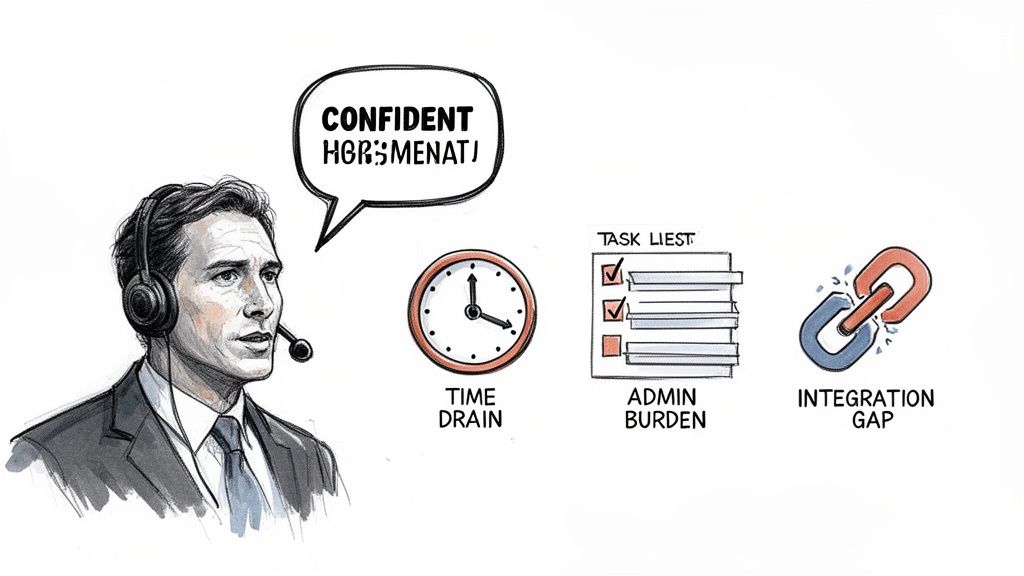
The Pain-First Opener is an assertive sales phone call script that flips the traditional model on its head. Instead of a slow build-up about who you are and what your company does, this approach leads with a highly specific, research-backed hypothesis about a prospect's most pressing challenge. By immediately addressing a known pain point, you cut through the noise, demonstrate relevance, and earn the right to continue the conversation.

A man in a headset on a call, dealing with business challenges like time drain, admin burden, and integration gaps.

This tactic is most effective when you have some context about the company, such as its size, recent sales hires, or signals indicating outbound challenges. It positions the SDR not as a generic seller, but as a specialist who understands the unique operational hurdles that come with the prospect's role and industry.

Example Pain-First Openers & Strategic Breakdown

Here’s how to deploy this script effectively for different decision-makers:

Scenario A: Call with a VP of Sales at a growing SaaS company

  • Opener: "Most sales leaders we work with at companies your size tell us their SDRs spend over two hours a day just figuring out what to do next and updating Salesforce. I'm guessing your team is facing something similar?"
  • Strategic Goal: This opener is powerful because it's specific ("two hours a day"), relatable (references "companies your size"), and directly ties to the VP's core concerns: productivity and pipeline. It's a calculated risk that pays off with an immediate nod of recognition, opening the door to discuss MarketBetter's task automation.
  • Potential Follow-up: "How is that admin time impacting your team's ability to hit its meeting-setting targets?"

Scenario B: Call with a RevOps Leader

  • Opener: "We've noticed most Salesforce-first teams struggle with dialer adoption because it lives outside the CRM, which skews activity data. Is that showing up in your call logs?"
  • Strategic Goal: This speaks directly to the RevOps mandate for data integrity and tech stack efficiency. It highlights a common system-level flaw (poor integration) and its consequence (unreliable data), immediately positioning MarketBetter’s native Salesforce dialer as the logical solution.
  • Potential Follow-up: "When your sales leaders look at their dashboards, how confident are they that the call data is 100% accurate?"

Actionable Takeaways & Tips

  1. Arm Yourself with Data: Use MarketBetter's customer data and case studies to ground your hypothesis. An opener like, "Our customers report a 35% reduction in admin time after the first month," adds credibility and quantifies the potential value from the very first sentence.
  2. Tailor Pain to the Persona: The most effective pain-first sales phone call script is role-specific. For an SDR Manager, focus on ramp time and coaching. For a VP of Sales, emphasize pipeline and forecast consistency. For RevOps, lead with data quality and tech consolidation.
  3. Prepare a Pivot: If the prospect responds, "Actually, that's not an issue for us," don't panic. Pivot smoothly by asking, "I appreciate that clarity. In that case, what is the biggest bottleneck your team faces right now?" This keeps the conversation moving and shows you're there to solve their actual problem.
  4. Keep it Conversational: The goal is to sound like an informed peer, not an aggressive interrogator. Your tone should be collaborative and consultative. Log the prospect's response in MarketBetter's talk-track feature to capture their exact language for follow-ups.

3. The Warm Intro / Referral Script: Leveraging Social Proof & Existing Relationships

A referral is the gold standard of sales leads, instantly elevating a cold call to a warm, trusted conversation. This sales phone call script is designed to capitalize on that existing trust by leveraging the credibility of a mutual connection. Unlike a cold call where you must fight for attention, you start the call with built-in social proof, which significantly lowers the prospect's guard and accelerates the path to a meaningful discussion about their business needs.

This approach is most effective when a current customer, a partner, or a trusted industry peer has recommended your solution. The key is to move from the introduction to discovery seamlessly, using the referrer’s context as a bridge to uncover specific pain points. It transforms the dynamic from a sales pitch into a recommended solution from a trusted source.

Example Referral Questions & Strategic Breakdown

Here’s how this sales phone call script works in practice, tailored for different referral sources:

Scenario A: Referral from an Existing Customer

  • Script: "Hi [Prospect Name], Jane from [Competitor/Peer Company] suggested I reach out. She just rolled out our AI call coaching workflow and mentioned you're also focused on scaling your SDR team this year. She thought you'd want to see how they cut new hire ramp time in half."
  • Strategic Goal: This immediately establishes relevance and social proof with a tangible, impressive result (cutting ramp time in half). By naming a direct competitor or peer, you create a sense of urgency and FOMO (fear of missing out).
  • Potential Follow-up: "Given your team is scaling, what does your current ramp-up process look like for new SDRs?"

Scenario B: Warm Intro from a Sales Peer/Partner

  • Script: "Hi [Prospect Name], Mike from [Partner Company] and I were discussing how RevOps teams are consolidating their tech stacks. He knows we helped his other clients replace three tools with our integrated platform, and thought it’d be worth a quick chat given your current Outreach and separate dialer setup."
  • Strategic Goal: This script demonstrates insider knowledge of the prospect's tech stack, showing the referrer provided specific, valuable context. It frames the conversation around a common industry pain point (tool consolidation) and positions your solution as a direct remedy.
  • Potential Follow-up: "How much time is your team spending syncing data between those separate systems right now?"

Actionable Takeaways & Tips

  1. Confirm the Introduction: Always get permission from the referrer before using their name. A quick email or message like, "Would you be comfortable with me mentioning your name when I reach out to [Prospect Name]?" protects the relationship.
  2. Open with Gratitude and Context: Start by thanking the referrer (e.g., "Jane was kind enough to connect us"). Immediately follow with the specific context they provided, such as, "She mentioned you were struggling with...." This proves the call is not random.
  3. Acknowledge the Referrer's Credibility: Validate the introduction's value. A phrase like, "Mike wouldn't have recommended this call if he didn't think it was highly relevant to your goals" shows you respect both the prospect's time and the referrer's judgment.
  4. Have a Pivot Plan: If the prospect doesn't immediately recall the referrer, don't force it. Gracefully pivot to a standard pain-based discovery question. For instance, "No problem at all. The main reason he connected us was the work we're doing around improving sales data hygiene. Is that a priority for you?"

4. The Objection Handler: Overcoming 'We Already Use Outreach/Salesloft'

Facing a well-entrenched competitor is one of the most common hurdles in SaaS sales. This sales phone call script is a strategic framework for turning a reflexive objection into a discovery opportunity. Instead of trying to replace an established tool like Outreach or Salesloft, the goal is to reposition your solution as a complementary execution layer that fills critical gaps they don't address, such as task prioritization, in-CRM dialing, and automated activity logging.

This approach transforms a competitive roadblock into a nuanced conversation about workflow efficiency. It’s most effective when an SDR hears, "We're already set," because it allows them to pivot from a "rip-and-replace" mentality to a "plug-and-enhance" value proposition. By agreeing with the prospect and then probing on specific workflow pain points, you can uncover hidden needs that the incumbent platform isn't solving.

Example Objection Responses & Strategic Breakdown

Here’s how to navigate this common objection with different angles:

Scenario A: Prospect says, "We're happy with Outreach."

  • Response: "That's great to hear, they're a solid platform. Quick question for my own understanding: when your reps are planning their day, how do they decide which prospect to call first? Are they working out of Outreach tasks or building views back in Salesforce?"
  • Strategic Goal: This question is a surgical probe. It acknowledges the competitor's value while shifting the focus to a specific, often inefficient, part of the SDR workflow: daily task prioritization. Most teams admit this is a manual, time-consuming process that happens outside their primary engagement tool.
  • Potential Follow-up: "Most teams we talk to say that decision-making layer is a real bottleneck. MarketBetter actually sits inside Salesforce to prioritize those tasks, so reps just click and dial with all the right context. Is that something your team has automated today?"

Scenario B: Prospect says, "We already pay for Salesloft; we don't have the budget."

  • Response: "I completely understand not wanting to add another line item. We actually don't replace Salesloft; we make the reps using it more effective. They're likely using it for email sequences, right? We handle the moment before the call with task prioritization and the moment after with auto-logging. Think of us as the execution engine that maximizes your current investment."
  • Strategic Goal: This response reframes the conversation from cost to ROI. By positioning MarketBetter as an enhancement, not a replacement, you sidestep the budget objection and focus on amplifying the value of their existing tech stack. It’s about making their current tools more productive.
  • Potential Follow-up: "What if you could increase your reps' call volume and connect rates by 15% without changing their email cadences? That’s the gap we fill."

Actionable Takeaways & Tips

  1. Never Disparage the Competitor: The golden rule is to agree and pivot. Phrases like "That makes sense" or "They're a great tool" build rapport. Then, immediately follow up with a specific, workflow-related question that highlights a known gap in their process.
  2. Focus on the "Gaps": Your script should be built around questions that expose the pain points your product solves uniquely. For MarketBetter, these are:
    • "How do you prioritize which tasks each rep should tackle first?" (Targets manual prioritization).
    • "Are your reps dialing through Salesloft or a separate click-to-dial tool?" (Targets disconnected dialing).
    • "How consistently are call notes and dispositions making it back into Salesforce?" (Targets poor data hygiene).
  3. Offer a Low-Risk Pilot: De-risk the decision. Suggest a pilot for a small group, like one SDR for 30 days, focused on a single metric like improving connect rates. This makes the commitment feel manageable and data-driven.
  4. Leverage Social Proof: Use MarketBetter's talk-track feature to have a pre-loaded phrase ready, such as: "We have over a dozen customers who use both MarketBetter and Outreach side-by-side to solve this exact challenge." This validates your "complementary" positioning.

5. The Account-Based Selling (ABS) Script: Multi-Threaded Discovery for Enterprise Deals

The Account-Based Selling (ABS) script is a sophisticated, multi-layered approach designed for complex enterprise deals. In contrast to a standard script focused on a single point of contact, it’s a series of interconnected conversations with different stakeholders within a target account, such as the VP of Sales, SDR Manager, and RevOps leader. The goal is to build a comprehensive business case by understanding and aligning the unique pain points and value drivers of each member of the buying committee. This strategy transforms a linear sales process into a web of influence, creating internal champions for your solution.

This script is crucial when selling high-value, complex solutions into large organizations where decisions are made by committee. It requires thorough research and a consultative mindset, moving beyond a single point of contact to orchestrate a unified narrative across the entire account. When developing an Account-Based Selling (ABS) script, a deep understanding of the Target Account Selling definition is fundamental for multi-threaded discovery and enterprise deals.

Example Multi-Threaded Questions & Strategic Breakdown

Here’s how this sales phone call script is threaded across different roles within one target account:

Scenario A: Initial Call with a VP of Sales

  • Statement & Question: "We're seeing teams like yours cut SDR ramp time by 40% and add 2-3 extra conversations per rep per day. For your 15-person team, that's over 150 extra qualified conversations monthly. How does that align with your pipeline acceleration goals for Q4?"
  • Strategic Goal: This frames the conversation around high-level business impact: revenue and pipeline growth. It uses specific, quantified value to grab the attention of a leader focused on the bottom line, opening the door to a broader strategic discussion.
  • Potential Follow-up: "Who on your team is directly responsible for new hire onboarding and daily rep consistency?" (This directly tees up the next call).

Scenario B: Follow-up Call with an SDR Manager

  • Question: "Your VP mentioned that pipeline acceleration is a key priority. I've seen that one of the biggest drags on that is ramp time. What's your typical timeline for a new hire to become fully productive, and how does that impact team quota?"
  • Strategic Goal: This conversation connects the VP's high-level goal to the SDR Manager's daily operational pain. It positions MarketBetter as an enablement and coaching tool that directly helps the manager hit their team-specific targets, creating another internal advocate.
  • Potential Follow-up: "If we could get your reps productive 3 weeks faster by automating their prep work, what would that mean for your team's morale and performance?"

Actionable Takeaways & Tips

  1. Map the Buying Committee First: Before your first call, use LinkedIn and company org charts to identify 3-4 key stakeholders. Use MarketBetter’s pre-call prep to gather intel on each person’s role, responsibilities, and recent company initiatives.
  2. Connect the Dots Between Calls: Start each new conversation by referencing previous ones. For example: "When I spoke with Sarah in RevOps, she mentioned data integrity in Salesforce was a challenge. How does that impact your ability to coach your reps effectively?" This shows you're building a cohesive understanding of their business.
  3. Assign Value Metrics to Each Role: Tailor your value proposition. For the VP, it's pipeline growth. For the SDR Manager, it's rep consistency and ramp time. For RevOps, it's data quality and tool consolidation.
  4. Create a Discovery Summary: After speaking with all key stakeholders, consolidate your notes into a single document. Share this with your champion to validate your findings and use it to schedule a joint demo that addresses every person's specific concerns.

6. The Value-Forward Script: Leading with ROI & Quantified Business Impact

This metrics-driven script flips the traditional sales model. Unlike a discovery script that probes for pain, this one leads with quantifiable business outcomes. It’s designed for conversations with ROI-focused buyers, especially when budgets are tight or procurement is involved. The core principle is to make the cost of inaction more painful than the cost of your solution by presenting an undeniable, data-backed case for investment.

This approach is most effective when engaging with senior leaders (VPs, CFOs) who are accountable for financial performance and operational efficiency. It preemptively answers the "So what?" question by translating your service into the language of revenue, cost savings, and productivity gains.

Example Value-Forward Statements & Strategic Breakdown

Here’s how this sales phone call script translates into a powerful, numbers-driven conversation:

Scenario A: Call with a CFO or Procurement Head

  • Statement: "Based on your team size of 20 SDRs, a conservative 15% increase in daily dials with our platform translates to over 100 more conversations a month. At your average deal size and close rate, that's a direct path to an additional $375k in annual pipeline, with a payback period on our software of just under five weeks."
  • Strategic Goal: This statement presents a complete, albeit high-level, ROI calculation upfront. It connects a specific activity (dials) to a top-line business outcome (pipeline), making the value tangible and immediately justifying the cost.
  • Potential Follow-up: "Would you agree that investing $15k to generate a potential $375k in new pipeline is a priority worth exploring?"

Scenario B: Call with a VP of Sales

  • Statement: "I noticed your team is hiring three new SDRs. Our data shows that better coaching, enabled by our auto-logging feature, can cut ramp time by three weeks per rep. For your team, that means reclaiming nine weeks of full productivity this quarter alone. What would that mean for hitting your Q3 target?"
  • Strategic Goal: This ties the solution directly to a current, observable business activity (hiring). It quantifies the cost of the status quo in terms of lost productivity, creating a sense of urgency that is highly relevant to a sales leader’s goals.
  • Potential Follow-up: "How are you currently measuring the time it takes for a new hire to become a consistent contributor?"

Actionable Takeaways & Tips

  1. Build a Live ROI Calculator: Don't just present numbers; build them collaboratively. Use key questions to populate a model in real-time. Ask: "How many SDRs are on the team?" "What's your average deal size?" Use MarketBetter’s talk-track feature to input these variables directly into a pre-built ROI template during the call.
  2. Frame the Cost of Inaction: The most powerful ROI argument is often what a prospect is losing by not changing. Frame your value proposition around stopping the bleed. A line like, "Every month you continue with manual logging, you're leaving an estimated $30,000 in potential pipeline on the table," is far more compelling than a list of features.
  3. Prepare Industry-Specific Case Studies: Have concrete ROI data from a similar company ready to go. Saying, "A mid-market SaaS company just like yours saw a 22% increase in meetings booked within 60 days," provides social proof and makes the potential results feel achievable.
  4. Offer a Pilot ROI Scenario: De-risk the decision by proposing a limited, metrics-focused trial. Suggest, "Let's measure these three KPIs on one team for 30 days. If you don't see a 15% improvement, we'll refund the pilot cost." This shows confidence and focuses the evaluation on tangible results.

7. The Product-Specific Deep Dive: The AI-Powered Call Coaching Script

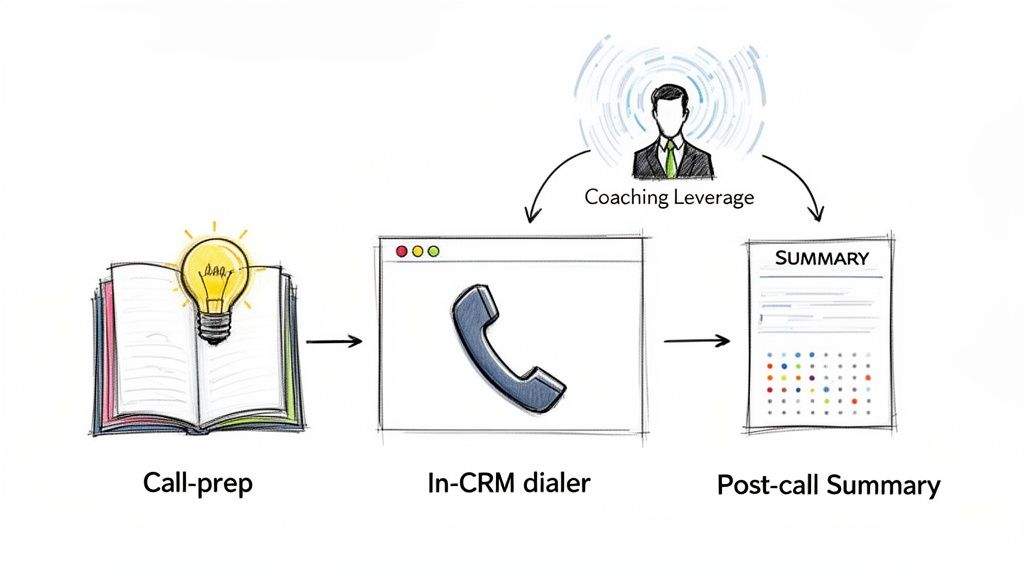
When a prospect moves beyond initial interest and wants to understand the "how" behind your product, a standard sales phone call script falls short. The AI-powered call coaching script is a feature-focused walkthrough, designed to demonstrate tangible value by showcasing a specific workflow. Instead of just telling them you can improve coaching, you show them exactly how your platform, like MarketBetter, transforms a rep’s day-to-day process and a manager's strategic oversight.

Workflow diagram showing sales call preparation, in-CRM dialing, post-call summary, and coaching leverage.

This approach is perfect for mid-funnel conversations with leads who have already engaged with high-level content and are now evaluating specific capabilities. It connects the dots between a feature (AI call coaching) and its direct impact on efficiency, rep development, and revenue goals.

Example Scripts & Strategic Breakdown

Here’s how to tailor this workflow-centric script for different stakeholders:

Scenario A: Call with a Sales Enablement Manager

  • Script: "Let’s walk through the workflow. This morning, your rep pulls up a prospect in Salesforce. MarketBetter's AI instantly auto-generates 4-5 talking points based on recent company news and their persona. It also flags 2-3 likely objections with proven responses from your top performers. The rep reviews this for 3 minutes, then calls through our dialer. After the call, we auto-log the disposition and generate a summary. You see patterns across all calls, like 'objection X came up 12 times this week,' and can coach proactively."
  • Strategic Goal: This narrative focuses on the entire lifecycle of a call, from prep to post-call analysis. It highlights time savings (3 minutes of prep vs. 15) and scalability, which are core concerns for enablement leaders responsible for rep productivity.

Scenario B: Call with a VP of Sales

  • Script: "Instead of listening to random call recordings, you'll see a dashboard of all calls this week grouped by outcome. You can drill into 'lost deals' calls and immediately see the common threads. Let's say you notice reps are struggling with our new pricing objection. You listen to 2-3 calls, pull the best response from another rep's call, and that response auto-generates into the talking points for next week. That's how you scale coaching from a 1-to-1 task to a 1-to-many strategy."
  • Strategic Goal: This script speaks directly to a VP's strategic priorities: data-driven decision-making and performance leverage. It contrasts the old, inefficient method (random call reviews) with a new, systemic approach to improving team-wide performance and hitting revenue targets.

Actionable Takeaways & Tips

  1. Show, Don't Just Tell: If possible, conduct this conversation as a live screen share. Walk them through an actual MarketBetter call prep screen and post-call summary. Use a real company as an example: "Let's pretend we're calling Acme Corp. Here’s what MarketBetter's AI would show your rep right now."
  2. Quantify the Time Savings: Frame the value in concrete numbers. "Instead of 5-10 minutes of manual research per call, reps get tailored talking points in 30 seconds. Across a team of 20 SDRs, that's over 30 hours of selling time reclaimed each week."
  3. Emphasize the Coaching Multiplier: The core benefit isn't just better calls; it's scalable coaching. Highlight how managers shift from reactive, individual feedback to proactive, team-wide improvements. MarketBetter’s talk-track feature helps identify these patterns automatically.
  4. Address AI Quality Concerns: Be direct. Explain that the AI-generated points aren't generic. "Our talking points are grounded in specific, real-time account context and your own team's past successes, not generic templates."

8. The Follow-Up Sequence Script: From Initial Call to Demo to Close

A single call rarely closes a complex deal. The follow-up sequence is a strategic, multi-touch framework designed to nurture interest, build value, and maintain momentum between the initial conversation and a final decision. In contrast to one-off, reactive check-ins, this sales phone call script structures a series of purposeful interactions, each adding a new layer of value and guiding the prospect closer to a commitment.

This approach is crucial for prospects who show initial interest but aren't ready for a demo, often because of timing, competing priorities, or the need for internal alignment. A well-executed sequence prevents leads from going cold by transforming follow-ups from "just checking in" to "here’s another reason why we should talk."

Example Follow-Up Sequence & Strategic Breakdown

Here’s a multi-touch sequence designed to guide a VP of Sales from initial discovery to a demo commitment:

Scenario: Nurturing a VP of Sales After a Brief Discovery Call

  • Call 1 (Day 0 - Initial Contact): "I understand from our initial chat you're focused on scaling the SDR team without tripling your budget. Let's book a 20-minute call next week to explore how you can increase outbound efficiency."

  • Strategic Goal: Acknowledge their primary challenge (scaling efficiently) and secure a low-commitment next step. The goal isn't a demo; it's simply to continue the conversation.

  • Call 2 (Day 4 - Pre-Call Value Add): "Ahead of our call, I shared a case study about a team that grew their pipeline by 40% with the same headcount. They focused on automating non-selling tasks. On our call, I'd love to ask, what's the single biggest bottleneck you see for your reps right now?"

  • Strategic Goal: This call frames the upcoming conversation around a proven success story. By providing value (the case study) before asking for more information, you build reciprocity and position yourself as a helpful resource, not just a seller.

  • Call 3 (Day 7 - ROI-Focused): "Based on our last chat, I used our ROI calculator with your numbers. With 20 SDRs making just two extra qualified conversations per day, you’re looking at a potential pipeline uplift of over $400k monthly. Would it be valuable to see a live breakdown of how that's possible?"

  • Strategic Goal: Shift the conversation from abstract problems to concrete financial impact. Tying the solution directly to a tangible ROI creates urgency and makes the decision to see a demo a logical next step.

Actionable Takeaways & Tips

  1. Map Every Touchpoint: Don't improvise your sequence. Plan the purpose of each call, email, and LinkedIn message in advance. Use MarketBetter’s pipeline view to set reminders and log notes for each stage of the sequence, ensuring no prospect falls through the cracks.
  2. Add Value, Don't Just Ask for Updates: Each follow-up must provide something new: a relevant blog post, a short video testimonial, a custom ROI calculation, or an industry benchmark. This keeps the conversation moving forward and reinforces your expertise.
  3. Vary Your Messaging: Use different angles for each touchpoint. One call might focus on efficiency gains, the next on data integrity for forecasting, and another on SDR ramp time. This multi-pronged approach helps you uncover which pain point resonates most.
  4. Know When to Qualify Deeper: A follow-up sequence is an extended discovery process. As you learn more, continuously refine your understanding of the prospect's needs. This aligns perfectly with the principles of how to properly qualify sales leads throughout the entire sales cycle.

Comparison of 8 Sales Phone Call Scripts

Script / ApproachImplementation Complexity 🔄Resource Requirements ⚡Expected Outcomes ⭐Ideal Use Cases 📊Key Advantages 💡
The Discovery Call: Identifying Pain Points & Building RapportMedium 🔄 — consultative skill + script practiceLow–Medium ⚡ — trained SDRs, prep research, 12–15m per call⭐⭐⭐⭐ — strong qualification and rapport; follow-up often requiredCold outreach to VP Sales / SDR Managers; relationship-first engagementBuilds trust, uncovers real pain, natural transition to demo
The Pain-First Opener: Leading with SDR Team ChallengesLow–Medium 🔄 — short, researched opener; execution-sensitiveLow ⚡ — quick role/company research; concise script⭐⭐⭐⭐ — grabs attention; shortens commitment timeHigh-velocity cold calls with prior signals or intent dataImmediate relevance, reduces "not interested", faster outcomes
The Warm Intro / Referral Script: Leveraging Social ProofLow 🔄 — simple script but reliant on referrerLow ⚡ — coordination with referrer; minimal prep⭐⭐⭐⭐⭐ — highest answer and trust rates; faster progressionReferral/warm leads, ABM, upsell or targeted outreachHigh trust, shorter sales cycle, lower objection rate
The Objection Handler: Overcoming "We Already Use Outreach/Salesloft"Medium–High 🔄 — requires competitor knowledge and nuanceMedium ⚡ — competitor playbooks, RevOps alignment, pilot offers⭐⭐⭐ — preserves conversations; dependent on incumbent gapsProspects entrenched with Outreach/Salesloft who show resistanceRepositions as complementary execution layer; enables low-risk pilots
The Account-Based Selling (ABS) Script: Multi-Threaded DiscoveryHigh 🔄 — multi-stakeholder coordination and messagingHigh ⚡ — senior sellers, multiple 20–60m calls, org research⭐⭐⭐⭐⭐ — significantly increases enterprise win probabilityEnterprise deals with buying committees (VPs, RevOps, Enablement)Builds multiple champions, uncovers hidden objections, strategic positioning
The Value-Forward Script: Leading with ROI & Quantified ImpactMedium–High 🔄 — accurate ROI modeling and data validationMedium–High ⚡ — ROI calculator, case studies, finance-ready 1-pagers⭐⭐⭐⭐ — accelerates budget approval and procurement buy-inCFO/procurement-led deals or price-sensitive buyersQuantifies payback, reduces cost objections, enables executive buy-in
The Product-Specific Deep Dive: AI-Powered Call CoachingHigh 🔄 — feature-depth demo; technical credibility requiredHigh ⚡ — live demo, product experts, call recordings, integrations⭐⭐⭐⭐ — builds confidence in capability for Enablement/RevOpsProspects already engaged who want detailed product validationDemonstrates differentiation, shows day‑to‑day workflows, reduces implementation anxiety
The Follow-Up Sequence Script: From Initial Call to Demo to CloseMedium 🔄 — multi-touch cadence with tailored messagingMedium ⚡ — sequencing, tailored content, disciplined follow-through⭐⭐⭐⭐ — improves conversion and pipeline hygiene over timeLeads not ready to demo; SDRs managing nurture pipelinesMaintains momentum, surfaces real objections, stages path to demo/pilot
Free Tool

Try our AI Lead Generator — find verified LinkedIn leads for any company instantly. No signup required.

From Script to System: Making Every Call Count

Throughout this guide, we've dissected a variety of high-impact sales phone call script examples, moving far beyond simple word-for-word templates. We’ve explored how to lead with pain points in a discovery call, how to leverage a warm referral for maximum impact, and how to confidently handle the "we already use a competitor" objection. Each script, from the highly targeted ABS approach to the ROI-centric value proposition, serves as a strategic blueprint, not a restrictive set of lines.

The core lesson is this: a powerful sales phone call script is not a cage; it's a launchpad. It provides the structure for consistency while demanding the flexibility of genuine human interaction. The goal is to internalize these frameworks so you can adapt, pivot, and personalize in real-time, transforming a potential monologue into a productive, two-way dialogue.

Key Takeaways: From Framework to Fluent Conversation

The difference between a good SDR and a great one often lies in their ability to transition from reciting a script to owning the conversation. Let's recap the foundational principles that enable this shift:

  • Customization is Non-Negotiable: A generic sales phone call script is a dead end. As we saw in the "Pain-First Opener" and "Account-Based Selling" examples, deep personalization based on role, industry, and known business challenges is what earns you the right to a conversation.
  • Context Over Content: The why behind your call is more important than the what. The "Warm Intro" script works because it immediately establishes context and credibility. Always lead with relevance to disarm skepticism and build immediate rapport.
  • Objections are Opportunities: An objection isn't a rejection; it's a request for more information. Our script for handling competitor objections demonstrated that the best response is to reframe the conversation around undiscovered value or gaps in their current solution, not to attack the competitor directly.
  • Value Must Be Quantified: Vague promises don't book meetings. The "Value-Forward Script" emphasized leading with specific, quantifiable business impact. Tying your solution to tangible ROI from the very first sentence is your most powerful tool.

Actionable Next Steps: Systematize Your Success

Reading about a great sales phone call script is one thing; consistently executing it under pressure is another. The ultimate goal is to bridge the gap between knowing what to do and actually doing it on every single call. This is where process and technology become critical.

  1. Audit and Adapt Your Scripts: Take the templates from this article and benchmark them against your current call scripts. Identify one or two key scripts, like your primary cold call opener or a common objection handler, and begin adapting them. Role-play these new versions with your team to build muscle memory.
  2. Build a Centralized Playbook: Don't let your best scripts live in scattered documents. Create a centralized, living playbook (in a tool like Notion, Confluence, or directly within your sales engagement platform) that your entire team can access and contribute to.
  3. Embed Scripts into Your Workflow: The most effective scripts are those that are seamlessly integrated into the SDR's daily process. This is where tools like MarketBetter transform theory into practice. By embedding dynamic "talk tracks" and call-prep notes directly into your CRM and dialer, you equip reps with the right words at the right moment, eliminating friction and boosting confidence.
  4. Analyze, Coach, and Iterate: A script is never truly "finished." Use call recordings and analytics to understand what’s working and what isn’t. Are reps consistently getting stuck at the gatekeeper? Is a certain value proposition falling flat? Use this data to refine your scripts, provide targeted coaching, and continuously improve performance.

Ultimately, mastering the sales phone call script is about creating a scalable system for excellence. It's about empowering every rep, from the new BDR to the seasoned veteran, with a proven framework for success. By combining strategic scripts with intelligent technology, you can ensure that every dial has a purpose, every conversation creates value, and your pipeline grows predictably and consistently.


Ready to turn your best sales phone call script into a repeatable system? marketbetter.ai embeds dynamic talk-tracks and AI-powered prep notes directly into your team's workflow, ensuring every rep executes flawlessly. See how you can systematize your sales process by visiting marketbetter.ai today.