
How EHS & Safety Compliance Software Companies Can Build a Signal-Driven Sales Pipeline

The Environmental, Health & Safety (EHS) software market is projected to hit $3.4 billion by 2028. Behind that number is an uncomfortable truth: most EHS SaaS vendors are still running their sales motion like it's 2018 — cold lists, generic sequences, and BDRs burning through contact databases with zero signal intelligence.
If you sell safety compliance software, incident management platforms, or environmental monitoring tools, you already know the challenges. Your buyers are EHS directors, VP of Operations, and Chief Safety Officers — people who don't respond to "just checking in" emails. They respond to relevance.
This article breaks down how one mid-market EHS compliance SaaS company transformed their outbound pipeline by replacing spray-and-pray tactics with AI-powered intent signals — and how the same playbook applies to every vendor in this space.
The EHS Sales Problem: Long Cycles, Silent Buyers, Fragmented Tech
EHS software sales have a unique structural challenge that most GTM playbooks ignore.
The buyer committee is massive. A typical EHS purchase involves the EHS Director, VP of Operations, IT security (because compliance data is sensitive), procurement, and often legal. That's five stakeholders minimum, each with different priorities. The EHS Director cares about incident tracking. IT cares about SOC 2 and data residency. Procurement cares about contract terms.
The sales cycle is 6-12 months. EHS purchases are rarely urgent until a regulatory audit lands or an incident happens. Your window of relevance is narrow and unpredictable.
Your prospects are scattered across CRMs. Many EHS companies serve both the European and North American markets — which means your BDRs are working across HubSpot and Salesforce simultaneously, often with duplicated contacts and inconsistent data.
Generic outreach gets ignored. An EHS Director at a chemical manufacturing plant doesn't care about your "AI-powered platform." They care about whether you can handle OSHA 300 logs, EU REACH compliance, and multi-site incident reporting. If your first email doesn't speak their language, you're deleted.
What "Before" Looked Like: A Real EHS SaaS Company's Pipeline Problem
Consider a mid-market EHS compliance software company headquartered in Europe with a growing US presence. Their product handled everything from chemical safety data sheets to incident management and environmental reporting — a comprehensive platform serving manufacturing, energy, and pharmaceutical verticals.
Their sales setup looked like this:
- European HQ running on HubSpot for marketing and BDR outreach
- Salesforce as the primary CRM for the sales team and account management
- HubSpot-Salesforce sync that was... temperamental (as anyone who's managed this integration knows)
- A team of BDRs running email sequences through HubSpot, targeting EHS directors and operations leaders
- No visitor identification — their marketing site got decent traffic from SEO and events, but they had zero visibility into who was visiting
The results were predictable:
- BDRs were sending sequences to static lists pulled from conferences and purchased databases
- Reply rates hovered around 2-3% — well below the 5-8% benchmark for targeted B2B outreach
- The HubSpot-Salesforce sync created duplicates, which meant BDRs occasionally emailed prospects already in active deals
- Zero insight into which target accounts were actively researching solutions
- Pipeline was heavily dependent on events and referrals — a feast-or-famine model
This isn't unusual. It's the default state for most EHS software companies selling into regulated industries. The question is what changes when you layer intent signals on top.
The Signal-Driven Pivot: What Changed
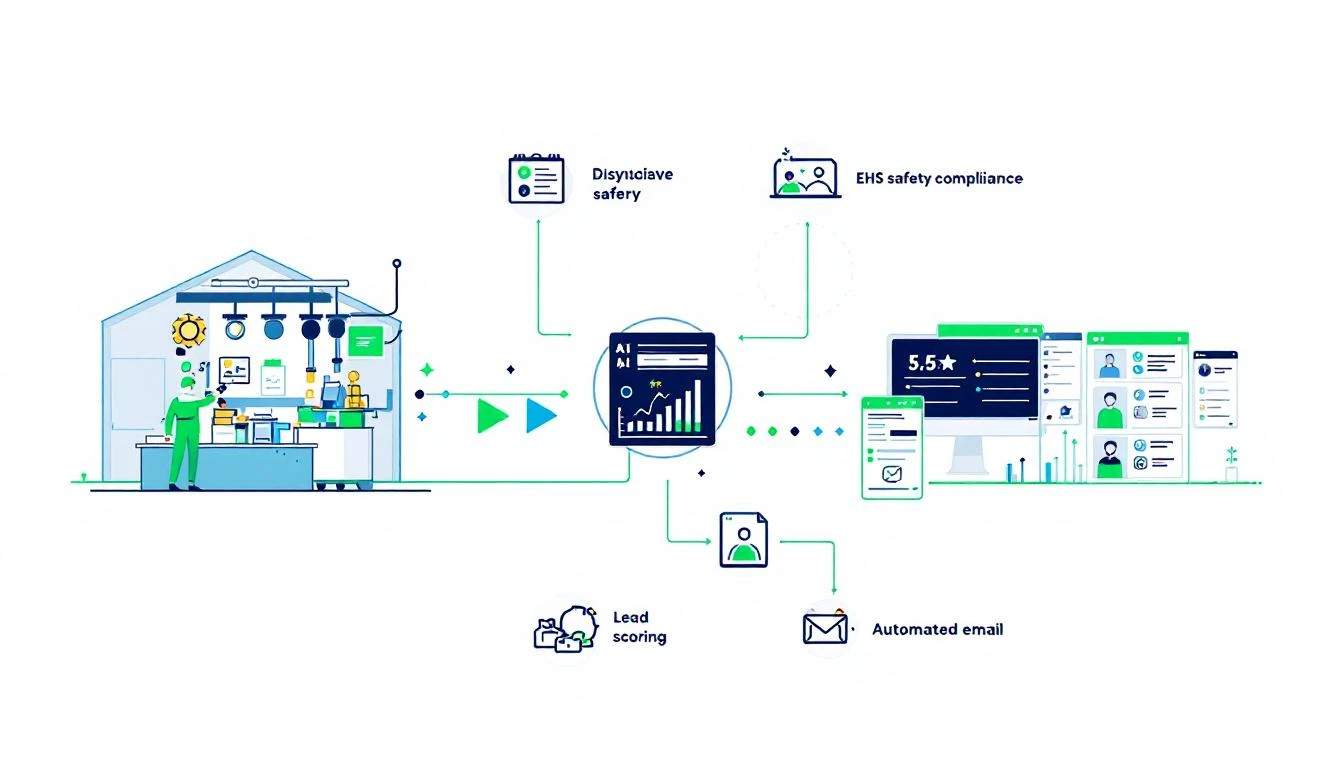
The transformation didn't require ripping out their CRM stack. It required adding an intelligence layer that turned anonymous website traffic into actionable pipeline.
1. Visitor Identification Revealed Hidden Demand
The first unlock was simple but profound: identifying the companies visiting their website.
Before visitor identification, their marketing team knew they got about 4,000 monthly visitors. After turning on website visitor identification, they discovered something startling — roughly 15% of their traffic came from companies already in their target account list. These were EHS directors and procurement managers actively researching compliance software, reading comparison pages, and checking pricing — all invisible before.
Within the first month, they identified 47 target accounts actively browsing their site. Of those, 12 were in active evaluation cycles (visiting 3+ pages, returning multiple times). None of these accounts had responded to any previous outbound sequences.
The takeaway: Your best leads are already on your website. You just can't see them. In EHS specifically, buyers do extensive online research before engaging vendors because they need to validate regulatory coverage before wasting time on demos.
2. CRM-Integrated Signals Solved the HubSpot-Salesforce Mess
The dual-CRM problem is epidemic in companies with European headquarters and US sales teams. Their HubSpot ran marketing campaigns and BDR sequences. Their Salesforce tracked deals, accounts, and customer data. The sync between them was a constant source of pain.
By routing visitor identification data directly into both systems, they created a unified view of account activity:
- When a target account hit the website, it triggered an alert in both HubSpot (for the BDR team) and Salesforce (for the AE if the account was already in pipeline)
- Duplicate detection improved because visitor data matched against both CRM records
- BDRs stopped accidentally emailing active-deal contacts — a problem that had cost them at least two deals in the previous quarter
This is where AI-powered CRM hygiene becomes critical. The EHS space is small enough that accidentally spamming an active prospect with a cold sequence can burn a relationship permanently.
3. Behavioral Triggers Replaced Batch-and-Blast Sequences
The old model: BDRs loaded 200 contacts from a conference list into a 5-email sequence every Monday. Response rates were low, unsubscribes were high, and the sequences had no connection to actual buyer behavior.
The new model: Automated email sequences triggered by behavioral signals.
Here's what the trigger logic looked like:
- Pricing page visit → BDR gets instant alert + suggested email referencing their specific compliance needs
- 3+ page views in a week from the same company → Account added to high-priority sequence with personalized first line
- Return visitor from a previously cold account → Re-engagement sequence activated with updated messaging
- Specific product page visits (e.g., incident management, chemical SDS) → Sequence tailored to that product area
The result: reply rates jumped from 2.3% to 7.1% within 60 days. Not because the BDRs wrote better emails — but because they were emailing the right people at the right time about the right topic.
4. Territory-Aware Routing Across Regions
This is where it gets specific to multi-region EHS companies. With operations in Europe and North America, the BDR team needed intelligent routing:
- European accounts → routed to the EU-based BDR team who understood REACH, CLP, and EU-OSHA requirements
- North American accounts → routed to the US team familiar with OSHA, EPA, and state-specific regulations
- Accounts in both regions → flagged for coordinated outreach to avoid conflicting messages
The old approach was manual — a spreadsheet with territory assignments, updated quarterly. The signal-driven approach automated routing based on the visitor's IP geography and matched it against the territory planning rules in their CRM.
Results After 90 Days
The numbers tell the story:
| Metric | Before | After 90 Days |
|---|---|---|
| Identified target accounts visiting site | 0 | 47/month |
| BDR reply rate | 2.3% | 7.1% |
| Pipeline from inbound signals | $0 | $340K |
| Deals sourced from visitor ID | 0 | 8 |
| Time to first contact (signal → email) | N/A | 4.2 hours |
| CRM duplicate rate | ~12% | <2% |
The most telling metric: 8 deals sourced purely from visitor identification signals — accounts that had never responded to cold outreach but were identified browsing the website and engaged within hours.
The EHS-Specific Playbook: 5 Actionable Takeaways
If you sell EHS, safety compliance, or environmental software, here's how to implement signal-driven selling:
1. Prioritize Regulatory-Page Visitors
Your highest-intent signal isn't pricing page visits — it's regulatory compliance page visits. When an EHS Director visits your OSHA 300 log page or your EU REACH compliance page, they're evaluating whether your platform covers their specific regulatory requirements. That's a buying signal stronger than a demo request form.
Set up alerts specifically for these pages. They indicate evaluation-stage research.
2. Build Sequences by Regulation, Not by Product
Stop sending generic "check out our EHS platform" emails. Build sequences organized by regulatory framework:
- OSHA sequence — for US manufacturing and industrial targets
- EU-OSHA / REACH sequence — for European chemical and manufacturing targets
- ISO 45001 sequence — for companies pursuing certification
- EPA / environmental compliance sequence — for energy and waste management targets
Each sequence should reference the specific regulation in the subject line. Intent data shows that regulatory-specific messaging outperforms generic product messaging by 3-4x in the EHS vertical.
3. Map the Buying Committee Early
Use visitor identification to map the full buying committee. If an EHS Director visits your site on Monday and a Procurement Manager visits on Wednesday from the same company, that's multi-stakeholder evaluation. Your BDR should be building a multi-threaded outreach plan, not just emailing the EHS Director.
4. Sync Your CRM Stack Before Adding Signals
If your HubSpot-Salesforce sync is broken, adding visitor signals will amplify the chaos. Fix the foundation first. Deduplicate contacts, establish clear routing rules, and define which system is the source of truth for each object type.
5. Use Conference Signals Differently
EHS companies rely heavily on events (NSC Congress, A+A, ASSE). Instead of exporting attendee lists and blasting them post-event, use conference attendee signals combined with visitor ID:
- Before the event: identify which target accounts are visiting your site (they're researching vendors pre-conference)
- During the event: prioritize meetings with accounts that showed digital intent
- After the event: sequence only the accounts that visited your site post-event (they're comparing)
This turns a 500-person attendee list into a prioritized 30-account list — dramatically improving BDR efficiency.
Why EHS Companies Can't Afford to Wait
The EHS software market is consolidating. Larger players are acquiring niche vendors, and the window for mid-market companies to build a scalable inbound pipeline is narrowing.
The companies that win will be the ones who stop relying on conference leads and referrals — and start building systematic, signal-driven pipelines that identify and engage buyers the moment they start researching.
The technology exists today. The question is whether your sales team is using it.
MarketBetter helps EHS and safety compliance software companies identify website visitors, trigger automated sequences, and build pipeline from intent signals. See how it works →