
OpenAI Codex Mid-Turn Steering: The Killer Feature for GTM Teams [2026]
When GPT-5.3-Codex dropped on February 5, 2026, everyone focused on the "25% faster" headline. But the real game-changer? Mid-turn steering.
This feature lets you redirect an AI agent while it's working—not after it finishes. For GTM teams running complex automation, this changes everything.
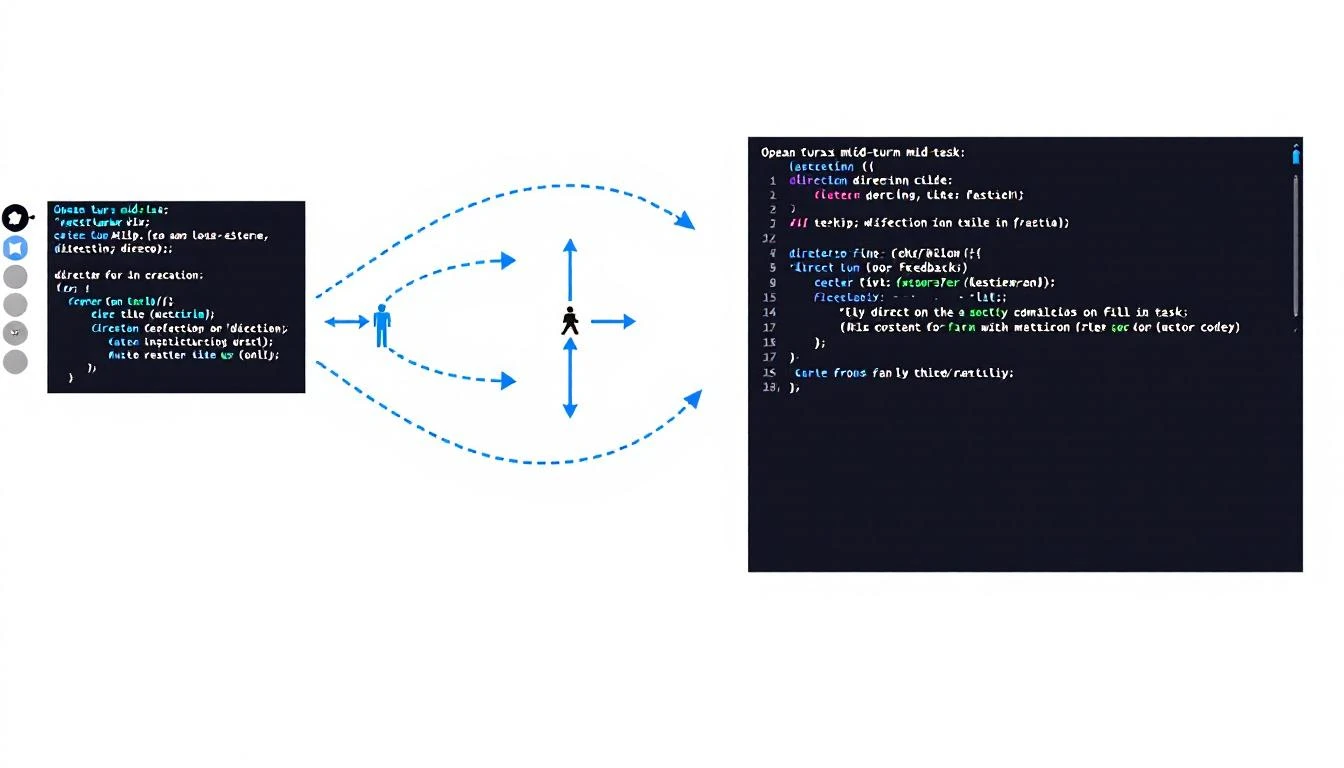
What is Mid-Turn Steering?
Traditionally, when you ask an AI to do something, you wait until it's done to give feedback. If it goes off track, you:
- Wait for completion
- Read the output
- Write a correction prompt
- Start over
Mid-turn steering breaks this pattern. You can intervene during execution:
You: Build a lead scoring model based on our HubSpot data

Codex: [starts working]
       - Pulling contact fields...
       - Analyzing conversion patterns...
       - Building scoring criteria...

You: Actually, weight company size more heavily than title

Codex: [adjusts mid-task]
       - Updating weight for company_size field...
       - Recalculating score thresholds...
       [continues with adjustment]
No restart. No lost work. Just a course correction.
Why This Matters for GTM
1. Complex Automation Doesn't Fail Silently
When building sales automation, you often don't know exactly what you want until you see the first attempt. Mid-turn steering lets you:
- Watch the agent's approach in real-time
- Correct misunderstandings immediately
- Guide toward edge cases as they appear
Without this, a 20-minute automation task might need 3-4 full restarts to get right.
2. Better Collaboration with AI
Mid-turn steering makes AI feel less like a black box and more like a collaborator. You're not just prompting and praying—you're actively directing.
For sales leaders building complex workflows, this means:
- Faster iteration cycles
- More precise outputs
- Higher confidence in automation
3. Reduced Token Waste
Every restart burns tokens. Mid-turn steering reduces:
- Repeated context loading
- Duplicate work
- Prompt engineering overhead
For teams running Codex at scale, this adds up.
GTM Use Cases for Mid-Turn Steering
Building Custom Lead Scoring
Traditional approach:
- Ask Codex to build a lead score
- Wait 10 minutes
- Realize it weighted "email opened" too heavily
- Start over with clarification
- Wait another 10 minutes
With mid-turn steering:
- Ask Codex to build a lead score
- Watch it start weighting criteria
- "Wait—de-emphasize email opens, focus on website visits"
- Codex adjusts in real-time
- Get the right model in one pass
Generating Email Sequences
Traditional approach:
- "Write a 5-email nurture sequence"
- Wait for all 5 emails
- Email 3 is too salesy
- Restart or write complex follow-up prompt
With mid-turn steering:
- "Write a 5-email nurture sequence"
- After email 2: "Make these more educational, less pitch-focused"
- Codex adjusts emails 3-5 accordingly
- Done
Building Pipeline Dashboards
Traditional approach:
- "Build a pipeline dashboard showing X, Y, Z"
- Wait for completion
- Visualizations aren't quite right
- Describe changes in detail
- Hope it understands
With mid-turn steering:
- "Build a pipeline dashboard"
- See the chart types being chosen
- "Actually, use bar charts for that, not pie"
- Watch it switch mid-build
- "Add a filter for deal size"
- Done with all adjustments in one session
How to Use Mid-Turn Steering
In Codex CLI
# Start a task
codex run "Build a HubSpot integration that syncs new contacts"

# While it's running, type to intervene
> Also add error handling for rate limits
> Skip the logging for now, we'll add that later
In Codex Cloud (Web UI)
The Codex dashboard shows real-time execution. A sidebar lets you:
- See what the agent is currently doing
- Type interventions
- Pause/resume execution
- Save partial progress
Via API
const session = await codex.createSession({
  task: "Build lead enrichment pipeline",
  onProgress: (state) => console.log(state),
  allowSteering: true
});

// Intervene mid-task
await session.steer("Use Apollo for enrichment instead of Clearbit");
Best Practices for Mid-Turn Steering
1. Let It Start Before Steering
Don't intervene in the first 10 seconds. Let Codex show its approach first—you might learn something.
2. Be Specific with Corrections
❌ "That's not quite right"
✅ "Use percentage instead of raw numbers for the conversion column"
3. Steer Early, Not Late
If you see it going the wrong direction, intervene immediately. Don't wait until it's 80% done.
4. Save Checkpoints
For complex tasks, tell Codex to checkpoint progress: "After each major step, commit and show me the current state"
This lets you roll back if steering doesn't work.
5. Don't Over-Steer
Every intervention has overhead. If you're steering every 30 seconds, your initial prompt probably wasn't clear enough.
Mid-Turn Steering vs. Other Approaches
| Approach | Pro | Con |
|---|---|---|
| Single prompt | Fast for simple tasks | No correction possible |
| Chain of prompts | More control | Context lost between prompts |
| Agent loops | Autonomous | Hard to intervene |
| Mid-turn steering | Best of both worlds | Requires Codex |
Mid-turn steering gives you the autonomy of agents with the control of manual prompting.
Real Example: Building a Competitor Alert System
Here's a real session transcript (abbreviated):
Me: Build a system that alerts me when competitors publish new content

Codex: Starting. I'll:
       1. Set up RSS feeds for competitor blogs
       2. Create a daily digest
       3. Send via email

       Setting up RSS parser...

Me: Actually, send via Slack not email

Codex: Switching to Slack webhook...
       Setting up #competitor-intel channel post...

Me: Also check their Twitter, not just blogs

Codex: Adding Twitter API integration...
       Will monitor @Warmly_AI, @CommonRoom...

Me: Add @6sense too

Codex: Added. Continuing with alert formatting...

[5 minutes later]

Codex: Done. System checks hourly, posts to #competitor-intel
       when new content detected.
That would have been 3-4 restarts without mid-turn steering.
Limitations to Know
1. Not All Tasks Support Steering
Some operations (like API calls mid-flight) can't be interrupted. Codex will tell you when steering isn't possible.
2. Token Cost Still Applies
Steering doesn't reduce total tokens—it just uses them more efficiently.
3. Requires Real-Time Attention
If you're not watching, you can't steer. For hands-off automation, traditional approaches might be better.
The Bottom Line
Mid-turn steering is Codex's competitive moat for complex GTM automation. It transforms AI from "prompt and pray" to "collaborative building."
For teams building:
- Custom integrations
- Complex workflows
- Multi-step automation
This feature alone justifies using Codex over alternatives.
Want AI that works out of the box? MarketBetter combines visitor identification, automated playbooks, and AI-driven outreach—no prompting required. Book a demo.
Try our AI Lead Generator — find verified LinkedIn leads for any company instantly. No signup required.