
AI Objection Handling: Build a Real-Time Battle Script Generator [2026]

"We need to think about it."
Those six words have killed more deals than any competitor ever could. And most sales reps respond with some variation of "I understand, when should I follow up?"—essentially handing the deal to the graveyard of "we'll get back to you."
The best closers don't just handle objections—they anticipate them, reframe them, and use them as springboards to close. The problem? That skill takes years to develop. Most reps never get there.
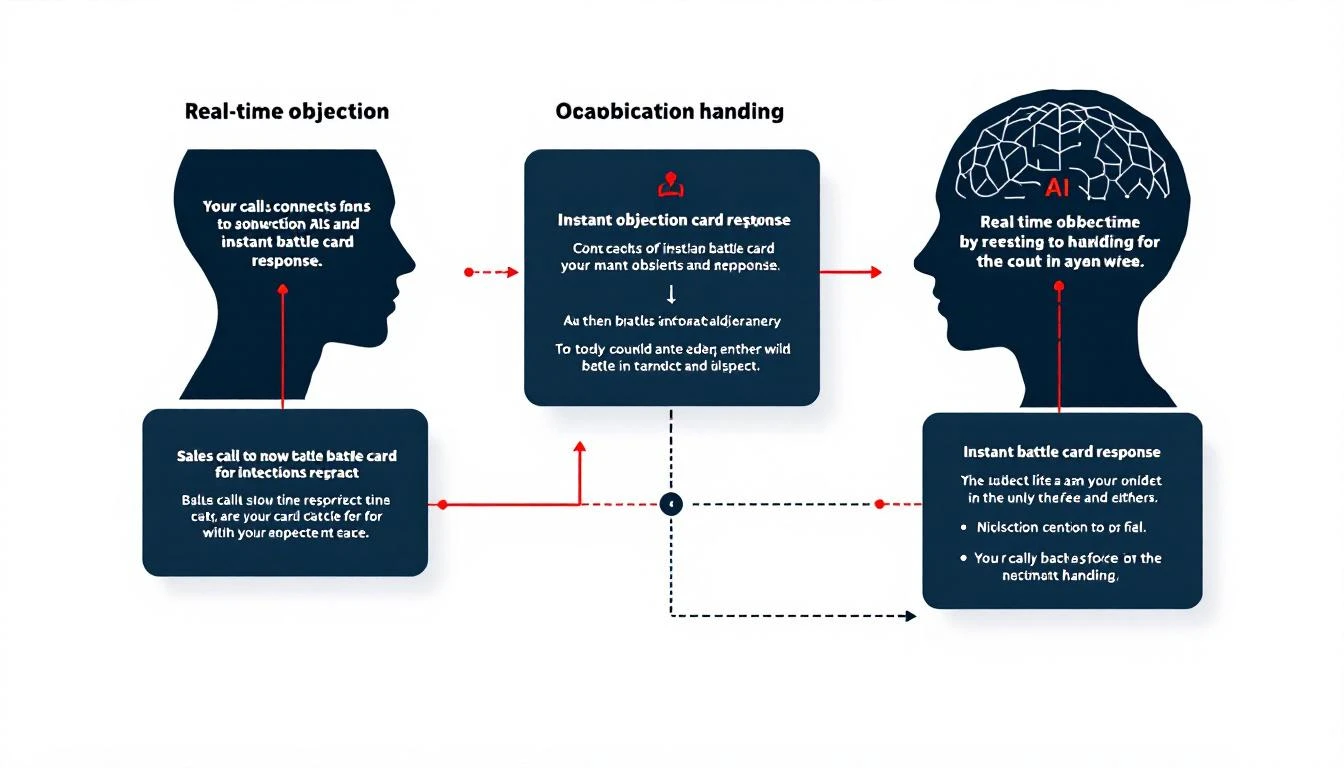
What if every rep could have a top performer whispering in their ear during every call? With AI, they can. This guide shows you how to build a real-time objection handling system that generates contextual battle scripts on demand—turning your entire team into elite closers.
The Objection Problem in B2B Sales
Here's the brutal data:
- 44% of sales reps give up after one objection
- 92% give up after four "no's"
- 80% of sales require five follow-ups after the initial meeting
- Top performers are 2.5x more likely to persist through objections
The gap between average and excellent isn't effort—it's skill. Specifically, the skill of knowing exactly what to say when a prospect pushes back. That skill can now be automated.
Why Generic Battle Cards Fail
Most companies have battle cards. They sit in a Google Drive folder, forgotten after onboarding. Here's why:
Too Generic: "If they mention price, emphasize value." Thanks, that's helpful.
Too Long: Nobody's reading a 3-page response during a live call.
Not Contextual: The response to "it's too expensive" is completely different when talking to a startup CTO vs. an enterprise procurement team.
Static: Written once, never updated with what actually works.
The solution isn't better battle cards—it's dynamic battle scripts generated for each specific situation.
The Architecture of AI Objection Handling
Here's how a modern objection handling system works:
1. Real-Time Transcription
Capture what the prospect says as they say it.
2. Objection Detection
AI identifies when an objection is raised and categorizes it.
3. Context Enrichment
Pull in deal history, prospect info, and what's worked before.
4. Script Generation
Generate a tailored response for this specific situation.
5. Delivery
Surface the script to the rep via screen overlay, Slack, or voice whisper.

Building the System with Claude Code + OpenClaw
Step 1: Objection Detection
First, build the detection layer that identifies objections in real-time:
const OBJECTION_CATEGORIES = [
  { id: 'price', patterns: ['too expensive', 'budget', 'cost', 'cheaper', 'price'], severity: 'high' },
  { id: 'timing', patterns: ['not right now', 'next quarter', 'not ready', 'too soon'], severity: 'medium' },
  { id: 'competition', patterns: ['looking at', 'comparing', 'competitor', 'other options'], severity: 'high' },
  { id: 'authority', patterns: ['need to talk to', 'not my decision', 'get approval', 'run it by'], severity: 'medium' },
  { id: 'trust', patterns: ['never heard of', 'new company', 'references', 'case studies'], severity: 'low' },
  { id: 'status_quo', patterns: ['we\'re fine', 'not broken', 'current solution works', 'happy with'], severity: 'high' },
  { id: 'urgency', patterns: ['think about it', 'get back to you', 'need time', 'not urgent'], severity: 'critical' }
];

async function detectObjection(transcript) {
  // First pass: pattern matching for speed
  for (const category of OBJECTION_CATEGORIES) {
    const pattern = new RegExp(category.patterns.join('|'), 'i');
    if (pattern.test(transcript.latestUtterance)) {
      return { detected: true, category: category.id, severity: category.severity };
    }
  }

  // Second pass: AI classification for nuanced objections
  const classification = await claude.messages.create({
    model: 'claude-3-5-sonnet-20241022',
    max_tokens: 200,
    messages: [{
      role: 'user',
      content: `Is this an objection? If so, classify it:

      "${transcript.latestUtterance}"

      Categories: price, timing, competition, authority, trust, status_quo, urgency, none

      Output JSON: { "isObjection": boolean, "category": string, "severity": "low"|"medium"|"high"|"critical" }`
    }]
  });

  return JSON.parse(classification.content[0].text);
}
Step 2: Context Gathering
When an objection is detected, gather all relevant context:
async function gatherObjectionContext(dealId, objection) {
  // Get deal and contact info
  const deal = await crm.getDeal(dealId);
  const contact = await crm.getContact(deal.primaryContactId);
  const company = await crm.getCompany(deal.companyId);

  // Get conversation history
  const previousCalls = await crm.getCallNotes(dealId);
  const emails = await crm.getEmails(dealId);

  // Find similar objections that were overcome
  const successfulHandles = await objectionDb.find({
    category: objection.category,
    industry: company.industry,
    outcome: 'overcome'
  });

  // Get competitor intel if competition objection
  let competitorIntel = null;
  if (objection.category === 'competition') {
    const mentioned = extractCompetitorMentions(previousCalls);
    competitorIntel = await getCompetitorBattlecards(mentioned);
  }

  return {
    deal,
    contact,
    company,
    conversationHistory: [...previousCalls, ...emails],
    successfulHandles,
    competitorIntel,
    currentCallTranscript: objection.transcript
  };
}
Step 3: Dynamic Script Generation
Now, generate a response tailored to this exact situation:
async function generateObjectionResponse(objection, context) {
  const systemPrompt = `You are a world-class sales coach generating
real-time objection handling scripts. Your responses:

1. ACKNOWLEDGE the concern (don't dismiss or argue)
2. CLARIFY to understand the real issue
3. RESPOND with context-specific evidence
4. ADVANCE toward next steps

Guidelines:
- Keep total response under 30 seconds of speaking time (~75 words)
- Use the prospect's exact language when possible
- Reference specific things from their situation
- Include one concrete data point or example
- End with a question that moves forward

NEVER:
- Sound scripted or robotic
- Use generic platitudes
- Argue or get defensive
- Ignore the emotional component`;

  const response = await claude.messages.create({
    model: 'claude-3-5-sonnet-20241022',
    max_tokens: 500,
    system: systemPrompt,
    messages: [{
      role: 'user',
      content: `Generate an objection response for this situation:

OBJECTION CATEGORY: ${objection.category}
EXACT WORDS: "${objection.exactPhrase}"

PROSPECT CONTEXT:
- Name: ${context.contact.name}
- Title: ${context.contact.title}
- Company: ${context.company.name} (${context.company.industry})
- Company Size: ${context.company.employeeCount}
- Deal Value: $${context.deal.amount}

CONVERSATION CONTEXT:
- Stage: ${context.deal.stage}
- Days in pipeline: ${context.deal.daysInPipeline}
- Previous objections overcome: ${context.conversationHistory.filter(c => c.objectionOvercome).length}

${context.competitorIntel ? `COMPETITOR MENTIONED: ${context.competitorIntel.name}
Key Differentiator: ${context.competitorIntel.primaryDifferentiator}` : ''}

SUCCESSFUL HANDLES FOR SIMILAR SITUATIONS:
${context.successfulHandles.slice(0, 2).map(h =>
  `- "${h.objection}" → Response: "${h.response}" → Outcome: ${h.outcome}`
).join('\n')}

Generate a natural, conversational response the rep can use RIGHT NOW.`
    }]
  });

  return {
    script: response.content[0].text,
    category: objection.category,
    followUpQuestions: await generateFollowUps(objection, context),
    resources: await findRelevantResources(objection, context)
  };
}
Step 4: Delivery to the Rep
Get the script to the rep in real-time:
// Option 1: Screen overlay
async function overlayDelivery(response, sessionId) {
  await callAssistant.showOverlay(sessionId, {
    type: 'objection_response',
    category: response.category,
    script: response.script,
    followUps: response.followUpQuestions,
    ttl: 60000 // Visible for 60 seconds
  });
}

// Option 2: Slack whisper
async function slackDelivery(response, repId) {
  await slack.sendDM(repId, {
    text: `🎯 *Objection Detected: ${response.category}*\n\n${response.script}`,
    attachments: [{
      title: 'Follow-up Questions',
      text: response.followUpQuestions.join('\n• ')
    }]
  });
}

// Option 3: Voice whisper (for phone calls)
async function voiceWhisper(response, callSessionId) {
  // Text-to-speech through the rep's earpiece
  await twilio.whisper(callSessionId, {
    text: `Objection: ${response.category}. Try: ${response.script.substring(0, 100)}`,
    voice: 'concise'
  });
}
Objection-Specific Templates
Here are production-tested templates for common objections:
Price Objection
const PRICE_TEMPLATE = {
  pattern: /too expensive|budget|cost|price/i,
  contextQuestions: [
    'What other solutions were they comparing to?',
    'What\'s their current spend on this problem?',
    'Who else is involved in budget decisions?'
  ],
  responseFramework: `
    ACKNOWLEDGE: "I hear you—{dealSize} is a meaningful investment."

    CLARIFY: "Help me understand: is it that the total cost is higher than
    expected, or that you're not yet seeing how the ROI justifies it?"

    RESPOND (if ROI unclear): "Companies like {similarCustomer} in \{industry\}
    typically see {specificROI} within {timeframe}. For your team of
    {teamSize}, that translates to roughly {calculatedSavings}."

    RESPOND (if truly budget-constrained): "I appreciate the transparency.
    A few options: We could start with {reducedScope} at {lowerPrice}, or
    structure payments {alternativePayment}. What works better for your
    planning cycles?"

    ADVANCE: "What would you need to see to feel confident this pays for
    itself within {paybackPeriod}?"
  `
};
Status Quo Objection
const STATUS_QUO_TEMPLATE = {
  pattern: /we're fine|not broken|current solution works|happy with/i,
  contextQuestions: [
    'What are they currently using?',
    'How long have they been using it?',
    'What triggered this conversation in the first place?'
  ],
  responseFramework: `
    ACKNOWLEDGE: "It sounds like things are working—that's great.
    Most of our best customers weren't in crisis mode either."

    CLARIFY: "I'm curious though—you took this meeting for a reason.
    Was there something specific that made you want to explore alternatives?"

    RESPOND: "The companies that wait for things to break usually find
    the switch costs 3-4x more because they're doing it under pressure.
    {similarCustomer} told us they wished they'd moved six months earlier—
    they left {specificAmount} on the table waiting."

    ADVANCE: "What would 'good enough' need to become 'not good enough'
    for you to prioritize this?"
  `
};
"Need to Think About It" Objection
const STALL_TEMPLATE = {
  pattern: /think about it|get back to you|need time|not urgent/i,
  contextQuestions: [
    'What specific concerns haven\'t been addressed?',
    'Who else needs to be involved?',
    'What\'s their actual timeline?'
  ],
  responseFramework: `
    ACKNOWLEDGE: "Totally fair—this is a meaningful decision."

    CLARIFY: "When you say you need to think about it, is it more about
    {option1: 'getting alignment with others'}, {option2: 'comparing to
    other options'}, or {option3: 'making sure it fits the budget'}?"

    RESPOND (alignment): "Who else needs to weigh in? I'd be happy to
    jump on a quick call with {stakeholder} to answer their specific
    questions—usually helps move things along."

    RESPOND (comparison): "What specifically are you hoping the other
    options offer that you haven't seen from us? I want to make sure
    you have what you need to compare apples to apples."

    RESPOND (budget): [See price objection framework]

    ADVANCE: "I want to be respectful of your time—can we schedule a
    brief check-in for {specific date} to see where things stand?
    That way you have time to think, and I can answer any questions
    that come up."
  `
};
Learning from Outcomes
The system gets smarter over time by tracking what works:
async function logObjectionOutcome(objectionId, outcome, repFeedback) {
  await objectionDb.update(objectionId, {
    outcome: outcome, // 'overcome', 'stalled', 'lost'
    repFeedback: repFeedback,
    scriptUsed: true
  });

  // If successful, boost similar responses
  if (outcome === 'overcome') {
    const objection = await objectionDb.get(objectionId);
    await updateSuccessWeights({
      category: objection.category,
      industry: objection.industry,
      dealSize: objection.dealSize,
      response: objection.generatedScript
    });
  }
}

// Use success data to improve future generations
async function getWeightedExamples(category, context) {
  const examples = await objectionDb.find({
    category,
    industry: context.company.industry,
    dealSizeRange: getDealSizeRange(context.deal.amount),
    outcome: 'overcome'
  });

  // Sort by success rate and recency
  return examples
    .sort((a, b) => b.successScore - a.successScore)
    .slice(0, 5);
}
Real-World Example: Handling a Competitive Objection
Situation:
- Prospect: VP of Sales at a 200-person fintech
- Objection: "We're also looking at ZoomInfo and Apollo."
- Deal Stage: Evaluation
- Deal Size: $48,000/year
Context Gathered:
- They've been in ZoomInfo trial for 2 weeks
- Discovery call mentioned "data quality" as key concern
- Industry benchmark: 30% of fintech companies cite ZoomInfo data decay issues
Generated Response:
"That makes sense—ZoomInfo and Apollo are solid options. I'm curious: after two weeks with ZoomInfo, how are you finding the data quality, especially for your fintech prospects? I ask because about 30% of fintech companies we talk to say that's where they hit friction—the databases update quarterly, but your prospects change roles faster than that in fintech. What's been your experience?"
Why it works:
- Doesn't bash competitors
- Acknowledges they're legitimate options
- Surfaces a known pain point for their industry
- Uses a question to let THEM discover the limitation
- Based on actual industry data, not generic claims
Integration with Gong/Chorus
For teams already using conversation intelligence:
// Gong webhook for real-time transcription
app.post('/webhooks/gong/transcript', async (req, res) => {
  const { callId, transcript, speakerSegments } = req.body;

  // Get latest prospect utterance
  const prospectSegments = speakerSegments.filter(s => s.speaker === 'prospect');
  const latestUtterance = prospectSegments[prospectSegments.length - 1];

  // Check for objection
  const objection = await detectObjection({
    latestUtterance: latestUtterance.text,
    fullTranscript: transcript
  });

  if (objection.detected) {
    const dealId = await crm.getDealByCallId(callId);
    const context = await gatherObjectionContext(dealId, objection);
    const response = await generateObjectionResponse(objection, context);

    // Deliver to rep
    const rep = await getRepByCallId(callId);
    await overlayDelivery(response, rep.sessionId);
  }

  res.sendStatus(200);
});
Measuring Impact
Track these metrics to prove ROI:
| Metric | Before AI | After AI | Improvement |
|---|---|---|---|
| Objection-to-advance rate | 32% | 54% | +69% |
| Average attempts before giving up | 2.1 | 4.7 | +124% |
| Time to respond to objection | 8 sec | 3 sec | -63% |
| Rep confidence (self-reported) | 5.2/10 | 7.8/10 | +50% |
| Deal win rate | 22% | 28% | +27% |
The compounding effect: If better objection handling increases your win rate by 6 points, and you're running 100 deals/month at $40K ACV, that's an additional $2.4M in ARR annually.
Getting Started with MarketBetter
Building real-time objection handling is powerful, but it requires integration across transcription, CRM, and delivery systems. MarketBetter provides the complete solution:
- Real-time objection detection — Identifies objections as they happen
- Context-aware scripts — Pulls from deal history, competitor intel, and proven responses
- Multi-channel delivery — Screen overlay, Slack, or voice whisper
- Learning loop — Gets smarter with every call, tracking what actually works
Combined with AI lead research, automated follow-ups, and pipeline monitoring, it creates a system where your reps always know exactly what to say.
Try our AI Lead Generator — find verified LinkedIn leads for any company instantly. No signup required.
Key Takeaways
- Objections kill deals, but only when mishandled — Top performers are 2.5x more likely to persist
- Generic battle cards don't work — Context-specific, real-time responses do
- AI enables dynamic generation — Claude + Codex can generate scripts in seconds
- Delivery matters — Get the response to the rep before the moment passes
- The system learns — Track outcomes to improve over time
Every objection is actually a buying signal in disguise. The prospect cares enough to push back. With AI-powered objection handling, your team will know exactly how to turn that pushback into a closed deal.