
How do you handle objections in sales: Master proven responses that close
Hearing "no" is just part of the job description in sales. Let's be real—nobody loves getting pushback. But how you handle those objections is what really separates the top reps from everyone else.
The secret? Stop seeing objections as dead ends. Start treating them as opportunities. They’re valuable signals that tell you exactly what a prospect is thinking and where their priorities lie.
Why Objections Are Opportunities, Not Roadblocks
It's easy to get defensive when a prospect pushes back on price or timing. It feels like the door is slamming shut. But that mindset is precisely what kills deals. A much better way to think about it is this: an objection isn't a rejection; it's a request for more information.
When a prospect raises a concern, they're actually engaging with you. The real deal-killer is apathy, not a bit of pushback. An objection gives you a direct line into what matters to them and what hurdles you need to help them clear. This simple mental shift can turn a tense, confrontational moment into a collaborative problem-solving session.
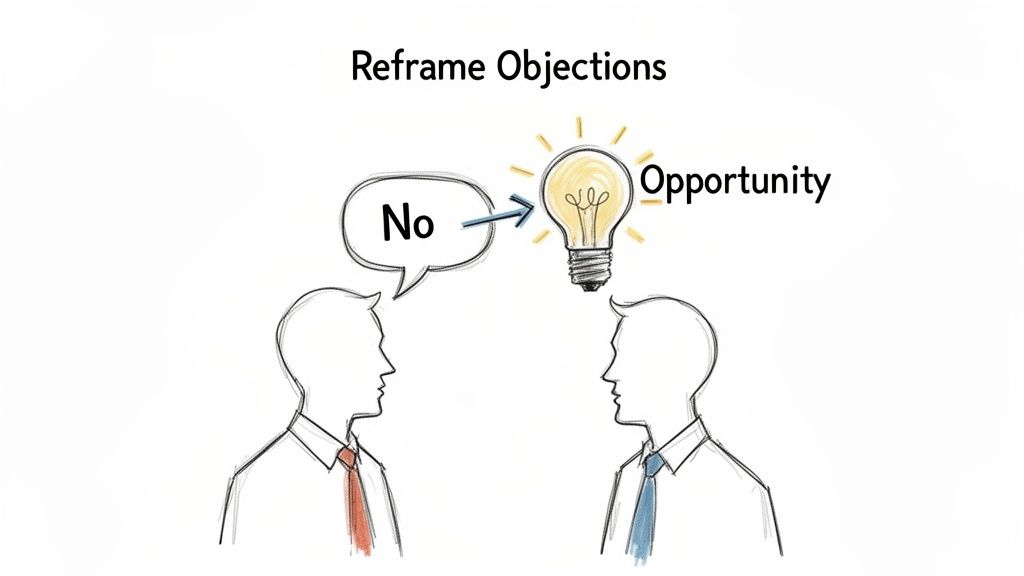
From Defensive to Diagnostic
A reactive SDR hears, "It's too expensive," and immediately starts defending the price tag. A strategic SDR hears the same thing and thinks, "Okay, they don't see the value yet. I need to ask some smarter questions to connect our price to their ROI."
This diagnostic approach is where the magic happens. Instead of arguing, you start probing. Compare the two approaches:
- Reactive Response (Ineffective): "But our product has all these features that justify the cost." This creates friction and puts you in a defensive position.
- Diagnostic Response (Actionable): "I get that. To make sure I'm on the right track, which part of the proposal felt out of line with the value you were hoping to see?" This opens a dialogue and positions you as a problem-solver.
The data backs this up. Research from Gong and SalesHive shows that reps who master this diagnostic approach can boost their win rates by up to 30%. Top performers do this by listening way more than they talk—maintaining a 43:57 talk-to-listen ratio—which helps them uncover the real problem. You can dig into the full research on how top sales reps handle objections to learn from their playbook.
An objection is not a rejection; it is a request for more information. When you see objections as opportunities to clarify value and build trust, you stop selling and start solving.
Master the Fundamentals First
To consistently turn these moments into pipeline, you need a framework you can rely on. One of the most effective and straightforward models out there is LAER: Listen, Acknowledge, Explore, and Respond. It’s simple, memorable, and it just works.
To make it even easier to recall in the heat of a call, here's a quick cheat sheet you can put into practice today.
The LAER Framework Quick Reference
| Phase | Action | Example Phrase to Use |
|---|---|---|
| Listen | Let the prospect finish their thought without cutting them off. Focus on their words and tone to truly hear their concern. | (Silent, active listening) |
| Acknowledge | Validate their feeling to show you heard them and you're on their side. This instantly lowers their guard. | "That's a fair point." or "I can definitely see why you'd be concerned about that." |
| Explore | Ask open-ended, clarifying questions to get to the root of the issue. This is the most important step. | "Can you tell me a bit more about what's driving that feeling?" |
| Respond | Once you fully understand the problem, offer a tailored answer that speaks directly to their specific concern. | "Based on what you've shared, it sounds like the main issue is X..." |
Having a simple structure like LAER in your back pocket ensures you stay in control of the conversation. It helps you turn what could be a deal-breaker into a productive discussion about creating real value for them.
Diagnosing the Four Core Types of Objections
Let’s be honest. A canned, one-size-fits-all response to an objection is the fastest way to get a dial tone. Before you can ever hope to handle an objection, you have to know what you’re really up against.
Most objections are just the tip of the iceberg. They're vague shields prospects throw up to avoid a real conversation. The best reps I know don't just react; they diagnose. They listen to the words, but they hear the real problem underneath. Almost every objection you'll ever hear falls into one of four buckets. Learning to sort them on the fly is your first step from playing defense to running the conversation.
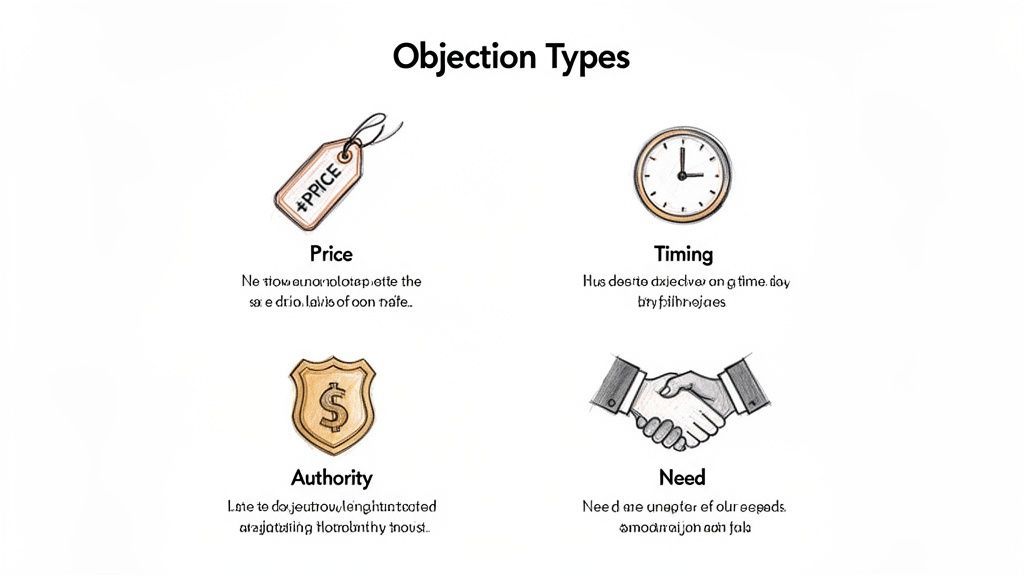
Price and Budget Objections
This is the classic. It's the one everyone fears, but it’s rarely about the money. When a prospect says, "It's too expensive," what they’re almost always saying is something else entirely.
What they really mean is, "I don't see enough value here to justify that number." This isn't a cost problem; it's a value gap. You haven't connected the dots for them yet.
- What it sounds like: "We just don't have the budget for this right now," or "I can get something that does the same thing for a lot less."
- Your Actionable First Move: Don't defend the price. Instead, get curious about the value gap. Acknowledge it, then ask a clarifying question. Try this: "That's a fair point. Could you help me understand which part of the proposal felt out of sync with the value you were expecting?"
Timing and Priority Objections
This one is all about urgency—or the lack of it. When someone says, "Now isn't a good time," it means you haven't made a strong enough case for why now. Your solution simply isn't a top-tier priority in their world.
They're saying, "I have bigger fires to put out than the one you're talking about." Your job isn't to argue with their schedule; it's to connect your solution directly to one of those bigger fires.
- What it sounds like: "Call me back next quarter," or "I'm buried right now."
- Your Actionable First Move: Empathize, then pivot to their known priorities. For example: "I totally get it. Most of the execs I talk to are laser-focused on [mention a common top priority, like 'improving team efficiency']. Our platform is designed to give your team 5 hours back a week. Is that something worth a 15-minute chat next week?"
Authority and Influence Objections
This objection pops up when you're talking to the wrong person—or at least, not the final decision-maker. It’s a clear signal that you need to do some discovery on the internal buying committee and find a way to build a consensus.
The prospect is literally telling you, "I can't say 'yes' even if I wanted to." Don't treat this as a dead end. See it for what it is: an opportunity to find an internal champion.
Key Takeaway: An authority objection isn't a roadblock; it's a roadmap. The person you're speaking with just gave you directions to the real buyer. Your job is to turn them into an internal guide who can make the introduction for you.
- What it sounds like: "I need to run this by my boss," or "That's not my decision to make."
- Your Actionable First Move: Empower your contact; don't go around them. Your goal is to turn them into an advocate. Say, "That makes perfect sense. To make that conversation as productive as possible, what information would be most helpful for me to provide you with before you talk to your boss?"
Need and Competition Objections
This is the status quo objection. The prospect either doesn't believe they have a problem worth solving or they’re perfectly happy with how they're doing things now, whether that's with a competitor or a messy internal spreadsheet.
What they're really communicating is, "The pain of changing feels greater than the pain of staying where I am." Your mission is to gently shine a light on the hidden costs and risks of doing nothing.
- What it sounds like: "We're happy with who we're using," or "We've got it handled internally."
- Your Actionable First Move: Validate their current setup, then create curiosity. Try this: "That's great that you have a system in place. A lot of our best customers felt the same way until they saw how they could [mention a specific, compelling outcome, like 'cut their reporting time in half']. Would you be against taking a quick look at how they did it?"
Your Actionable Objection Handling Playbook
So, you’ve diagnosed the objection. Now what? This is where having a playbook separates the pros from the rookies. Without a framework, you’re just improvising under pressure, which usually means you’re letting the prospect drive the conversation straight into a ditch.
The two most battle-tested frameworks are LAER and Feel-Felt-Found. But they're not interchangeable. Using the wrong one is like bringing a hammer to a job that needs a screwdriver—you’ll just make a mess.
Knowing which one to grab is the real skill. One is for dissecting logic, the other is for building an emotional bridge.
Choosing Your Framework: LAER vs. Feel-Felt-Found
Think of these as different tools in your sales toolkit. Each one is designed for a specific job.
-
LAER (Listen, Acknowledge, Explore, Respond): This is your scalpel. Pull this out for logical, data-driven objections. When a prospect starts questioning specific features, the ROI math, or your integration capabilities, LAER helps you methodically unpack their concern and address it head-on with facts. It's an investigative tool.
-
Feel-Felt-Found: This is your bridge-builder. It’s perfect for emotional or skeptical objections. When you hear fear about switching, frustration from a bad experience with a past vendor, or just general uncertainty, this framework builds instant empathy. It uses social proof to lower their guard and show them a safe path forward. It's a reassuring tool.
Let’s put them side-by-side so you can see how to choose in the heat of the moment.
Framework Comparison: LAER vs. Feel-Felt-Found
This table breaks down the core differences, helping you make a split-second decision on a live call.
| Framework | Best For | Core Strategy | Example Use Case |
|---|---|---|---|
| LAER | Logical, specific concerns (e.g., price, features, implementation). | Deconstruct the objection with clarifying questions before presenting a solution. | "I'm not sure your tool integrates with our existing tech stack." |
| Feel-Felt-Found | Emotional resistance, skepticism, or fear of change. | Validate their feeling with empathy and use a story to reframe their perspective. | "This feels like a huge change for our team; I'm worried about adoption." |
Choosing the right approach isn’t just about sounding smart—it's about connecting with the real reason behind the objection, whether it's rooted in logic or emotion.
Scripts for Common Objections
Okay, let's put these frameworks into action. Here are some scripts you can adapt and make your own, starting today. Notice how each one follows the designated framework to get to the root of the issue, not just the surface-level complaint.
Objection 1: "It's too expensive." (Using the LAER Framework)
This is almost never really about the price tag. It's about a value gap. Your job is to find that gap and fill it.
- Listen: Let them say their piece. Don't jump in or get defensive. Just listen.
- Acknowledge: "I appreciate you sharing that. It’s a significant investment, and it's fair to question the cost."
- Explore: "Help me understand a bit better—when you say it's expensive, are you comparing it to a specific competitor, or is it more about the budget you had in mind for this kind of problem?"
- Respond: "That makes sense. A lot of our customers look at the initial cost, but the real story is in the ROI. For instance, we see teams like yours cut SDR admin time by 40%. For a team your size, that could mean generating 20% more pipeline without adding headcount. Can we spend two minutes on what that math would look like for you?"
HubSpot data shows reps who master this kind of value-framing see close rates up to 64% higher. They're also 81% better at holding margins because they anchor the conversation on outcomes, not discounts.
Objection 2: "We already use a competitor." (Using the Feel-Felt-Found Framework)
This is a classic "status quo" objection. They're comfortable. Your job isn't to bash the competition; it's to spark curiosity about a better way.
- Feel: "I totally get that. It makes sense you're with them; they're a solid company and a well-known name in the space."
- Felt: "You know, many of our best customers today felt the exact same way when we first connected. They were comfortable and honestly saw no compelling reason to even look at an alternative."
- Found: "But what they found was that while their old tool was great for X, it wasn't built to solve for Y [mention a specific pain point your solution crushes]. They discovered they could slash [a specific negative metric] by 30% just by making the switch. Would you be open to a quick 15-minute call next week to see if you might be in a similar boat?"
By structuring your responses like this, you shift from being a reactive debater to a strategic guide. For a deeper look at crafting your entire messaging strategy, check out our guide on building effective outbound playbooks.
Adapting Your Strategy for Calls, Emails, and Follow-Ups
Knowing what to say when an objection hits is only half the battle. The other half is knowing where and how to say it. An approach that lands perfectly on a live call can fall completely flat in an email, and vice versa.
The secret is adapting your playbook to the medium. Each channel has its own rhythm and rules of engagement. A phone call is all about speed and composure, while an email gives you the space for a more measured, precise response. And a follow-up? That’s a delicate dance between persistence and adding genuine value.
On a Live Call: Stay in Control
When you’re on a live call, your tone and pacing are everything. The second you hear an objection, the worst thing you can possibly do is rush to counter it. That signals panic.
Actionable Tip: Pause. Take a breath. Let the silence hang for a second. This small move shows you’re in control, not flustered. From there, lean on a framework like LAER (Listen, Acknowledge, Explore, Respond) to guide the conversation without getting defensive.
Your goal here is to be a doctor, not a debater. Diagnose the root of the issue with clarifying questions. A calm, curious question shows you're a confident expert trying to solve a problem, not just a rep pushing a product.
In an Email: Invite a Dialogue
Email is a completely different game. You lose all the nuance of tone and body language, so your words have to do all the heavy lifting. The biggest mistake reps make here is writing a five-paragraph essay defending their product. It's overwhelming, defensive, and almost guarantees you won't get a reply.
Your email response should be short, respectful, and focused on one simple goal: reopening the conversation.
Actionable Tip: Acknowledge their concern, validate it, and then ask a simple, open-ended question that makes it easy for them to reply.
Here’s an example template:
Subject: Re: Our chat
Hi [Prospect Name],
Thanks for being candid about the budget. I appreciate the honesty.
Just so I'm on the right track, what would a more comfortable budget look like for a solution that solves [Problem X] for you?
Best,
[Your Name]
See how that works? It’s not confrontational. It turns a potential dead-end into a continued discussion. For more tactics tailored to live conversations, check out our guide on AI-powered cold call workflows.
In a Follow-Up: Add New Value
So, what happens if they raise an objection and then go quiet? A follow-up isn't just a "checking in" message—that’s a waste of everyone’s time. It's your chance to re-engage by providing fresh value that tackles their previous concern without even mentioning it.
This quick decision tree helps visualize how to diagnose whether an objection is coming from a logical place or an emotional one.
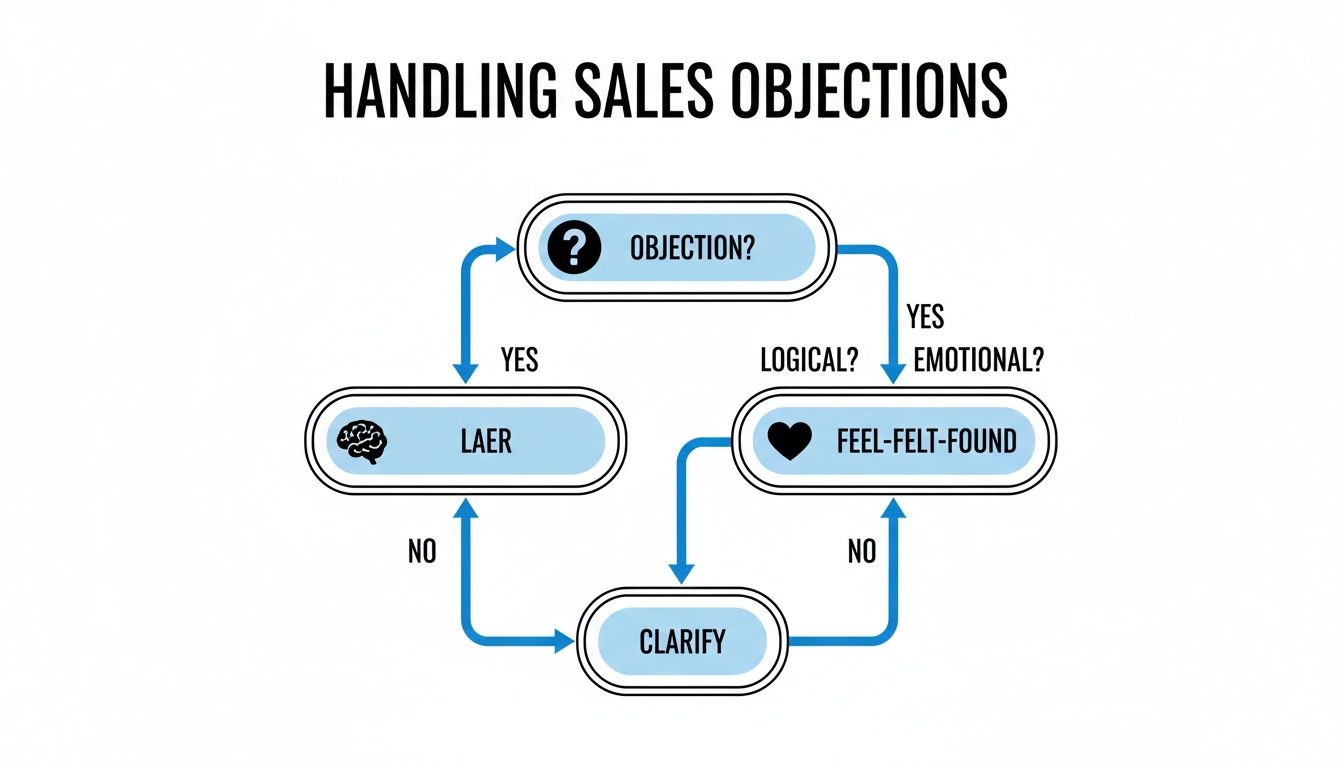
Actionable Tip: If they objected on price, your follow-up could be a case study showing how a similar company achieved a massive ROI. If they were worried about a missing feature, send a one-minute video showing exactly how that feature delivers value. By bringing something new and relevant to the table, you give them a real reason to reconsider.
Using AI and Your CRM to Finally Master Objection Handling
Look, proven techniques are the engine of great sales, but modern tech is the rocket fuel. When you connect your objection handling frameworks to the tools you live in every day—your CRM and AI assistants—the entire game changes. It transforms this skill from a reactive art into a proactive, data-driven science.
It’s the difference between improvising under pressure and running a flawless, pre-planned play.
This is where an SDR Task Engine like marketbetter.ai comes in. It’s designed to help reps execute perfectly by automatically prepping for calls. We’re talking AI-generated talking points and a list of anticipated objections based on the prospect's actual industry and persona. This completely eliminates that frantic, last-minute research that leaves reps walking into calls feeling unprepared.
Instead of raw data, reps get an actionable workflow with key insights and clear next steps, right at their fingertips.
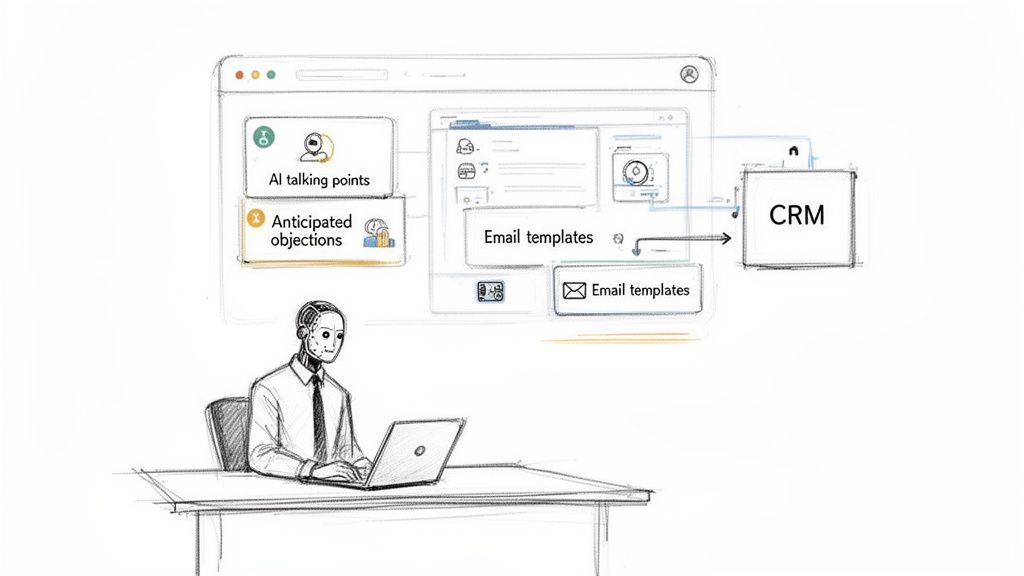
By plugging directly into your CRM, the system makes sure every rep has the right context and content before they even dial.
From Manual Logging to Intelligent Feedback Loops
Let’s be honest: one of the biggest drags on SDR productivity is manual data entry. After a tough call gets shot down, the absolute last thing a rep wants to do is spend ten minutes filling out CRM fields.
An integrated system kills this problem by automatically logging call outcomes and objection types straight into Salesforce or HubSpot.
But this automation does way more than just save time—it creates a powerful feedback loop. When you have clean, structured data on which objections your team faces most often, you can tailor your coaching and build scripts that actually work. You move from guessing where reps are struggling to knowing with certainty.
Here's a hard truth from thousands of B2B deals: repeatedly seeing the same objection is a flashing red light that you're failing to address it proactively. On the flip side, data shows that successfully resolving objections is directly tied to a 64% lift in close rates.
Proactive Preparation vs. Reactive Scrambling
Let's put the two workflows side-by-side to see just how different the day-to-day feels. This comparison highlights the actionable difference an integrated AI system makes.
| Manual Workflow (The Common Struggle) | AI-Powered Workflow (The Strategic Advantage) |
|---|---|
| Rep scrambles to research the prospect minutes before the call. | AI auto-preps the call with talking points & anticipated objections. |
| Rep improvises responses based on memory or generic scripts. | Rep has specific, tailored rebuttals ready for likely concerns. |
| Rep spends 5-10 minutes post-call on manual CRM logging. | Outcomes and objection types are logged automatically. |
| The manager gets inconsistent, messy data for coaching. | The manager gets clean, actionable data to spot team-wide patterns. |
This execution-first workflow frees you up to focus entirely on the conversation, not the mountain of admin work surrounding it.
To get your tech stack right, check out some of the Best AI Tools for Sales and see how they can streamline your process. With the right systems in place, every single interaction becomes a chance to learn and get better.
Try our AI Lead Generator — find verified LinkedIn leads for any company instantly. No signup required.
Common Questions About Handling Objections
Even with the best scripts and frameworks, the real world of sales calls is messy. Theory is great, but reps and managers run into the same practical questions day after day. Let's get straight to the stuff that actually comes up on the floor.
What's the Single Biggest Mistake Reps Make?
Easy. Talking too much and listening too little.
It's a reflex. A prospect throws out an objection, and the rep's heart rate spikes. They get defensive and immediately launch into a pre-canned rebuttal without ever digging into what the prospect really means. This instantly turns a conversation into a confrontation.
Let's compare the two approaches. A rookie hears "it's too expensive" and immediately starts listing features to justify the price. A pro, on the other hand, leans in. They pause, then ask something like, "Help me understand, which part of the proposal felt out of sync with the value you were expecting?" One approach builds a wall; the other opens a door.
Top performers consistently talk less than half the time when an objection comes up. That's not a guess; the data backs it up. They use questions to find the root cause before they even think about offering a solution. Actionable Step: Always acknowledge and explore before you respond.
How Do You Tell a Real Objection from a Brush-Off?
This is a critical skill. Getting it wrong means wasting time on people who will never buy or, worse, giving up too early on someone who's actually interested.
A brush-off is lazy. It’s vague and designed to get you off the phone quickly. Think "Just send me an email" or a flat "Not interested." It’s a shield, nothing more.
A genuine objection has substance. It’s specific and tied to their reality. You'll hear things like, "Our budget for new software is frozen until Q4," or "We just signed a one-year contract with Competitor X." See the difference? Real roadblocks.
Actionable Tip: To sort them out, gently probe. When you get a classic brush-off, don't just accept it. Try asking, "Is the timing not right, or is this just not a priority for your team right now?" That simple question often forces a more honest answer and can uncover the real objection hiding just beneath the surface.
How Can Sales Managers Actually Coach This Stuff Effectively?
Good coaching is about data and practice, not just motivational speeches. A manager who relies on gut feelings is flying blind. Here is a two-step actionable plan:
-
Step 1: Stop Guessing, Start Measuring. First things first, you need clean data. Make sure every call outcome and every objection type is logged automatically in your CRM. This is the only way to spot real patterns. Is your whole team getting stuck on price objections? Are the new hires folding every time a competitor's name comes up? The data will tell you where to focus.
-
Step 2: Make Role-Playing Real. Once you know the problem areas, dedicate time in your weekly one-on-ones to role-play those exact scenarios. Don't invent fake objections. Pull from the data and even use snippets from real call recordings. Walk them through the frameworks in this guide, give pointed feedback, and run it again. This is how you build muscle memory.
Turn your SDRs into execution experts with marketbetter.ai. Our AI-Powered SDR Task Engine helps reps prep faster, handle objections with confidence, and automatically logs every activity in Salesforce or HubSpot, giving you the data you need to coach effectively. See how it works at marketbetter.ai.