
Your GTM Stack Is Probably Wrong for Your Revenue Stage. Here's How to Fix It.

There is a pattern we see in almost every B2B company that comes to us for help with outbound. They are spending $5K to $15K per month on GTM tools. They have somewhere between 12 and 25 active subscriptions. And their pipeline per dollar spent is worse than it was when they had three tools and a spreadsheet.
The problem is not the tools. The problem is that most companies buy tools for the company they want to be, not the company they are right now.
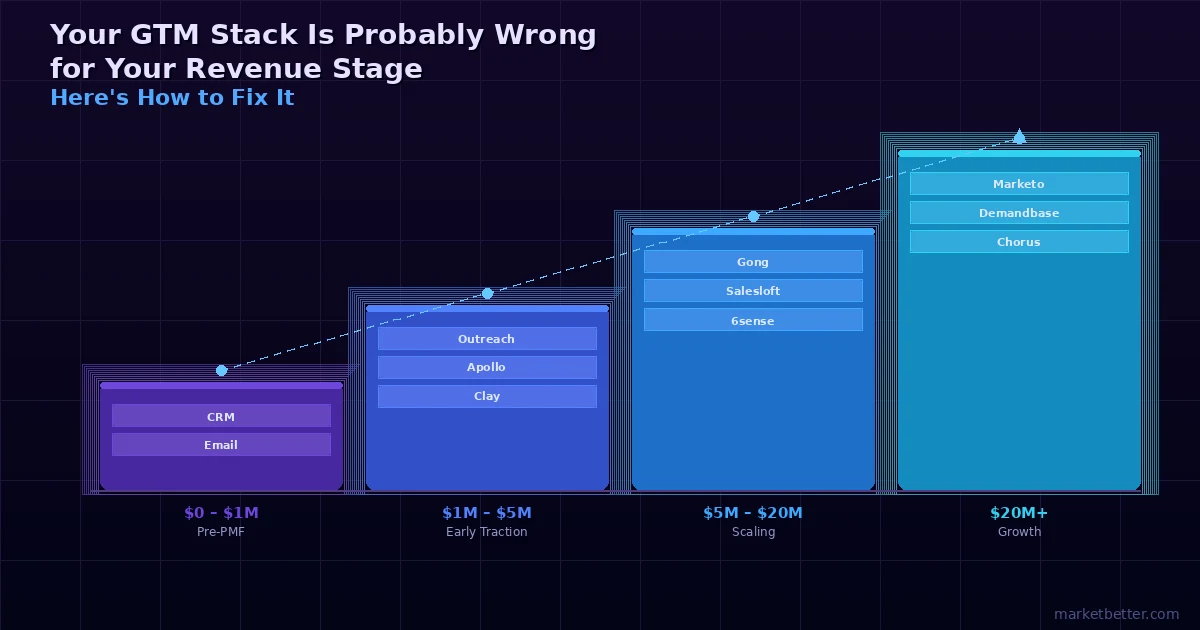
The Tool Collection Problem
We track the tech stacks of the fastest-growing B2B companies. The data is clear: the companies generating the most pipeline per dollar are not the ones with the largest stacks. They are the ones where every tool solves a problem they have right now, not one they might have in six months.
The most common failure mode is premature tool adoption. A founder raises a seed round and immediately subscribes to Clay, 6sense, Salesforce Enterprise, an ABM platform, and whatever three tools their competitor mentioned on LinkedIn last week. Six months later, half those tools have zero logins.
We call it stack drift — the gap between what your revenue stage demands and what your tool subscriptions assume. The wider the gap, the more money you burn on integration overhead, unused features, and data that nobody acts on.
Stage 1: $0 to $500K ARR — Survive First
Target tool spend: $200 to $500/month
At this stage, you are the GTM team. Maybe you have one other person. Your only job is to prove that outbound works for your market before you invest in systems. Speed and simplicity matter. Nothing else does.
What you actually need:
- CRM: HubSpot free tier. You need somewhere to track deals. You do not need custom objects, automation, or reporting dashboards yet. You do not have enough deals to justify any of that.
- Email finding: One provider. Prospeo, Apollo, or Hunter. Pick one. The difference in hit rates between them is single digits. Do not overthink this.
- Email sending: One platform. Instantly or Smartlead. Not both. You are not running enough volume to need deliverability split testing across providers.
- AI: This is the one area where early investment pays for itself immediately. A Claude or GPT subscription at $200/month replaces $3K to $5K in research labor. Use it for prospect research, email personalization, ICP analysis, and competitive intelligence.
- LinkedIn: Manual outreach. Free Sales Navigator trial. You need the manual reps at this stage to understand what messaging works before you automate anything.
What you do not need yet: Clay, paid ads, intent data, ABM tools, multiple ESPs, workflow automation, enrichment waterfalls, or anything with "enterprise" in its name.
The hard truth at this stage is that most of your time should be spent on targeting, not tooling. If your ICP is wrong, the best tools in the world just help you reach the wrong people faster. We wrote about this when we analyzed 11x.ai's pricing model — $8,000/month to send AI-written emails to the wrong people is worse than $30/month to send manual emails to the right ones.
Stage 2: $500K to $2M ARR — Automate What Works
Target tool spend: $1,000 to $2,500/month
You have validated that outbound generates revenue. Now you need to do more of it without hiring proportionally more people. This is the stage where automation earns its keep — but only for processes you have already proven manually.
What to add:
- Clay ($185/month on their new Launch plan). This is the inflection point tool. Clay sits at the center of your enrichment workflow — pull target companies, enrich contacts across 150+ providers, run AI scoring, push qualified leads to your sequences. One table replaces what used to take three tools and manual CSV exports. But here is the thing nobody tells you: Clay is a workflow builder that requires someone who knows how to build workflows. If you do not have that person, you need a platform that delivers the same output without the build-it-yourself requirement.
- A second ESP. Running all your volume through one sending platform is a single point of failure. Add Smartlead as a backup if you started with Instantly, or vice versa.
- Email verification. Before sending a single cold email at this volume, verify every address. A deliverability hit at this stage costs more than a year of DeBounce or ZeroBounce.
- Website visitor identification. RB2B or similar. Someone visits your pricing page three times but never fills out a form. Now you know who they are. At this revenue stage, every website visitor showing buying intent matters.
What you still do not need: ABM tools, intent data platforms, LinkedIn ads, or enterprise CRM. If you find yourself reaching for those, you are stack-drifting.
Stage 3: $2M to $5M ARR — Systems, Not Tools
Target tool spend: $3,000 to $6,000/month
You have a sales team now. Multiple SDRs or AEs. Content is generating inbound. The question shifts from "does outbound work?" to "how do we make every channel compound the others?"
This is the stage where most companies make their most expensive mistake: they add tools for each new channel instead of building a system where channels work together.
The signal problem. At this stage, you need buying signals — hiring surges, tech installs, LinkedIn engagement, community mentions, funding rounds. The temptation is to add a separate tool for each signal type: BuiltWith for technographics, PredictLeads for growth signals, Trigify for LinkedIn engagement, Common Room for community signals. Four tools, four data feeds, four integrations into Clay, four sets of alerts.
Here is what happens in practice: your team gets 200+ signals per day across these sources. Each signal has different urgency, different relevance, different optimal response channels. Without a system that scores these signals automatically and routes them to action, you are paying for a firehose of data your SDRs cannot process fast enough. The signal that mattered — the VP of Sales who visited your pricing page and just posted about needing better outbound tooling — gets buried under 199 noise signals.
What actually matters at this stage is not the number of signal sources. It is the time between signal detection and action. A system that detects a signal and converts it to a meeting within 24 hours across the right channel will always outperform a stack that collects better signals but takes three days to act on them.
Multi-channel is not "add LinkedIn ads." Real multi-channel orchestration means a signal triggers coordinated action across email, LinkedIn, phone, and chat — automatically, with shared context. When a prospect opens your email but does not reply, the LinkedIn connection should go out the same day referencing the email topic without repeating it. When they accept and view your profile, the phone call should happen within the hour with full context on every prior touchpoint.
That coordination does not exist in a stack of independent tools connected by Zapier. It requires a platform that owns the orchestration layer.
Stage 4: $5M to $10M+ ARR — Compound and Cover
Target tool spend: $8,000 to $15,000/month
At this scale, you are running what we call Allbound — outbound, content, community, and paid working as one system. The stack at this stage is about coverage, redundancy, and compounding advantage.
Now you can justify:
- Account-level intent data. 6sense, Demandbase, or equivalent. Below $5M ARR, the cost does not justify the signal volume. Above it, knowing which accounts are actively in-market changes how your entire team prioritizes.
- Enterprise CRM. Not for the features. For the reporting, custom objects, and integrations you need when 10+ people touch the same pipeline.
- Programmatic SEO. AirOps plus Ahrefs for long-tail content pages. SEO compounds — you should have started earlier, but this is where the investment becomes unavoidable.
- Newsletter. A subscriber list you own. LinkedIn can throttle your reach tomorrow. Your newsletter list is yours.
The paradox of this stage: You can now afford the integration tax that kills smaller companies. You have GTM engineers, ops people, and agency partners who can wire 15+ tools together and keep them running. The question is whether you should.
The fastest-growing companies at this stage are not building bigger stacks. They are consolidating. They realized that the marginal quality gain from picking the absolute best tool in each of 15 categories does not offset the compounding cost of keeping 15 tools synchronized. A platform that does enrichment, scoring, and sequencing in one place — even if each function is 85% as good as the standalone best — outperforms a fragmented stack where data falls through the cracks.
The Integration Tax Nobody Talks About
Here is the number nobody publishes: subscription costs are 30% of the real cost of your GTM stack. The other 70% is integration and maintenance.
At the $2M to $5M stage, a typical best-of-breed stack requires 15 to 40 hours per month maintaining connections between tools that were never designed to work together. Clay to HubSpot to Instantly to Smartlead to DeBounce to your signal tools. Each connection is a failure point. Each one needs custom logic for edge cases — duplicate contacts, conflicting enrichment data, bounced emails propagating back to suppress lists across platforms.
Add eight tools at the $2M stage and you have not added $3K to $6K per month. You have added $3K to $6K in subscriptions plus half a headcount in integration maintenance. That is the real cost, and it is why companies at $3M ARR with 20-tool stacks often generate less pipeline per rep than companies at $1M ARR with five tools that actually work together.
The Decision Framework
Before adding any tool to your stack, four questions:
- Does this solve a problem we have TODAY? Not hypothetically. Not "when we scale." If the problem is theoretical, the tool is premature.
- Does this replace a manual process costing 5+ hours per week? If nobody is spending real time on what this tool automates, the ROI is not there.
- Can we implement it in less than one week? If a tool requires a two-month implementation, it is not a tool — it is a project.
- Will it still matter at 2x our current revenue? This filters out tools that solve temporary problems.
If any answer is no, do not buy it.
The Takeaway
The best GTM stack is not the most sophisticated one. It is the one where every tool solves a real problem at your current revenue stage, every signal gets acted on within 24 hours, and no data falls through the cracks between tools.
At most revenue stages, that means fewer tools, not better tools. It means a system that works as a unit, not a collection of best-of-breed point solutions held together by Zapier and hope.
Start lean. Add tools only when you have outgrown what you have. Kill anything that does not earn its keep. And remember: the question is never "which tool should I buy?" It is "what is the simplest system that turns signals into meetings?"
Sometimes that is three tools. Sometimes it is one platform. It is almost never twenty.