
Copilotforce: Salesforce Is Now a Plugin Inside Microsoft Copilot [2026]


November 17 was the busiest single day the sales interface war has ever had. In the span of one Monday: OpenAI launched ChatGPT for Sales with 30+ partner plugins. Microsoft GA'd Dynamics 365 in Copilot with 44 prebuilt sales skills. And — the headline nobody had on their bingo card — Microsoft and Salesforce jointly announced Copilotforce, putting Salesforce itself inside Microsoft Copilot as a plugin.
Two companies that spent 2024 and 2025 building rival AI sales agents and openly poaching each other's CRM customers just agreed on one thing: sellers live in chat surfaces now, and the CRM is becoming something those surfaces call into.
Here's what actually shipped at Ignite, what status each piece is really in, what both vendors left out of the announcement, and what it means if you run a sales team on either stack.
What Copilotforce actually is (and isn't)
First, a definition worth being precise about, because the name suggests a product and the announcements describe something else. Both companies call Copilotforce a partnership, not a product. Salesforce's own framing: "a partnership bringing Salesforce to Microsoft's expansive enterprise productivity ecosystem." Under that umbrella sit three concrete pieces, each at a different maturity stage:
| Piece | What it does | Status (Nov 17, 2026) |
|---|---|---|
| Salesforce in Microsoft Copilot | Plugin with 38+ prebuilt sales skills; read CRM context, take supported actions from Copilot | Public preview (beta), live now |
| Data 360 ↔ Microsoft Fabric Zero Copy | Query Fabric OneLake data inside Data 360 (Data Federation); share Data 360 context into OneLake (Data Sharing) | Federation: GA. Sharing: public preview |
| Sales Cloud in Teams | Salesforce customer context inside Teams conversations | Pilot only; open beta "later this year" |
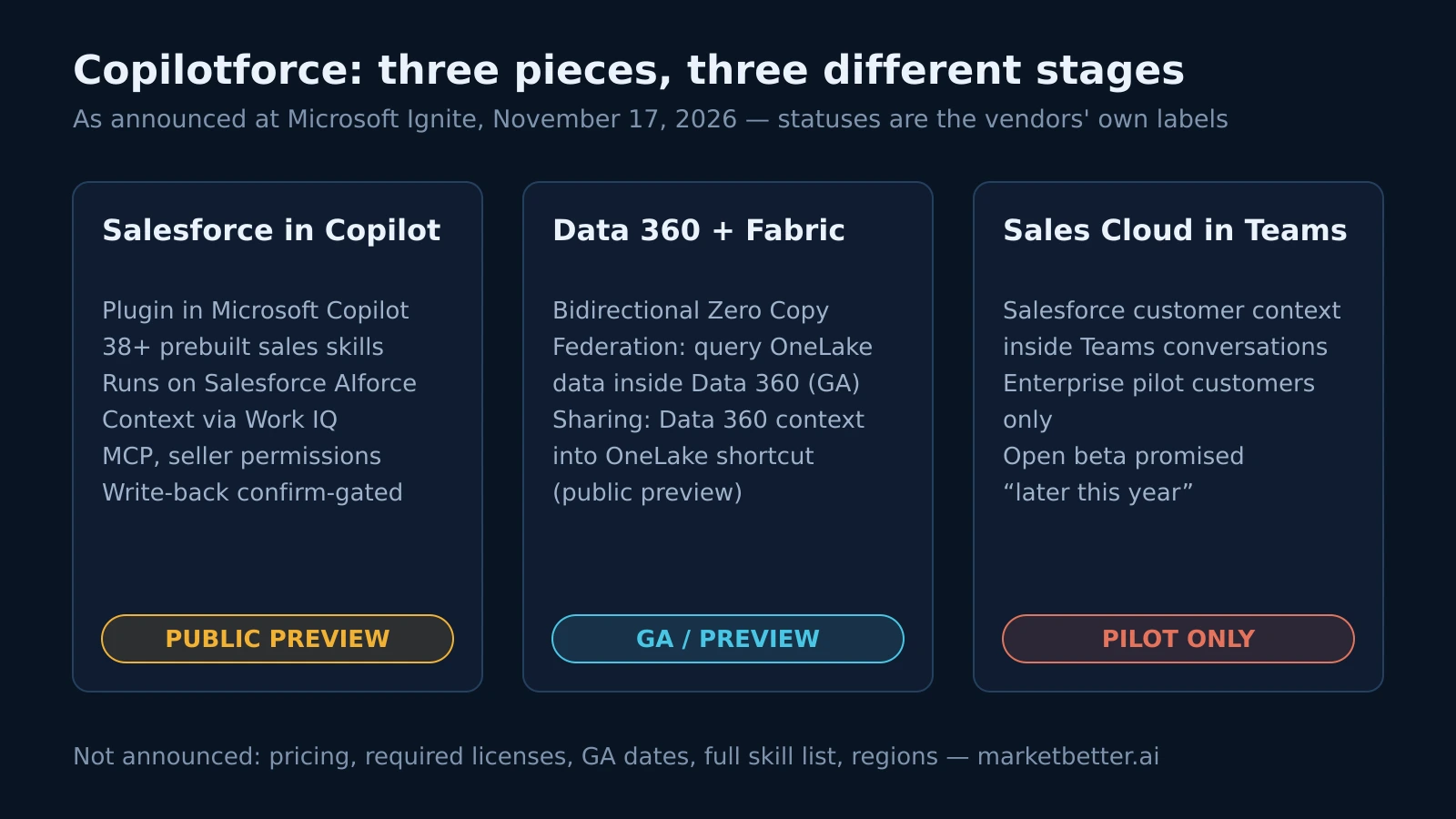
So the shipping-today reality is narrower than the headlines: one plugin in beta, one data integration direction in GA, and a Teams app that most customers can't touch yet. The pattern matches every major launch we've tracked this fall — 6sense's Breakthrough announcements had the same shape, where the only genuinely GA items were the least flashy ones.
How the plugin works
The mechanics, assembled from both companies' launch material:
- It runs on AIforce, which Salesforce describes as "the live interface layer that brings Salesforce capabilities into external AI environments." If that sounds familiar, it's the same layer behind Claudeforce, the Salesforce-in-Claude integration from September. Salesforce has now shipped its CRM into Claude, ChatGPT (via the Nov 17 OpenAI partner list), and Microsoft Copilot in under three months. That's not three integrations; that's a strategy — be present in every chat surface rather than betting on owning the one that wins.
- Microsoft's Work IQ supplies the other half of the context. Salesforce insights get synthesized with "relevant relationships and content from Teams meetings, Outlook emails, and shared documents across SharePoint and OneDrive." This is the part Microsoft brings that OpenAI structurally can't: the meeting, the email thread, and the deck already live in Microsoft's graph.
- Access runs over authenticated Salesforce MCP, scoped to each seller's existing Salesforce permissions. The Model Context Protocol keeps winning as the plumbing standard — the same rail Salesloft and Clari exposed their data on, and the same protocol we built MarketBetter's own agent access on.
- Write-back is confirm-gated. "Supported writeback actions to the CRM require explicit user confirmation and respect existing validation rules." Same design OpenAI chose for its Sales plugin: propose, don't silently write. Nobody wants to be the vendor whose agent corrupted a pipeline report.
The named skills give a feel for the altitude: Pipeline Review, Close Planning, Deal Review, Customer Health, Renewal Radar, Call Follow-Up, plus workflows for customer meeting preparation and deal-health analysis. The full list of 38+ is not published anywhere in the launch material — you get the count, not the catalog.
Distribution is through Salesforce's AgentExchange and the new Microsoft Copilot plugin directory, which Ignite also introduced, with a "unified plugin registry" for admin control.
The frenemy mechanics: Microsoft announced both sides of this trade
Here's the part of the keynote that deserves more attention than it got. The same Ignite announcements that welcomed Salesforce into Copilot also:
- GA'd Dynamics 365 in Copilot — Microsoft's own CRM as a Copilot plugin, with 44 sales skills (versus Salesforce's 38+), covering account plans, meeting prep, pipeline prioritization, decision-maker mapping, and deck building. Microsoft's framing is blunt: "Copilot is the new front door to Dynamics 365."
- GA'd Dynamics 365 Activate for CRM — Microsoft's tool for migrating customers off Salesforce and onto Dynamics 365. A Microsoft partner claims one enterprise customer is moving 20,000 Salesforce seats to Microsoft in about five months. This shipped to general availability the same day Microsoft put Salesforce's logo in its keynote.
Read those together and the strategic picture is clean: Microsoft wins either way. If you stay on Salesforce, your sellers now live in Copilot and Microsoft owns the interface, the meeting data, and (eventually) the consumption billing. If you leave Salesforce, Activate moves you to Dynamics 365 — whose sales agents and usage-based Copilot Credit billing we broke down when the Sales Development Agent was announced. Every road runs through the same front door.
Salesforce's calculus is the mirror image. Agentforce's own sales agents are still maturing — Hunter, the outbound agent, remains in pilot with GA promised for this month — and Salesforce has watched sellers drift into chat surfaces it doesn't own. Being the trusted data and action layer inside all of them, powered by AIforce, beats being the tab nobody opens. Miguel Milano, Salesforce's President and COO, said the quiet part at launch: Copilot is "the largest surface in enterprise software today," and Salesforce wants to be embedded in it.
Accenture is the launch proof point for the whole arrangement — design partner and self-described "customer zero," running Copilot across more than 740,000 employees with 55,000 Salesforce users. Worth noting that's about the least representative customer imaginable: a global SI that is simultaneously Partner of the Year for both vendors. Your mileage as a 200-person B2B company will vary.
What the announcement doesn't say
Our standing practice with launch coverage is to list what's conspicuously absent, because the omissions are usually where the budget surprises live:
| Question | What the announcements say |
|---|---|
| Pricing | Nothing. Only a disclaimer that "pricing and packaging are subject to change" |
| Required licenses | Not stated — neither which Microsoft Copilot license nor which Salesforce edition |
| GA date for the Copilot plugin | None given |
| Full 38+ skill list | Not published |
| Regions | "Regional availability and customer access are governed by applicable customer agreements" |
| Sales Cloud in Teams open beta date | "Later this year" |
The licensing silence matters most. Microsoft said at Ignite that its model is a two-track system — a per-user Copilot subscription plus "a usage-based consumption model" for agent work — and that it will "continue to move more and more capability into the subscription license" over time. Which track Salesforce-in-Copilot queries land on, and whether Data 360 or Fabric entitlements are prerequisites for the Zero Copy pieces, is unstated. If you've followed this year's drift toward AI meters and consumption billing across the sales stack, you already know the default assumption to make: the preview is free, the meter arrives later. Microsoft's own Sales Development Agent followed exactly that arc — free public preview, then usage billing on Copilot Credits starting December 1.
One more flag for the skeptics' file: Microsoft's launch post cites "a greater than 25% reduction in seller effort" and "9% improvement in deal closure velocity" for CRM-in-Copilot workflows. The footnote says those numbers come from internal telemetry in Microsoft's own controlled customer-zero environment, offered with "no warranties." Treat them as marketing, not benchmarks.
What this means for your sales team
If you're a Salesforce shop on Microsoft 365, Copilotforce is genuinely useful news, and the beta is a reasonable thing to pilot — the meeting-prep and pipeline-review skills attack real seller time sinks, and confirm-gated write-back limits the blast radius. Just go in with eyes open on three things: you're wiring your CRM into an interface whose pricing for this workload doesn't exist yet, the full skill list is unpublished so you can't scope what reps will actually do in it, and the Teams piece most sellers will want first is the piece furthest from shipping.
If you're evaluating the broader pattern, the week of November 17 settled an argument. OpenAI, Microsoft, and Salesforce all now agree the chat surface is the seller's front door, and all three shipped plugin architectures to claim it. The CRM — the system sellers spent two decades being forced to live in — is officially becoming a context provider behind an interface someone else owns. The AI assistants doing that retrieval are already a measurable share of how buyers research too; the interface shift is happening on both sides of the deal.
But notice what none of this does. Every skill named across both launches — pipeline review, deal health, meeting prep, follow-ups, renewal radar — operates on deals and contacts you already have. Same gap we flagged in OpenAI's partner list two days ago: no signal vendors, no visitor identification, no intent data, no outbound execution engine. Copilotforce tells your sellers everything about the accounts in the CRM. It does not put a single new account into the CRM, and it doesn't watch your website, your market, or your buyers' job changes to tell an SDR who to touch today and why.
The interface layer is consolidating fast. The engine layer — the thing that finds in-market buyers and turns signals into executed outreach — is still the part you have to bring yourself. That's the layer MarketBetter lives in: visitor identification, buying signals, and playbooks that tell your team who to act on and what to do, whatever chat window ends up on top of your stack.
See what an engine behind the interface looks like: Book a demo →
Sources: Salesforce and Microsoft Copilotforce announcements (Nov 17, 2026), Microsoft Dynamics 365 and Copilot Ignite 2026 blog posts, Accenture newsroom, CX Today. All availability statuses as stated by the vendors on launch day; pricing unannounced at publication.