
Your Actionable Sales enablement strategy Playbook
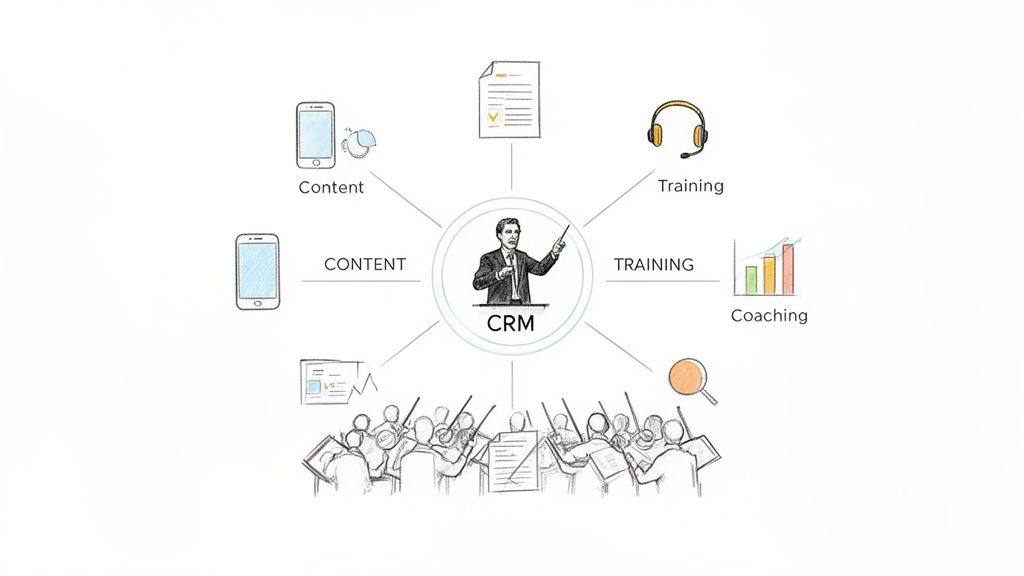
Let's be honest, a sales enablement strategy isn't some abstract business school concept. It's the playbook that stops your sales team from running in circles and starts them closing deals. Think of it as the difference between a garage band making a racket and a symphony orchestra creating something powerful. Without a conductor—your strategy—you just have a lot of talented people playing their own tune, making noise instead of revenue.
A strategy without actionable steps is just a wish. A sales team without a clear strategy is just a group of individuals making calls. This guide will give you both: a clear strategy and the actionable steps to implement it.
Why You Can't Afford to Ignore Sales Enablement Anymore
Cutting through the jargon, a sales enablement strategy is all about systematically removing friction from the sales process. It attacks the biggest problem on most sales floors: your reps are drowning in busywork and spending way too little time actually selling.
Let’s compare the two realities:
- Without a Strategy: "Sales support" is chaotic. Marketing creates content that sales never uses. A great training session is forgotten by next week. Expensive new tools gather digital dust. The team runs on gut feelings, leading to inconsistent results and frustrated reps.
- With a Strategy: The entire process is proactive and predictable. The right asset is delivered to the right rep at the right time. Training sticks because it’s reinforced. Tools are adopted because they eliminate work, not create it. The team operates as a cohesive, revenue-generating machine.
A well-executed sales enablement strategy transforms this reactive chaos into a proactive, predictable sales machine. It’s not just about giving reps more stuff; it’s about delivering the right asset, at the right time, in the right context to move a deal forward.
From Disconnected Tools to an Integrated Engine
Picture a typical sales development representative (SDR). They're juggling a CRM, a separate dialer, a messy folder of outdated PDFs, and their email client. This chaos forces them to toggle between a dozen tabs and manually log every single activity, burning through precious selling time.
It's a bigger problem than you think. In today's B2B world, reps spend just 30% of their time selling. The rest is lost to admin tasks, internal meetings, and wrestling with their CRM. But there's good news: companies with formal enablement programs see 49% higher win rates on forecasted deals because they reclaim that lost time. You can dig into more sales enablement statistics and their impact on team performance to see the full picture.
A modern sales enablement strategy tackles this mess head-on by integrating tools and processes right where reps work. Instead of a clunky, standalone dialer, imagine a click-to-call button inside the CRM that automatically logs every conversation. Instead of reps digging through folders for a case study, picture the perfect one being suggested based on the deal stage and prospect's industry.
This is where a CRM-native execution engine changes the game. It embeds productivity directly into the daily workflow by connecting three critical areas:
- Signals: Spotting buyer intent from things like website visits or content downloads.
- Tasks: Turning those signals into a prioritized to-do list for each rep.
- Execution: Giving them the tools—like an integrated dialer or AI-assisted email writer—to complete those tasks efficiently, all without leaving the CRM.
By tying these pieces together, a strong enablement strategy does more than just support your sales team. It becomes the central nervous system that guides every action, ensuring reps spend their days building pipeline, not fighting their tech stack.
Core Pillars Of A Modern Sales Enablement Strategy
| Pillar | Core Purpose | Key Activities & Tools |
|---|---|---|
| Content Enablement | To arm reps with the right marketing and sales assets at the perfect moment in the buyer's journey. | - Content Management Systems (CMS): Highspot, Seismic - Activities: Creating battle cards, case studies, one-pagers, ROI calculators, and organizing them for easy access. |
| Sales Training | To build foundational knowledge and skills, from product expertise to mastering the sales methodology. | - Learning Management Systems (LMS): Lessonly, Brainshark - Activities: Onboarding programs, product training, certification courses, and competitive intelligence sessions. |
| Sales Coaching | To provide personalized, real-time feedback that reinforces training and improves rep performance on live deals. | - Conversation Intelligence: Gong, Chorus.ai - Activities: Call shadowing, deal reviews, role-playing, and one-on-one coaching based on call recordings. |
| Tools & Technology | To automate administrative tasks and streamline workflows, freeing up reps to focus on selling. | - CRM-Native Execution Engines: marketbetter.ai - Activities: Implementing dialers, email automation, lead routing, and reporting dashboards directly within the CRM. |
Ultimately, these four pillars aren't separate functions; they're interconnected parts of a single engine designed to make your entire sales organization more effective and predictable.
The Four Pillars Of A Powerful Enablement Program
A killer sales enablement strategy doesn’t just happen. It's built on four pillars that have to work together, feeding off each other to create a high-performance sales engine. When these pillars are solid, your team is set up to win. When they're wobbly or disconnected, all you get is friction, wasted time, and missed quotas.
Enough with the theory. Let's look at what actually makes each pillar work by comparing the broken, old-school approach with a modern, actionable one.
Pillar 1: Content
First up is Content. At its core, this is all about giving your reps the right thing to say at exactly the right moment.
The old way is a dumpster fire of decentralized folders. Picture a shared drive choked with outdated PDFs, slide decks with names like Final_Deck_v9_USE_THIS_ONE, and case studies from three years ago. Reps burn more time hunting for a decent asset than they do talking to prospects. Eventually, they just give up and create their own rogue materials.
A modern content strategy is the polar opposite. It’s a living, breathing, central hub where every single asset is current, on-brand, and dead simple to find.
| Ineffective Content Approach | Effective Content Strategy |
|---|---|
| Decentralized & Chaotic: Assets are lost in shared drives, ancient email threads, and local desktops. | Centralized & Organized: A single source of truth, usually a content management system (CMS), where reps know to go. |
| Static & Outdated: Content gathers dust, leaving reps to share wrong pricing or obsolete product features. | Dynamic & Contextual: Assets are updated in real-time and even suggested to reps based on deal stage or a competitor's name. |
| Generic & Irrelevant: One-size-fits-all materials that land with a thud because they don't speak to specific buyers. | Personalized & Timely: Battle cards, ROI calculators, and industry-specific case studies are available instantly. |
Actionable Tip: Don't just build a content library; build a playbook. For each stage of your sales process, define the one key asset reps need to move the deal forward. Make that the priority.
Pillar 2: Training
Next is Training, which is how you build and lock in the skills your team needs to actually close deals.
Bad training is all about one-off events. The classic example is the annual sales kickoff—a high-energy workshop packed with information that everyone forgets within two weeks. Without reinforcement, the knowledge just evaporates, and reps slide right back into their old habits.
A winning training program, on the other hand, builds a culture of continuous learning.
The goal of training isn't just to dump information on people; it's to change their behavior. The best training is reinforced daily, right inside the tools reps already use, connecting the dots between theory and the live deals they're working on.
Instead of one huge event, think of an ongoing drip of micro-learnings. A new rep gets short, video-based lessons on handling objections delivered to their inbox weekly, maybe with a quick quiz. This approach makes learning stick because it's bite-sized and directly tied to the challenges they're facing right now. For more on this, you can dig into various sales enablement best practices that champion this continuous approach.
Actionable Tip: Implement a "certification" program for core skills like your elevator pitch or a key objection response. Have reps record themselves, submit it, and get direct feedback from a manager. This turns passive learning into active practice.
Pillar 3: Coaching
While training builds the foundation, Coaching is what sharpens the skills. This pillar is all about personalized, one-on-one guidance that actually moves the needle on performance.
Poor coaching is vague and runs on gut feelings. A manager listens to one call and offers useless advice like, "You need more confidence," or "Just build more rapport." That kind of feedback is impossible to act on and almost never leads to improvement.
Data-driven coaching delivers specific, actionable insights. Using a tool like Gong or Chorus to analyze call recordings, a manager can pinpoint the exact moment a deal started to go south.
- Vague Feedback: "You lost control of the call during the pricing part."
- Data-Driven Coaching: "I noticed you did 90% of the talking after the prospect mentioned price. Next time, let's try asking an open-ended question right there to figure out their budget concerns before you present our numbers."
Actionable Tip: Dedicate a specific part of your weekly 1:1s to reviewing one call recording. Don't just talk about deals; listen to them. This makes coaching a consistent, expected part of the rhythm of the business.
Pillar 4: Technology
Finally, the Technology pillar holds everything else up. This is the infrastructure that automates the grunt work and connects workflows so your reps can spend their time, you know, selling.
A fragmented tech stack is the enemy of productivity. When reps have to bounce between their CRM, a separate dialer, an email tool, and a content portal, they waste a ton of time on context switching and manual data entry. Adoption tanks because the tools create more work than they save.
An integrated tech stack kills that friction. The most powerful setup is a CRM-native execution engine. Instead of bolting on yet another standalone tool, it embeds key functions—like a dialer or an AI email writer—directly within the CRM. When a rep needs to make a call, they click a button right on the contact record in Salesforce. The call is made, logged, and dispositioned without ever leaving the screen.
Actionable Tip: Before buying any new sales tool, ask one question: "Does this integrate seamlessly into our CRM and remove a manual step, or does it add one?" If it adds a step, it will likely fail.
How To Build Your Sales Enablement Strategy
Building a killer sales enablement strategy isn't about flipping a switch. It's a deliberate process, like building a high-performance engine piece by piece, designed to create a revenue machine that actually lasts. For sales leaders and RevOps pros, this means getting beyond random acts of sales support and finally building a real framework. You can't just bolt on new tools and hope for the best. You need a blueprint.
That blueprint follows four distinct phases: Audit, Align, Build, and Integrate.
This isn’t just a checklist; it’s a flow.
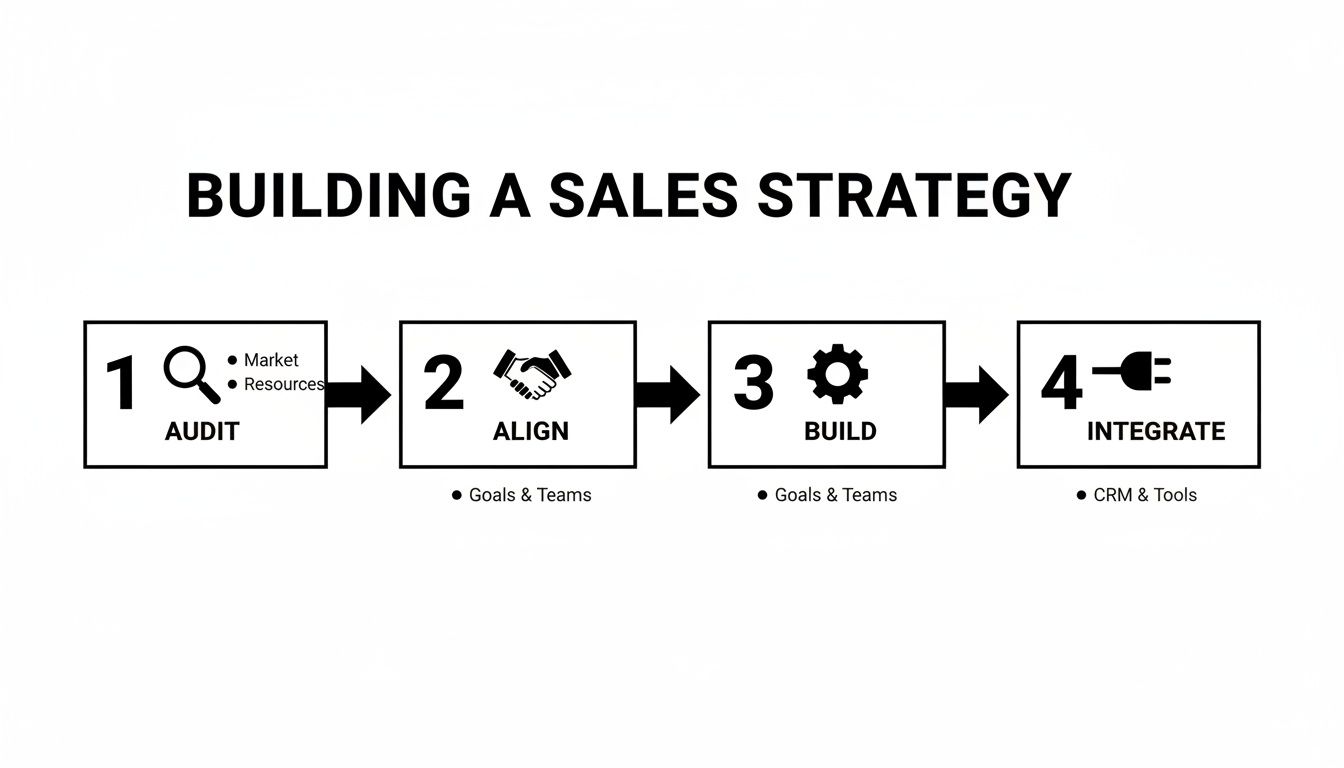
Each stage stacks on the one before it, making sure your strategy is built on solid data, backed by the right people, and actually has the teeth to drive results.
Phase 1: Audit And Goal Setting
Before you can build anything, you have to know what you're working with. The audit phase is about getting brutally honest about where your sales process is leaking money. This isn't about pointing fingers; it's about finding the friction that grinds your reps to a halt and quietly kills deals.
Actionable Steps for Your Audit:
- Map the Sales Process: Identify every single step from lead to close. Where do deals consistently get stuck or slow down?
- Interview Your Team: Ask SDRs and AEs to walk you through their day. Where do they waste the most time? What manual tasks are slowing them down? Use a simple survey if needed.
- Analyze Content Usage: Run a report in your CMS or shared drive. Which assets are used most? Which are never touched? Ask reps why.
- Review the Tech Stack: List every tool the sales team uses. Which ones have high adoption? Which are being ignored?
This process will uncover the ugly truth about productivity gaps. Once you’ve pinpointed the real problems, you can set goals that matter.
A vague goal like "improve sales" is completely useless. An actionable goal is "increase meetings booked per SDR by 15% this quarter by cutting call prep time in half."
That level of clarity turns a simple review into a strategic weapon. It gives your entire enablement effort a clear target to hit.
Phase 2: Stakeholder Alignment
A sales enablement strategy built in a silo is dead on arrival. You absolutely need buy-in from every single department that touches the revenue journey. This alignment phase is all about getting everyone rowing in the same direction, with shared goals and a crystal-clear understanding of their part to play.
Actionable Steps for Alignment:
- Form an Enablement Council: Schedule a recurring meeting with leaders from Sales, Marketing, Product, and RevOps. This is not a one-time thing.
- Share the Audit Findings: Present the data from Phase 1. Frame the problems in terms of shared business impact (e.g., "Our outdated content is costing us deals, which affects both Marketing ROI and sales quota.").
- Define a Shared Charter: Create a one-page document that outlines the enablement program's mission, primary goal for the quarter, and each department's role.
Alignment isn't a one-off meeting; it's an ongoing conversation. By setting up a cross-functional "enablement council," you create a permanent feedback loop where marketing learns what content actually moves the needle and sales understands the why behind new campaigns.
Phase 3: Content And Training Development
With your goals locked in and your teams aligned, it’s time to start building the actual assets. This phase is all about creating the resources your reps will lean on every single day to be more effective.
First, focus on building a practical content library, not a digital graveyard where PDFs go to die. This is all about quality over quantity.
Actionable Steps for Content:
- Prioritize Based on Gaps: Use your audit findings. If reps are losing to a specific competitor, make that battle card the #1 priority.
- Build Reusable Templates: Create email templates for common scenarios (e.g., post-demo follow-up, breaking up with a prospect) and load them into your sales engagement tool.
- Launch an "Asset of the Week": Highlight one new or underused piece of content in your weekly sales meeting to drive awareness and adoption.
Next, design an SDR onboarding and training program that actually sticks. Forget those week-long bootcamps crammed with theory. The modern approach is all about continuous, in-workflow learning. New reps should get bite-sized lessons on objection handling, immediately followed by role-play sessions with managers who can give instant, data-backed feedback.
Phase 4: Technology Integration
Finally, you need the right tech to bring your strategy to life. This is where so many companies stumble. The old way was to just bolt another standalone tool onto an already bloated tech stack. This just creates more friction, kills adoption, and forces reps to work outside the one system they live in all day—the CRM.
A modern, integrated approach is the only way to win. When you’re choosing your tools, think consolidation and workflow. You can find some of the best CRM software options to serve as your foundation.
Actionable Steps for Technology:
- Conduct a Tech Audit: Review your existing tools. Are there overlapping functionalities you can consolidate to save money and reduce complexity?
- Prioritize CRM-Native Solutions: When evaluating new tech, make "deep integration with our CRM" a non-negotiable requirement.
- Focus on Adoption, Not Just Implementation: A tool isn't "launched" when it's turned on. It's launched when reps are using it consistently. Build a simple dashboard to track weekly active usage for every key tool.
There's a reason over 90% of high-growth companies now run dedicated sales enablement programs. The most mature functions see 32% higher quota attainment because they've cracked this code of integration and efficiency.
How To Measure The ROI Of Your Sales Enablement
Figuring out if your enablement strategy is actually working can feel like trying to nail Jell-O to a wall. But proving its value to the C-suite isn't about fuzzy feelings or vanity metrics. It’s about drawing a straight, undeniable line from your efforts to the company's bottom line.
To do that, you need to track what matters. This means splitting your KPIs into two buckets: leading indicators (the activities) and lagging indicators (the results).
- Leading indicators are your early warning system. They track adoption and behavior—is the team doing the things you enabled them to do?
- Lagging indicators are the final score. They measure business outcomes like revenue, win rates, and quota attainment.
Leading Indicators: Are We On The Right Track?
Leading indicators give you a real-time pulse check. Is the team actually using the new content, tools, and processes you rolled out? These metrics are your secret weapon for course-correcting mid-quarter, long before you miss a target.
Here's what to keep an eye on:
- Content Adoption Rate: What percentage of reps are actively using the new battle cards in live deals?
- Training Program Completion & Certification: Are reps not just finishing modules but also passing skill certifications?
- Key Tool Adoption: How many reps are logging in and using the new dialer or content portal daily?
If you ignore these, you're basically flying blind. A low adoption rate is a sign that your initiative is irrelevant or too complex, and you can fix it before the quarter is lost.
Lagging Indicators: Did We Actually Make More Money?
While leading indicators track the doing, lagging indicators measure the winning. These are the results you march into the boardroom with to justify your budget and prove the ROI of your entire strategy.
Focus on these heavy hitters:
- Quota Attainment Percentage: What slice of your sales team is hitting or crushing their number?
- Win Rate: Of all the qualified opportunities your team works, what percentage do they actually close?
- Average Sales Cycle Length: How long does it take to get a deal done, from the first "hello" to a signed contract?
The data backs this up. Organizations where sales and marketing are tightly aligned through enablement see 20% annual revenue growth, while misaligned teams can actually see a 4% revenue decline. Some studies on the financial returns of mature enablement programs show they can deliver as high as a 4:1 return on investment.
Leading vs Lagging Indicators For Enablement ROI
This table breaks down how to think about both types of metrics. Leading indicators tell you if your process is working today, while lagging indicators confirm it's impacting the business tomorrow.
| Metric Type | KPI Example | What It Measures | How An Integrated System Helps |
|---|---|---|---|
| Leading | Content Adoption Rate | Are reps using the right assets in active deals? | Automatically links content usage to CRM opportunities. |
| Leading | Training Assessment Scores | Is knowledge from training being retained and applied? | Tracks completion and ties performance to rep activity data. |
| Leading | CRM Activity Logging | Are calls and emails being captured accurately? | Auto-logs all activities, eliminating manual data entry. |
| Lagging | Win Rate Percentage | How effective are reps at closing qualified deals? | Provides clean data to connect winning deals to specific plays. |
| Lagging | Sales Cycle Length | How efficient is the sales process from start to finish? | Clearly shows how new processes impact deal velocity. |
| Lagging | Quota Attainment | What percentage of the team is hitting their target? | Connects individual rep performance to their adoption of tools. |
Ultimately, you need both. Leading indicators let you coach and fix problems in real-time, while lagging indicators prove the long-term value of your program.
The Manual Nightmare vs. Integrated Clarity
Let's be honest about how this data gets collected in most companies.
- The Old Way (Manual Nightmare): The RevOps leader spends half their week begging reps to log their calls. The data is messy and incomplete. Trying to connect which email template drove the most meetings is a pipe dream.
- The Modern Way (Integrated Clarity): A CRM-native system auto-logs activities. When a rep uses a tool like marketbetter.ai to make a call from inside Salesforce, the activity is captured automatically. The data is clean and reliable.
This is how you stop guessing about your impact and start knowing it. The principles for tracking sales enablement ROI are closely related to proving the value of any GTM function. You can explore a deeper dive in our guide on how to calculate marketing ROI.
Common Sales Enablement Traps That’ll Kill Your Momentum
Even the smartest sales leaders fall into them. A sales enablement plan looks great on a whiteboard, but it can quickly unravel in the real world. It usually isn't one big disaster that sinks the ship; it's a series of small, well-intentioned mistakes that create drag, frustrate reps, and ultimately fail to move the needle on revenue.
Let's walk through the most common traps and, more importantly, how you can sidestep them.
Pitfall 1: Launching "Random Acts of Enablement"
This is the classic, number-one mistake. A sales leader sees a problem—call connect rates are down—and their first move is to buy a shiny new dialer. Problem solved, right? Wrong. This is a “random act of enablement.” It’s a knee-jerk reaction that treats a symptom without ever diagnosing the actual disease.
| The Trap (What Not To Do) | The Fix (What To Do Instead) |
|---|---|
| Reactive Problem-Solving: Buying a new tool for every little hiccup. The result? A messy, expensive, and fragmented tech stack that nobody fully uses. | Strategic Diagnosis: Hit pause. Ask why connect rates are low. Is it bad data? Are we calling at the wrong times? Are the talk tracks stale? Or is the tool actually the issue? |
| Siloed Decisions: The sales manager buys the dialer without talking to RevOps, marketing, or the very reps who have to use it every single day. | Cross-Functional Huddle: Get a small group together from sales, marketing, and ops. Make sure every new initiative solves a real, agreed-upon problem that everyone sees. |
Actionable Tip: Before launching any new initiative, force yourself to complete this sentence: "We are doing this because [insert data-backed problem from your audit] in order to achieve [insert specific, measurable goal]." If you can't fill in the blanks, don't do it.
Pitfall 2: Drowning Reps in Theory, Not Practice
So many enablement programs feel like a college course. Reps get fire-hosed with hours of PowerPoints on sales methodologies, product specs, and competitor battle cards. That knowledge is important, but it has a shockingly short half-life if it’s not put into practice immediately.
You end up with reps who can ace a multiple-choice quiz but freeze up when a real prospect hits them with an objection they weren't expecting.
The goal isn't to create reps who are certified academics. The goal is to build reps who can consistently run the right play when a deal is on the line. Training is measured by behavior change, not by certificates of completion.
Actionable Tip: Follow the "3:1 Rule." For every three hours of theoretical training, schedule at least one hour of practical application like role-playing, call reviews, or a certification exercise. This ensures knowledge is immediately put into practice.
Pitfall 3: Picking Tech That Reps Hate (and Ignore)
This trap is the direct result of the first two. You buy that standalone dialer or a separate content portal, thinking you’ve checked a box. But because it doesn't live inside the CRM—the place where your reps spend 90% of their workday—it gets ignored. Forcing reps to constantly juggle tabs is a workflow killer.
Think about the classic standalone dialer fail: A manager rolls out a new dialer. Reps have to alt-tab out of Salesforce, find the contact, make the call, then tab back to Salesforce to manually log the activity. By week three, adoption has flatlined.
Now, compare that with an integrated approach: With a CRM-native task engine like marketbetter.ai, the dialer is built right into the Salesforce interface. A rep clicks a button on the contact record, the call connects, and the outcome is logged automatically. Zero friction.
Actionable Tip: Create a "Day in the Life" map of your reps' workflow. Before buying any new tech, physically map out how it will fit into that day. How many extra clicks does it add? If it adds friction instead of removing it, it's the wrong tool.
The Future Of Enablement Is Integrated

If this playbook makes one thing clear, it's this: modern sales enablement isn’t just another department. It's the operational engine that drives your entire revenue team. The days of fragmented tools and siloed initiatives are over. Frankly, they create more friction than they solve.
The future belongs to integrated—or embedded—enablement. This is where your content, your coaching, and your execution tools live directly inside the platforms your reps use all day, every day. Think CRM.
Instead of forcing reps to hunt for a battle card in one portal and log a call in another, an integrated system surfaces the right asset and auto-logs the activity without them ever leaving their workflow.
This approach just makes sense. It kills the friction that tanks tool adoption and gives leadership a crystal-clear, real-time view of what actually drives performance.
The takeaway is simple: stop adding more tabs to your tech stack. It's time to build a unified system that makes your sales process smarter from the inside out. A huge piece of this puzzle is making sure your core systems are set up for it. You can see how the best tools achieve seamless integration with SFDC to make this a reality.
Common Questions, Answered
If you're building a sales enablement program, you've probably got questions. Here are a few of the most common ones I hear from leaders trying to get it right.
What’s The Biggest Mistake People Make In Sales Enablement?
Without a doubt, it's launching what I call "random acts of enablement." This is when leaders buy a shiny new tool or create a one-off training deck without first tying it to a real business problem. It’s a solution in search of a problem.
A great strategy doesn't start with a tool. It starts by diagnosing the friction in your sales process. A reactive approach just buys a new dialer. A strategic one digs in and asks why call volume is low—is it bad data? Clunky workflows? Weak talk tracks?—and then builds a focused plan to fix it.
How Is Sales Enablement Different From Sales Operations?
This one comes up all the time, and it's a critical distinction. The easiest way to think about it is like a Formula 1 race team.
- Sales Operations is the pit crew chief. They build and maintain the car—territory planning, comp plans, forecasting, and keeping the CRM running. Ops makes sure the machine is in perfect working order.
- Sales Enablement is the driver's coach. Their job is to make the driver faster and smarter on the track. They provide the right training, content, and in-the-moment coaching to help the driver navigate every turn and win the race.
They work hand-in-glove, but Ops owns the process and infrastructure, while Enablement owns the rep’s effectiveness and productivity.
How Do You Actually Measure If An Enablement Strategy Is Working?
You measure success by drawing a straight line from your enablement activities to real business outcomes. Forget vanity metrics like how many times a PDF was downloaded.
The only way to prove value is by tracking both leading and lagging indicators. Leading indicators—like tool adoption or reps completing a new training module—show if your team is engaging. Lagging indicators—like higher quota attainment, better win rates, and shorter sales cycles—prove it's actually hitting the bottom line.
Modern enablement makes this easy. Instead of guessing, you can see clear proof, like reps who use a specific battle card having a 10% higher win rate. That's an undeniable ROI.
What Does The Future Of Enablement Look Like?
The future is all about being integrated and AI-driven. Standalone tools and one-off training are on their way out. The next evolution is "embedded enablement," where support lives directly inside the tools your reps use every single day, like the CRM.
Instead of a rep digging through a content library to find the right case study, AI will surface it for them in the middle of a live call. The focus is shifting from simply equipping reps to actively helping them execute in the moment, automating the grunt work so they can spend all their energy selling.
Ready to embed an execution engine directly into your CRM? marketbetter.ai turns buyer signals into prioritized tasks and helps SDRs execute faster with an AI-powered dialer and email writer inside Salesforce and HubSpot. Stop chasing reps to log activities and start building a predictable outbound motion. Learn more at marketbetter.ai.