
Unlocking Growth with Marketing Automation B2B
Picture a top-tier restaurant kitchen. Now imagine trying to run it all by yourself—taking orders, cooking, cleaning, and serving every single table. That’s what a B2B sales team is doing without marketing automation B2B software. It’s not just another tool; it's the operational engine that turns chaos into a smooth, efficient service where nothing gets missed.
What Is B2B Marketing Automation, Really?
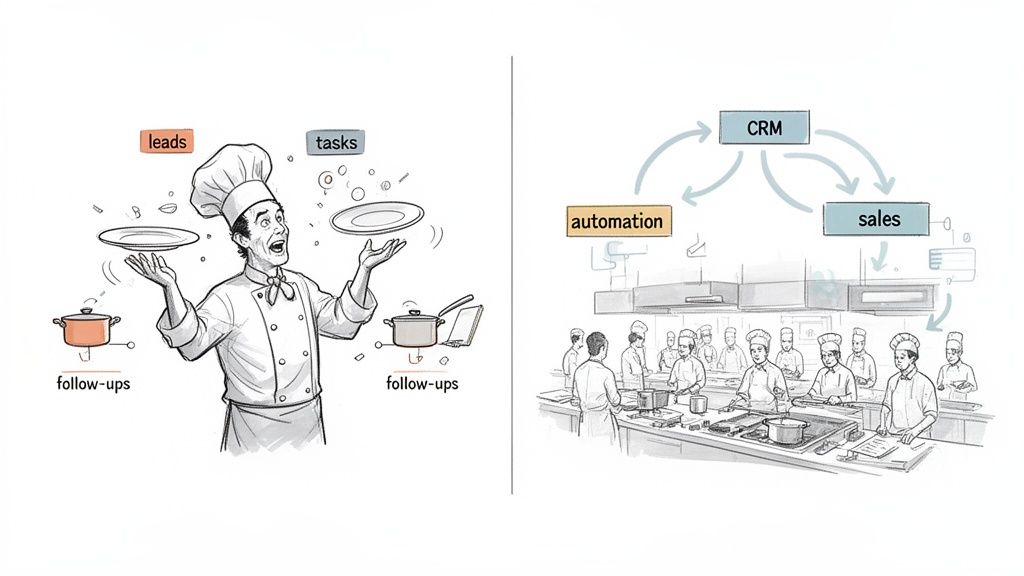
At its heart, B2B marketing automation is all about using software to handle the repetitive, manual tasks that bog down marketing and sales teams. The B2B world is a different beast than B2C. Sales cycles are long, decisions are made by committees, and the journey is complex. This is where manual follow-ups, inconsistent messaging, and administrative overload become massive business risks.
It’s the difference between a lone chef frantically juggling pans and an orchestrated kitchen with dedicated stations for prep, cooking, and plating. Without automation, reps burn valuable time logging calls, sending one-off follow-up emails, and trying to remember which lead to call next. Good leads inevitably slip through the cracks. In a manual setup, a hot inbound lead might wait hours for a response. With automation, that same lead can be routed, assigned, and have a task created in the rep's queue within seconds.
The Strategic Shift from Manual Labor to an Execution Engine
True B2B automation is more than just scheduling a few emails. It’s a fundamental shift in how you operate, turning manual, error-prone processes into a finely tuned engine for revenue growth. This tech was built to solve specific, painful problems that plague B2B sales teams every single day.
The adoption rates tell the story. A whopping 79% of marketers are now automating parts of their customer journey. This isn’t just a trend; it's a response to a real need, with 91% of organizations reporting that requests for automation are on the rise across the board. If you want the full picture, you can dive deeper into the latest marketing automation statistics.
A B2B sales team without automation is just a collection of individual efforts. With automation, it becomes a coordinated system designed to engage the entire buying committee at the right time, with the right message, every single time.
Key Problems Solved by B2B Automation
So, what headaches does it actually cure? Here are actionable problems you can solve today:
- Eliminating Inconsistent Follow-Up: Automation makes sure every lead gets timely, relevant communication based on what they do.
- Actionable Tip: Set up a simple "lead nurture" workflow. If a lead downloaded a whitepaper, trigger a 3-email sequence over 10 days that offers related content and a call with a specialist.
- Freeing Up Sales Reps: By taking over tedious tasks like data entry and activity logging, it lets reps focus on what they do best: building relationships and closing deals.
- Actionable Tip: Choose an automation tool that automatically logs every call and email to your CRM. This single change can give reps back an hour a day.
- Preventing Lost Leads: It acts as a safety net. It captures and nurtures leads that aren't quite ready to buy, keeping them warm so they don’t just vanish from your pipeline.
- Actionable Tip: Create a "recycling" workflow. When a lead is marked "closed-lost," automatically add them to a 6-month check-in sequence to stay top-of-mind.
Ultimately, marketing automation platforms turn chaotic, person-dependent workflows into predictable, scalable systems. This paves the way for faster growth, more accurate forecasting, and a sales team that can finally hit its full potential.
The Real Payoff: What B2B Automation Actually Delivers
Let’s be honest, "saving time" is a lazy promise. It doesn't get a budget approved. The real value of marketing automation b2b isn’t just about doing things faster; it’s about turning your team's daily grind into predictable revenue. It’s about giving leadership the hard numbers they need to see this isn't just another tool—it's a growth engine.
For a VP of Sales, this means a fatter pipeline, faster. It’s about watching lead-to-opportunity rates climb because follow-up is sharp and immediate. For an SDR leader, it's about giving your reps the superpower to have more quality conversations every single day. And for the RevOps team? It's the holy grail: clean, automatically logged CRM data you can actually trust for forecasting and attribution.
More Selling, Less Clicking
The first and most obvious win happens on the sales floor. Right now, your Sales Development Reps (SDRs) are probably burning hours on tasks that generate zero pipeline—manually logging calls, hunting for contact info, and guessing who to reach out to next. An automation platform rips that friction right out of their day.
It serves up the "next best action" on a silver platter, based on what a buyer is actually doing. No more digging. Just clear, prioritized tasks inside their workflow. When your dialer and an AI email writer live right inside the CRM, reps can pounce on an opportunity instantly. No more context switching, no more tab juggling—just pure execution.
This is a massive accelerator for new hires, too. Instead of spending months learning a Frankenstein's monster of a tech stack, they just follow the guided workflow. They become productive in weeks, not quarters.
Finally, Data You Can Believe In
Bad CRM data is a silent killer for B2B teams. When reps forget to log calls or fudge their notes, leadership is flying blind. You can't forecast with any confidence, you have no idea which campaigns are really working, and you can't attribute a single dollar of pipeline correctly.
Marketing automation flips the script by making perfect data hygiene the path of least resistance. When every single call, email, and touchpoint is launched from the CRM and logged automatically, you get 100% data integrity by design, not by begging your reps to do it.
This gives RevOps a pristine dataset to build dashboards and attribution models that reflect reality. It’s the end of chasing down reps for updates and trying to build a forecast on a foundation of swiss cheese.
The Before and After Transformation
Putting a manual process next to an automated one shows just how massive the shift is. It’s not a small step up; it’s a different league entirely. A core benefit here is how automation scales your outreach, which is a key pillar of the top B2B lead generation strategies that winning teams deploy.
Let's look at what this transformation actually looks like for a sales development team.
Manual SDR Workflow vs Automated Execution Engine
Here’s a snapshot of a typical B2B sales development team's performance before and after integrating their workflow into a unified automation and execution platform. The numbers speak for themselves.
| Metric | Manual Process (Before) | Automated Workflow (After) |
|---|---|---|
| Daily Outbound Actions | 50-60 calls/emails per rep | 120+ calls/emails per rep |
| CRM Data Accuracy | ~65% (manual, inconsistent logging) | ~100% (automatic logging) |
| New SDR Ramp Time | 3-4 months to full productivity | 4-6 weeks to full productivity |
| Lead-to-Opportunity Rate | 8% (inconsistent follow-up) | 15% (timely, relevant outreach) |
This isn't just an incremental improvement—it’s a fundamental change in your team’s capacity to generate pipeline. B2B automation turns the art of sales into a science, driving predictable outcomes by making sure the right actions happen at the right time, every time, with flawless data capture.
A Practical Roadmap to Your First Automation Win
The thought of rolling out a new automation platform can make any team groan. You picture months of painful setup, disrupted workflows, and a long, slow crawl before you see any actual value. It doesn't have to be that way.
Successful marketing automation b2b adoption isn't about boiling the ocean on day one. It's about securing a quick, high-impact win that builds real momentum.
This roadmap is designed to get you from planning to tangible results without derailing your team. It's a simple, four-phase framework to help you start small, solve a real problem, and expand when you're ready. The goal is to deliver immediate value that gets your reps excited and your leadership convinced.
Phase 1: Pinpoint Your Biggest Bottlenecks
Before you can automate anything, you need to know exactly where the friction is. The best automation targets the most painful, time-consuming, and error-prone parts of your current process. Don't start with a vague goal like "improve efficiency." Get specific.
Actionable Step: Interview three of your sales reps. Ask them: "What is the single most annoying, time-wasting task you do every day?" Listen for patterns. Common answers include:
- Manual Data Entry: "Logging my calls and updating Salesforce fields after a block of dials takes forever."
- Poor Lead Follow-Up: "I get an alert that a hot lead visited the pricing page, but by the time I can research them and reach out, they've gone cold."
- Low Email Relevance: "I spend too much time researching accounts just to write a semi-personalized first email."
Find the one or two bottlenecks doing the most damage to your pipeline and your team's morale. This isn't a wishlist—it's a diagnosis of your most critical operational wound.
Phase 2: Prioritize a High-Impact Use Case
Once you've found the bottleneck, pick a single, high-impact use case to solve it. Instead of trying to automate everything at once, focus on one contained workflow that will deliver a clear, measurable win. This is how you build confidence and drive adoption from the ground up.
A great example is automating tasks that come from intent data. Manually, a rep has to see a signal, research the account, find the right contact, create a CRM task, and then finally reach out. The process is slow and full of drop-off points.
An automated workflow, on the other hand, could instantly take that same signal, create a prioritized task in the CRM, and serve it to the right rep with an AI-generated email draft and a click-to-call button. That single change turns a 15-minute manual slog into a 30-second action.
To get ideas for your own high-impact workflows, you can learn more about common marketing automation workflows that deliver rapid results.
This visual shows exactly how finding bottlenecks and applying automation leads to measurable growth.
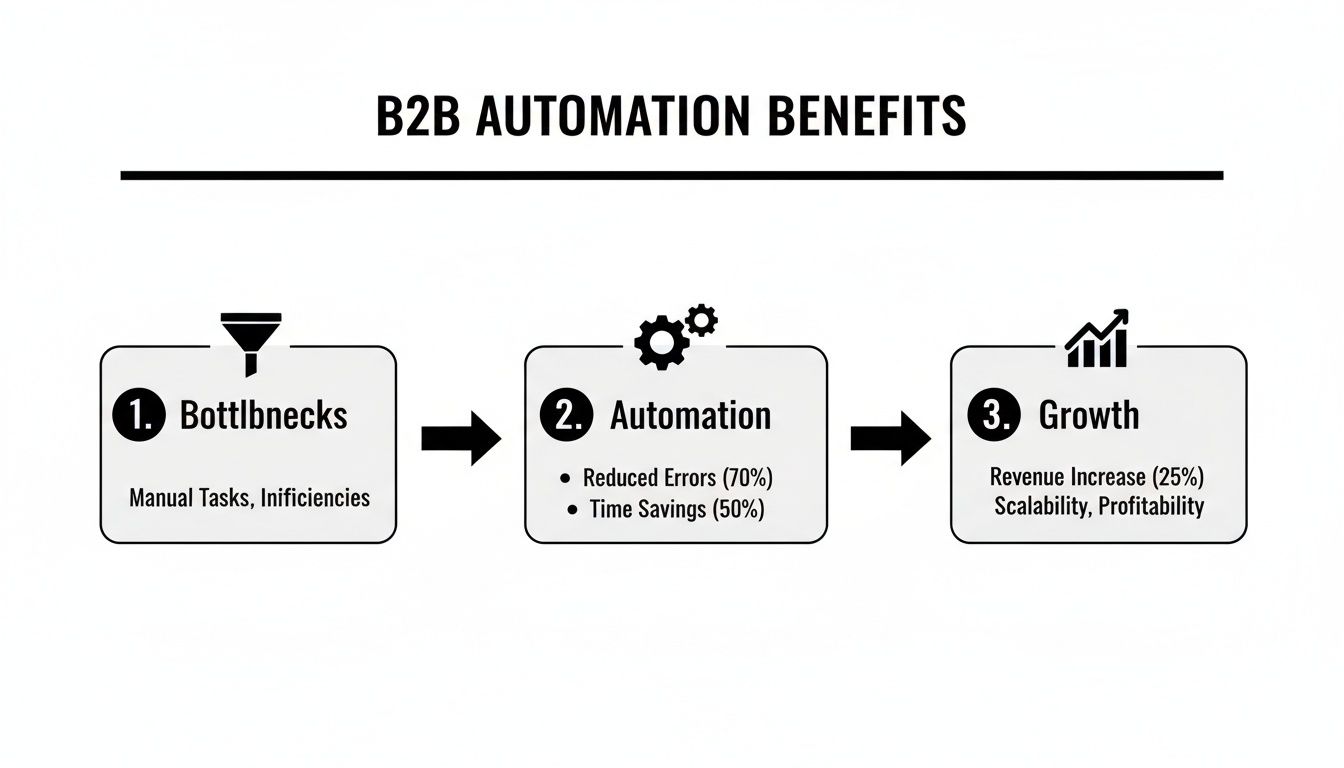
The key insight? Growth isn't just about strategy; it's about removing the operational friction that slows your team down.
Phase 3: Seamlessly Integrate with Core Systems
The number one reason automation rollouts fail is poor user adoption. And the fastest way to kill adoption is to force your reps into yet another browser tab.
Your automation engine has to live where your team works—inside your CRM.
Actionable Step: During vendor demos, insist on seeing the workflow from a rep's perspective. Ask them: "Show me exactly how a rep completes their five most common tasks without leaving the CRM." If they have to switch tabs, it's a red flag. Whether you use Salesforce or HubSpot, a native integration is non-negotiable. For instance, a key part of a practical roadmap involves strategies like turning LinkedIn outreach into a B2B sales machine, which is most effective when managed from a central system.
Phase 4: Measure, Iterate, and Expand
With your first workflow live, the final phase is all about proving its value and scaling your success. Start by tracking the metrics tied directly to your initial bottleneck.
Actionable Step: Before you launch, create a simple "before" and "after" dashboard.
- If you automated activity logging: Measure the percentage of calls logged before and after. The goal should be a jump from ~60% to 100% accuracy.
- If you automated intent signal follow-up: Track the average time-to-first-touch (in minutes) and the lead-to-meeting conversion rate. Aim to cut the time by at least 90%.
Share these early wins with your team and leadership. Use that momentum to identify the next bottleneck and repeat the process. By tackling one problem at a time, you methodically build a powerful automation engine that solves real-world challenges and drives sustainable growth—without disrupting your entire organization.
How to Choose the Right B2B Automation Platform
Picking the right automation platform is one of those decisions that can either supercharge your revenue team or bog them down in useless complexity. It’s not about finding the longest feature list. It’s about finding a tool that fits so neatly into your reps' daily grind that they wonder how they ever worked without it.
The wrong choice adds another login, another dashboard, another layer of friction. The right one becomes the engine that drives everything.
The very first question you should ask any vendor is simple: "Where does your platform live?" If the answer involves opening yet another browser tab outside of their CRM, you're looking at a huge adoption problem right out of the gate. Real, effective automation works where your team works—natively, inside the tools they already have open all day, like Salesforce or HubSpot.
Execution Engine or Just Another Dashboard
A lot of platforms are built for managers, not for reps. They're packed with complex dashboards and analytics suites that look impressive in a demo. But analytics don't book meetings. Execution does.
Your SDRs need a tool built to help them act—to make one more call, send a smarter email, and have every single touchpoint logged perfectly without a second thought. So, the question is, is this an execution-first engine designed to tee up the "next best action" for a rep? Or is it just another dashboard they have to manage?
This is the critical difference between a tool reps actually love and one they ignore.
The Critical Role of Guaranteed Data Hygiene
This brings us to the next deal-breaker: data integrity. You have to ask vendors how their system guarantees that every activity is logged accurately. Manual data entry is the silent killer of reliable reporting and accurate forecasting.
A platform that automatically logs every call, email, and meeting outcome by design is in a completely different league than one that depends on reps remembering to update records after the fact.
The best B2B automation platforms make perfect data hygiene the path of least resistance. When every action is launched from and logged back to the CRM automatically, you get 100% data visibility without having to chase down your team.
This is how RevOps and sales leaders get a clean, trustworthy dataset for attribution, performance tracking, and strategic planning. Without it, you’re just guessing.
The sketch below nails the difference between a cluttered, multi-app mess and a clean, CRM-native workflow.
As you can see, execution-first tools don't add to the chaos. They simplify the tech stack by plugging directly into the CRM, keeping reps focused instead of forcing them to juggle a half-dozen different applications.
Comparing All-in-One Platforms to Execution Engines
To really get to the heart of the matter, you need to understand the two competing philosophies in the sales automation world. On one side, you have the "all-in-one" platforms that try to be everything to everyone. On the other, you have specialized "execution-first" engines built for one purpose: solving the core problems of an outbound sales team. This becomes especially important when you start looking at modern AI marketing automation tools that all claim to make reps more efficient.
Here's a quick table to help you compare the two approaches.
Sales Engagement Platform vs Execution-First Task Engine
This comparison clarifies the fundamental differences in approach. All-in-one platforms often act as a separate command center, while execution-first engines are designed to be an invisible, powerful extension of your CRM.
| Evaluation Criteria | All-in-One Sales Engagement Platform (e.g., Salesloft/Outreach) | Execution-First SDR Task Engine (e.g., marketbetter.ai) |
|---|---|---|
| Primary Focus | Manages sequences, contacts, and reporting in a separate application. | Executes prioritized tasks (calls/emails) from within the CRM. |
| User Workflow | Reps must switch between the CRM and the platform's browser tab. | Reps stay entirely within their Salesforce or HubSpot workflow. |
| Data Logging | Often relies on syncing, which can lead to delays, errors, or incomplete data. | Every action is logged instantly and automatically to the CRM record. |
| Main Value Prop | A centralized library for managing large-scale outreach campaigns. | Maximum SDR efficiency and perfect data hygiene by design. |
| Adoption Risk | High. Reps often resist using "yet another tool" that complicates their day. | Low. It makes the job easier inside the system they already use. |
Ultimately, your choice boils down to what problem you’re actually trying to solve. If your biggest headaches are slow SDR workflows, low daily activity numbers, and messy data that makes attribution impossible, an execution-first engine is your answer. It’s purpose-built to fix the operational bottlenecks that kill pipeline growth, not just to add another pretty dashboard to your tech stack.
Measuring the KPIs and ROI That Truly Matter
Putting a B2B marketing automation platform to work isn't about making your team look busier. It's about driving real, tangible business outcomes. The whole point is to turn those newfound efficiencies into financial and operational wins. To do that, you have to connect the dots between your team's daily grind and bottom-line growth.
Success isn't found in tracking activity metrics like emails sent or calls logged. While those numbers are useful for measuring raw output, the real story—the one your leadership team actually cares about—is told by outcome metrics.
Activity vs. Outcome: Knowing the Difference
Think of it this way: activity metrics measure the work being done, while outcome metrics measure the impact of that work. An SDR manager needs to see a high volume of daily outbound actions, but a VP of Sales is fixated on the pipeline that activity generates.
You need to track both, but always with an eye on how one drives the other. A spike in daily calls is only valuable if it leads directly to a higher meeting-booked rate. Here's a comparative look:
-
Activity Metrics (The "How Busy"): These are leading indicators. They're easy to measure but don't tell the whole story.
- Number of calls logged per rep
- Number of personalized emails sent
- Tasks completed from the queue
-
Outcome Metrics (The "How Effective"): These are lagging indicators that prove the strategy is working and tie directly to revenue.
- Pipeline generated from outbound efforts
- Lead-to-opportunity conversion rate
- Sales cycle length (and how much you're shrinking it)
Actionable Tip: Create a dashboard that connects one key activity metric to one key outcome metric. For example, show a chart that plots "Calls per Rep per Day" against "Meetings Booked per Rep per Week." This visually proves that increased, focused activity is driving real results.
Calculating the True Return on Investment
Measuring the ROI of marketing automation goes way beyond simple cost savings. Automation is flexing some serious financial muscle in B2B sales development, delivering an impressive 544% average return—that's a whopping $5.44 back for every single dollar spent.
Digging a little deeper, B2B automation has been shown to drive a 451% increase in qualified leads, turning faint signals into genuine sales opportunities. For any demand gen manager or sales leader whose team is drowning in admin work, that kind of impact is massive. Platforms like marketbetter.ai embed AI-powered cold email writers and dialers right into Salesforce or HubSpot, auto-logging every single action for pristine data hygiene. You can get more stats on the financial impact of marketing automation on flowlyn.com.
The core of automation ROI is proving you're not just doing more things, but that you're doing the right things more efficiently. It's about showing how a smarter workflow leads directly to a healthier sales pipeline and faster revenue growth.
When every single action is logged perfectly, you also get a massive leg up on attribution. For any RevOps leader, this clean data is priceless. It finally allows them to build attribution models that accurately show which activities are creating and influencing revenue. That clarity helps you double down on what works and kill what doesn't. You can dive deeper into this topic by exploring our guide on the most important marketing KPIs for B2B teams.
KPIs That Resonate with Different Leaders
To truly prove your automation platform's worth, you have to speak the language of your stakeholders. Every leader cares about a different slice of the pie, so tailor your reporting to highlight the KPIs that matter most to them.
What Different Leaders Want to See
| Role | Key Concerns | KPIs to Report |
|---|---|---|
| SDR Manager | Rep productivity, ramp time, daily output | Daily actions per rep, connect rates, meetings booked |
| VP of Sales | Pipeline growth, forecast accuracy, team capacity | Pipeline created, lead conversion rates, sales cycle duration |
| RevOps Leader | Data integrity, attribution, tech stack ROI | CRM data accuracy, influenced revenue, cost per opportunity |
When you frame your results in the context of what each leader values, you demonstrate a holistic impact across the entire revenue organization. This approach shifts the conversation from, "How much does this tool cost?" to "How much more revenue can we generate with this tool?" That strategic alignment is what ensures continued investment and support for your automation programs.
Try our Marketing Plan Generator — generate a complete AI-powered marketing plan in minutes. No signup required.
Common Questions About B2B Marketing Automation
When you’re looking at a new marketing automation b2b strategy, the tough questions and skeptical objections are guaranteed to pop up. And they should. The goal isn't to brush those concerns aside, but to meet them head-on with straight, real-world answers.
Let's dive into the practical challenges that VPs of Sales, SDR leaders, and RevOps pros bring up when they're kicking the tires on a new platform.
We Already Have a Sales Engagement Platform. How Is This Different?
That’s a perfectly fair question, and one we hear all the time. Most sales engagement tools like Salesloft or Outreach operate like a separate library for your contacts and sequences. They're great for planning, but they force reps to work in another tab, away from their source of truth—the CRM.
Here's the key comparison: An all-in-one platform is like a separate kitchen built next to your restaurant. An execution-first engine is like upgrading the equipment inside your existing kitchen.
It doesn’t make reps switch windows to see what’s next. Instead, it serves up the "next best action" based on live buyer signals—and gives them the tools, like a native dialer or an AI email writer, to act on it instantly within the CRM record. You're moving from a planning tool to an action tool that ensures the work gets done and the data gets logged, perfectly, every single time.
Will AI-Generated Emails Sound Generic or Robotic?
The output you get from AI is only as good as the input you give it. This is where most basic AI writers fall flat; they have no context, so they spit out generic, bland content.
A smarter system grounds its AI in your own CRM data.
It looks at the account history, the specific persona you're targeting, and the buyer's recent activity to draft outbound emails that are genuinely relevant and punchy. The idea isn't to replace the rep's brain, but to give them a killer first draft they can quickly tweak and send. It’s about assistance, not full automation. Think of it as a sous chef prepping ingredients versus a robot cooking the whole meal. The rep is still the chef.
The single biggest failure point is poor user adoption, which almost always stems from a workflow that operates outside the team's primary system. Success comes from embedding automation directly into the existing CRM workflow.
What Is the Most Common Reason an Automation Rollout Fails?
Hands down, the number one killer of any new tool is poor user adoption. And that almost always comes from forcing a workflow that lives outside the team's main system. If you give your reps another tool that makes them constantly juggle windows, they just won't use it consistently. It's that simple.
Success is all about embedding the automation right into the CRM workflow they already know.
Actionable takeaway: A great implementation makes the rep's job easier within the system they already live in all day. Every action is simpler and logged automatically. That native approach is the difference between a tool that collects digital dust and one that actually drives revenue.
How Long Does It Take to See a Return on Investment?
You'll see the full ROI build over a few quarters, but the initial returns can show up incredibly fast by tackling the most immediate pain points first.
- Immediate Gains (First 30 Days): Just by flipping on a CRM-native dialer, you can see a rep's daily call volume and connect rate jump within the first month. By automating activity logging, you get 100% data visibility from day one. No more gaps.
- Strategic Returns (First 1-2 Quarters): The bigger wins—like shorter sales cycles and higher conversion rates—start to become obvious within one or two quarters. That's when the daily efficiency gains really start to compound and your team finds its rhythm.
At marketbetter.ai, we turn buyer signals into prioritized SDR tasks and help reps execute with AI-powered tools inside Salesforce and HubSpot. Discover how our execution-first engine can transform your outbound motion.