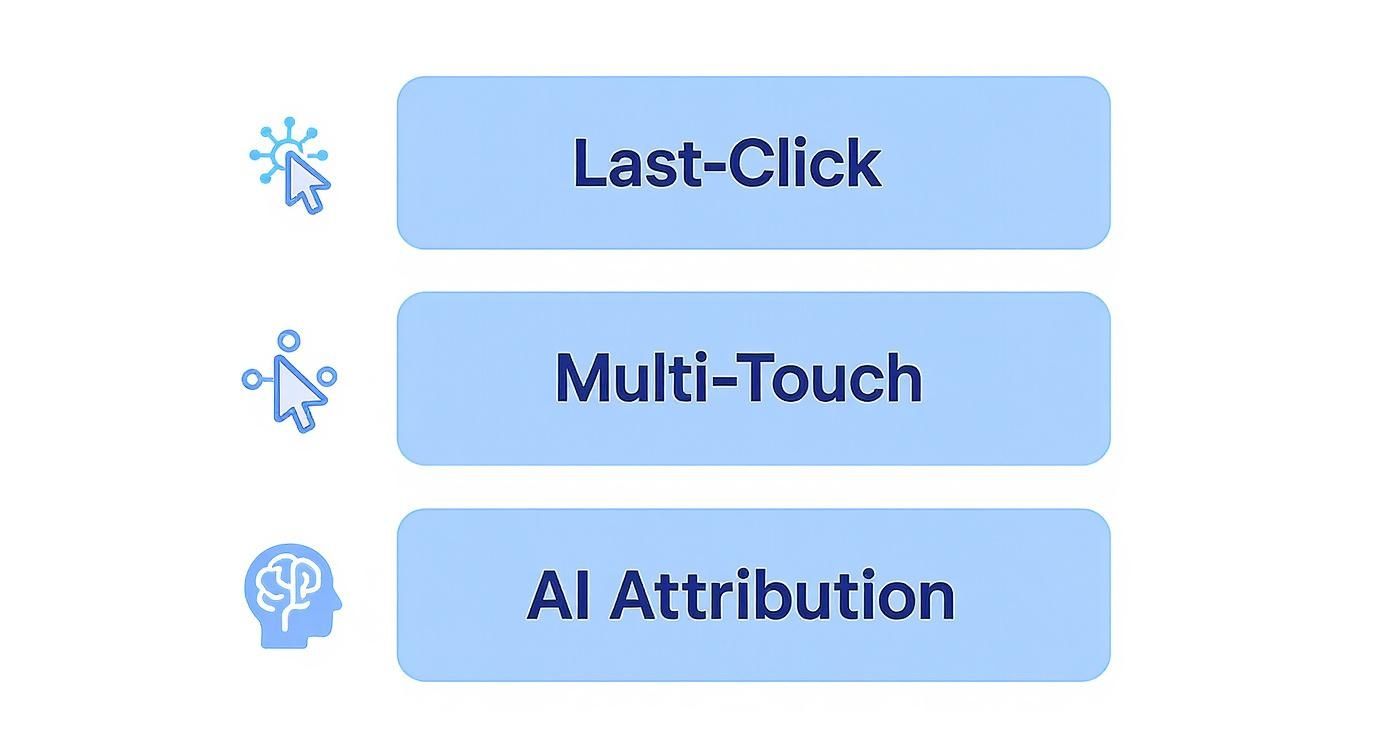
What Is Attribution Modeling and How Does It Actually Work
So, what exactly is attribution modeling? Think of it as the rulebook marketers use to figure out which of their efforts actually deserve credit for a sale. It’s a framework for assigning value to the ads, emails, and content that guide a customer from "just browsing" to "take my money."
Done right, attribution modeling shows you which channels are your heavy hitters, letting you invest your marketing budget where it will make the biggest impact. It transforms marketing from a cost center into a predictable revenue engine.
Decoding the Customer Journey

Imagine your customer's path to purchase is a soccer game, and the conversion is the winning goal. If you only credit the player who kicked the ball into the net, you’re ignoring the entire team's effort—the defender who stole the ball, the midfielder who threaded the perfect pass, and the forward who set up the final shot.
That’s the exact problem attribution modeling solves.
Without it, marketers often default to what’s called last-click attribution—giving all the glory to that final kick. It’s simple, but it's dangerously misleading. This approach gives far too much credit to bottom-of-funnel tactics (like a final "Buy Now" ad) while completely ignoring what introduced the customer to you in the first place, like that blog post or social media ad they saw weeks ago.
Why Old Methods Fall Short
Relying on a simple, single-touch model is like trying to understand a great movie by only watching the last five minutes. You see the outcome, but you miss the character development and plot twists that made it meaningful. This tunnel vision leads to flawed budget decisions and wasted ad spend.
For example, a company might slash its budget for top-of-funnel content marketing because it doesn't look like it’s driving direct sales under a last-click model. What they miss is that this content is the very first touchpoint for 70% of their most valuable customers. This is where a smarter, more holistic approach to attribution becomes mission-critical.
Attribution modeling gives you a framework to move beyond guesswork. It’s a structured way to analyze and assign credit across all the touchpoints that lead to a conversion, finally giving you the complete picture of what’s truly driving results.
The Real-World Impact on Your Bottom Line
Getting attribution right isn't just an academic exercise; it’s a competitive necessity for justifying budgets and proving marketing’s value. It directly answers the tough questions every CMO and marketing director has to face:
- Where should we invest our next dollar? By seeing which channels are actually performing, you can allocate your budget with confidence.
- Which campaigns are dead weight? It shines a light on the weak spots in your strategy, letting you optimize or cut what isn't working.
- What's the real ROI of our marketing? It delivers clear, evidence-based proof of how marketing contributes to revenue.
Ultimately, solid attribution modeling connects the dots between your team's actions and the company's bottom line. It gives you the clarity needed to scale growth efficiently and make smarter, data-driven decisions that benefit the entire organization.
The Evolution of Attribution: From Guesswork to Precision
To really get why modern attribution is such a big deal, you have to look at where we came from. It's a story that starts with broad, fuzzy guesses and ends with the kind of AI-powered precision we have today. This wasn't just a tech upgrade; it was a total mindset shift in how businesses understand their customers.
The journey started way before the internet. Back in the 1950s, the best marketers could do was use massive Marketing Mix Models (MMMs). Think of these as high-level statistical reports trying to connect a spike in sales to a big TV or print ad campaign. It gave you a bird's-eye view, but you couldn't see what was happening on the ground in real-time.
The Rise and Fall of the "Final Touch"
Then the digital age hit, and everything changed. Almost overnight, last-click attribution became the default. It's simple: whatever a customer clicked right before they bought something gets 100% of the credit. Easy to track, easy to explain. What's not to love?
Well, a lot, it turns out. Its simplicity was its biggest weakness. Last-click gave a dangerously narrow view of reality, heaping all the praise on bottom-of-the-funnel tactics (like a final Google Ad click) while completely ignoring the blog posts, social media ads, and email newsletters that got the customer interested in the first place.
Trying to See the Whole Story
Marketers knew this was broken. We could feel it. That gut feeling led to the first real attempts at Multi-Touch Attribution (MTA) in the mid-2000s. Suddenly, we had models like linear, time-decay, and position-based, all trying to spread the credit around more fairly.
The big idea behind multi-touch was a breakthrough: every single touchpoint has value. It was a conscious move away from just rewarding the finish line and finally starting to appreciate the entire race.
But the early excitement quickly ran into a wall. These rules-based models, while a step up, were still just educated guesses. They were rigid, a pain to set up, and relied on our assumptions, not actual performance data. To even begin, you need rock-solid data collection, which is why a practical guide to Google Analytics UTM parameters is non-negotiable for tracking campaign sources correctly.
By 2014, Gartner's Hype Cycle was already showing marketers were getting fed up with MTA's flaws. Then, the landscape shifted again. Machine learning got smarter, and privacy rules like GDPR forced everyone to rethink their data strategies. Today, sophisticated algorithmic models that analyze every possible path are boosting accuracy by 20-30% in major markets, setting a completely new bar for what "good" looks like.
This whole journey—from statistical guesswork to data-driven clarity—has brought us here. AI and machine learning aren't just trendy terms anymore; they're the essential tools that finally let us see what’s really working. They deliver on the original promise of attribution: to stop guessing and start knowing.
Comparing the Six Common Attribution Models
Picking an attribution model is a lot like choosing the right tool for a job. A hammer is perfect for nails but useless for screws. Each model gives you a different lens to look through when you're evaluating marketing performance, and the best one for you hinges entirely on your business goals, your sales cycle length, and the story you need to tell with your data.
Let's walk through the six models you'll run into most often, starting with the simple, rules-based classics and moving up to the smarter, data-informed approaches. We'll use a hypothetical $100 sale for each to make the differences crystal clear.
This flowchart shows how we got here—from broad, high-level guesses to the sharp, algorithmic models we rely on now.
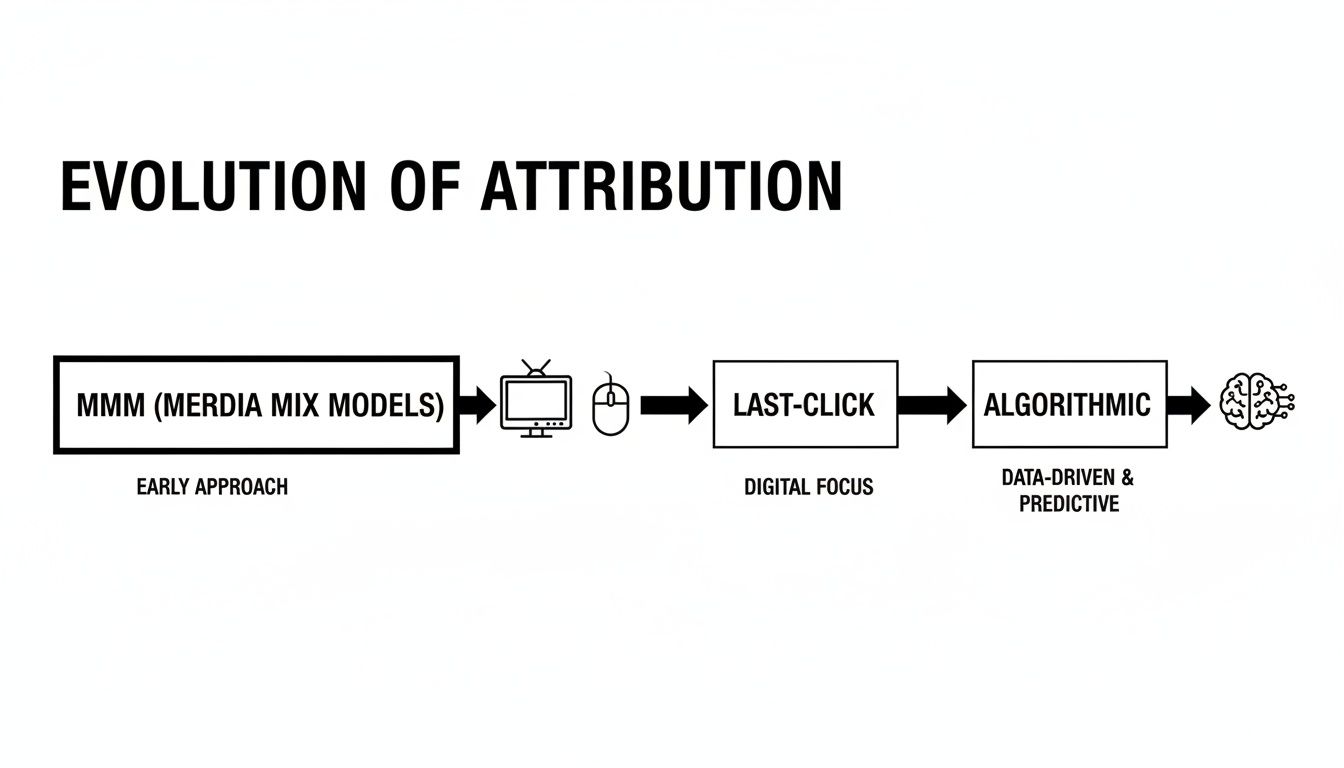
You can see a clear path from old-school Marketing Mix Models (MMM) to the dangerously simple Last-Click model, and finally to the sophisticated algorithms that run modern attribution.
The Single-Touch Models: Last-Click and First-Click
Single-touch models are the most basic form of attribution. They give 100% of the credit for a conversion to just one event in the customer's journey. They're dead simple to set up and understand, which explains their long-standing popularity, but they provide a very narrow view.
1. Last-Click Attribution
This is the old default for a reason. It gives all the glory for a sale to the very last thing a customer did before they converted. Think of it like a soccer game where only the goal scorer gets any credit, ignoring the rest of the team's passing and setup.
- How it works: A customer clicks a Google Ad and buys. The Google Ad gets 100% of the credit.
- $100 Sale Example: That final retargeting ad a customer clicked? It gets the full $100.
- Best For: Businesses with super short sales cycles and a heavy focus on direct-response campaigns, where that last touch really is the deal-maker.
2. First-Click Attribution
As you'd guess, this is the polar opposite of last-click. It hands all the credit to the very first touchpoint a customer ever had with your brand. The focus here is all about discovery—what brought someone into your world in the first place?
- How it works: A customer finds your brand through a blog post. Months later, they buy. That original blog post gets 100% of the credit.
- $100 Sale Example: An early-funnel social media ad made the customer aware of you. It gets the full $100 in credit.
- Best For: Companies obsessed with top-of-funnel growth and brand awareness. If new leads are your north star, this model tells you what's working.
The Multi-Touch, Rules-Based Models
Multi-touch models get more realistic. They recognize that it takes more than one interaction to close a deal and try to spread the credit around based on a set of pre-defined rules. They’re a significant step up from single-touch, but they still operate on assumptions rather than performance data. To go even deeper on this, check out our guide on multi-touch attribution models.
3. Linear Attribution
The linear model is the diplomat of the group. It distributes credit perfectly evenly across every single touchpoint in the journey. No playing favorites.
- How it works: If a buyer interacted with a blog post, an email, a social ad, and a direct visit, each one gets exactly 25% of the credit.
- $100 Sale Example: With four touchpoints, each one would be credited with $25.
- Best For: Marketers who want a simple, holistic view of every channel that played a part, without making any judgment calls on which one mattered more. It's a great baseline model.
4. Time-Decay Attribution
This model operates on the idea that the closer an interaction is to the sale, the more influential it was. Touchpoints that happen nearer to the conversion get a bigger piece of the pie.
- How it works: Credit is handed out on a sliding scale. A click from yesterday gets more credit than a click from two weeks ago.
- $100 Sale Example: The final direct visit might get $40, an email from three days prior gets $25, a social ad from last week gets $20, and the first blog post they read gets $15.
- Best For: Businesses with longer consideration periods, like B2B or high-ticket e-commerce, where the late-stage nurturing really matters.
Comparison: Think of Linear vs. Time-Decay. A Linear model treats a blog post read two months ago as equal to the pricing page visit yesterday. A Time-Decay model correctly argues the pricing page visit was more influential in the final decision.
The Advanced Algorithmic Models
This is where things get really smart. Instead of relying on rigid, human-defined rules, these models use data and machine learning to figure out how much credit each touchpoint truly deserves based on its actual impact.
5. Position-Based (U-Shaped) Attribution
This is a hybrid model that champions the first and last touches as the most important moments. It gives them the lion's share of the credit and sprinkles the rest across the interactions in the middle. The standard split gives 40% to the first touch, 40% to the last touch, and the remaining 20% is divided among everything else.
- How it works: It highlights the two bookend moments of the journey: the introduction and the close.
- $100 Sale Example: The first touch gets $40, the last touch gets $40, and all the middle touches share the leftover $20.
- Best For: Marketers who are convinced that generating the lead and closing the deal are the two most critical jobs of their marketing efforts.
6. Data-Driven Attribution
Welcome to the big leagues. This is the most sophisticated and accurate model available. It uses machine learning to analyze every converting and non-converting customer path to figure out the actual impact of each touchpoint. It doesn't guess; it learns from your data.
- How it works: The algorithm calculates the probabilistic value of each interaction based on historical performance.
- $100 Sale Example: The algorithm might decide the first ad gets $15, a social media view gets $5, attending a webinar gets $50, and the final email click gets $30—all based on what it's learned from thousands of other customer journeys.
- Best For: Businesses with enough conversion data to feed the algorithm and a real commitment to letting the data guide their decisions.
A Practical Comparison of Attribution Models
To make this even clearer, here’s a side-by-side breakdown of the models we just covered. This table should help you quickly assess which approach might be the best fit for your team right now.
| Model | How It Works | Pros | Cons | Best For |
|---|---|---|---|---|
| Last-Click | Gives 100% credit to the final touchpoint before conversion. | Simple to implement and track. Identifies closing channels. | Ignores the entire top and middle of the funnel. Highly misleading. | Short sales cycles; direct-response campaigns. |
| First-Click | Gives 100% credit to the very first touchpoint in the journey. | Great for understanding which channels generate initial awareness. | Ignores all nurturing and closing activities. Also misleading. | Brands focused on top-of-funnel growth and lead generation. |
| Linear | Distributes credit equally across all touchpoints. | Provides a balanced view; ensures no channel is ignored. | Falsely assumes all touchpoints are equally valuable. | Getting a baseline understanding of all contributing channels. |
| Time-Decay | Gives more credit to touchpoints closer to the conversion. | Reflects that later touches are often more influential. | Can undervalue crucial awareness-building activities. | Businesses with longer consideration periods (B2B, high-value B2C). |
| Position-Based | Gives 40% to the first touch, 40% to the last, and 20% to the middle. | Balances the importance of lead generation and closing. | The 40/20/40 split is arbitrary and may not fit your journey. | Teams that value the first and last touches most. |
| Data-Driven | Uses machine learning to assign credit based on actual impact. | The most accurate and unbiased model; adapts over time. | Requires significant data; can be a "black box." | Mature organizations ready for truly data-informed marketing. |
Ultimately, moving from a simple model like last-click to something more nuanced is a sign of a maturing marketing organization. The goal isn't just to assign credit, but to understand the customer journey so you can make smarter investments.
How to Implement an Attribution Model: An Actionable Guide
Alright, let's move from the "what" to the "how." Knowing what attribution models are is one thing, but actually picking one and putting it to work is where you start seeing real results. This is the playbook for moving beyond last-click and turning your marketing data from a tangled mess into a clear roadmap for growth.
The Framework: Picking the Right Model for You
Choosing a model isn’t about grabbing the most complicated one you can find. It’s about finding the one that fits your business reality right now. Before you commit, you have to be honest about where you stand on four key pillars. This framework will point you to the perfect starting line.
-
Business Goals: What are you actually trying to achieve? If your main goal is raw brand awareness, a First-Click model might be your best friend, since it highlights what’s bringing people in the door. But if you’re laser-focused on closing deals and proving ROI, you’ll need a model like Position-Based or Data-Driven that gives more weight to the stuff that happens just before the sale.
-
Sales Cycle Length: How long does it take for a stranger to become a customer? For an e-commerce brand with a short, simple sales cycle, a Last-Click or Linear model can give you quick, actionable insights. But if you’re a B2B company with a sales cycle that spans several months, a Time-Decay model is a much better fit because it correctly values the touchpoints closer to the deal.
-
Channel Mix: Where are you spending your money? If you pour most of your budget into a couple of direct-response channels like paid search, a simple model might suffice. But if you're juggling a complex mix of social media, content marketing, email nurture sequences, and paid ads, a multi-touch model like Linear or Position-Based is non-negotiable. You have to see how they all play together.
-
Data Maturity: Let’s be real—how clean is your data? A Data-Driven model sounds amazing, but it requires a huge amount of clean conversion data for the algorithm to learn from. If your tracking is spotty or you're just getting started, don't jump into the deep end. Start with a solid rules-based model like Linear and make your first priority improving your data quality.
Your Step-by-Step Implementation Guide
Got a model in mind? Great. Now for the hard part. Implementation requires careful planning and a bit of grunt work upfront. Follow these steps to get it right and avoid the common traps that trip people up.
-
Define Your Conversion Goals. Seriously, what counts as a win? A signed contract? A demo request? A completed purchase? Be crystal clear on this, because this single action is what your entire model will be measured against.
- Actionable Tip: Create a primary conversion goal (e.g., "Purchase") and one or two secondary goals (e.g., "Newsletter Signup"). This gives you a more nuanced view of performance.
-
Audit Your Data Tracking. This is the step everyone wants to skip, and it's the most critical one. You have to make sure your tracking is consistent everywhere. Standardize your UTM parameters, check your CRM integration, and verify your tracking codes are firing correctly on every single page. Data silos are the absolute enemy of good attribution.
- Actionable Tip: Create a simple spreadsheet for your team that dictates the exact format for UTMs (
utm_source,utm_medium,utm_campaign). Consistency is key.
- Actionable Tip: Create a simple spreadsheet for your team that dictates the exact format for UTMs (
-
Select Your Starting Model. Based on your framework analysis, pick your first model. Don't chase perfection on day one. It's almost always better to start with a straightforward model like Linear to get a baseline. You can always get more sophisticated later.
-
Configure It in Your Analytics Platform. This is the technical part. Go into your analytics tool of choice—whether it's HubSpot or Google Analytics—and actually set it up. Most platforms have a "Model Comparison Tool" that lets you view data through different lenses.
- Actionable Tip: In Google Analytics, use the Model Comparison Tool to compare Last-Click against your chosen model (e.g., Linear or Data-Driven) side-by-side. This will immediately highlight which channels you’ve been undervaluing.
-
Monitor, Analyze, and Act. Attribution isn't a "set it and forget it" project. Check in on your reports regularly.
- Actionable Tip: Set aside time each month to review your attribution reports. Ask: "Which channels are over-performing or under-performing compared to last-click? Based on this, where can we test shifting 10% of our budget next month?"
A successful attribution strategy hinges on unified, clean data. Inconsistent tracking across channels will undermine even the most advanced model, leading to flawed insights and poor budget decisions.
That challenge of breaking down data silos is a big one, but you can't sidestep it. Getting all your marketing and sales tools talking to each other is foundational. If you're trying to get a handle on this, check out our guide on customer data platform integration—it breaks down exactly how to build that unified view of your customer's journey.
Understanding the Power of AI and Data-Driven Models
This is where marketing measurement gets really interesting. While rules-based models give you a structured, educated guess at what's working, data-driven attribution scraps the guesswork entirely. It uses machine learning to crunch the numbers on every single customer path—the ones that converted and, just as importantly, the ones that didn't—to figure out who gets the credit with mathematical confidence.

Here's a comparison. A rules-based model is like following a pre-written recipe step-by-step. A data-driven model is like a master chef who tastes every single ingredient, understands how they all play together, and creates the perfect dish based on pure experience and evidence. It doesn't lean on a static formula; it actually learns from your unique data.
Beyond Rigid Rules to Probabilistic Credit
Think about a Position-Based model that blindly assigns 40% credit to the first touchpoint. A data-driven algorithm might look at your actual sales data and find that the initial blog post a customer read only contributed 5% of the influence for that specific conversion path.
On the flip side, it might discover that a mid-funnel webinar—something a Last-Click model would completely ignore—was massively influential and deserves 50% of the credit.
This is the entire ballgame. Data-driven attribution assigns credit based on probability, not a predetermined spot in the lineup. It calculates how much each touchpoint increased the likelihood of a sale, giving you a far more dynamic and honest picture of what's actually driving revenue.
Data-driven attribution isn't just another model. It's a fundamental shift from applying human assumptions to letting your own performance data tell you the truth. It's the most objective way to understand what's really working.
The Tangible Benefits of Algorithmic Analysis
Moving from gut-feel heuristics to AI-driven precision pays off in real, measurable ways. It's redefining how modern marketing teams prove their value and decide where to place their bets.
The results speak for themselves. Google’s own Data-Driven model in GA4 delivers 15-27% higher accuracy in ROI forecasts for advertisers compared to rules-based models. And a 2023 trends report found that 62% of Fortune 500 marketers using algorithmic attribution saw a 20% improvement in budget allocation. The trend is clear: smarter data leads to smarter spending. You can learn more about how algorithmic models are changing marketing on owox.com.
This kind of insight is invaluable. It gives marketers the power to:
- Invest with Confidence: Stop arguing over which channels deserve more budget. The model points directly to where you can allocate funds for maximum impact.
- Optimize the Full Funnel: Uncover the hidden gems in the middle of your customer journey that simpler models always undervalue.
- Adapt to a Cookie-Less Future: As third-party cookies fade away, models that can analyze patterns across all your available data become absolutely essential for keeping your measurement accurate.
Making Advanced Insights Accessible
The good news? You don't need a team of data scientists locked in a room to get this done anymore. Platforms like Google Analytics 4 (GA4) now offer data-driven attribution as the default setting, making this powerful technology accessible to more teams.
It automates the heavy lifting, giving marketing teams sophisticated insights that once required a massive investment. By looking beyond simple conversion counts, these systems spot trends and can even make forward-looking recommendations.
This move from reporting on the past to actively shaping the future is a game-changer. For a deeper look into this shift, check out our article on predictive analytics in marketing. At the end of the day, AI-driven models give you the clarity to stop reacting and start building your future success with confidence.
How to Measure Success with Attribution KPIs
Picking an attribution model is just the starting line. The real win comes when you can translate all that new data into a clear story about what's working and what's not. To do that, you need to anchor your analysis in key performance indicators (KPIs) that connect your marketing spend directly to revenue.
Forget vanity metrics. The right model lets you zero in on the numbers that actually move the needle for the business.
Core Attribution KPIs to Track
To get a complete picture of your performance, you can boil it down to a few essential KPIs. These three give you a rock-solid foundation for measuring the impact of your marketing efforts.
- Cost Per Acquisition (CPA): This is the bottom-line cost to land one new customer. With a multi-touch model, you get a far more honest CPA because you’re properly crediting all the touchpoints that contributed, not just the final click.
- Customer Lifetime Value (CLV): By seeing the whole customer journey, you can finally identify which channels and campaigns are bringing in the best customers—the ones who stick around and spend more over time. This helps you optimize for long-term profitability, not just the first sale.
- Return on Ad Spend (ROAS): This is the ultimate proof of campaign profitability. It’s a simple, powerful metric that tells you exactly how much revenue you’re generating for every single dollar you put into advertising.
How Different Models Tell Different Stories
Let’s walk through a quick example to see how your choice of model can completely change your perception of success.
Imagine you spend $1,000 on a campaign that brings in $4,000 in revenue. The customer’s journey involved seeing a social media ad, reading a blog post, and finally clicking a retargeting ad to make a purchase.
Under a Last-Click model, that retargeting ad gets 100% of the credit. Its ROAS looks phenomenal, while the social ad and blog post look like they did nothing. But a Data-Driven model might analyze the path and see the social ad was crucial for discovery, assigning it $1,500 in credit and proving its value.
This shift is everything. It stops you from making the classic mistake of cutting the budget for top-of-funnel channels that are quietly teeing up all your future customers.
For a deeper dive into how this plays out in a specific environment like Connected TV, this CTV Measurement Attribution Guide is a fantastic resource. It gives you the language and data you need to confidently explain each channel’s true value to your stakeholders.
Try our Marketing Plan Generator — generate a complete AI-powered marketing plan in minutes. No signup required.
Your Top Attribution Modeling Questions, Answered
Once you start digging into attribution, the real-world questions pop up fast. Let's tackle a few of the most common ones I hear from marketing teams trying to put these models into practice.
What’s the Best Model for a B2B Company with a Long Sales Cycle?
If your customer journey is a marathon, not a sprint—spanning months or even quarters—then simple models like First-Click or Last-Click just won't cut it. They’re blind to all the critical, relationship-building work that happens in the middle of the funnel.
For a more honest look, you need a model that respects the entire journey.
A Time-Decay model is a great place to start. It correctly assumes that the touchpoints closest to the deal closing carried more weight, reflecting that final push that gets a long-term contract signed. Even better is a Data-Driven model, assuming you have the data volume to support it. It algorithmically figures out which interactions—that key webinar six weeks ago or the product demo last week—were the real heavy hitters, no matter where they happened in the cycle.
Comparison: A rules-based model like Time-Decay gives you a logical framework for a long sales cycle. But a Data-Driven model delivers the most accurate, unbiased view by letting your actual performance data write the rules.
How Often Should I Change My Attribution Model?
Almost never. The whole point is to establish a consistent yardstick to measure performance over time. Changing your model frequently is like changing the rules of a game halfway through—you'll never know if you're actually getting better. Think of it as a strategic commitment, not a tactical tweak.
That said, there are a few specific times when you absolutely should revisit your model:
- Annually: A yearly check-in ensures your model still reflects your business goals and marketing reality.
- Major Strategy Shift: Launching a new flagship product? Entering a new global market? Your customer journey is about to change, and your model needs to change with it.
- Significant Channel Mix Changes: If you suddenly invest heavily in a new channel (like Connected TV) or pull back from another, the dynamics of your touchpoints will shift, making a review a smart move.
The goal is stability, punctuated by deliberate, strategy-driven reviews.
Is It Useful to Compare Multiple Models at the Same Time?
Yes, one hundred percent. In fact, this is one of the most powerful things you can do to get a full, nuanced understanding of your marketing performance.
Running models side-by-side instantly reveals the inherent bias in each one. For example, when you compare your Last-Click report to a Linear or Data-Driven one in your analytics tool, you can suddenly see how much heavy lifting your top-of-funnel channels are really doing.
This is how you build an ironclad business case for the channels that are essential for building awareness and nurturing leads, even if they don't get the glory of landing the final click.
Ready to stop guessing and start knowing which marketing efforts are driving real revenue? The marketbetter.ai platform uses AI-powered, data-driven attribution to give you a clear, accurate picture of your performance. See how you can optimize your budget and prove your impact at https://www.marketbetter.ai.