
Slack-First Sales Alerts with OpenClaw: Real-Time Deal Intelligence for Your Team [2026]
Your sales team lives in Slack. Your deals live in HubSpot. And the gap between them is where revenue goes to die.
A deal stage changes at 2 PM. The rep updates HubSpot at 4 PM. The manager notices in the weekly pipeline review. That's 3 days of latency on information that should trigger immediate action.
What if your team got intelligent, contextual deal alerts in Slack the moment something changed? Not raw CRM notifications — those are noise. Real intelligence: "This deal just stalled past the critical 14-day mark in proposal stage. Deals matching this pattern close at 34% instead of 67%. Suggested action: Executive sponsor call."
That's what OpenClaw enables. An AI agent that monitors your CRM, understands deal context, and delivers actionable intelligence to your team in the tool they already live in.
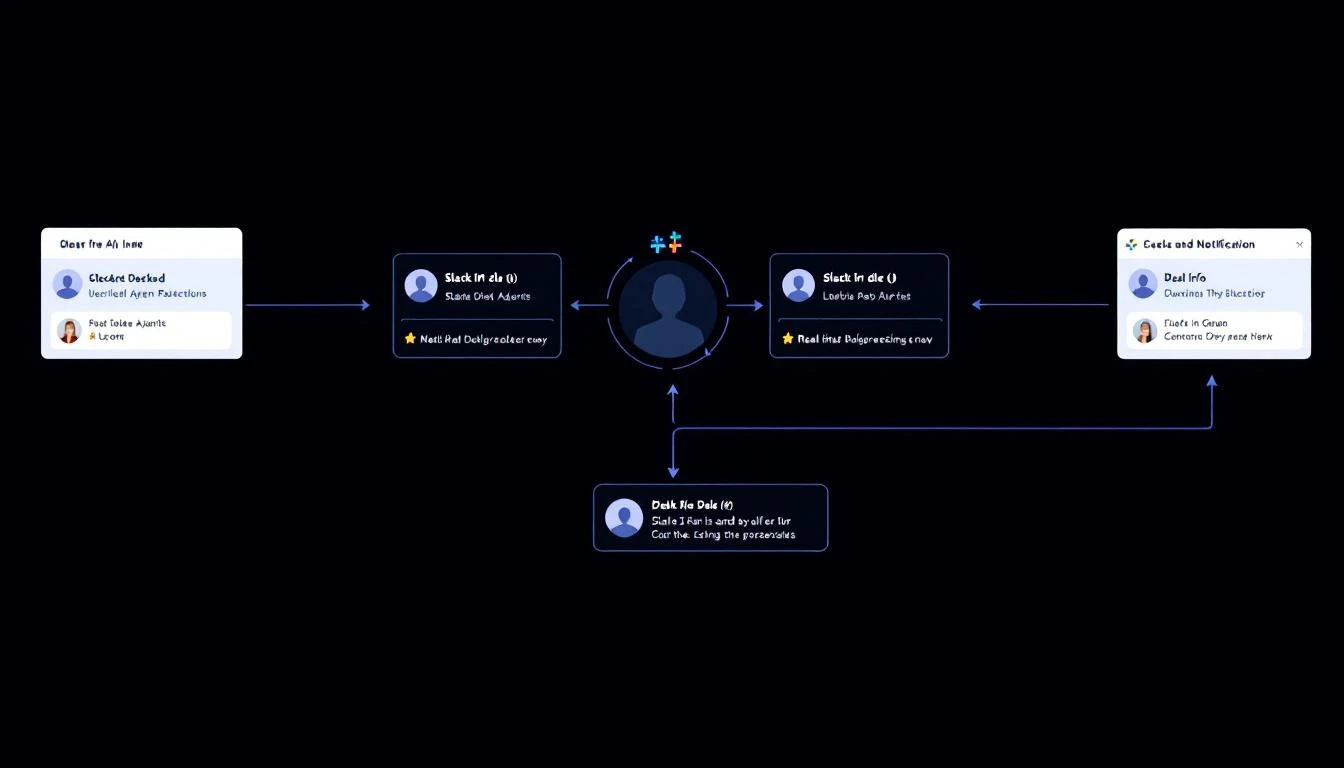
Why Raw CRM Notifications Don't Work
Every CRM offers Slack notifications. HubSpot, Salesforce, Pipedrive — they all have "send to Slack when X happens" automations. So why do teams still miss critical deal signals?
Too much noise. When you notify on every field change, people mute the channel. "John updated deal amount from $24,000 to $24,500" — nobody needs to see that in real time.
No context. "Deal X moved to Proposal stage" is a fact, not intelligence. What's missing: Is this fast or slow compared to similar deals? Are the right stakeholders engaged? Is there competitive pressure?
No recommended action. Knowing that something changed is step one. Knowing what to do about it is what actually drives revenue. Raw notifications leave the "so what?" entirely to the reader.
Wrong audience. Everyone in the sales channel sees everything. The SDR who owns the deal, the manager, the VP — they all need different information at different times.
OpenClaw-powered alerts solve all four problems.
The Architecture
Here's how a Slack-first sales intelligence system works with OpenClaw:
Monitor layer: OpenClaw agent checks your CRM at regular intervals (every 15-60 minutes). It tracks changes to deal stage, amount, close date, stakeholder engagement, and activity levels.
Intelligence layer: When changes are detected, Claude analyzes the change in context. Not "deal moved stages" but "deal moved to proposal in 8 days, which is 40% faster than average for this deal size — high-velocity pattern detected."
Routing layer: Different alerts go to different people. The rep gets tactical advice. The manager gets pipeline impact. The VP gets the roll-up. Nobody gets noise.
Action layer: Every alert includes a suggested next step. Not "check the deal" — a specific action based on what the data says works.
What Smart Alerts Look Like
Here are the types of alerts your team should actually receive:
Deal Velocity Alerts
Fast-moving deal (positive):
🚀 Deal Accelerating: Acme Corp Moved from Discovery → Demo in 3 days (avg: 9 days) This matches the pattern of your fastest closes. Don't let momentum stall. Action: Schedule proposal review within 48 hours.
Stalling deal (warning):
⚠️ Deal Stalling: GlobalTech 16 days in Proposal stage (avg: 8 days) Deals that exceed 14 days here close at 34% vs 67%. Action: Check if champion is still engaged. Consider executive sponsor introduction.
Engagement Alerts
Multi-threading success:
👥 Multi-threading Detected: DataFlow Inc 3 new stakeholders added this week (was single-threaded). Multi-threaded deals close at 2.8x the rate. Strong signal. No action needed — keep doing what you're doing.
Ghost alert:
👻 Radio Silence: CloudNine Solutions No email opens, no meetings, no activity in 12 days. Last activity: Proposal sent on Jan 31. Action: Try a different channel. Phone call or LinkedIn to backup contact.
Competitive Alerts
Competitor detected:
🏁 Competitor Alert: TechStart Competitor mentioned in latest email thread: Warmly Your win rate against Warmly: 62% when demo happens before theirs. Action: Accelerate demo if possible. Send comparison one-pager.
Pipeline Impact Alerts (Manager/VP only)
Forecast shift:
📊 Q1 Forecast Shift 3 deals moved to Closed-Lost this week ($87K total) Current forecast: $412K (down from $499K) Gap to target: $88K Top pipeline to watch: Acme Corp ($65K, score: 82), DataFlow ($45K, score: 74)
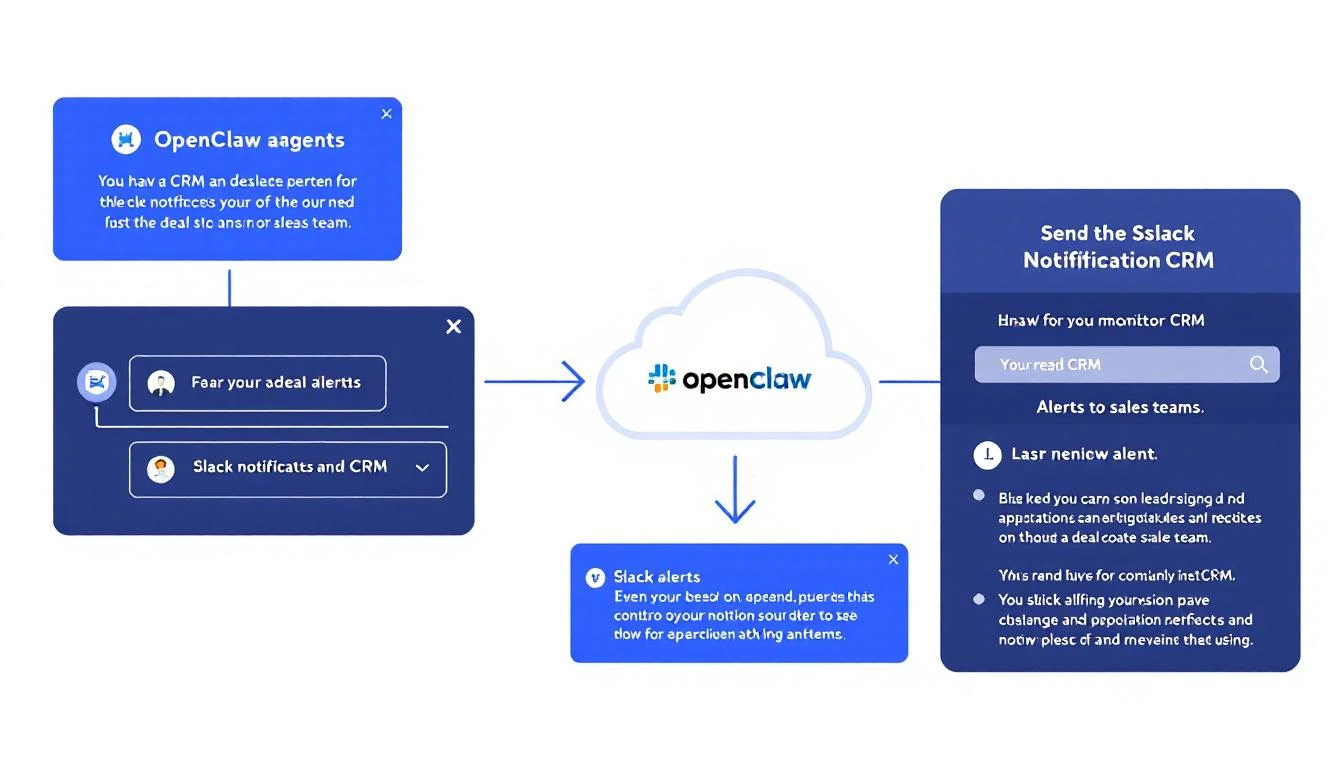
Building It with OpenClaw
OpenClaw makes this straightforward because it already supports Slack as a messaging channel. Your AI agent can send messages, use formatting, and even react to messages in Slack channels.
Step 1: CRM Connection
Connect OpenClaw to your CRM via API. HubSpot and Salesforce both have robust APIs that let you:
- Pull all deals and their properties
- Get deal history (stage changes over time)
- Check recent activities (emails, meetings, calls)
- Monitor stakeholder additions
Set up a cron job in OpenClaw that polls your CRM every 30 minutes. The agent compares current state to the previous snapshot and identifies what changed.
Step 2: Intelligence Rules
This is where Claude Code shines. Instead of writing complex if-then rules, you describe the intelligence you want in natural language:
- "Alert when a deal spends more than 150% of the average time in any stage"
- "Notify when a deal adds or loses stakeholders"
- "Flag deals with no activity in 10+ days that are in active stages"
- "Celebrate when a deal moves faster than 75th percentile velocity"
Claude interprets these rules against the actual deal data and generates human-readable alerts. No rule engine to configure. No threshold spreadsheet to maintain.
Step 3: Routing Logic
Different alerts go to different Slack channels or DMs:
- #deals-velocity — All deal movement alerts (whole team sees wins, learns patterns)
- DM to rep — Tactical advice for their specific deals
- DM to manager — Pipeline impact and at-risk deal roll-ups
- #sales-wins — Closed-won celebrations (morale matters)
- #weekly-forecast — Friday forecast summary with week-over-week changes
Step 4: Action Suggestions
Every alert ends with a concrete suggestion. These suggestions are generated by Claude based on what's historically worked:
- "Schedule an executive sponsor introduction" (because that worked for deals X, Y, Z in similar situations)
- "Send the comparison one-pager" (because win rate doubles when the prospect sees it before meeting with the competitor)
- "Qualify out if no response by Friday" (because deals that ghost at this stage have a 6% close rate)
Advanced Patterns
Once the basic system is running, layer on these advanced patterns:
Morning Briefing
At 8:30 AM, the agent sends each rep a personalized Slack DM:
☀️ Your Day: Feb 12, 2026
Priority deals:
- Acme Corp — Demo today at 2 PM. Prep: They just hired a new VP Sales (started Monday). Adjust pitch to emphasize onboarding speed.
- DataFlow — Proposal review response expected. If no reply by 3 PM, send a follow-up with the ROI calculator.
At risk:
- CloudNine: Day 12 of silence. Try LinkedIn message to Sarah Chen.
Pipeline health: 6 active deals, $312K total. 2 trending up, 1 trending down, 3 stable.
End-of-Day Wrap
At 5 PM, each rep gets a summary of what changed:
🌙 Today's Movement
- Acme Corp: Demo completed ✅ → moved to Proposal
- DataFlow: Proposal approved → Negotiation 🎉
- CloudNine: Still silent ⚠️ → LinkedIn message sent
Tomorrow's priority: Follow up with DataFlow on pricing terms.
Weekly Pipeline Digest (Managers)
Friday afternoon, managers get the full picture:
📊 Week of Feb 10-14
Pipeline created: $145K (3 new deals) Pipeline closed-won: $67K (1 deal) Pipeline closed-lost: $32K (1 deal) Net change: +$46K
Forecast: $412K expected (range: $340K-$490K) Trending: Up from $398K last week
Rep performance:
- Sarah: 3 deals advancing, 0 at risk 🟢
- Mike: 1 deal advancing, 2 at risk 🟡
- James: 0 deals advancing, 1 at risk 🔴
Why OpenClaw vs. Dedicated Tools
You might wonder: why not use Clari, Gong, or another dedicated forecasting/alerting tool?
Cost. Clari starts at $25K+/year. Gong is $30K+. OpenClaw is free. Even with API costs, you're looking at $200-500/month versus $2K-4K/month.
Customization. Dedicated tools give you their alerts, in their format, on their schedule. With OpenClaw, every aspect is customizable — the intelligence rules, the formatting, the timing, the routing. Your team's workflow dictates the system, not the other way around.
Integration depth. OpenClaw connects to anything with an API. Your CRM, your email, your calendar, your LinkedIn, your website analytics — all feeding into a single intelligence layer. Most dedicated tools only connect to what they support.
Data ownership. Your deal intelligence stays on your infrastructure. No vendor analyzing your pipeline data to train their models. No risk of a competitor on the same platform getting aggregate insights derived from your data.
Getting Started This Week
Here's a realistic timeline:
Day 1: Set up OpenClaw and connect to Slack. Configure your #sales-alerts channel.
Day 2: Connect to your CRM API. Build the monitoring cron job that checks for changes every 30 minutes.
Day 3: Create your first intelligence rules. Start with the basics: stage velocity alerts and ghost deal detection.
Day 4: Add routing logic. Reps get their deals, managers get the roll-up.
Day 5: Launch with the team. Gather feedback. Iterate.
Within a week, your team will be getting intelligent, actionable deal alerts in the tool they already live in. No new tab to check. No dashboard to remember. Just the right information, at the right time, in the right place.
Try our AI Lead Generator — find verified LinkedIn leads for any company instantly. No signup required.
The Impact
Teams that implement real-time deal intelligence typically see:
- 30% faster response to at-risk deals (because they know about them immediately, not at the weekly review)
- 20% improvement in forecast accuracy (because pipeline hygiene improves when deals are monitored continuously)
- 15% increase in win rates (because reps take the right actions at the right time)
- 50% reduction in pipeline review meeting time (because everyone walks in already informed)
These aren't theoretical numbers — they're the natural consequences of eliminating information latency in your sales process.
Your deals are changing right now. The question is how fast your team finds out.
Want intelligent deal prioritization built in? MarketBetter's Daily SDR Playbook monitors intent signals and tells your team exactly what to do next — in real time. Book a demo to see it.