
How to Build an AI Sales Hiring Assistant with Claude Code [2026]
Hiring SDRs is broken. The process looks like this: post a job, get 300 resumes, spend 40 hours screening them, phone screen 30 candidates, interview 10, hire 3, watch 1 quit within 90 days. Rinse, repeat.
The average cost of a bad SDR hire is $115,000 when you factor in salary, training, lost pipeline, and the opportunity cost of the seat being occupied by someone who can't sell (Bridge Group, 2025). And most sales teams make 2-3 bad hires per year.
What if AI could screen resumes in minutes instead of hours, generate structured interview scorecards that predict success, and evaluate roleplay responses against your top performers' patterns?
Claude Code — with its 200K token context window and sophisticated reasoning — can do all of this. And when you pair it with OpenClaw for automation, you get a hiring assistant that works 24/7 and gets smarter with every hire.
The SDR Hiring Problem, Quantified
Let's look at why sales hiring needs AI more than almost any other function:
Volume: A single SDR job posting generates 200-500 applications. That's 40-100 hours of screening at 12 minutes per resume.
Speed: Top sales candidates are off the market in 10 days (LinkedIn). If your screening process takes 2 weeks, you're losing the best people before you even talk to them.
Accuracy: Hiring managers predict SDR success correctly only 50% of the time (Harvard Business Review). That's a coin flip. And it's not because they're bad at hiring — it's because resumes and interviews are terrible predictors of sales ability.
Bias: "Culture fit" interviews favor people who look and sound like the interviewer. This misses diverse candidates who might outperform homogeneous teams.
Consistency: When you interview 10 candidates over 2 weeks, candidate #1 gets a different experience than candidate #10. Your evaluation criteria drift. Your energy changes. AI doesn't get tired on Friday afternoon.
What Claude Code Can Do for Sales Hiring
1. Resume Screening (Minutes, Not Hours)
Traditional resume screening is pattern matching: look for keywords, check for years of experience, scan for brand-name companies. Claude Code goes deeper.
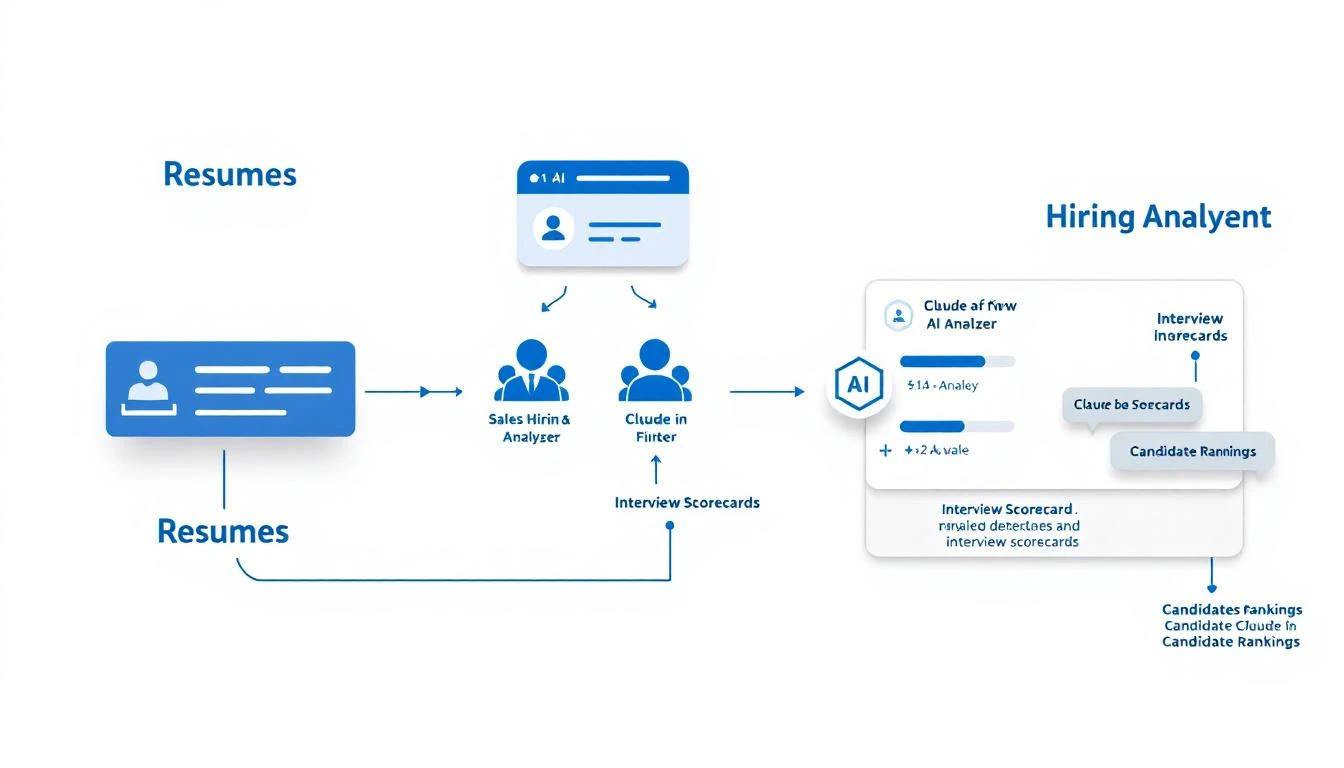
Feed Claude your job description, your team's performance data, and a stack of resumes. It evaluates each candidate on criteria that actually predict SDR success:
Coachability Indicators:
- Career progression (did they advance, or lateral-move?)
- Variety of experiences (shows adaptability)
- Education in non-obvious fields (English majors often make great SDRs)
- Volunteer or extracurricular leadership
Hustle Signals:
- Multiple roles or side projects
- Self-initiated achievements (started a club, built something, organized an event)
- Metrics in resume ("increased by X%," "generated $Y")
- Sales-adjacent experience (fundraising, customer service, retail)
Red Flags:
- Job hopping without upward movement
- Vague descriptions without metrics
- Overly corporate language (usually copied from job descriptions)
- No evidence of initiative or self-direction
Claude doesn't just rank candidates 1-10. It provides a written brief on each, explaining WHY they might succeed or struggle, based on patterns from your existing team's performance data.
2. Interview Scorecard Generation
Most sales interviews are unstructured conversations where the hiring manager "goes with their gut." This approach has a 0.20 correlation with job performance — barely better than random (Schmidt & Hunter meta-analysis).
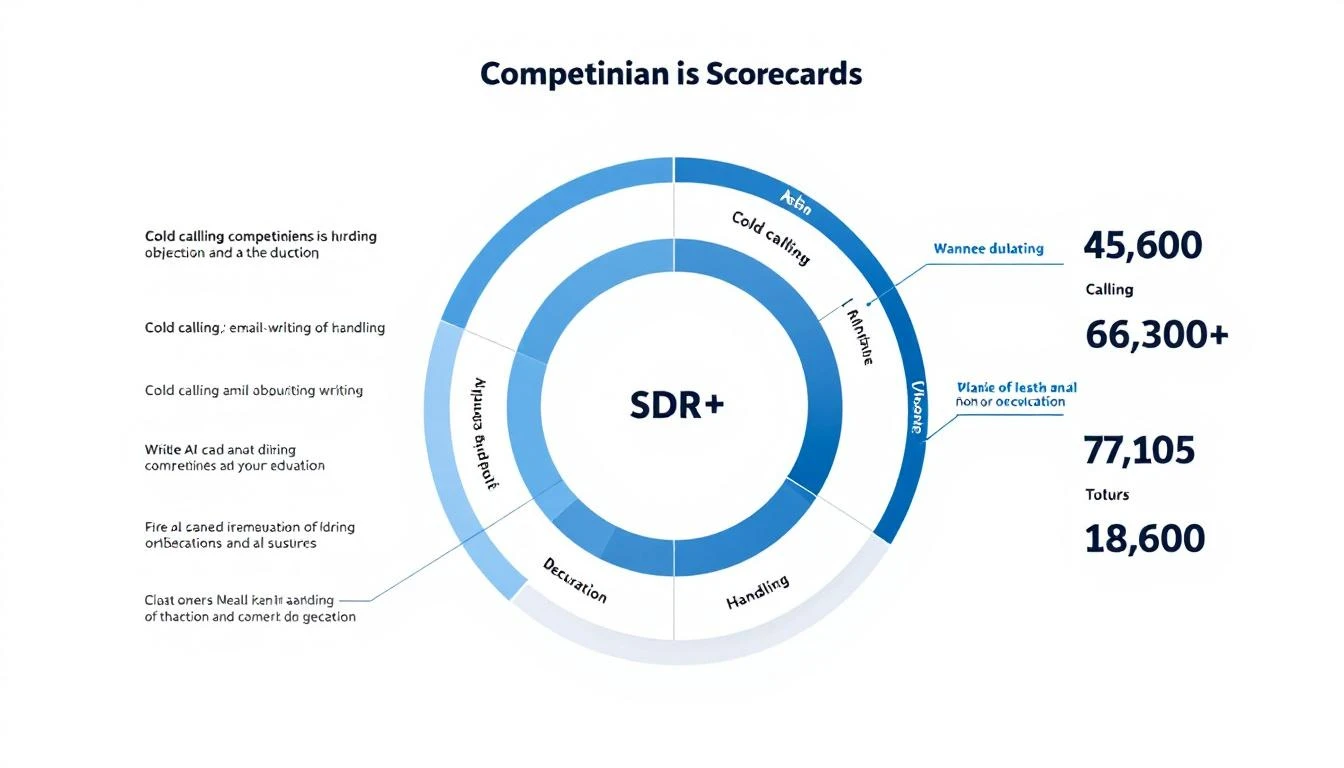
Structured interviews with standardized scorecards have a 0.44 correlation — more than double. Claude Code generates these scorecards customized to your specific role:
For a Cold-Calling SDR:
- Resilience assessment (behavioral questions about handling rejection)
- Curiosity measurement (how they research, learn, and prepare)
- Communication speed and clarity
- Competitive drive indicators
- Time management and self-organization
For an Inbound SDR:
- Active listening assessment
- Qualification methodology understanding
- Urgency creation without pressure
- Product comprehension speed
- Multi-tasking ability
Each scorecard includes:
- The exact questions to ask
- What a "strong" vs. "average" vs. "weak" answer looks like
- Follow-up probes for vague responses
- A numerical scoring rubric
This ensures every candidate gets evaluated on the same criteria, regardless of which interviewer they meet or what day of the week it is.
3. Roleplay Evaluation
Here's where Claude Code really shines. Sales roleplay is the single best predictor of SDR success, but evaluating it is subjective and inconsistent.
Your AI hiring assistant can:
Generate Roleplay Scenarios: Based on your actual ICP and product, Claude creates realistic scenarios:
- Cold call to a skeptical VP
- Discovery call with a chatty but non-committal prospect
- Objection handling when the prospect says "we're happy with our current tool"
- Follow-up call after a ghosted email
Evaluate Responses: When candidates submit recorded roleplays (or the transcript from a live roleplay), Claude analyzes:
- Opening hook quality
- Question depth and relevance
- Active listening indicators
- Objection handling technique
- Next-step commitment
- Tone and confidence level
- Comparison to your top performers' patterns
Calibrate Against Top Performers: Feed Claude transcripts from your best SDRs' calls. It learns what "great" sounds like for YOUR team and product. Then it evaluates candidates against that benchmark, not a generic "good sales" standard.
4. Predictive Success Scoring
This is the advanced play. If you have 12+ months of hiring data (who you hired, how they performed, who churned), Claude Code can identify the patterns that predict success at YOUR company.
Maybe your best SDRs all played team sports. Maybe they all had customer service experience. Maybe the candidates who asked the most questions in THEIR interview outperformed those who answered perfectly.
Claude analyzes your historical data and builds a predictive model specific to your team. Not "what makes a good SDR generally" — what makes a good SDR HERE.
The Full Workflow with OpenClaw
Automated Pipeline:
Day 0: Application Received → OpenClaw webhook catches new application → Claude screens resume against criteria → Candidate scored and categorized: Pass / Maybe / Reject → Pass candidates receive automated scheduling link within 1 hour
Day 1: Phone Screen → Interviewer uses Claude-generated scorecard → Scores entered into system → If score > threshold: auto-schedule next round → If below: personalized rejection email drafted
Day 3: Roleplay Assessment → Candidate receives roleplay scenario (AI-generated) → Submits recorded response → Claude evaluates against top-performer benchmark → Detailed evaluation shared with hiring manager
Day 5: Final Interview → Hiring manager receives full candidate brief:
- Resume analysis
- Phone screen scorecard
- Roleplay evaluation
- Predictive success score
- Recommended focus areas for final interview
Day 7: Offer Decision → All data compiled into decision-ready format → Side-by-side candidate comparison → AI recommendation with confidence level
Total time: 7 days from application to offer. Compare that to the industry average of 36 days for sales roles.
Results: AI-Assisted vs. Traditional Hiring
| Metric | Traditional | AI-Assisted | Improvement |
|---|---|---|---|
| Time to screen 100 resumes | 20 hours | 30 minutes | 97% faster |
| Time from application to offer | 30-45 days | 7-10 days | 75% faster |
| Interview-to-hire ratio | 10:1 | 4:1 | 2.5x more efficient |
| 90-day retention | 65-70% | 85-90% | 20+ points |
| Ramp time to quota | 4-6 months | 3-4 months | 30% faster |
| Cost per hire | $8-12K | $3-5K | 60% reduction |
| Diversity of candidate pool | Baseline | +25-35% | Structured = fairer |
The 90-day retention improvement alone justifies the system. One fewer bad hire per year saves $115K.
Ethical Considerations
AI in hiring raises legitimate concerns. Here's how to address them:
Bias Auditing: Run your AI screening against historical data. If it systematically scores any demographic group lower, the training data has bias that needs correction. Claude Code can self-audit: ask it to check its evaluations for demographic patterns.
Human Final Decision: AI screens, scores, and recommends. Humans decide. Never let AI make a hire/no-hire decision autonomously.
Transparency: Tell candidates that AI assists in resume screening. Most candidates prefer fast, structured processes over slow, subjective ones.
Appeals Process: Any candidate rejected by AI screening should have a path to request human review.
Regular Calibration: Compare AI predictions against actual performance quarterly. Retrain the model when predictions diverge from reality.
Claude Code vs. Hiring Tools
How does this compare to dedicated hiring platforms?
| Feature | Claude + OpenClaw | Lever/Greenhouse/BambooHR |
|---|---|---|
| Resume screening AI | ✅ Claude (best-in-class) | ⚠️ Basic keyword matching |
| Custom scorecards | ✅ AI-generated per role | ✅ Template-based |
| Roleplay evaluation | ✅ Deep analysis | ❌ Not available |
| Predictive scoring | ✅ Custom to your team | ⚠️ Generic models |
| Interview scheduling | ⚠️ Via integrations | ✅ Native |
| ATS functionality | ❌ Not an ATS | ✅ Full ATS |
| Cost | Free (self-hosted) | $5-15K/year |
The smart play: Use your ATS for the pipeline management and scheduling. Use Claude + OpenClaw for the intelligence layer — screening, scoring, evaluation, and prediction. They complement each other.
Getting Started
-
This Week: Document what makes your top SDRs successful. Interview your best performers. What did their resume look like? What did they do differently in interviews?
-
Next Week: Feed this data to Claude Code and build your screening criteria and scorecard templates.
-
Week 3: Test the system on your next 20 applicants alongside your normal process. Compare results.
-
Month 2: Go live with AI-assisted screening for all SDR applications.
-
Quarter 2: Add roleplay evaluation and predictive scoring as you accumulate performance data.
Try our AI Lead Generator — find verified LinkedIn leads for any company instantly. No signup required.
How MarketBetter Connects
A great SDR with bad tools is still a struggling SDR. MarketBetter's Daily SDR Playbook means your new hires ramp faster because the platform tells them exactly who to call, what to say, and when to reach out.
Combined with AI-powered hiring, you get the right people in the seats AND the right tools in their hands. That's how you build a sales machine.
Ready to arm your SDR team with AI-powered playbooks? Book a demo and see how MarketBetter gets new reps productive faster.
Related reading: