
Lead Generation for SaaS: The Definitive Playbook for Faster Growth
Welcome to the definitive playbook for building a high-performance lead generation engine. This isn't theory; it's a field guide for the modern SaaS landscape. We're going to show you how to blend inbound, outbound, and product-led strategies to build a pipeline you can actually count on.
The Modern SaaS Lead Generation Playbook
Forget what you think you know about SaaS lead generation. It's no longer just about cramming leads into the top of your funnel.
In a world where buyers have done their homework before they ever talk to you and competition is absolutely ruthless, the old playbook is broken. Blasting out cold emails and running generic ads just doesn't cut it anymore. What works today is a smarter, integrated system—a true engine that blends multiple strategies to create a predictable pipeline, not just a messy contact list.
This means you have to ditch the idea of a simple, linear "funnel." Buyers don't walk a straight line. They bounce between channels, do their own research, and engage when they're ready. The only way to win is to meet them where they are, whether that’s with a genuinely helpful blog post, a smooth product trial, or a perfectly timed, relevant outreach message. To really get this right, you need to understand the detailed approaches for lead generation for B2B SaaS and what makes this market unique.
Comparing Key Lead Generation Models
At the core of any great strategy is the right mix of models. Each one has its own strengths, and they fit different company growth stages and customer types. Let's compare the three core models so you can decide which to prioritize.
-
Inbound & Content-Led: This is your magnet. It's all about creating high-value content—blogs, webinars, SEO-optimized guides—that pulls in prospects who are actively looking for answers. This is a long-term play that builds incredible brand authority and generates high-intent leads, but you have to be patient. Actionable Step: Start by identifying the top 10 questions your ideal customers ask during sales calls. Turn each answer into a detailed blog post or a short video.
-
Outbound & Sales-Led: This is your proactive, spear-fishing approach. Your team directly targets and engages potential customers who are a perfect match for your Ideal Customer Profile (ICP). It’s the fastest way to land high-value accounts or break into a new market. The real challenge? Making your outreach feel personal and valuable, not like another piece of spam. Actionable Step: Create a list of 25 "dream accounts" that fit your ICP perfectly. Task your sales team with researching a key contact at each and initiating a hyper-personalized outreach sequence this week.
-
Product-Led Growth (PLG): In this model, the product does the selling. Users sign up for a free trial or a freemium plan, and their actions inside the product tell you if they're a qualified lead. PLG is incredibly powerful because it proves your product’s value upfront. But it only works if your product is intuitive and delivers a "wow" moment quickly. Actionable Step: Identify the one feature in your product that delivers the most value to new users. Rework your onboarding flow to guide every new sign-up to that "aha!" moment as quickly as possible.
The best SaaS companies don't just pick one strategy; they build a hybrid engine. An inbound lead from a webinar might get dropped into a personalized outbound sequence. A highly engaged freemium user might get a call from an SDR. It’s this smart integration that creates a pipeline that’s truly built to last.
To build a balanced strategy, you need to understand the tradeoffs between the most common lead generation channels. This table breaks down what you can expect from each one.
SaaS Lead Generation Channel Mix Comparison
A comparison of the most effective SaaS lead generation channels, evaluating their typical lead quality, cost, and primary use case to help you build a balanced strategy.
| Channel | Typical Lead Quality | Relative Cost (CAC) | Best For |
|---|---|---|---|
| Inbound & SEO | High | Low to Medium | Building a sustainable, long-term pipeline with high-intent prospects. |
| Paid Ads | Varies | Medium to High | Generating immediate traffic and targeting specific demographics quickly. |
| Outbound Sales | High (if targeted) | High | Reaching high-value enterprise accounts and getting immediate market feedback. |
| Product-Led (PLG) | Very High | Low | Companies with a self-serve product and a large potential user base. |
Ultimately, your channel mix will evolve. What works for a seed-stage startup trying to find product-market fit will be different from a scale-up aiming for market leadership. The key is to start with a balanced approach, measure everything, and be ready to double down on what's actually driving revenue.
Defining Your Ideal Customer Profile
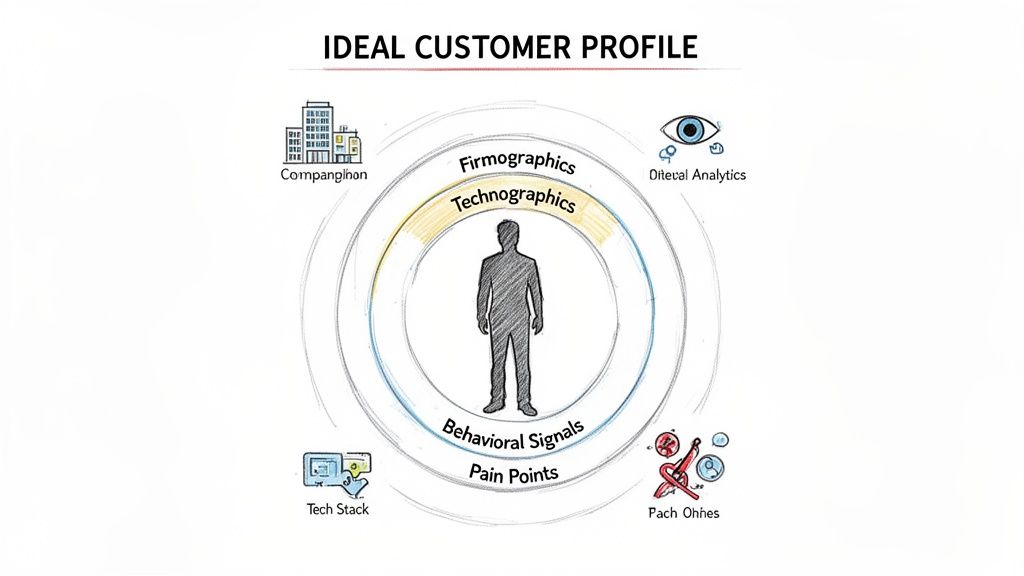
Before a single email gets sent or one call is dialed, every solid SaaS lead gen strategy has to start with a foundational question: who are we really selling to?
Forget the generic buyer personas with fluffy, irrelevant details. The answer lies in building a data-driven Ideal Customer Profile (ICP). This isn't just another document to file away; it's a living, breathing definition of the perfect-fit company for your product.
A well-defined ICP is the line in the sand between a high-volume, low-quality outreach motion and a targeted, efficient sales engine that actually books qualified meetings. The goal is to make your profile so sharp that any SDR can instantly spot a high-value account and know exactly how to tailor their pitch. This clarity stops you from wasting time on companies that were never going to buy, no matter how good your demo is.
Beyond Basic Firmographics
Most teams check the box on their ICP by listing firmographics—company size, industry, location. That’s a start, but it’s nowhere near enough. Real precision comes from layering in other data points that signal actual intent and need.
Let’s say you sell a project management tool. Targeting "all tech companies with 50-200 employees" is just shouting into the void. A powerful ICP gets way more specific.
- Firmographics (The Basics): B2B tech companies in North America with 50-200 employees.
- Technographics (Their Tech Stack): They use Slack, Jira, and HubSpot. This tells you they’re already invested in modern, collaborative software, making them a much better fit than a company running on spreadsheets and legacy tools.
- Behavioral Signals (Their Actions): Someone from the company hit your pricing page twice this week, and another downloaded your "Ultimate Guide to Agile Workflows." These are huge indicators of active buying intent.
This layered approach transforms a vague target into a high-probability opportunity. You're no longer guessing; you're acting on real signals that point to a real problem you can solve.
Uncovering Deeper Insights With Data
Pinpointing these technographic and behavioral signals isn't magic. It just requires the right tools and a process for digging into the data. To really sharpen your ICP, using data enrichment tools can be a game-changer by filling in the gaps in what you know.
For instance, you can fire up LinkedIn Sales Navigator to filter companies not just by size and industry but also by hiring trends. A company that’s rapidly hiring software engineers is almost certainly facing project management headaches—a perfect trigger for your outreach.
Actionable Step: Spend one hour this week analyzing your top 10 best customers. Identify three commonalities in their tech stack (e.g., they all use Marketo) and one behavioral trigger that preceded their purchase (e.g., they just hired a new VP of Marketing). Add these criteria to your ICP document immediately.
Ultimately, a sharp ICP is the GPS for your entire GTM team. It dictates your content, focuses your ad targeting, and guides your SDRs' daily grind. Without it, you’re just driving blind. With it, every action is deliberate and aimed at landing customers who won't just buy—they'll succeed.
Building Your Inbound and Content Engine
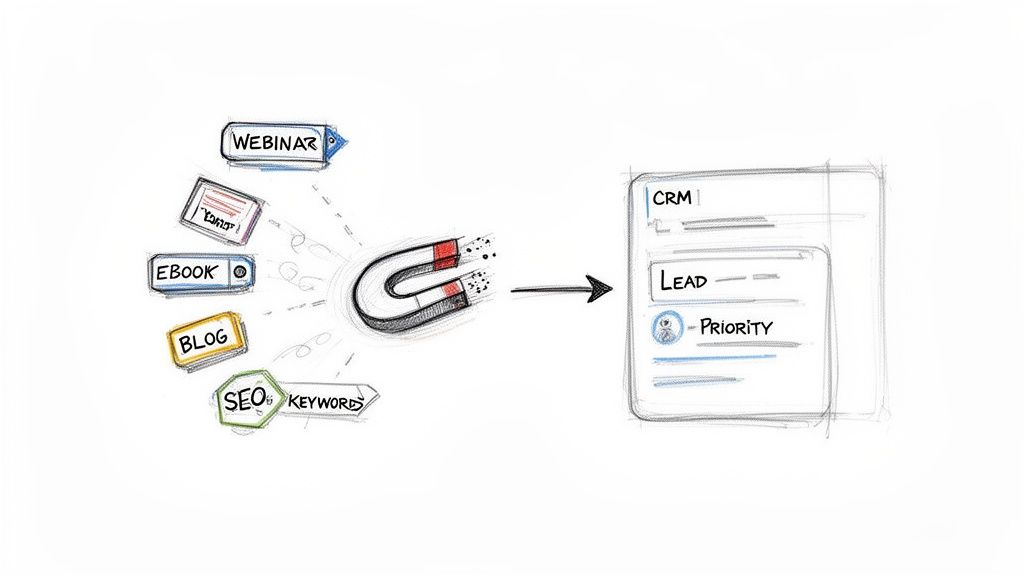
While a sharp outbound strategy gives you control over who you talk to, a smart inbound engine is the magnet that pulls your best-fit customers toward you. This is especially true when they're already out there, actively looking for a solution to their problem.
This isn’t about just churning out blog posts and hoping for the best. It’s about building a system that attracts the right people, captures their interest, and—most importantly—signals exactly when they’re ready for a sales conversation.
In the SaaS world, content marketing isn't just a "nice-to-have." It consistently drives about three times more marketing qualified leads (MQLs) than old-school outbound calling. SEO leads, in particular, are gold, with 35% of companies citing them as their highest-performing source. You can dig into more detailed industry statistics on your own time, but the takeaway is clear.
The game has changed. Your content can't just inform; it has to be a finely tuned instrument for converting passive interest into real sales intelligence.
Creating Content That Actually Generates Leads
The heart of any inbound strategy that works is content that speaks directly to the headaches and goals of your Ideal Customer Profile (ICP). Generic, top-of-funnel fluff has its place for brand awareness, but the real power in lead generation for SaaS comes from content built for prospects who are much deeper in their buying journey.
Forget another high-level "what is" post. Your focus should be on creating assets that help prospects solve a very specific problem or make a critical decision. This is where you elegantly connect your content to your product’s value without it feeling like a cheap sales pitch.
Let's compare two content approaches for a financial forecasting software company:
- The Generic Play (Low Intent): Write an article called "5 Tips for Better Financial Planning." This is too broad. It will attract a massive, low-intent audience of students, small business owners, and everyone in between, resulting in low conversion rates.
- The Targeted Play (High Intent): Create an article titled "How to Build a Rolling Forecast Model in Excel (With Free Template)." This title targets someone actively wrestling with a painful, manual task that your software just so happens to automate.
The second approach pulls in a lead who is infinitely more qualified. The person downloading that Excel template is practically raising their hand and shouting, "I have this exact problem right now!"
The best content isn’t measured by traffic alone; it’s measured by the intent it uncovers. Every asset you create should have a clear job, whether that’s educating a buyer, helping them compare solutions, or giving them a tool that solves an immediate pain.
From Content Engagement to a Sales Play
Getting someone to your site is just step one. To turn that inbound interest into actual pipeline, you need a slick way to capture their info and a process to act on it—fast. This is where compelling lead magnets and clear conversion paths are non-negotiable.
Why Actionable Lead Magnets Beat Passive Content
A lead magnet is simply a valuable resource you offer up in exchange for an email address. The trick is making the offer completely irresistible to your ICP. For a deeper dive, check out our guide on generating inbound leads.
Here’s a quick comparison of common lead magnets and where they fit:
| Lead Magnet Type | Best For | Why It Works |
|---|---|---|
| Webinars | Demonstrating complex solutions and engaging mid-funnel prospects. | Puts your experts front and center and allows for live Q&A, which builds trust and shows off your product’s real-world value. |
| Whitepapers & Ebooks | Educating prospects on industry trends and establishing you as a thought leader. | Perfect for buyers in the research phase who need deep, credible information to justify a purchase internally. |
| Templates & Checklists | Capturing high-intent leads who are trying to solve a problem right now. | Offers immediate, hands-on value and is directly tied to a pain point your product solves. This is a massive buying signal. |
| ROI Calculators | Targeting bottom-of-funnel prospects who need to build a business case. | Helps your champion quantify the value of your solution, making it much easier to get budget approval from their boss. |
But here’s the crucial part: the handoff from marketing to sales has to be airtight. Actionable Step: Set up an automation rule in your CRM. When a lead downloads a high-intent asset (like a template or ROI calculator), automatically create a "High Priority Follow-Up" task for the assigned SDR, due within 2 hours. This ensures you act on buying signals immediately.
Activating Your Outbound and Social Selling
While your inbound engine is busy attracting leads, a sharp outbound strategy is how you go after your perfect-fit, high-value accounts. It puts you in the driver’s seat. You’re not waiting for them to find you; you’re engaging them long before they even start their search.
This isn’t about blasting generic emails into the void. We're talking about a modern, scalable motion built on relevance and precision.
A winning outbound plan is never single-threaded. It’s a blend of multiple touchpoints, recognizing that decision-makers live across different platforms. The real trick is knowing where each channel shines and making them work together.
Comparing Your Primary Outbound Channels
Your channel mix should be a direct reflection of your ICP and the story you need to tell. A quick look at the main players reveals some clear strengths and weaknesses.
| Channel | Key Advantage | Best For | Potential Downside |
|---|---|---|---|
| Cold Email | Scalability and directness. It's a cost-effective way to reach a large, defined audience fast. | Delivering a concise, value-driven message to specific personas within your target accounts. | It's an incredibly crowded space. You'll see low reply rates without exceptional personalization. |
| Social Selling (LinkedIn) | Unmatched targeting and context. You can see a prospect's role, recent activity, and connections in a glance. | Building credibility and warming up contacts before you ever send an email or make a call. | It's time-intensive. To be effective, you need consistent, non-salesy engagement. |
| Cold Calling | Immediate feedback and human connection. It's hands-down the fastest way to have a real conversation. | High-value accounts where you need to unpack a complex problem or build a strong relationship from the start. | Connect rates can be painfully low, and it feels intrusive if not handled with skill. |
For most SaaS teams I've worked with, the sweet spot is an integrated sequence. Think of it like this: a light social touch on LinkedIn precedes a highly personalized email, which is then followed by a well-timed call.
Why LinkedIn Dominates B2B SaaS Prospecting
When it comes to social selling, one platform stands head and shoulders above the rest for B2B SaaS. Research shows LinkedIn is a staggering 277% more effective for generating leads than platforms like Facebook or X.
It’s no surprise that 40% of B2B marketers see it as their top channel for high-quality leads. This is partly because LinkedIn's own Lead Gen Forms boast a 13% conversion rate—a huge jump from the typical 2.35% for website landing pages—by keeping users right inside the app. If you want to dive deeper, there are some great stats on LinkedIn's lead generation power.
But the platform’s real magic is the context it gives you. You can join the same groups your ICP uses to talk about their challenges, see who’s engaging with your competitors, and spot key decision-makers who just changed jobs—a classic buying trigger.
Actionable Step: Identify the top 3 LinkedIn groups where your ICP congregates. Have your SDRs spend 15 minutes each day contributing valuable comments (not pitches) to relevant discussions. This builds familiarity and credibility before the first outreach.
The Art of the Modern Cold Email
While LinkedIn is for warming up the conversation, email is where you make your direct, compelling ask. The problem? Most cold emails are awful. They’re long, self-serving, and get deleted on sight.
The secret to getting replies is making the message about them, not you.
This is where AI-powered tools are completely changing the game. Instead of just spinning tired templates, modern platforms analyze your prospect’s company data, their persona, and recent market signals to generate a context-aware first draft. This doesn’t replace your SDRs; it augments them. The AI handles 80% of the research and drafting, freeing up your reps to nail that final 20% of personalization that makes an email feel genuine.
For a more comprehensive look at these tactics, check out our guide on building a powerful outbound lead gen strategy.
Tying It All Together in Your CRM
A solid outbound motion can fall apart without a clean workflow. If your reps are manually logging calls, copy-pasting email templates, and trying to remember their LinkedIn activity, you're not just losing hours to admin work—your data is becoming a mess.
This is where true CRM integration becomes non-negotiable. Picture this flow:
- A prospect from a target account likes your company's latest LinkedIn post.
- This engagement acts as a trigger, instantly creating a prioritized task in your SDR's CRM queue.
- The task pops up with the context of their LinkedIn activity and an AI-generated email draft already tailored to that prospect.
- Your SDR adds a human touch, hits send, and the entire activity is auto-logged back to the contact record in Salesforce or HubSpot.
This kind of closed-loop system kills friction, ensures your data stays pristine, and lets your team focus on what they do best: building relationships and booking meetings.
Nailing the SDR Execution Workflow
Even the most brilliant strategy for lead generation for SaaS falls flat without sharp execution. This is where your Sales Development Reps (SDRs) step onto the stage. Their daily workflow is the engine that turns your target accounts and all those marketing signals into actual, qualified meetings for the sales team.
Let's be real: without a structured process, SDRs drown. They waste hours just trying to figure out the "next best action" instead of actually engaging prospects. A disciplined execution workflow isn't about micromanaging them; it's about empowering them. It gives reps the clarity to focus on high-value conversations, not just busywork.
This is the high-level flow of a modern outbound motion. It’s simple but powerful.
The key takeaway here is how automation connects the dots. It’s the glue between targeting and engagement, creating a system you can actually repeat and scale.
Prioritizing Tasks for Maximum Impact
An SDR's day is a constant battle for their attention. They’ve got hundreds of leads, a dozen high-priority accounts, and alerts firing off from every direction. The single biggest drain on their productivity is simply deciding what to do next.
This is why an intelligent task engine is no longer a nice-to-have. Instead of just handing reps a static list of contacts to call, a modern workflow should automatically prioritize their tasks by blending different data points.
- Account Fit: How closely does this company really match your Ideal Customer Profile (ICP)?
- Buyer Intent Signals: Did someone from the account just binge-read three blog posts or visit your pricing page?
- Engagement History: Has this person opened your last three emails but never once replied? That's a signal.
By scoring and ranking these signals, the system can serve up the "next best action" with all the context needed. The SDR no longer has to guess; they can just execute.
Designing a Multi-Touch Sales Sequence
If you're still relying on a single channel, you're setting yourself up to fail. A single cold email gets lost in the noise. A single cold call is easily ignored. Effective outreach is a carefully orchestrated sequence, using multiple channels to build familiarity and deliver a consistent message over time.
A solid sequence might run for two or three weeks and include a mix of automated emails and manual, human touches.
Example Multi-Touch Sequence
| Day | Channel | Action |
|---|---|---|
| Day 1 | View their profile and send a simple, non-pitchy connection request. | |
| Day 2 | Send a highly personalized email that references a specific trigger (like a company announcement or a recent LinkedIn post). | |
| Day 4 | Phone | Make a quick intro call. The goal isn't to sell; it's to validate their role and see if you can confirm a pain point. |
| Day 7 | Follow up with a valuable resource—maybe a case study from a similar company in their industry. | |
| Day 10 | Engage with something they shared or commented on. Show you're paying attention. | |
| Day 12 | Phone & Email | Make one last call. If no answer, send a respectful "breakup" email to close the loop cleanly. |
Actionable Step: Build this exact 12-day sequence in your sales engagement platform. Create templates for each email step and a short script for the calls. Enroll 10 new high-value prospects into this sequence and track the response rate compared to your old single-channel approach.
Transforming Call Preparation With AI
One of the biggest time-sucks for any SDR is prepping for calls. Manually digging through a company's website, recent press releases, and the prospect's LinkedIn profile can easily eat up 15-20 minutes for a single call. When you try to do that at scale, all that admin work just kills productivity.
This is where AI gives your team massive leverage. Instead of reps doing the grunt work, an AI-powered system can surface the most important talking points just seconds before a call.
Imagine an SDR clicks to dial a prospect. A screen instantly pops up showing:
- Recent Company News: "They just announced a Series B funding round to expand into Europe."
- Key Talking Points: "Mention how our platform helps with international compliance."
- Common Objections: "They might say they're happy with their current vendor; here's how to respond."
This doesn't just save time; it fundamentally improves the quality of the conversation. Reps sound more informed, confident, and relevant—which leads directly to more meetings booked.
The Power of an Integrated Dialer
The final piece of this execution puzzle is connecting the phone directly to your CRM. If your reps are dialing from their cell phones or a separate app, you're creating two huge problems: friction and data loss. They have to manually log every call, every outcome, and every note—a step that gets skipped the second things get busy.
An integrated dialer that lives inside your CRM, like Salesforce or HubSpot, solves this instantly. With click-to-dial functionality, reps can launch calls straight from a contact record. Better yet, when the call ends, a window prompts them to log the outcome ("Connected," "Left Voicemail") and add notes, which are automatically saved to the record.
This seamless workflow keeps reps focused on what they do best—talking to prospects—not on administrative data entry. It also guarantees that every single touchpoint gets logged, giving leadership a clean, accurate view of team activity. This is crucial, as optimizing follow-up is a top priority for accelerating lead velocity. In fact, 40% of SaaS companies identify it as their number one tactic. You can dig into more of these impactful lead generation statistics to see how they affect sales pipelines.
Measuring Performance and Optimizing Your Strategy
You can't fix what you can't see. A lead generation plan looks great on a whiteboard, but it's useless if you can’t tell what’s actually working versus what’s just burning cash. This is the final, non-negotiable piece of the puzzle: setting up a framework to measure what truly matters.
This isn’t about chasing vanity metrics like total leads or email open rates. Sure, they're interesting, but they don’t pay the bills. The real goal is to draw a straight, undeniable line from your team's daily grind to the closed-won deals that grow the business.
From Vanity Metrics to Revenue KPIs
If you want to get a real pulse on your lead gen health, you have to track the numbers that speak to efficiency, speed, and quality. These are the metrics that should live on your sales dashboard and drive the conversation in every single weekly meeting. They tell the story of how well your effort is turning into actual pipeline.
Forget the fluff. Zero in on these key performance indicators:
- MQL-to-SQL Conversion Rate: This is it. This is the ultimate test of lead quality and the alignment between your marketing and sales teams. If this number is low, it’s a massive red flag that your definition of a “good lead” is flat-out wrong.
- Pipeline Velocity: How fast are deals moving from that first touchpoint to a signed contract? A slow velocity is a sign of friction somewhere in your sales process. Or, it could mean you're targeting prospects who just don't have enough urgency to buy.
- Cost Per Qualified Lead (CPQL): This blows the generic Cost Per Lead (CPL) out of the water. CPQL tells you exactly how much you're spending to generate a lead that your sales team actually accepts and puts time into.
Here's a hard truth: the most critical piece of this entire puzzle is clean data. If your reps aren't logging every call, email, and social touch, your reports are pure fiction. This is exactly why auto-logging activities from integrated sales tools isn't a "nice-to-have"—it's an absolute must.
Building Actionable Dashboards in Your CRM
Your CRM should be a command center, not a data graveyard. The best way to keep your team laser-focused on the numbers that matter is by building simple, visual dashboards. For a much deeper dive on what to track, check out our complete guide on the most important KPIs for lead generation.
When you compare your key channels side-by-side on a dashboard, it becomes instantly obvious where you need to double down and where you need to pull back.
Example Channel Performance Snapshot
| Channel | MQLs this Quarter | MQL-to-SQL Rate | Avg. Deal Size |
|---|---|---|---|
| Outbound Email | 120 | 25% | $15,000 |
| Inbound (SEO) | 85 | 45% | $12,500 |
| Paid Ads | 210 | 8% | $9,000 |
A simple view like this tells a powerful story. Right away, you can see that while paid ads are driving volume, the leads from inbound are far higher quality. You can also see that your outbound efforts are landing bigger deals. Armed with this data, you can now make smart decisions, like shifting budget from paid ads to SEO or building a new outbound sequence that targets the ICP that's proving most successful.
Got Questions? Here Are Some Straight Answers
You're not the first person to ask these. Let's clear up a few common questions that pop up when building a modern SaaS lead gen machine.
What’s the Single Best Lead Generation Channel for SaaS?
Everyone wants the one magic bullet, but it just doesn't exist. The real answer is that the best strategy for lead generation for SaaS is a smart mix of channels working together. Think of it this way: content marketing and SEO are fantastic for pulling in a steady flow of high-quality inbound leads—people who already know they have a problem and are actively looking for a solution.
On the other hand, for surgically precise outbound prospecting in B2B, LinkedIn is still king. It lets you zero in on your exact ICP like no other platform.
But the real magic happens when you connect the dots. Imagine a prospect downloads one of your whitepapers (an inbound signal). Instead of just sitting in a database, that action instantly kicks off a personalized, multi-touch outbound sequence. That’s how you turn a flicker of passive interest into a real sales conversation.
How Do I Use AI for My SDRs Without Them Sounding Like Robots?
This is a huge, valid concern. The goal of modern AI isn't to replace your reps; it's to give them superpowers. It acts as a co-pilot, not the pilot. Instead of spitting out generic, soulless emails, a good AI tool analyzes account data, digs into the persona, and flags recent intent signals to draft a sharp, relevant first email.
From there, your SDR takes over. They review it, add their human touch, inject their personality, and hit send. For calls, AI can serve up real-time talking points or smart ways to handle objections. This whole approach shaves hours off the soul-crushing manual prep work, freeing up your reps to do what they do best: have better, more human conversations. You end up with both higher quantity and higher quality outreach.
My Team Hates Logging Activities in the CRM. How Do I Fix This?
You’ve hit on one of the most common—and critical—problems in sales operations. The root cause is almost always workflow friction. If your reps are constantly jumping between their dialer, their email client, and the CRM, logging activities will always be the first thing they skip when they get busy.
The most practical fix is to bring the tools to the reps, right inside the CRM. When you use a platform that has a native dialer for Salesforce or HubSpot, activities get logged automatically the second a call or email is done. This doesn't just solve your adoption problem; it gives leadership the clean, accurate data you need to actually see what's working. You have to make doing the right thing the easiest thing to do.
Ready to cut the busywork and give your SDRs a workflow that actually works? marketbetter.ai translates buyer signals into a prioritized to-do list and helps your team execute flawlessly with an AI-powered dialer and email writer that lives right inside Salesforce and HubSpot.
See how you can build a consistent, high-performing outbound motion at https://www.marketbetter.ai.