
Email Marketing to Generate Leads a B2B Playbook
When it comes to building a predictable B2B sales pipeline, using email marketing to generate leads is still the most reliable play in the book. It consistently crushes almost every other channel on ROI, transforming what used to be a manual outreach grind into a high-performance system that drives revenue without burning out your team.
Why Email Is Your B2B Lead Generation Engine
In a world overflowing with marketing channels, email is the undisputed workhorse. Social media and paid ads get all the hype, but email gives you a direct, owned channel to your prospects. You're not at the mercy of some algorithm's mood swing or skyrocketing ad costs. It’s the engine that powers predictable pipeline growth.
Let's be real—the main problem for modern sales teams isn't a shortage of potential leads. It's the soul-crushing manual work it takes to actually engage them. This is where a smart, automated email strategy completely changes the game. We're not talking about sending a monthly newsletter. We're talking about building a system that turns your CRM into a powerful task engine that works for you.
Comparing Lead Generation Channels
When you stack email up against the other usual suspects, the numbers make the decision for you. Email consistently outperforms paid media and events, both in cost and in return.
The data is pretty clear: multiple studies across different industries put email marketing’s average ROI somewhere between $36 and $40 in revenue for every single dollar you spend. That's a massive 3,600%–4,000% return.
Now, look at the alternatives. The typical cost per lead for Google Ads has crept up to around $70.11. That's a big reason demand gen teams are leaning so heavily on owned channels like email to keep customer acquisition costs from spiraling. And events? They’re in another league entirely, averaging an eye-watering $811 per lead, making them nearly 10–20 times more expensive. You can dig into more email marketing ROI statistics on porchgroupmedia.com if you want to see the full picture.
This process isn't complicated. It's about a smart, initial investment that pays dividends over and over.
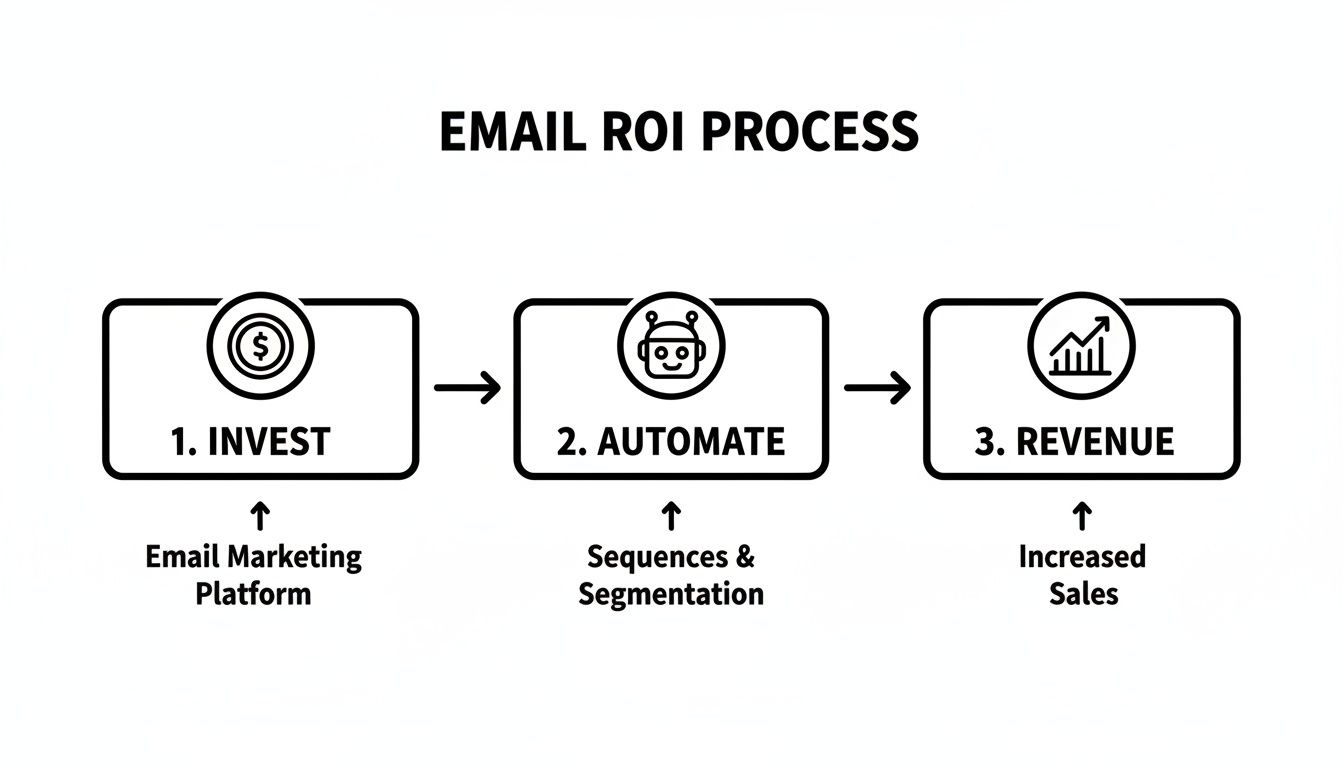
The takeaway here is that a small investment in the right tools and a solid strategy creates a scalable, automated system that just keeps producing revenue.
Think of this guide as your tactical playbook for building that exact system. We’re going to get past the high-level theory and give you actionable steps to use email marketing to generate leads that actually convert, turning your outreach into a predictable source of qualified opportunities for your sales team.
Building Your High-Intent Lead List
A killer email campaign doesn't start with a clever subject line. It starts with the right audience.
This is where so many teams go wrong. They chase quantity over quality and end up with a bloated list that produces nothing but dismal open rates and wasted effort. To actually generate leads with email marketing, you have to build a list of high-intent prospects who want to hear from you.
Think of your list as the foundation of your entire lead generation engine. Without a solid, engaged audience, even the most brilliant emails fall on deaf ears. The real goal isn't just collecting email addresses; it's attracting people who fit your ideal customer profile (ICP) and are actively searching for the exact solutions you provide.
Inbound Opt-Ins vs. Targeted Outbound
First things first: how are you going to get these contacts? You’ve got two main paths, each with its own flavor, and your sales development reps (SDRs) will need to master both.
- Inbound Opt-Ins: These are the folks who willingly trade their email for something valuable you're offering. Because they made the first move, they’re usually higher-intent. They're essentially raising their hand and saying, "I'm interested."
- Targeted Outbound: This is where you proactively identify and source contacts who perfectly match your ICP but haven't found you yet. It gives you direct control, letting you go after high-value accounts instead of waiting for them to stumble upon you.
For most B2B teams, the sweet spot is a hybrid approach. Use inbound to capture active interest and outbound to strategically target the big fish that might otherwise swim by.
Creating Lead Magnets That Actually Work
A lead magnet is the currency you use to earn an email address. Forget the generic, low-effort PDFs from 2015. High-intent B2B leads are busy, and they're looking for practical value that helps them solve a real problem right now.
Instead of another basic ebook, think about offering something with tangible value:
- Interactive Calculators: An ROI calculator or a pricing comparison tool gives immediate, personalized insight. It helps a prospect quantify their pain, which is a powerful nudge toward finding a solution.
- Industry Benchmark Reports: Give them exclusive data they can't get anywhere else. This instantly positions you as an authority and gives your prospect something valuable to share with their team.
- Exclusive Webinar Recordings: Gate the recordings of your most popular, high-value webinars. The content is already made, and it automatically targets prospects interested in a very specific topic.
The idea is to create something so genuinely useful that your ICP would gladly hand over their contact info for it. It's no wonder that 76.2% of marketers who use opt-in forms prefer pop-ups—they capture that contact information at the absolute peak moment of interest.
Here’s a quick comparison to help you pick the right tool for the job.
Comparing B2B Lead Magnet Effectiveness
This table compares common B2B lead magnets based on their typical target audience, lead quality, and effort to create, helping teams choose the right asset for their goals.
| Lead Magnet Type | Target Funnel Stage | Typical Lead Quality | Effort to Create | Best Use Case |
|---|---|---|---|---|
| Checklist/Template | Top/Middle | Low to Medium | Low | Driving broad top-of-funnel sign-ups with practical, easy-to-digest content. |
| Ebook/Whitepaper | Top/Middle | Medium | Medium | Educating prospects on a complex problem and positioning your company as an expert. |
| Webinar/Event | Middle | Medium to High | High | Engaging a live audience on a specific topic and generating interactive Q&A. |
| Benchmark Report | Middle/Bottom | High | High | Providing unique industry data that establishes authority and helps in decision-making. |
| Calculator/Tool | Bottom | Very High | Medium | Helping prospects build a business case by quantifying the value of your solution. |
Choosing the right magnet isn't just about getting an email; it's about starting the right kind of conversation from the very first interaction.
The Unsexy but Critical Job of Data Hygiene
Building a list is only half the battle. Maintaining it is where the real work begins.
Poor data hygiene—think old contacts, typos, and bounced emails—is a silent killer. It tanks your sender reputation, hurts deliverability, and sends your beautifully crafted emails straight to the spam folder. This is the boring, behind-the-scenes work that makes or breaks an email marketing to generate leads strategy.
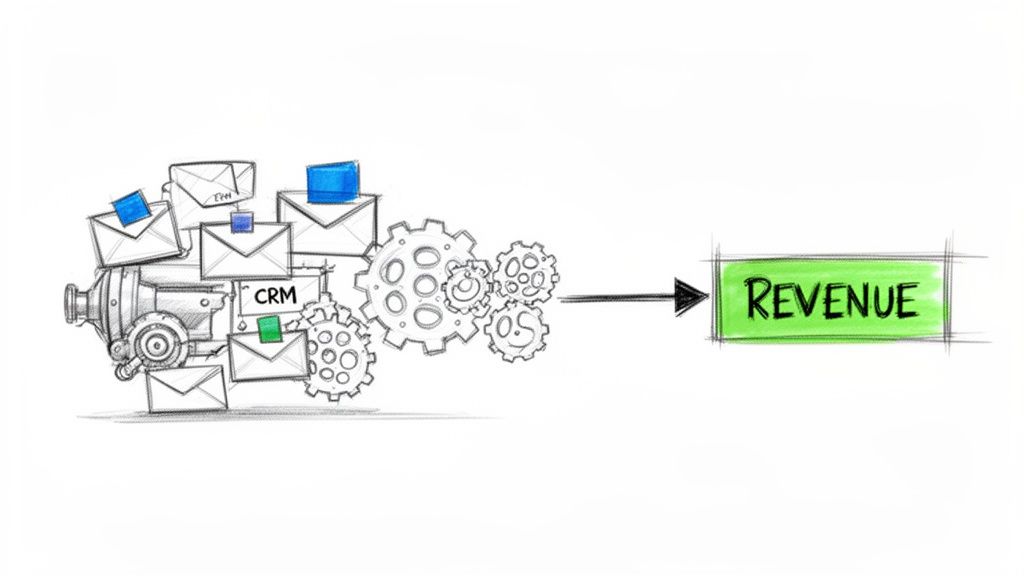
This is what it looks like when it all works together. A clean, well-managed list is the engine that turns systematic email outreach into actual revenue.
A clean email list isn't a "nice-to-have"—it's a non-negotiable for success. Regularly validating emails and pruning inactive subscribers protects your deliverability and makes sure your message actually reaches the people who matter.
The data backs this up. A full 48% of marketers rank email as their single most effective tactic for lead generation, according to a survey highlighted on EmailToolTester.com. With 74.7% of marketers actively working to grow their lists, the competition for inbox attention is fierce.
Ultimately, your most valuable asset is a list built on high-quality contacts who are showing real buying signals. If you want to get better at spotting those signals, check out our recent guide on what is intent data.
Crafting Nurture Sequences That Actually Convert
So, you got their email address. Great. Now the clock is ticking.
This is that critical window where a prospect goes from casually interested to genuinely sales-ready. Dumping them into your generic monthly newsletter is the fastest way to get ignored, deleted, or worse, marked as spam. Real email marketing to generate leads is all about strategic, automated nurture sequences that deliver the right message at exactly the right time.
This isn't about blasting out content and hoping something sticks. Think of it as building a conversation. A well-designed sequence acts as a digital guide, anticipating a lead's questions, hitting on their pain points, and systematically building trust until they're asking to talk to sales.
Why Most Nurturing Falls Flat
Let's be honest, most nurture sequences are lazy. You see the classic "newsletter" approach all the time—every new subscriber gets the same weekly update, regardless of who they are or what they care about. It's low-effort, sure, but it's also incredibly low-impact. This strategy makes the fatal mistake of treating a brand-new, top-of-funnel lead the same way it treats an MQL who’s been all over your pricing page.
A context-aware sequence, on the other hand, delivers hyper-relevant content based on how that lead entered your world. Someone who downloaded a deep-dive technical case study is in a completely different headspace than someone who signed up for a high-level trends webinar. Your follow-up has to reflect that reality.
The goal of a nurture sequence isn't just to stay top-of-mind; it's to advance the conversation. Each email should build on the last, moving the prospect one step closer to a solution—and a sales meeting.
By tailoring the journey from the very first email, you prove you understand their specific challenges. That’s the bedrock of any real business relationship.
A Welcome Sequence That Works
For new subscribers who just grabbed a lead magnet, those first few emails are everything. This is your shot to make a killer first impression and set the tone for everything that follows. I’ve found a 5-email welcome series, spread over about two weeks, works wonders.
Here’s a simple, proven framework:
- Email 1 (Immediate): Deliver the Goods. This email has one job: give them the thing they asked for. Keep it short, direct, and focused on value. I like to end with a P.S. that teases what's coming next, like, "P.S. Keep an eye on your inbox tomorrow for a quick tip on how to put this into action."
- Email 2 (Day 2): Provide Context and a Quick Win. Now, build on the lead magnet. If they downloaded a template, maybe share a 90-second video on how to get the most out of it. The goal is to help them get an immediate win from what you provided.
- Email 3 (Day 4): Introduce a Related Problem. Time to broaden the conversation. Connect the topic of the lead magnet to a bigger, more strategic business problem that your company just so happens to solve. Link out to a relevant blog post or a customer story.
- Email 4 (Day 7): Share Social Proof. This is where you build authority. Drop in a powerful customer testimonial, a jaw-dropping statistic, or a short case study that proves your impact. You’re shifting the focus from "what you do" to "what you've done for others."
- Email 5 (Day 11): The Soft Pivot to a CTA. You've just spent a week and a half delivering pure value. You've earned the right to ask for something small in return. This is where you can introduce a low-friction CTA, like an invitation to a webinar or a suggestion to check out a product tour. The "book a demo" ask can wait.
This structured flow is miles more effective than a random series of emails because it follows a logical narrative designed to educate, build trust, and gently guide them forward.
Nurturing Your Marketing Qualified Leads
The game changes completely when you're nurturing an MQL—someone who has shown clear buying intent by, say, visiting your pricing page three times or requesting a demo. These leads are hot. They need a more direct, but still value-driven, approach. A 7-touchpoint sequence over 3-4 weeks usually hits the sweet spot.
With MQLs, your job is to seamlessly bridge the gap between marketing and sales. The content should be laser-focused on solutions and speak directly to how your product solves their specific problems.
| Sequence Stage | Email Focus | Example Call-to-Action |
|---|---|---|
| Emails 1-2 | Acknowledge their action, provide value related to their interest. | "Here's a case study from a company in your industry." |
| Emails 3-4 | Address common objections, share third-party validation (reviews, awards). | "See how we compare to other solutions." |
| Emails 5-6 | Make the sales connection clear, highlight the value of a conversation. | "Would a 15-minute call to discuss [their goal] be helpful?" |
| Email 7 | The "breakup" email—a final, friendly offer to help before moving them to a less frequent list. | "Is this still a priority for you?" |
This focused sequence respects their time while making it obvious that the next logical step is a conversation. To accelerate the process of writing compelling, personalized copy for each stage, many teams now use AI email writer tools. These platforms can generate relevant and engaging copy for each touchpoint, saving your team a ton of time.
You can dive deeper into the mechanics of building these sequences in our complete guide to marketing automation workflows.
At the end of the day, a successful nurture sequence is just an automated system for building relationships at scale. It makes sure no lead ever falls through the cracks and that your sales team only spends time with educated, engaged prospects who are ready to talk business.
How To Personalize Email Beyond The First Name
Automating your lead generation shouldn't mean sounding like a robot. Dropping in a {{first_name}} merge tag is a start, but let's be honest—it’s table stakes in a crowded B2B inbox. Real personalization goes way deeper. It’s about turning a generic email blast into a message that feels like a one-to-one conversation.
The real power kicks in when your automation feels human. This means moving past basic mail merge fields and actually using the rich data you have—in your CRM, from your website—to send hyper-relevant content that speaks directly to a lead’s industry, job title, and behavior. This is how you make a prospect feel understood, not just marketed to.
Basic vs. Advanced Personalization: What’s the Difference?
Let's get practical. Basic personalization uses static data points that rarely change, like a name or company. Advanced personalization, on the other hand, is dynamic. It adapts the message based on who the person is and what they’ve actually done.
The gap in impact is massive.
| Personalization Level | What It Uses | Example in Action | Prospect's Reaction |
|---|---|---|---|
| Basic | Static CRM fields like {{first_name}} or {{company_name}}. | "Hi Sarah, wanted to share some info about Acme Corp." | "Okay, another generic sales email." |
| Advanced | Behavioral data (website visits), firmographics (industry), and CRM data (job title). | "Hi Sarah, saw you checked out our manufacturing case study. As a VP of Operations, you might find this ROI calculator for production lines useful." | "Wow, this is actually relevant to my job and what I was just looking at." |
It’s night and day. One feels like a broadcast; the other feels like a helpful, timely conversation. That shift is what builds trust and moves leads down the funnel.
Let Your CRM Data Drive Your Campaigns
Your CRM is a goldmine of context. Every single data point—from job title and industry to the original lead source—is a potential trigger for a highly personalized email. The trick is to connect those data points to specific, automated actions.
Instead of one generic nurture sequence, you can build several smaller, more targeted ones that run automatically:
- Industry-Specific Content: When a new lead from the "Manufacturing" industry signs up, immediately send them your most popular manufacturing case study. No waiting.
- Role-Based Nurturing: A "Director of IT" has completely different problems than a "CMO." Your email content should reflect that, speaking their language and hitting their specific pain points.
- Behavioral Triggers: This is where things get really interesting. A lead visiting your pricing page is a huge buying signal. You can build an automation that triggers a personal email from an SDR 24 hours later, offering to walk them through the different tiers.
The secret to scaling relevance isn't about writing thousands of individual emails. It's about building smart systems that use data to send the right email to the right person automatically.
This is exactly where an SDR task engine like marketbetter.ai shines. It connects these buyer signals directly to prioritized tasks, so your reps know exactly who to email and what to say based on real-time activity, all right inside their CRM.
Use Dynamic Content to Make Every Email Feel Unique
Triggered campaigns are powerful, but what if you could personalize the content inside a single email? That’s the magic of dynamic content. It lets you show different text, images, or calls-to-action to different people, all within the same email campaign.
Here’s a quick example of how a SaaS company might use it in one promotional email:
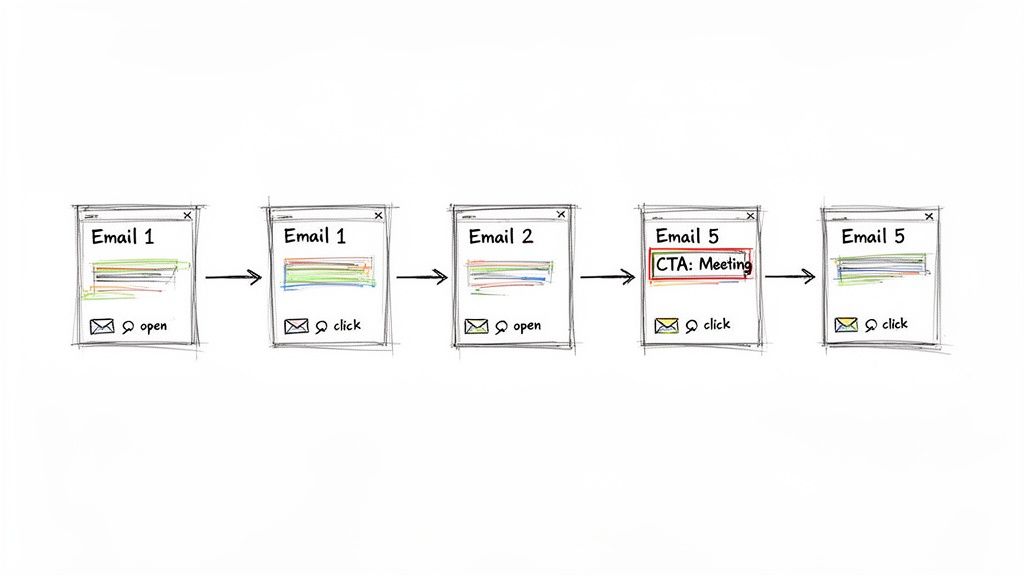
This screenshot shows a smart automated sequence where engagement dictates the next move. The CTA for a meeting only goes out after the lead is warmed up. It's this kind of smart sequencing, fueled by personalization, that prevents you from asking for the meeting too soon.
So, instead of creating three separate emails for three different industries, you just create one email with a dynamic content block.
- A lead from the healthcare industry sees a customer testimonial from a hospital.
- A lead from the finance industry sees a testimonial from a bank.
- A lead from the retail industry sees one from an e-commerce brand.
The rest of the email is exactly the same, but that one crucial piece of social proof is perfectly tailored to the recipient's world. This move dramatically increases how much your message resonates, all without tripling your workload. If you want to dive deeper into the nuts and bolts, you can learn more about what is dynamic content and how to set it up.
By combining behavioral triggers with dynamic content, you can create a truly personal experience at scale. Suddenly, your email marketing to generate leads feels less like automation and more like a real relationship.
Measuring The Metrics That Matter For Lead Gen
Email lead generation is never a "set it and forget it" game. If you want to prove your efforts are actually working—and frankly, to get more budget—you have to measure what leadership actually cares about. And I'll give you a hint: it’s almost never the open rate.
A disciplined approach to measurement is what separates a guessing game from a predictable revenue engine.
This isn’t about drowning in a sea of data. It’s about zeroing in on the numbers that prove your email marketing to generate leads is creating real business impact, not just a blip of inbox activity.
The Great Divide: Activity vs. Outcome Metrics
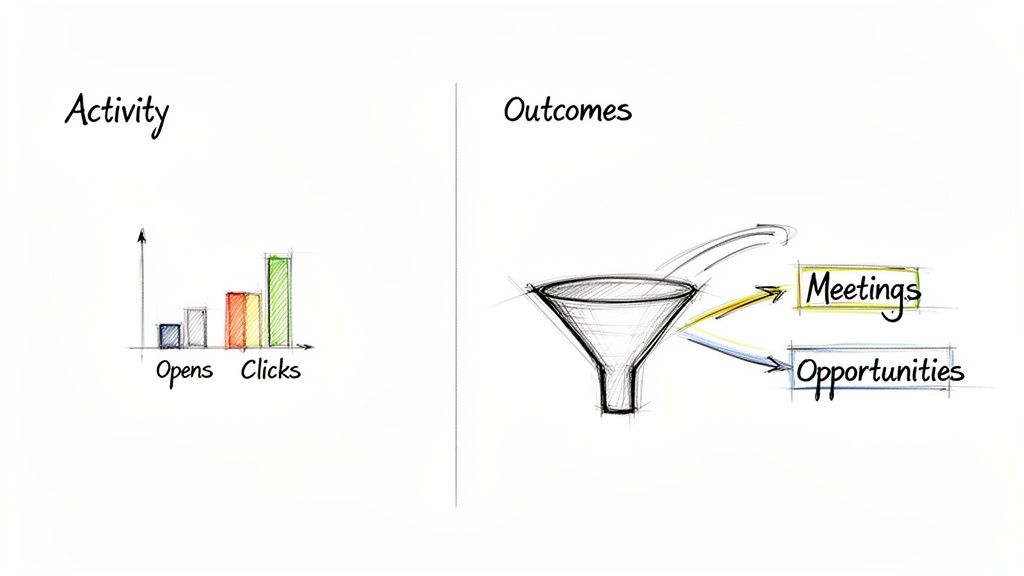
The single most common mistake I see teams make is obsessing over "Activity Metrics." These are the easy-to-track vanity numbers like opens and clicks. They tell you if people are engaging, but they don't tell you if they're buying.
"Outcome Metrics," on the other hand, are tied directly to pipeline and sales. These are the numbers that get your VP of Sales to lean in during a meeting. They measure tangible business results, proving your email campaigns are a critical part of the entire sales motion.
Email Lead Gen Metrics: Activity vs Outcome
Most marketers get stuck tracking activity. That's fine for optimizing tactics. But if you want to talk strategy and ROI with leadership, you need to speak the language of outcomes. Here's a quick guide to what to measure, what it really tells you, and who's paying attention.
| Metric Category | Example Metrics | What It Tells You | Who Cares Most |
|---|---|---|---|
| Activity Metrics | Open Rate, Click-Through Rate (CTR), Unsubscribe Rate, Bounce Rate | Are people opening and interacting with our emails? Is our list healthy? | Marketing Managers, Email Specialists, Content Creators |
| Outcome Metrics | Meetings Booked, Demos Scheduled, Marketing Qualified Leads (MQLs), Sales Qualified Leads (SQLs), Opportunities Created, Pipeline Value, Customer Acquisition Cost (CAC) | Is our email outreach creating real sales conversations and revenue opportunities? | VP of Sales, CRO, CEO, Sales Development Leaders, RevOps |
Both sets of metrics absolutely have their place. Activity metrics help you diagnose why a campaign is or isn't working at a tactical level. But outcome metrics are what prove its strategic value to the business.
A Practical A/B Testing Plan for SDR Teams
A/B testing is your best friend for making small, consistent improvements that add up. Instead of just guessing what works, you let the data tell the story. For sales development teams, this means running disciplined tests on the variables that most directly impact your outcomes.
Forget testing everything at once. Focus your energy on a few high-impact elements.
- Test Subject Lines for Meetings Booked: Instead of just optimizing for opens, measure success by the number of meetings booked from each email variant. A clever subject line might get more opens, but a direct, value-driven one often gets more meetings.
- Test the Call-to-Action (CTA): Pit a direct CTA like "Book a 15-min call here" against a softer one like "Interested in learning more?" Track which one leads to more SQLs over a 30-day period.
- Test the "From" Name: For an outbound sequence, test sending from a specific SDR's name versus a general sender like "The Team at [Company]." That personal touch can make a huge difference in qualified replies.
The goal of A/B testing isn't just to get more clicks; it's to find the specific combination of words and offers that consistently generates more qualified pipeline. Always tie your tests back to a meaningful business outcome.
CRM Integration: The Source of Truth
So how do you actually track outcome metrics like "Opportunities Created" back to a specific email? This is where a clean, seamless integration between your email platform and CRM becomes non-negotiable. Without it, attribution is just a shot in the dark.
When your systems are connected, you see the entire journey unfold.
A lead clicks a link in Email #3 of your nurture sequence. They visit the pricing page, which triggers a high-intent signal. An SDR gets an automatic follow-up task from a tool like marketbetter.ai. That SDR books a meeting, logs it in the CRM, and it becomes a qualified opportunity with a dollar value attached.
This kind of closed-loop reporting is the only way to prove which email campaigns are generating real pipeline. It shifts the conversation from, "Our last email got a 2.7% click-through rate," to something far more powerful: "Our last email generated $75,000 in new sales opportunities."
That’s a conversation every leader wants to have. For a deeper look at which specific performance indicators to monitor, this guide on the essential email campaign performance metrics provides a solid framework for tracking what really drives growth.
Common Questions About Email Lead Generation
Even with the best playbook, you're going to hit a few roadblocks when you get into the weeds. It just happens. Let's tackle some of the most common questions and sticking points that marketers and sales leaders run into when they're really trying to make email generate leads.
Getting these right can be the difference between a stalled campaign and a pipeline that's humming along.
Here are some clear, no-fluff answers to help you push past those hurdles and build a program that actually works.
Is Buying an Email List Ever a Good Idea?
This is the classic question, and the answer comes down to one word: quality.
Buying a static, off-the-shelf list is almost always a terrible idea. Period. Those things are usually stale, packed with people who have no interest in you, and they’re a fast track to getting your domain blacklisted. You're buying volume, not opportunity.
What does work is using a modern data provider to build a highly targeted, compliant list of contacts that perfectly match your ideal customer profile (ICP). Think of it as list acquisition, not list buying. You partner with a service that gives you verified contacts based on real signals—like company size, tech stack, and even buying intent—so you know you're reaching out to people who might actually want to talk.
How Often Should I Email My Leads?
The biggest mistake you can make is blasting your entire list with the same number of emails at the same time. Cadence has to match context. The frequency of your emails should depend entirely on where that lead is in their journey and how much they're engaging.
Here’s a practical way to think about it for different segments:
- New Inbound Leads: These folks are hot. Hit them with a welcome sequence of 3-5 emails over two weeks. This is your chance to deliver value while you have their full attention.
- Warm MQLs: They've shown interest, so you can keep the momentum going. A sequence of 5-7 touches over three to four weeks works well here. It’s persistent without being annoying.
- Cold Outbound Prospects: For a cold audience, you have to earn their attention. Start slow. An initial email, then a follow-up every 4-5 business days, is a solid baseline.
The real key is using automation to let their behavior dictate your next move. If someone clicks a link, that's a signal to follow up sooner. If they go quiet for a few weeks, ease them into a long-term, low-touch nurture track.
Which Is Better An In-House Team or an Agency?
This really comes down to a trade-off between control and specialized horsepower.
An in-house team lives and breathes your product. They get the culture, the nuances, the voice. But building that team is a serious investment in hiring, training, and the right tools.
An agency, on the other hand, gives you instant access to experts who have run this playbook a hundred times. You get their processes and experience on day one, often for less than the cost of a full-time hire. The potential downside? They might not have that deep, intrinsic knowledge of your specific business.
For most B2B companies, a hybrid approach hits the sweet spot. Let your in-house team own the overall strategy and manage the hot, bottom-of-funnel leads. Then, bring in an agency or use powerful tools to handle the heavy lifting of top-of-funnel list building and campaign execution.
This way, you keep control over what matters most while leveraging outside expertise to scale your efforts faster than you could on your own.
Ready to turn buyer signals into prioritized SDR tasks and execute outreach faster? marketbetter.ai provides the AI-powered task engine your team needs to send relevant emails and make smarter calls, all inside Salesforce or HubSpot. See how you can build a consistent outbound motion without the busywork at https://www.marketbetter.ai.