
AI-Powered Sales Onboarding: Cut SDR Ramp Time from 3 Months to 3 Weeks [2026]
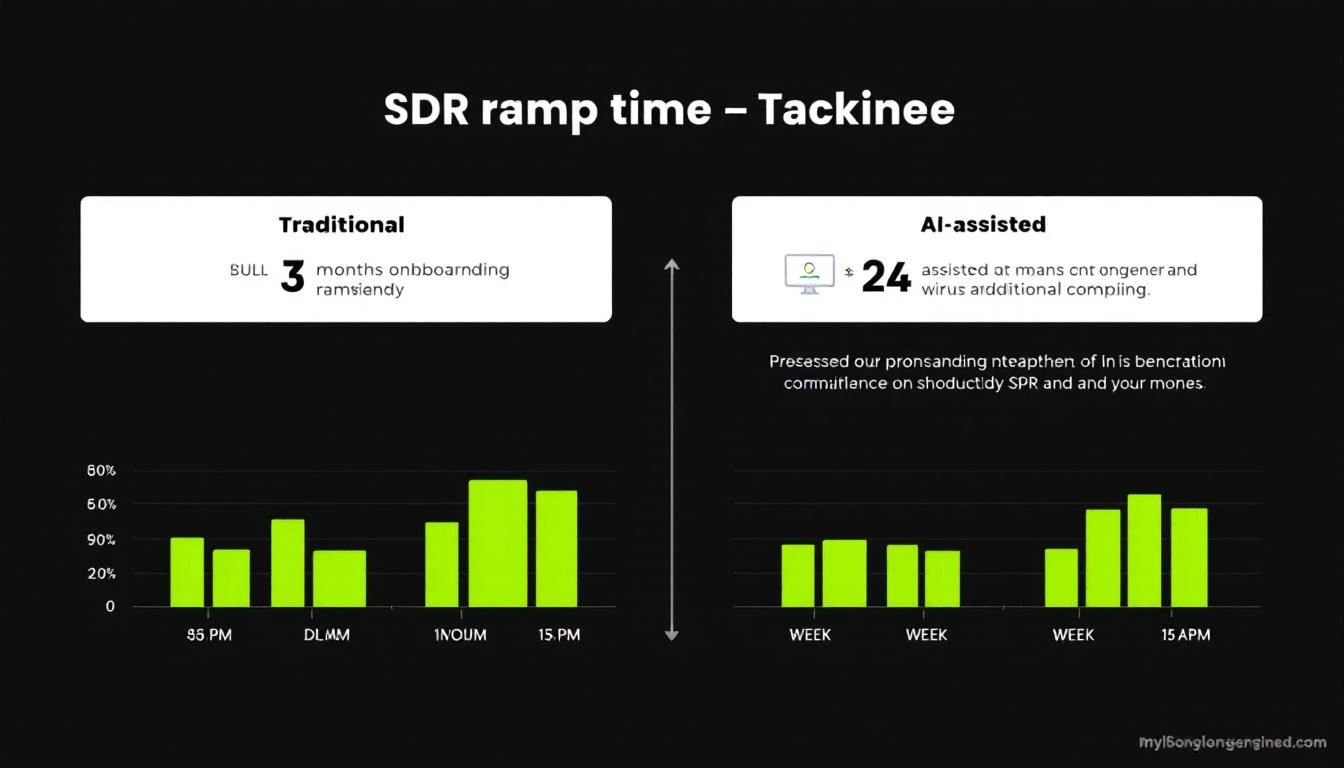
The average SDR takes 3.2 months to reach full productivity. That's 96 days of salary, benefits, and management overhead before they're really contributing.
Meanwhile, quota pressure doesn't wait. Pipelines don't pause. And every day a new rep is "ramping," you're losing opportunities.
What if you could compress that timeline to 3 weeks?
AI coding agents like Claude Code are making it possible—not by replacing human training, but by augmenting it with intelligent, personalized, always-available coaching.
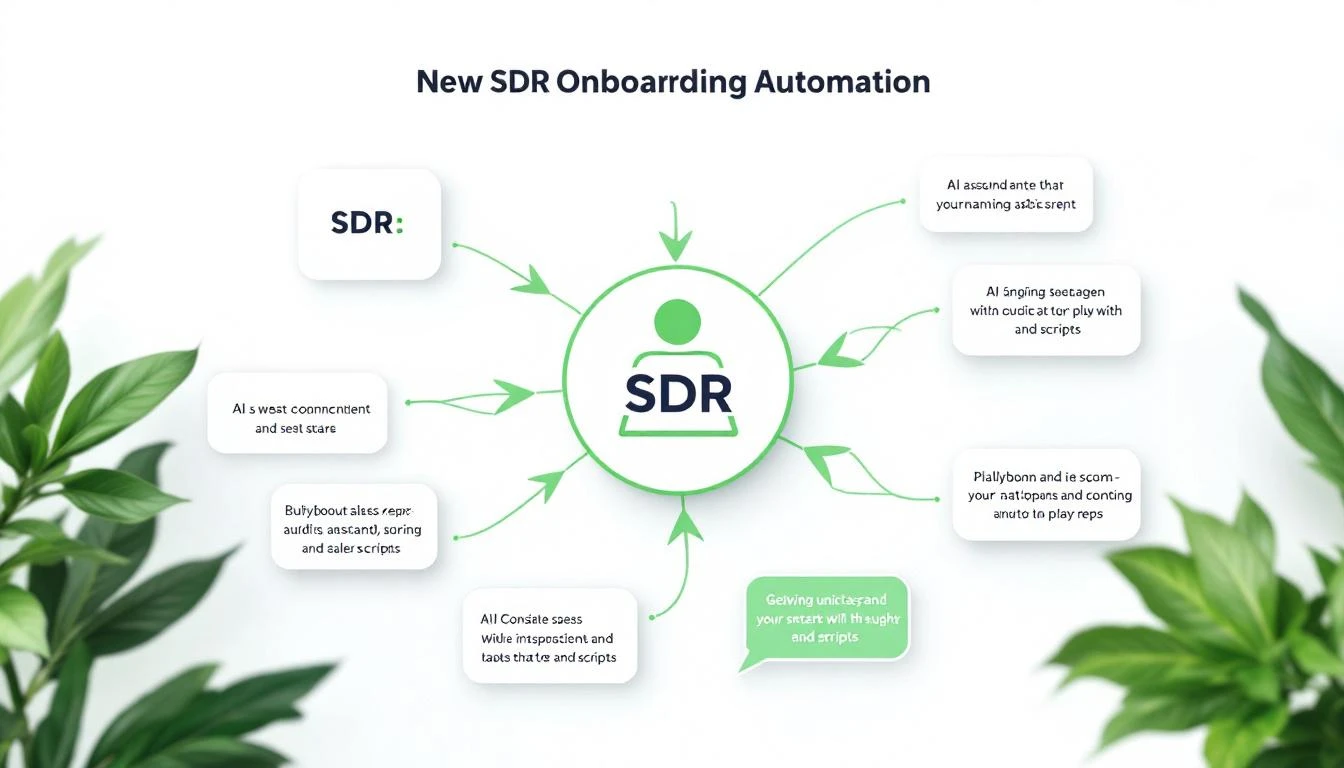
Why Traditional SDR Onboarding Fails
Most onboarding programs share the same problems:
1. Information Overload in Week 1
New hires get:
- 47 product documentation links
- 12 competitor battle cards
- 8 hours of recorded calls
- 5 personas to memorize
- 3 playbooks to read
By Friday, they remember maybe 15%.
2. Shadow Period Bottleneck
"Shadow top reps for two weeks" sounds great until:
- Your best reps are slammed and can't stop to explain
- The shadowing rep learns ONE person's style (which may not transfer)
- There's no structured feedback loop
- They see deals in progress but never see the beginning-to-end journey
3. Sink-or-Swim After Week 3
After the formal onboarding, new reps are "on their own." Questions get answered inconsistently. Bad habits form silently. By the time gaps surface in pipeline reviews, it's too late.
4. No Personalization
Every rep gets the same training, regardless of:
- Previous experience
- Learning style
- Individual knowledge gaps
- Pace of learning
The result? Some reps are bored. Others are lost. Most are somewhere in between but with different gaps.
The AI Onboarding Stack
Here's how to build an AI-powered onboarding system using Claude Code and OpenClaw:
Component 1: AI Knowledge Base
Instead of dumping 47 links, create an intelligent knowledge base that answers questions contextually:
# onboarding_assistant.py
from anthropic import Anthropic

client = Anthropic()

KNOWLEDGE_BASE_PROMPT = """
You are an expert onboarding assistant for SDRs at a B2B SaaS company.

You have deep knowledge of:
- Our product (features, pricing, positioning)
- Our ICP (ideal customer profile)
- Competitor landscape
- Sales methodology
- Objection handling
- Email and call best practices

When answering questions:
1. Be specific and actionable
2. Use examples from our context
3. Suggest related topics they should learn next
4. If they seem confused, simplify
5. Encourage questions—no question is too basic

Remember: This person is new. Be patient and supportive while maintaining high standards.
"""

def answer_onboarding_question(question: str, rep_context: dict) -> str:
    """Answer a new rep's question with context awareness"""

    # Include rep's progress and gaps
    context = f"""
    Rep: {rep_context['name']}
    Started: {rep_context['start_date']}
    Completed modules: {rep_context['completed_modules']}
    Known gaps: {rep_context['identified_gaps']}
    Recent questions: {rep_context['recent_questions']}
    """

    response = client.messages.create(
        model="claude-sonnet-4-20250514",
        max_tokens=1500,
        system=KNOWLEDGE_BASE_PROMPT,
        messages=[
            {"role": "user", "content": f"{context}\n\nQuestion: {question}"}
        ]
    )

    return response.content[0].text
Component 2: AI Role-Play Coach
New reps need practice. AI provides unlimited, judgment-free practice sessions:
ROLEPLAY_SCENARIOS = {
    "cold_call_gatekeeper": {
        "scenario": "Call the main line at Acme Corp. The gatekeeper picks up.",
        "persona": "Busy executive assistant who's heard every sales pitch.",
        "goal": "Get transferred to the VP of Sales.",
        "evaluation_criteria": ["Value proposition clarity", "Gatekeeper rapport", "Call-to-action"]
    },
    "discovery_call_skeptic": {
        "scenario": "First discovery call with a VP who agreed reluctantly.",
        "persona": "Skeptical leader who's tried similar tools before.",
        "goal": "Uncover 3+ pain points and book a demo.",
        "evaluation_criteria": ["Question quality", "Active listening", "Pain acknowledgment"]
    },
    "objection_price": {
        "scenario": "Mid-demo, prospect says 'This looks great but it's out of our budget.'",
        "persona": "Budget-conscious director who likes the product.",
        "goal": "Reframe value and keep deal alive.",
        "evaluation_criteria": ["Value reframe", "Creative solutions", "Next steps clarity"]
    }
}

def run_roleplay_session(scenario_id: str, rep_response: str) -> dict:
    """Run a roleplay session and evaluate performance"""

    scenario = ROLEPLAY_SCENARIOS[scenario_id]

    prompt = f"""
    You are playing the role: {scenario['persona']}

    Scenario: {scenario['scenario']}

    The SDR said: "{rep_response}"

    Respond in character, then break character to provide coaching:

    IN-CHARACTER RESPONSE: [How the persona would respond]

    ---COACHING---

    What worked:
    - [Specific positive feedback]

    What to improve:
    - [Specific actionable feedback]

    Score (1-10): [Score based on {scenario['evaluation_criteria']}]

    Try saying this instead:
    "[Suggested alternative response]"
    """

    response = client.messages.create(
        model="claude-sonnet-4-20250514",
        max_tokens=1000,
        messages=[{"role": "user", "content": prompt}]
    )

    return parse_roleplay_response(response.content[0].text)
Component 3: Personalized Learning Paths
Not every rep needs the same training. AI assesses knowledge and creates custom paths:
def assess_rep_knowledge(rep_id: str) -> dict:
    """Assess a rep's current knowledge through adaptive testing"""

    assessment_topics = [
        "product_features",
        "icp_definition",
        "competitor_landscape",
        "objection_handling",
        "email_best_practices",
        "call_techniques",
        "crm_usage",
        "sales_methodology"
    ]

    results = {}

    for topic in assessment_topics:
        # Generate adaptive questions
        questions = generate_assessment_questions(topic, difficulty="adaptive")

        # Score responses
        score = evaluate_responses(rep_id, topic, questions)

        results[topic] = {
            "score": score,
            "level": categorize_level(score),
            "gaps": identify_specific_gaps(rep_id, topic)
        }

    return results

def generate_learning_path(assessment_results: dict) -> list:
    """Create personalized learning path based on assessment"""

    prompt = f"""
    Based on this SDR's assessment results, create a personalized 3-week learning path:

    Assessment: {assessment_results}

    Create a day-by-day plan that:
    1. Starts with their weakest areas (but not overwhelming)
    2. Builds confidence with early wins
    3. Includes daily practice exercises
    4. Has milestone checkpoints
    5. Balances learning with doing (real calls/emails)

    Format: JSON with day, focus_area, activities, success_criteria
    """

    response = client.messages.create(
        model="claude-sonnet-4-20250514",
        max_tokens=3000,
        messages=[{"role": "user", "content": prompt}]
    )

    return json.loads(response.content[0].text)
Component 4: Real-Time Call Coaching
The magic happens when AI listens to actual calls and provides feedback:
def analyze_call_recording(transcript: str, call_type: str) -> dict:
    """Analyze a call recording and provide coaching feedback"""

    prompt = f"""
    Analyze this {call_type} call transcript and provide coaching feedback:

    Transcript:
    {transcript}

    Evaluate on:
    1. Opening (Did they establish credibility and relevance?)
    2. Discovery (Quality and depth of questions)
    3. Listening (Did they pick up on cues?)
    4. Value proposition (Clear, relevant, compelling?)
    5. Objection handling (If any objections came up)
    6. Next steps (Clear call-to-action?)

    For each area, provide:
    - Score (1-10)
    - Specific example from the call
    - What to do differently next time

    Also identify:
    - Best moment in the call
    - Biggest opportunity for improvement
    - One thing to practice before next call
    """

    response = client.messages.create(
        model="claude-sonnet-4-20250514",
        max_tokens=2000,
        messages=[{"role": "user", "content": prompt}]
    )

    return parse_call_analysis(response.content[0].text)
Putting It Together with OpenClaw
Here's how to deploy your AI onboarding system using OpenClaw:
# openclaw.yaml
agents:
  onboarding-assistant:
    prompt: |
      You are an AI onboarding coach for new SDRs. Help them:
      - Answer product and process questions
      - Practice sales scenarios
      - Review their calls and emails
      - Track their progress
      - Celebrate wins and encourage improvement

      Be supportive but maintain high standards. They'll thank you later.

    memory: true

    tools:
      - knowledge_base_search
      - run_roleplay
      - analyze_call
      - track_progress
      - generate_practice_task

  daily-practice-coach:
    prompt: |
      Every morning, check each onboarding rep's progress and send them:
      1. A quick knowledge quiz (3 questions)
      2. One roleplay scenario to practice
      3. A reminder of their focus area for the day
      4. Encouragement based on their progress

    cron: "0 8 * * 1-5"  # 8am weekdays

  call-reviewer:
    prompt: |
      When a new rep's call recording comes in, analyze it and send feedback
      within 1 hour. Include:
      - What they did well (specific moments)
      - One thing to improve (actionable)
      - A practice prompt to address the gap

    triggers:
      - event: call_recording_uploaded
        filter: rep_status == "onboarding"
The 3-Week Accelerated Onboarding Schedule
Here's a proven schedule that leverages AI coaching:
Week 1: Foundation
Day 1-2: Product Deep Dive
- AI-guided product exploration (not documentation dumps)
- Roleplay: Explain product value in 30 seconds
- Quiz: Feature → benefit translation
Day 3-4: ICP & Personas
- AI teaches persona characteristics through scenarios
- Roleplay: Discovery call with each persona type
- Practice: Write persona-specific email openers
Day 5: Competitive Landscape
- AI-powered competitive comparison Q&A
- Roleplay: Prospect brings up competitor
- Quiz: Feature comparison accuracy
Week 2: Skills
Day 6-7: Cold Calling
- AI roleplay: 10 practice calls with different personas
- Real call listening with AI annotation
- First real calls with AI post-call coaching
Day 8-9: Email Sequences
- AI reviews and rewrites practice emails
- Personalization exercises with feedback
- First real emails sent (AI-assisted)
Day 10: Objection Handling
- AI scenario practice for top 10 objections
- Pattern recognition: When to use which response
- Certification: Handle 5 objections in roleplay
Week 3: Integration
Day 11-12: Live Call Coaching
- Real calls with AI providing real-time suggestions
- Post-call AI coaching sessions
- Manager review of AI coaching accuracy
Day 13-14: Full Process Run
- Complete cold → demo process with AI support
- Identify remaining gaps
- Create 30/60/90 day continuation plan
Day 15: Graduation
- Final assessment (AI-administered)
- Certification call with manager
- Transition to standard AI coaching cadence
Measuring Onboarding Success
Track these metrics to prove AI onboarding works:
| Metric | Traditional | AI-Assisted | Target |
|---|---|---|---|
| Time to first meeting booked | 4 weeks | 1.5 weeks | 1 week |
| Time to first deal closed | 14 weeks | 6 weeks | 5 weeks |
| 90-day quota attainment | 45% | 78% | 80% |
| Onboarding satisfaction score | 6.2/10 | 8.7/10 | 9/10 |
| Knowledge assessment score | 62% | 89% | 85% |
| Manager coaching time required | 15 hrs/rep | 6 hrs/rep | 5 hrs |
Common Mistakes to Avoid
1. Replacing Human Connection
AI augments human onboarding—it doesn't replace it. New reps still need:
- Manager 1:1s for relationship building
- Team culture integration
- Peer mentorship
- Human judgment on complex situations
2. Over-Automating Too Soon
Start with one AI component (like the knowledge assistant) and add others as you validate effectiveness. Going full-automation Day 1 leads to confusion.
3. Ignoring AI Coaching Feedback
If AI suggests improvements and reps ignore them, the system fails. Build accountability:
- Track whether reps implement AI suggestions
- Celebrate improvement from feedback
- Escalate persistent gaps to managers
4. Generic Scenarios
The roleplay scenarios must match YOUR sales process, YOUR product, YOUR ICPs. Generic cold call practice won't help if your sales motion is consultative.
The ROI of AI Onboarding
Let's do the math for a 10-person SDR team hiring 20 reps per year:
Traditional Onboarding Costs:
- 3 months ramp time × $6K/month salary = $18K per rep
- Manager time: 20 hours × $75/hour = $1,500 per rep
- Lost productivity: ~$15K pipeline per rep
- Total per rep: ~$34,500
- Annual cost: $690,000
AI-Assisted Onboarding Costs:
- 3 weeks ramp time × $6K/month salary = $4.5K per rep
- Manager time: 8 hours × $75/hour = $600 per rep
- AI tooling: ~$200/month per rep during onboarding
- Lost productivity: ~$4K pipeline per rep
- Total per rep: ~$9,700
- Annual cost: $194,000
Savings: $496,000/year (72% reduction)
Plus: Faster ramp means hitting quota sooner, which compounds.
Getting Started Today
You don't need to build everything at once. Start here:
- Week 1: Set up AI knowledge assistant for Q&A
- Week 2: Add roleplay scenarios for practice
- Week 3: Implement call review automation
- Month 2: Build personalized learning paths
- Month 3: Full AI-assisted onboarding program
The technology exists. The ROI is clear. The only question is how fast you want your next hire to start producing.
Try our AI Lead Generator — find verified LinkedIn leads for any company instantly. No signup required.
Ready to Transform Your SDR Team?
MarketBetter combines AI coaching with the daily playbook that tells your reps exactly who to call and what to say. Faster ramp. Higher quota attainment. Better retention.
Related Posts: