
Build an AI-Powered Referral Engine with OpenClaw [2026]
Here's a stat that should haunt every sales leader: referred leads convert at 3-5x the rate of cold outbound, close 69% faster, and have 16% higher lifetime value (Influitive, 2025). Yet most B2B companies treat referrals like a happy accident instead of a systematic growth channel.
The excuse is always the same: "We don't have a formal referral program." Translation: nobody has time to identify happy customers, reach out at the right moment, personalize the ask, follow up when they don't respond, and track the referral through the pipeline.
What if an AI agent did all of that, 24/7, with zero manual effort?
That's exactly what you can build with OpenClaw — the open-source AI gateway that connects Claude Code to your CRM, email, and messaging tools. In this guide, we'll build a fully automated referral engine that turns your happiest customers into your most effective sales channel.
Why B2B Referral Programs Fail
Most B2B referral programs follow the same script: create a referral page, send one mass email asking for referrals, get 3 responses, declare the program "doesn't work for our business," and go back to cold outreach.
Here's what's actually broken:
Wrong Timing
You ask for referrals during QBRs — when the customer is reviewing problems, not celebrating wins. The best time to ask is immediately after a success moment: hit a milestone, saved them time, got a compliment from their boss. Most teams miss these moments entirely.
No Personalization
"Hi [First Name], would you refer us to anyone?" — this is the referral equivalent of a cold spray-and-pray email. Effective referral requests are specific: "Your friend Sarah at Acme Corp would probably love our visitor identification feature — would you mind making an intro?"
No Follow-Up
A customer says "sure, I'll think about it" and... silence. Nobody follows up because nobody is tracking it. The intent was there. The execution died.
Wrong Customers
Not every customer is a referral candidate. Asking a customer who just filed a support complaint for a referral is tone-deaf. You need to identify your actual promoters — the ones who love you — and focus your asks there.
No Scalability
Even if you do everything right with 10 customers, can you do it with 200? With 1,000? Manual referral programs don't scale. AI-powered ones do.
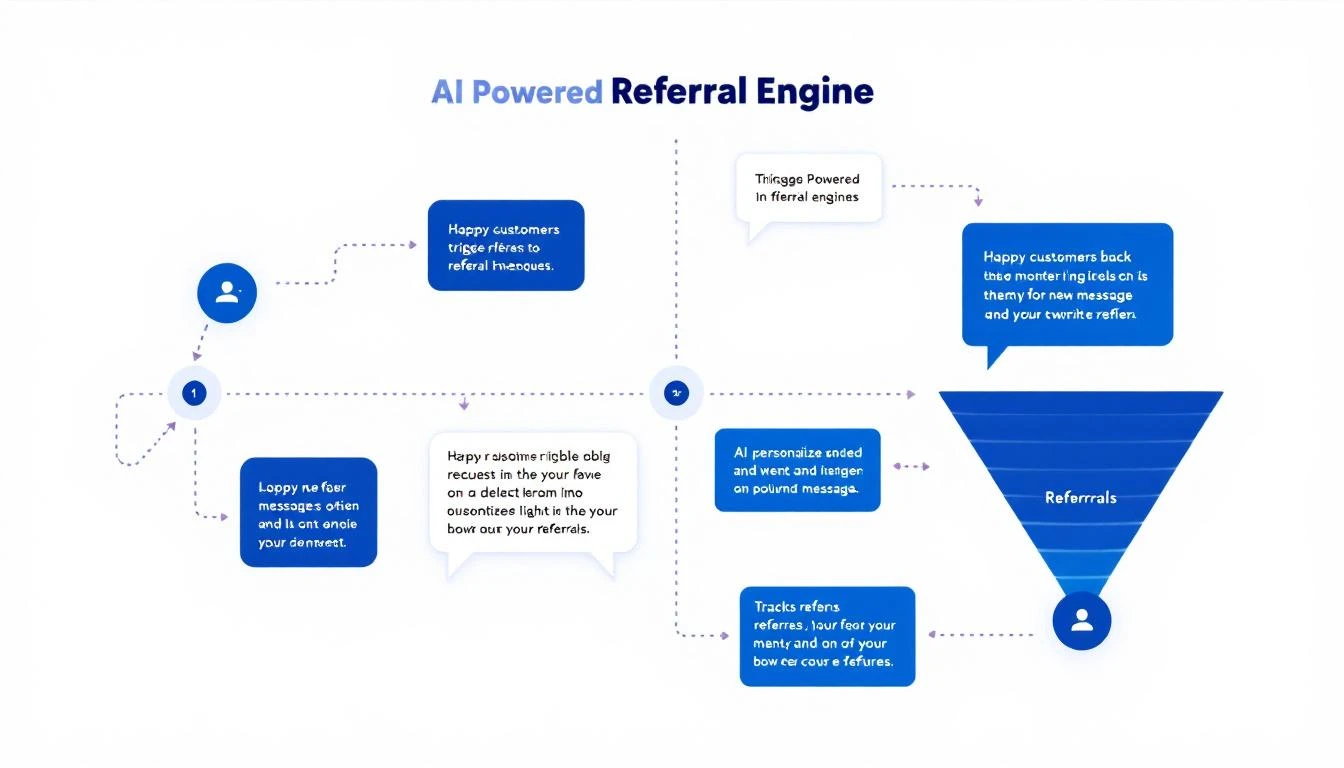
The AI Referral Engine Architecture
Here's the system we're building:
Layer 1: Promoter Identification Continuously monitor customer signals to identify who's ready to refer:
- NPS scores of 9-10
- Positive support interactions
- Product usage milestones
- Public testimonials or G2 reviews
- Social media mentions
- Renewal/expansion events
Layer 2: Timing Engine Trigger referral requests at the perfect moment:
- Within 48 hours of a success milestone
- After a positive support resolution
- Following a product achievement (e.g., "You've sent 10,000 emails!")
- After expansion or renewal
- When they've been using a feature 30+ days
Layer 3: Personalized Request Generation Claude Code crafts each referral request based on:
- The customer's specific success with your product
- Their network (LinkedIn connections at target companies)
- The specific value prop that would resonate with their referral
- The customer's communication style (formal vs. casual)
Layer 4: Follow-Up Automation Track and nurture referral commitments:
- Thank-you after initial agreement
- Gentle nudge if no intro after 5 days
- Alternative approach if first ask is ignored
- Update when referral enters pipeline
Layer 5: Pipeline Tracking Track referred leads from introduction to close:
- Tag referral source in CRM
- Monitor conversion stages
- Calculate referral revenue attribution
- Reward referrers when deals close
Building It with OpenClaw
Step 1: Identify Your Promoters
Not every happy customer will refer. Your AI agent needs to score "referral readiness" based on multiple signals:
Strong Indicators (High Confidence):
- NPS score of 9 or 10 in last 90 days
- Left a positive G2 or Capterra review
- Publicly mentioned your product on LinkedIn or Twitter
- Referred someone before (past behavior predicts future behavior)
- Recently expanded their contract
Moderate Indicators:
- High product usage (top 25% of accounts)
- Zero support escalations in 90 days
- Attended your webinar or event
- Engaged with your content regularly
Negative Indicators (Do NOT Ask):
- Open support tickets
- NPS score below 7
- Recent billing dispute
- Less than 3 months as customer
- Low product adoption
Your OpenClaw agent runs this scoring daily and maintains a ranked list of referral candidates in your CRM.
Step 2: Build the Timing Engine
The difference between a 5% referral response rate and a 35% response rate is timing. Here are the trigger events your agent should watch for:
Immediate Triggers (Ask Within 48 Hours):
- Customer hits a measurable milestone ("You just booked your 100th meeting through our platform!")
- Customer sends a positive email to their CSM
- Customer gives you a 9 or 10 NPS score
- Customer's champion gets promoted (they're feeling good, ride the wave)
Scheduled Triggers:
- 90 days post-onboarding (enough time to see value)
- 30 days before renewal (they're already thinking about the relationship)
- After quarterly business review with positive outcomes
Event-Based Triggers:
- Customer speaks at your event or webinar
- Customer agrees to a case study
- Customer refers someone organically (ask for more!)
Step 3: Generate Personalized Referral Requests
This is where Claude Code transforms a generic ask into a compelling one. Here's the difference:
Generic (5% Response Rate):
"Hi Sarah, hope you're doing well! Would you be willing to refer MarketBetter to anyone in your network? Let me know!"
AI-Personalized (30%+ Response Rate):
"Sarah — congrats on hitting 150 qualified meetings this quarter through MarketBetter! That's 3x what you were doing with your old process. 🎉
I noticed your former colleague Mike at TechCorp is hiring SDRs right now. He'd probably love to see how you're getting these results. Would you be open to a quick intro? I'll make it easy — just forward this with a one-liner and I'll take it from there."
What Claude Code does differently:
- References a specific success metric (not generic)
- Identifies a specific referral target (not "anyone in your network")
- Explains why that person would benefit (not just "they might like us")
- Makes it easy ("just forward this")
- Sets clear expectations ("I'll take it from there")
Step 4: Automate Follow-Up Sequences
Most referral requests get a "sure, let me think about it" and then die. Your agent keeps the momentum:
Day 0: Initial referral request (triggered by success event) Day 3: If no response — casual follow-up with a slightly different angle Day 7: If still no response — offer an alternative (share a link instead of intro) Day 14: If no action — thank them anyway, mention you'll check back later Day 30: Circle back with a new trigger event or success story
If the customer makes the intro, the sequence shifts: Immediately: Thank the referrer profusely When referral books a demo: Update the referrer When referral closes: Personal thank-you + referral reward (if applicable)
This follow-up cadence is impossible to maintain manually across 200 customers. For OpenClaw, it's just a cron job.
The Numbers: Referral ROI
Here's what a well-executed AI referral program looks like at scale:
| Metric | Without AI | With AI Referral Engine |
|---|---|---|
| Customers asked for referrals | 10-20/quarter | 100% of promoters |
| Referral request response rate | 5-10% | 25-35% |
| Introductions made per quarter | 3-5 | 30-50 |
| Referral conversion rate | 25-30% | 35-45% |
| Time spent on referral program | 5-10 hrs/week | 1 hr/week (oversight only) |
| Referral pipeline per quarter | $50-100K | $500K-1M+ |
The math is simple. If your average deal is $30K and you generate 10 additional referral-sourced deals per quarter, that's $300K in pipeline with a near-zero acquisition cost.
OpenClaw vs. Referral Software
Dedicated referral platforms like Referral Rock, GrowSurf, and Friendbuy charge $500-2,000/month and are designed for B2C or PLG referral programs (share a link, get a reward). They don't work well for high-touch B2B referrals where the "ask" needs to be personalized and the "reward" is relationship-based, not transactional.
| Feature | OpenClaw + Claude | Referral Platforms |
|---|---|---|
| B2B personalized asks | ✅ AI-crafted per customer | ❌ Template-based |
| CRM integration depth | ✅ Full (reads deal context) | ⚠️ Basic (name/email) |
| Success event triggers | ✅ Any data source | ❌ Manual triggers only |
| Network analysis | ✅ LinkedIn + CRM connections | ❌ Not available |
| Follow-up automation | ✅ Context-aware sequences | ✅ Basic drip emails |
| Cost | Free (self-hosted) | $500-2,000/month |
| Setup time | Half a day | 1-2 weeks |
For B2C or PLG companies with simple "share a link" programs, the dedicated platforms work fine. For B2B companies where referrals require relationship intelligence and personalized outreach, OpenClaw is dramatically better.
Advanced Strategies
Network Mapping
Use LinkedIn data to map your customers' connections to your target accounts. When Customer A knows someone at Target Account B, that's a warm path. Claude Code can prioritize referral asks based on the strategic value of the potential introduction.
Referral Clustering
Some customers are "super referrers" — they know everyone and love making intros. Your AI agent should identify these people and treat them differently: more frequent asks, higher-touch follow-up, exclusive access to new features as a thank-you.
Reverse Referrals
Instead of asking customers to refer YOU, offer to refer THEM. "I know someone who needs [what your customer sells]. Want an intro?" Generosity creates reciprocity. Your customer is much more likely to refer you after you've referred someone to them.
Event-Triggered Referral Campaigns
When you host a webinar or event, use the attendee list to identify mutual connections between customers and prospects. Then trigger targeted referral asks: "Hey, I saw your friend Dave from TechCorp attended our webinar last week. Seems like he's interested — would you vouch for us?"
Getting Started
- Day 1: Export your NPS scores and identify your top 20 promoters
- Day 2: Set up OpenClaw with your CRM and email integrations
- Day 3: Build the scoring model and trigger events
- Week 2: Launch with your top 20 promoters as a pilot
- Month 2: Expand to all qualifying customers, optimize based on data
Start small. 20 customers. Prove the referral-to-pipeline conversion. Then scale.
Try our AI Lead Generator — find verified LinkedIn leads for any company instantly. No signup required.
How MarketBetter Powers the Referral Pipeline
When a referred prospect arrives, MarketBetter ensures they get the best possible experience. Our visitor identification catches them when they land on your site. Our Daily SDR Playbook prioritizes them as warm referrals. Our AI chatbot engages them immediately.
The result: referred leads that already trust you, handled by a system that converts them fast.
Ready to turn happy customers into your best sales channel? Book a demo and see how MarketBetter helps you close more deals — from referral to revenue.
Related reading: