
AI Contract Renewal & Expansion Automation: The Complete Guide [2026]
The uncomfortable truth: Most B2B companies don't know a customer is churning until they've already decided to leave.
By the time the renewal conversation happens, it's too late. The competitor calls have been made. The internal evaluation is done. You're not renewing—you're negotiating their exit.
But what if you could see churn coming 90 days out? What if you could identify expansion opportunities before the customer even asks?
This isn't fantasy. AI agents running 24/7 can monitor every signal, predict every risk, and trigger every action—automatically.
Why Contract Renewals Fail
Let's be honest about why renewal rates suffer:
1. You're reactive, not proactive Customer Success teams are buried in firefighting. By the time you check who's renewing next month, the at-risk accounts have already made decisions.
2. Signals are scattered Usage data is in one system. Support tickets in another. NPS scores somewhere else. No human can synthesize it all.
3. Outreach is generic "Hey, your renewal is coming up!" isn't a strategy. It's a reminder—and a weak one.
4. Expansion is an afterthought You're so focused on not losing revenue that you forget to grow it.
AI solves all four problems. Here's how.
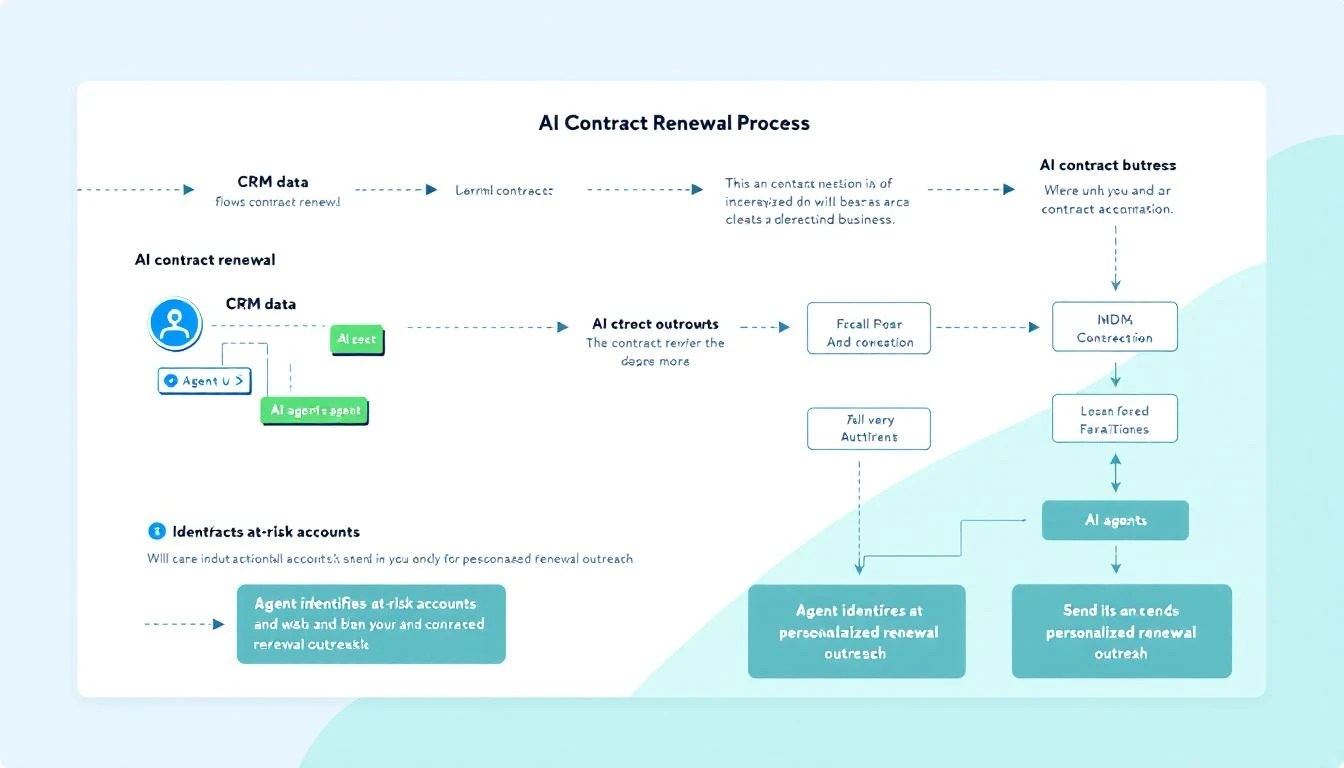
The AI-Powered Renewal Workflow
A properly configured AI renewal system does five things:
- Monitors health signals continuously
- Predicts churn risk before it's obvious
- Generates personalized outreach at scale
- Identifies expansion triggers automatically
- Keeps humans focused on high-value conversations
Let's build each piece.
Step 1: Continuous Health Monitoring with OpenClaw
OpenClaw agents can monitor your customer base 24/7, synthesizing signals you'd never catch manually.
# Health monitoring agent configuration
schedule:
  kind: cron
  expr: "0 6 * * *"  # Daily at 6am

payload:
  kind: agentTurn
  message: |
    Review all customers renewing in the next 90 days.
    For each, check:
    - Product usage trends (up, flat, declining?)
    - Support ticket volume and sentiment
    - Last CSM touchpoint
    - NPS/CSAT scores
    - Champion status (still at company?)

    Flag any account with 2+ warning signals.
    Create tasks for CSM outreach on flagged accounts.
The agent runs daily, cross-references data sources, and only escalates accounts that need attention.
What this catches:
- Usage dropped 40% last month (they're evaluating alternatives)
- 5 support tickets in 2 weeks (they're frustrated)
- Main champion left the company (your internal advocate is gone)
- NPS score dropped from 9 to 6 (something changed)
Step 2: Churn Risk Prediction with Claude Code
Claude Code excels at analyzing complex patterns across data sources. Here's how to build a risk scoring system:
# Renewal risk analyzer with Claude Code
def analyze_renewal_risk(customer_data):
    """
    Analyzes multiple signals to predict churn probability
    """
    risk_factors = []

    # Usage decline detection
    if customer_data['usage_trend'] < -0.20:  # 20%+ decline
        risk_factors.append({
            'signal': 'usage_decline',
            'severity': 'high',
            'detail': f"Usage down {abs(customer_data['usage_trend']):.0%} vs last quarter"
        })

    # Support sentiment analysis
    if customer_data['support_sentiment'] < 0.6:  # Below threshold
        risk_factors.append({
            'signal': 'support_frustration',
            'severity': 'medium',
            'detail': f"Negative sentiment in {customer_data['negative_tickets']} recent tickets"
        })

    # Champion tracking
    if customer_data['champion_status'] == 'departed':
        risk_factors.append({
            'signal': 'champion_loss',
            'severity': 'critical',
            'detail': f"Primary champion {customer_data['champion_name']} left on {customer_data['departure_date']}"
        })

    # Calculate composite score
    severity_weights = {'low': 1, 'medium': 2, 'high': 3, 'critical': 5}
    risk_score = sum(severity_weights[f['severity']] for f in risk_factors)

    return {
        'customer': customer_data['name'],
        'risk_score': risk_score,
        'risk_level': 'critical' if risk_score >= 5 else 'high' if risk_score >= 3 else 'medium',
        'factors': risk_factors,
        'recommended_actions': generate_action_plan(risk_factors)
    }
Claude's 200K context window means it can analyze an entire customer's history—every ticket, every call note, every usage pattern—in a single pass.
Step 3: Personalized Outreach with Codex
Generic renewal emails get ignored. AI-generated, context-rich outreach gets responses.
Here's how Codex GPT-5.3 generates renewal touchpoints:
// Renewal outreach generator using Codex
async function generateRenewalOutreach(customer, riskLevel) {
  const context = await gatherCustomerContext(customer.id);

  const prompt = `
    Generate a personalized renewal touchpoint for:

    Customer: ${customer.name}
    Risk Level: ${riskLevel}
    Renewal Date: ${customer.renewal_date}

    Context:
    - Primary use case: ${context.primary_use_case}
    - Key wins: ${context.documented_wins.join(', ')}
    - Recent challenges: ${context.recent_issues.join(', ')}
    - Champion: ${context.champion.name} (${context.champion.title})

    Generate:
    1. Email subject line (personalized, not salesy)
    2. Email body (reference specific wins, acknowledge any issues, propose value review)
    3. Suggested follow-up sequence if no response

    Tone: Consultative, not pushy. We're their partner, not their vendor.
  `;

  const outreach = await codex.generate(prompt);
  return outreach;
}
Example output:
Subject: Quick thought on your Q2 expansion plans
Hi Sarah,
I was reviewing the 47% increase in qualified leads your team drove through MarketBetter last quarter—impressive execution on the ABM campaigns.
With your renewal coming up in March, I wanted to share some ideas we've seen work well for teams scaling from 5 to 10 SDRs. Specifically around territory mapping and the new intent signals we released.
Would a 20-minute call next week work to explore what Q2 could look like?
No "your renewal is coming up." No generic value props. Just relevant context that shows you're paying attention.
Step 4: Expansion Opportunity Detection
Here's where AI really shines—finding revenue you didn't know was there.
OpenClaw agents can monitor for expansion triggers:
# Expansion trigger detection
schedule:
  kind: cron
  expr: "0 9 * * MON"  # Weekly on Monday

payload:
  kind: agentTurn
  message: |
    Scan customer base for expansion signals:

    1. USAGE EXPANSION
       - Accounts approaching plan limits
       - Features at >80% utilization
       - New user invites (team growing)

    2. ORG EXPANSION
       - New departments using product
       - International office mentions
       - Subsidiary/acquired company news

    3. BUDGET SIGNALS
       - Job postings indicating team growth
       - Funding announcements
       - Fiscal year timing (Q1 budget releases)

    For each signal:
    - Rate expansion probability (1-10)
    - Estimate potential ARR impact
    - Draft outreach angle
    - Assign to appropriate CSM/AE
Signals that indicate expansion:
| Signal | What It Means | Action |
|---|---|---|
| Usage at 90%+ of plan | They need more | Proactive upgrade conversation |
| New team invites | Department is growing | Multi-seat expansion offer |
| Job posting: "SDR Manager" | Building SDR team | Additional seats pitch |
| Funding announcement | Budget available | Expansion + add-on conversation |
| International IP logins | Global expansion | Multi-region deployment |
Step 5: Keeping Humans in the Loop
AI doesn't replace your CS team—it makes them superhuman.
The workflow:
- AI monitors everything continuously
- AI flags accounts that need attention
- AI drafts outreach and recommendations
- Humans review and personalize
- Humans have high-value conversations
- AI follows up on action items
# Human-in-the-loop workflow
when: ai_flags_risk_account

do:
  - create_task:
      assignee: csm
      title: "Review renewal risk: {customer_name}"
      body: |
        AI Analysis:
        {risk_summary}

        Recommended Actions:
        {action_plan}

        Draft Outreach:
        {generated_email}

        Please review and adjust before sending.
      due: 2_business_days
Real Results: What This Looks Like
Companies running AI-powered renewal systems see:
- 30-day earlier churn risk detection
- 15%+ improvement in gross retention
- 25%+ improvement in net revenue retention
- 60% reduction in CSM time spent on data gathering
The math is simple: If your CSM can spend 80% of their time on strategic conversations instead of Salesforce data entry, they'll save more accounts.
Building Your System: Claude Code vs Codex vs OpenClaw
Each tool has its strength:
| Tool | Best For | Use In Renewal Workflow |
|---|---|---|
| OpenClaw | Continuous monitoring, scheduled tasks, multi-system coordination | Daily health checks, trigger detection, task creation |
| Claude Code | Complex analysis, nuanced writing, long context | Risk scoring, comprehensive reviews, strategy recommendations |
| Codex GPT-5.3 | Code generation, integrations, automation scripts | Building custom integrations, generating outreach sequences |
Pro tip: Use OpenClaw as the orchestration layer that coordinates Claude and Codex for specific tasks.
Implementation Checklist
Ready to automate your renewal process? Here's your roadmap:
Week 1: Data Foundation
- Inventory all customer health signals (usage, support, NPS, engagement)
- Ensure data is accessible via API or export
- Define your churn risk criteria
Week 2: Monitoring Setup
- Deploy OpenClaw renewal monitoring agent
- Configure daily/weekly health scans
- Set up alert thresholds
Week 3: Outreach Automation
- Build outreach templates for each risk tier
- Configure Codex/Claude for personalization
- Create approval workflow for AI-generated emails
Week 4: Expansion Detection
- Define expansion trigger signals
- Configure monitoring for each signal type
- Build routing to appropriate owner (CSM vs AE)
Try our AI Lead Generator — find verified LinkedIn leads for any company instantly. No signup required.
The Bottom Line
Contract renewal isn't a 30-day process. It's a continuous relationship.
AI lets you treat it that way—monitoring every signal, catching every risk, and surfacing every opportunity—without drowning your team in busywork.
The companies winning on retention aren't the ones with the biggest CS teams. They're the ones with the smartest systems.
Build yours now.
Ready to see how MarketBetter's AI-powered platform can help your team identify at-risk accounts and expansion opportunities automatically?