
How to Automate Competitive Content Monitoring with Claude Code [2026]
Your competitor just published a blog post positioning themselves directly against you. They changed their pricing page last Tuesday. Their CEO posted a LinkedIn thread announcing a new feature that overlaps with your roadmap.
You found out about all of this two weeks later, during a deal you lost.
Competitive intelligence isn't a "nice to have" — it's survival. But most teams treat it like a quarterly research project instead of a continuous monitoring system. That's like checking the weather once a month and being surprised when it rains.
In this guide, we'll build an always-on competitive content monitoring system using Claude Code and OpenClaw that tracks your competitors' every public move and delivers actionable intelligence to your team in real time.
What Most Teams Get Wrong About Competitive Intel
Problem 1: Point-in-time research. Someone creates a competitive analysis deck once per quarter. By the time it's presented, half the information is outdated. Competitors ship features monthly. They adjust positioning weekly. They publish content daily.
Problem 2: Signal overload. Even teams that try to monitor competitors get overwhelmed. RSS feeds pile up. Google Alerts send irrelevant noise. Nobody has time to read 50 competitor blog posts a month AND do their actual job.
Problem 3: No analysis, just aggregation. Collecting competitor content isn't intelligence. Intelligence is understanding WHAT changed, WHY it matters, and WHAT you should do about it. That requires reasoning — exactly what AI coding agents excel at.
Problem 4: Knowledge stays siloed. The product manager who notices a competitor's new feature doesn't tell the sales team. The marketing person who spots a positioning shift doesn't tell the CEO. Critical intel dies in someone's browser tabs.
The AI-Powered Competitive Monitor
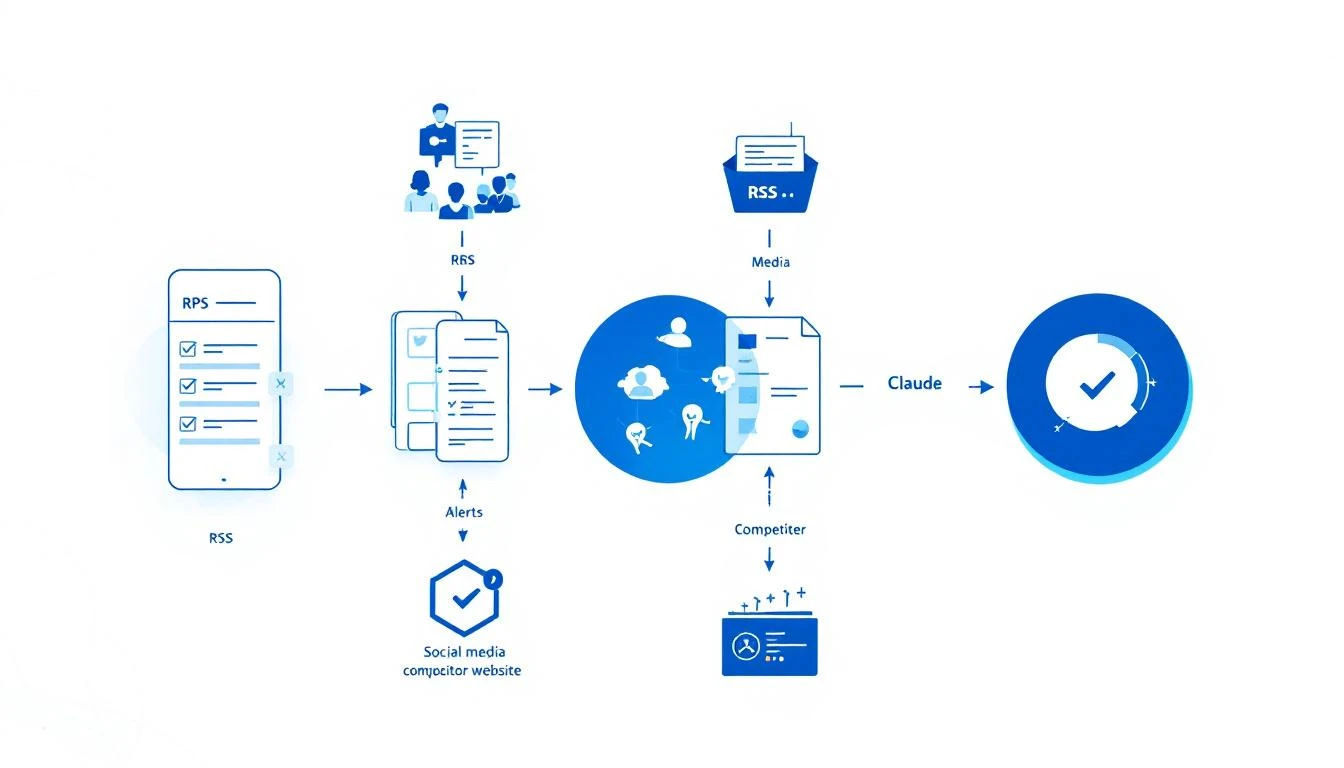
Here's the system architecture:
Data Collection Layer:
- Competitor blog RSS feeds / sitemaps
- Pricing pages (checked daily for changes)
- LinkedIn company feeds and executive posts
- G2/Capterra review feeds
- Job postings (reveals strategic direction)
- Press releases and news mentions
Analysis Layer (Claude Code):
- Content categorization (feature announcement, thought leadership, competitive positioning)
- Sentiment and messaging shift detection
- Feature comparison against your product
- Pricing change analysis
- Strategic implications summary
Distribution Layer (OpenClaw):
- Slack alerts for high-priority changes
- Weekly competitive digest emails
- Real-time battlecard updates
- CRM notes on relevant accounts
Building It: Step by Step
Step 1: Define Your Competitive Landscape
Before monitoring anything, get clear on what matters:
Tier 1 Competitors (Monitor Daily):
- Direct competitors who come up in deals
- Companies your prospects compare you to
- Anyone bidding on your brand keywords
Tier 2 Competitors (Monitor Weekly):
- Adjacent players who might expand into your space
- Companies serving the same ICP differently
- Emerging startups getting VC attention
Tier 3 (Monitor Monthly):
- Large platforms that could add your functionality
- International players entering your market
For each competitor, catalog their public channels:
- Blog URL / RSS feed
- Pricing page URL
- LinkedIn company page
- G2 profile URL
- Careers page URL
- Key executive LinkedIn profiles
Step 2: Set Up Content Change Detection
The foundation of the system is detecting when something changes. Here's where OpenClaw's cron jobs become invaluable.
For blogs: Most company blogs have an RSS feed or sitemap. Your agent checks these every few hours and flags new posts. Claude Code then reads and analyzes each new post.
For pricing pages: This is where it gets interesting. Pricing pages don't have RSS feeds — they just change. Your agent needs to snapshot the page content, store it, and compare against the previous snapshot. Claude Code is perfect for this because it can understand semantic changes, not just text diffs.
For example, it won't flag a CSS tweak as a "pricing change." But it WILL flag when a competitor removes their free tier, adds a new enterprise plan, or increases prices by 15%.
For LinkedIn: Monitor key executive posts. When a competitor's VP of Product posts about "exciting announcements coming," that's a signal. When their CEO writes about a new market segment, that's a strategic shift.
For G2 reviews: New reviews — especially negative ones — are gold for sales teams. Your agent can analyze themes across reviews and surface specific objections your reps can address in deals.
Step 3: Build the Analysis Engine
Raw data is noise. Analysis is intelligence. Here's how Claude Code transforms competitor content into actionable insight:
Content Categorization: Every new piece of competitor content gets classified:
- Feature announcement → Alert product team
- Thought leadership / SEO content → Note for marketing team
- Customer case study → Analyze which segments they're winning
- Competitive positioning (mentioning you) → URGENT alert to sales + marketing
- Pricing / packaging change → Alert sales + finance
Messaging Shift Detection: Claude's 200K context window is perfect for this. Feed it the last 20 competitor blog posts and ask: "What messaging themes are emerging? What topics are they investing in? How has their positioning shifted compared to 3 months ago?"
This kind of longitudinal analysis is impossible for a human to do consistently across 5-10 competitors. For Claude, it's routine.
Feature Gap Analysis: When a competitor announces a new feature, Claude can immediately compare it against your product capabilities and generate a battlecard update:
- What they launched
- How it compares to your equivalent feature
- Talking points for sales
- Gaps to flag for product
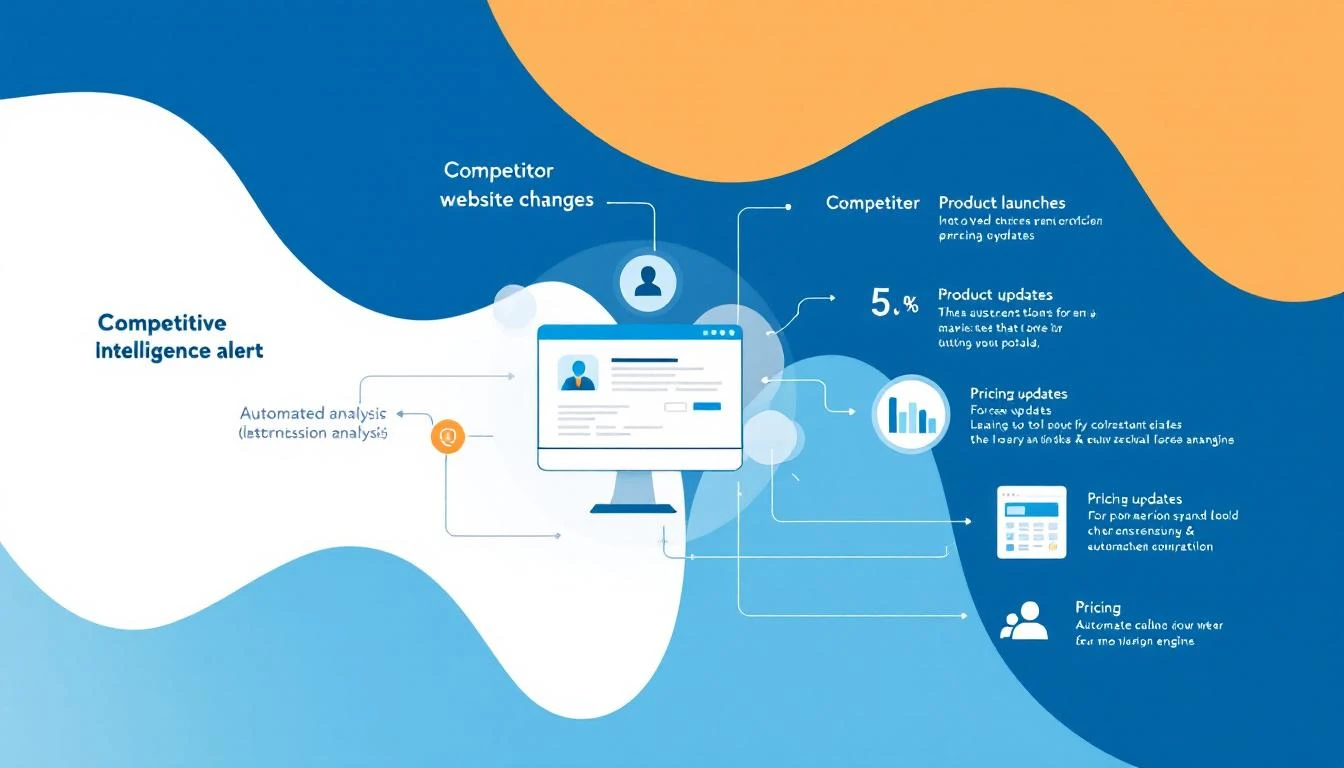
Step 4: Automate Distribution
Intelligence that sits in a database is worthless. It needs to reach the right person at the right time.
Immediate Alerts (Within Minutes):
- Competitor mentions your company by name → Sales + Marketing leads
- Pricing page changes → Sales leadership + Finance
- New feature that directly competes with yours → Product + Sales
Daily Digest:
- New blog posts published by all competitors
- New G2 reviews with sentiment summary
- Social media highlights from competitor executives
Weekly Strategic Brief:
- Messaging trend analysis across all competitors
- Feature shipping velocity comparison
- Hiring pattern changes (are they building a sales team? Product team?)
- Recommended strategic responses
Battlecard Updates (As Needed):
- Auto-update competitive battlecards when new information surfaces
- Flag outdated information for review
- Add new objection-handling scripts based on competitor messaging
The OpenClaw Advantage: Free vs. $40K CI Platforms
Let's talk about cost. Enterprise competitive intelligence platforms like Klue, Crayon, and Kompyte charge $25-75K per year. Here's what you get for free with OpenClaw:
| Capability | OpenClaw + Claude | Enterprise CI Platform |
|---|---|---|
| Blog monitoring | ✅ RSS + scraping | ✅ Built-in |
| Pricing change detection | ✅ AI-powered semantic diff | ✅ Screenshot comparison |
| AI analysis quality | Claude (state-of-the-art) | Proprietary (varies) |
| Custom analysis prompts | ✅ Unlimited | ❌ Fixed templates |
| Distribution (Slack/Email) | ✅ Native | ✅ Built-in |
| Battlecard generation | ✅ Claude-powered | ✅ Template-based |
| Cost | $0 (self-hosted) | $25-75K/year |
| Setup time | Half a day | 2-4 weeks |
| G2 review monitoring | ✅ With web scraping | ✅ Native integration |
The enterprise tools add value with pre-built integrations and pretty dashboards. But if you're a startup or mid-market team watching every dollar, OpenClaw + Claude gives you 80% of the capability at 0% of the cost.
Advanced Use Cases
Competitor Messaging A/B Testing Detection
When a competitor runs messaging experiments on their website, Claude can detect it. If their hero tagline changes three times in a week, they're testing. Your agent can track which version they settle on — and what that tells you about what resonates with your shared audience.
Job Posting Intelligence
Competitor job postings are one of the most underused competitive intelligence sources. They reveal:
- What they're building — "Senior Engineer, AI/ML team" = they're investing in AI
- Where they're expanding — New city = new market entry
- Their pain points — "VP of Customer Success" posting after a year of churn = retention problems
- Budget signals — Salary ranges in listings reveal compensation philosophy
Win/Loss Pattern Correlation
Connect your competitive monitoring data with your CRM's win/loss data. When you lose a deal to Competitor X, did they publish something relevant that week? Did they change pricing? This correlation analysis helps you predict competitive threats before they affect your pipeline.
Getting Started
You can have a basic competitive monitoring system running in under a day:
- Hour 1: List your top 5 competitors and catalog their public channels
- Hour 2: Set up OpenClaw with web scraping capabilities
- Hour 3: Create your Claude Code analysis prompts
- Hour 4: Configure Slack notifications and test the pipeline
Start with blog monitoring only. Once that's solid, add pricing page tracking. Then G2 reviews. Build incrementally.
Try our Tech Stack Detector — instantly detect any company's tech stack from their website. No signup required.
How MarketBetter Fits In
MarketBetter's platform already bakes competitive intelligence into your SDR workflow. When a prospect visits a competitor's page before yours, our visitor identification catches it. When a lead is evaluating alternatives, our AI playbook adjusts the messaging to address specific competitive objections.
The Daily SDR Playbook doesn't just tell you who to call — it tells you what to say based on where the prospect is in their evaluation journey, including which competitors they're considering.
Want to see competitive intelligence built into your sales workflow? Book a demo and we'll show you how MarketBetter turns competitor awareness into closed deals.
Related reading: